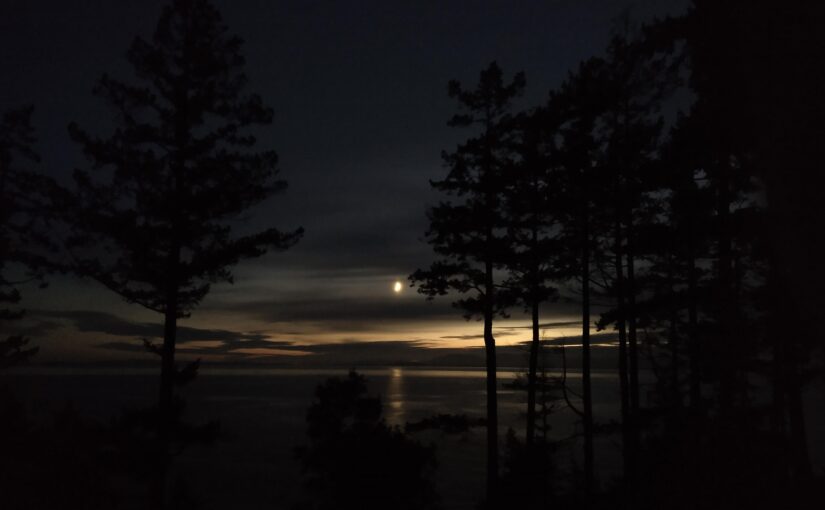
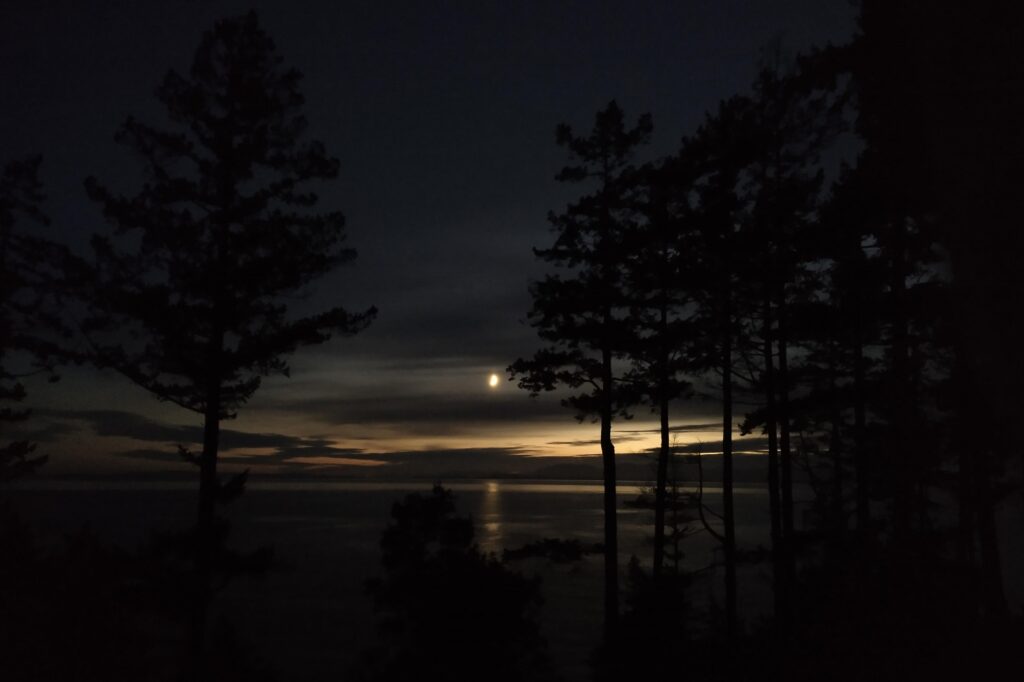
I drove through sunset into the night, fleeing the family I’ve had almost all my life, and the complex snaggle of pain and dysfunction we exist in. Snaggle. My Mama used to call the biggest tangles in my hair ‘snaggles’, as she carefully brushed them out. She tried to be gentle, but it always pulled. I’d close my eyes and allow her hands to pull the pain from the back of my head. Darkness. Let it go.
As I drove the highway from my dysfunctional step-family to the home where I once lived with my mother, the darkness fell on me like a soft quilt. I remembered her hand on my back as I’d cry myself to sleep when I came home from my Dad’s house, as a child. But her hand isn’t there, anymore. Tears streamed down my face for all the pains I can’t relieve; all the anger I’ve lived under for so long but can’t escape, and for my mother, who died of a brain tumour not two years ago, and now my step-mother has one too. But it’s not the same. Nothing is ever the same. And as I shook the tears away, gripping the steering wheel until my fingertips were numb and my eyes burned, I shouted at the darkening road; the lines of white headlights streaming by on my left and the red blaring taillights in front of me: “Mama!! I need you!! I want you back!!”
But she wasn’t there. Only the darkness came. The same darkness that took her away. The same darkness that used to wrap me up under my shaky brass bed at my Dad’s house, when I was a child. The darkness that settles on my sister’s brow when she finally falls asleep. The darkness that sucks the light out the window and promises tomorrow might be better.
The other night, in too much pain to breathe, I took my partner to the beach, to save myself. “We missed the sunset,” I said, as we drove. “It’ll just be dark.”
He never blinked, but said calmly, like the slow-growing dark had sucked the power from his voice, “that’s OK. It’s not important.”
We walked down to the beach, stepped over the logs that confront the end of the path, and found a forgivingly-hard sandy spot, between the many rocks. It was already too dark to see if we might be sitting on seaweed or garbage or a child’s half-eaten hotdog, so we felt around in the sand with our hands, before settling our bums. I lay back, then, and watched too many satellites going by, among the stars. I mourned for my childhood, when we still thought satellites were interesting. I mourned for my childhood, when the pain of snaggles could be brushed away; when the pain of my Dad’s house could be washed away by the relative safety of my Mama’s; soothed by the resting of her hand on my back.
Somehow in adulthood nothing is so simple, anymore. Everything is a snaggle and too complex to even look at, nevermind pick apart. The darkness gently softens the sharp edges of that snaggle, so we focus only on the line of fading light at the horizon; the setting sun far beyond it, calling the darkness along the earth’s surface, and our mind, along with it. The darkness settles more and more, deepening and obscuring and eventually obliterating every twist and knot of the snaggle, until we lay on that forgiving, hard sand, and I said to my partner in that beautiful darkness, “we don’t have to go home. We can just sleep here, on the beach.”
Another satellite seemed almost to meander between the stars, and my partner said quietly into the night, “I think I’d be too cold.”
The darkness is temporary, for most of us. A place we can go for solace. A place where the things we cannot fix are muted for a while and our eyes can recover from the cold light of the world we inhabit. It’s a place to heal and grow and love and cry. It’s a small place, for a moment, when we close our eyes, and sometimes it’s a big huge nothing that consumes us. The darkness slipped my mother into a forever-dream, where cancer is a figment of some brightly-lit imagination. My step-mother isn’t going there, yet. She’s fighting with her eyes open and a blaring white compulsion to save her daughters. Like the headlights streaming through the darkness, beside me. On the highway. Going the opposite direction. I am going into the setting sun. I am going into a long quiet night in the home I used to share with my mother. I am going into darkness.