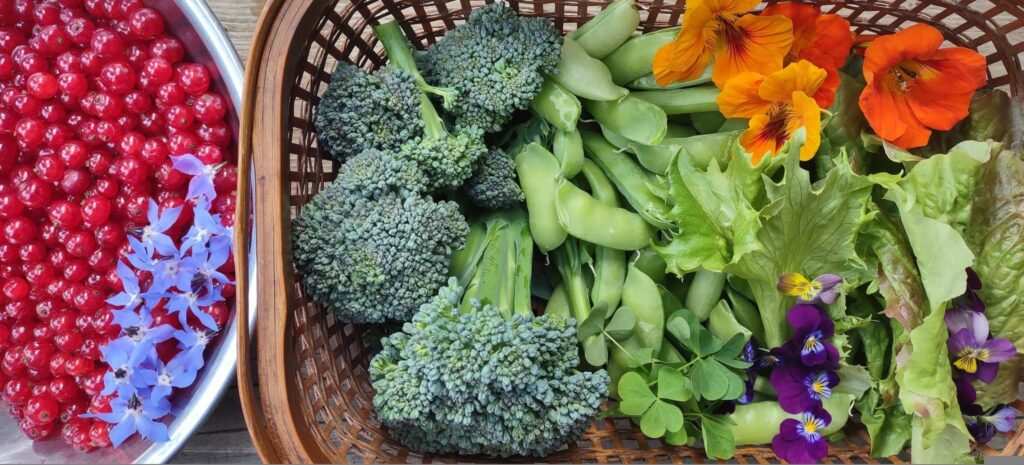
It was summer; probably July, and so hot I was hiding in the house with my baby dressed only in a diaper, fanning us with damp washcloths, when Mum appeared at the front door. With a basket of kale and lettuces in one arm, a partly-eaten zucchini in the other hand, and sweat dripping out from under her straw hat, she said, “you’re going to have to get a handle on the weeds in your end of the potato bed”. She took a big bite of the raw zucchini in her hand and awaited my response.
“Oh. OK. Why are you just eating a whole plain zucchini?”
“I was hungry.” She said, as if it was a silly question. “Here.” She took another zucchini out from under the leaves in her basket and handed it to me.
“Thank you, Mum.” It was warm from the sun, but when I sliced it open, the inside was cool and refreshing.
I was thinking about this the other night, as I handed my partner Markus his dinner: a big bowl of fresh snap peas I’d just picked from the garden. Nothing more. Why would we need more? We have tons of snap peas right now, and really they contain everything we could want for dinner: protein, carbs, vitamins, and so much deliciousness. Later we felt a hole in our stomachs where processed food likes to be, so we ate a storebought bagel. We do grow all our own veggies and eggs, and most of our own meat and fruit, but we can’t really grow grains here, and we can’t grow junk food. Also, Markus loves bananas, and I love imported cheese. And both of us love a frozen pizza or storebought bread when we’re just too tired to make something more… which is at least once a week!!
We used to aim to be self-sufficient, but over the years our ambition changed. We raised our children, grew our garden and skills, and now live just the two of us again, with a quarter-acre regenerative veggie/flower garden, two cats, one rooster, eightteen hens and their many annual offspring, and about fifty billion weeds. We still want to be self-sufficient, but the meaning of that term has changed for us. We realized it’s more about community and mindset than it is about production.
First of all, we really can’t grow grains. We tried. About ten years ago we turned our rectangular lawn into a field of hull-less oats. (Awesome! We thought. We’re gluten free and we eat tons of oats; we can feed ourselves all year!!) Well… we live in a beautiful little rainforest clearing on the west coast of northern Turtle Island. We don’t live on the prairie. So we did actually manage to harvest a whole bucketful of oats (maybe a sixth of what our family consumed in a year), but it turns out hull-less oats still have hulls, and they’re basically impossible to remove. We didn’t enjoy our oats mixed with what felt like fingernail trimmings. And we discovered we could grow far more in that rectangle of yard if we grew crops that actually want to be in this ecology. Then we found out that some people just inland from us are growing oats quite successfully, and we can buy from a small local farm in a different ecology, that’s growing what we can’t grow. So now that’s what we do: We grow all kinds of brassicas, lettuces, squashes, cucumbers, potatoes, garlic, onions, celery, beans, peas, and many many flowers and fruits, and we buy our grains from farms a bit further inland.
We also learned that community isn’t just about the other humans around us; it’s about ALL the other beings. Most obviously, we understood that it’s important to entice and support wild pollinators, and since that just means planting lots of flowers (preferably native varieties that native pollinators will be drawn to), it was an easy and enjoyable adjustment.
Next we discovered the importance of weeds. With exception of a very small handful of troublesome invasives, most weeds are not only OK to leave in the ground, but very important. We started pulling out the invasives and leaving the edible and non-troublesome weeds. They shelter the soil and keep water in the ground. They feed the soil both by pulling nitrogen down into it, and by composting themselves there. They attract all kinds of insects, birds and other small wildlife. And we’ve found they even support our growing plants like trellises! And when they crowd out the veggies we’re trying to grow, we eat them ourselves or feed them to our chickens. They’re just a part of the ecology of our garden, and the food on our table.
Then mushrooms. Putting deciduous wood chips in some of our garden paths, and into garden beds that needed a bit more bulk or aeration meant making space for the mycelial network that supports our plants! We did put winecap mushroom spore into the chips so we’d have lots to harvest and eat for ourselves, but the mycelial network also moves in from the forest that surrounds our home, and that means we need to care about the trees! We learned that different areas of our yard actually have extremely different microclimates, depending partly on their proximity to the creek, but also on which trees are close-by. We ended up with a xeriscaped garden of fennel, strawberries, rhubarb, parsley, wild ginger and various flowers that have now been perennial for over a decade, right under our sequoia! I’d love to say that we are just so dedicated that we tailored everything we did to the specificity of the soil, trees, weeds and other features in each area of the yard, but… I mean really. Doesn’t this sound kind of overwhelming?? It is definitely overwhelming for us, so we simplified: Diversity. That bountiful garden under the sequoia was the result of just planting lots of diverse things and seeing what survived.
We just encourage diversity in everything, and accept that everything is an experiment. Things die, and they feed the soil; crops fail and other crops succeed more than expected. I have no idea what species of insects live in my garden, but I trust that the huge diversity of both insect and plant species I see means there are fewer devastating infestations. And over time this has proven to be true: the only pest we deal with regularly in our yard is slugs. We’ve learned over the years that some veggies grow wonderfully in some areas of the yard, and not in others. We’ve had fruit trees die and tiny shrubs become gargantuan and overtake their respective garden neighbourhoods. We don’t really understand the complexity, but we appreciate the signs of it, and try to manage the challenges that do happen without harming the garden community they happen in. That’s basically our job, now: Trying to live and work in harmony with the ecology of our garden in a rainforest, which is also our home.
This past weekend we hosted people at our ecology-centred regenerative food garden, to talk about growing food mindfully and in harmony with our surroundings, and someone asked about growing for CSA boxes. I *love* the idea of Community-Supported Agriculture boxes: you grow food, and community-members subscribe for a weekly box of produce from their local farm. I know a few people who have done this, and there always seems to be one common challenge: how to grow enough of the foods customers want to see in their boxes, while not giving them too many surprises. This leads me to the biggest thing I’ve learned about growing food: It requires a particular mindset, that many of us have now lost.
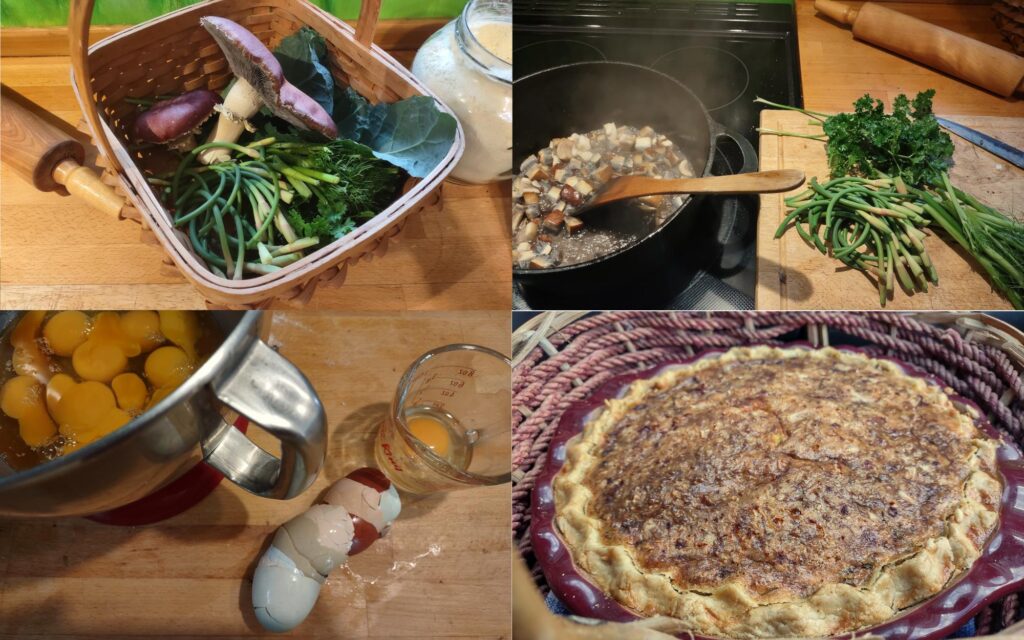
It’s not just about “eating seasonally”. It’s about adaptability – flexible thinking. A successful CSA business requires a customer base that’s happy to receive surprises and work with what they get. It also requires farmers who know what’s valuable and how to take surprises and make them exciting for customers. An adaptable local-food mindset is about understanding where food comes from, and enjoying what’s available. Which may or may not seem “seasonal”, especially with our constantly-shifting weather patterns, these days. It’s not just about only eating fresh tomatoes in the summer; it’s also about accepting that some years there just aren’t many, and some years there are way more than we expected. We all know about too-many-zucchinis. But I’ve had a couple of years with too few! Those years made the bounty of other years feel much more wonderful, and it’s pure delight to pull frozen shredded zucchini out in winter, to bake with. Some years we get so many mushrooms we have to dry them for winter; other years we get a tiny handful and treasure them immensely. Often the mushrooms are full of fly larvae and we have to eat only the tiniest ones, before the flies get them! And always, always, we leave at least half of them to spore out on the ground, so we’ll have more mushrooms, later.
Growing our own food, or even truly eating locally or seasonally means accepting that we can’t have any old food any old time, and also being willing to adapt to what’s currently available. Which may be entirely unpredictable. It means that we may suddenly find ourselves in a greens-drought in the middle of summer, and end up pulling out preserved greens from last year, just when we least expected to! It means developing skills we may not have yet, like farming practices, food preservation, and cooking commonly-discarded parts of the produce. And most importantly, it means becoming curious and actually *wanting* to discover new things; new ways of being. This is not only the mindset that makes living off of regenerative farming possible, it’s also a mindset that brings a community closer. When we are compelled to feed ourselves as well as possible, as locally as possible, and as ethically as possible, we inevitably have to rely on others to help us meet our needs.
I absolutely love the opportunity to call my neighbours and tell them I have extra eggs. And likewise, they understand that there won’t be any extra eggs when the chickens are moulting, or when it rains, or snows, or when there’s a heat-wave. The neighbours understand that our chickens only lay when they’re happy! And they love eating happy chicken eggs. Every year we get a big bag of corn from the neighbours with the flattest, sunniest yard, where corn loves to grow. And sometimes we get a pot of honey from the other neighbours. When one of my hens goes broody I tell my chicken friends, and we all anticipate the brood, together. When a chick dies, or one of our treasured hens; we console each other.
This afternoon my brother and I sat on opposite sides of our parents’ red currant bush, filling bowls – plunk! plunk! plunk! – and talking about the drought, rooting cuttings, different areas we grow things in our yards, and just generally sharing ideas. We swatted various species of flies from our legs, crawled around in the grass and creeping buttercup, and listened to the birds, waiting to come take their share of the berries. Then we hugged goodbye and went to our respective homes for dinner and the most delicious red currant desserts.
Growing food means celebrating life in community. I see inklings of change all the time, and many tiny changes make big change. It feels to me like our society is growing to love the food we eat; to love living in a diversity of people, plants, and our ecology, and to love each other. What a beautiful world we’re creating!