Canadian social practice artist working with participatory performance, ecological systems, and community storytelling. Works span installation, performance, writing, and socially engaged projects.
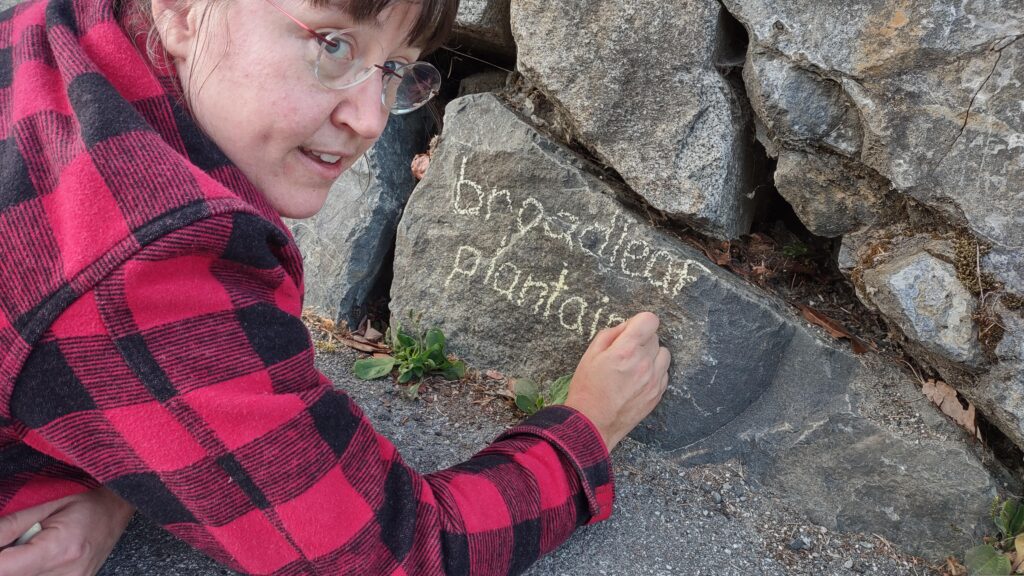
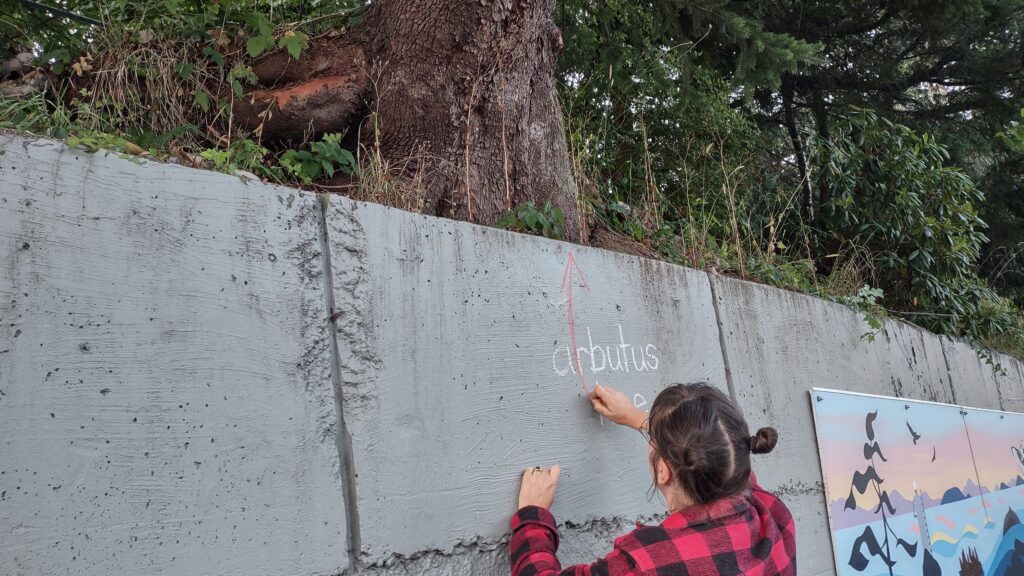
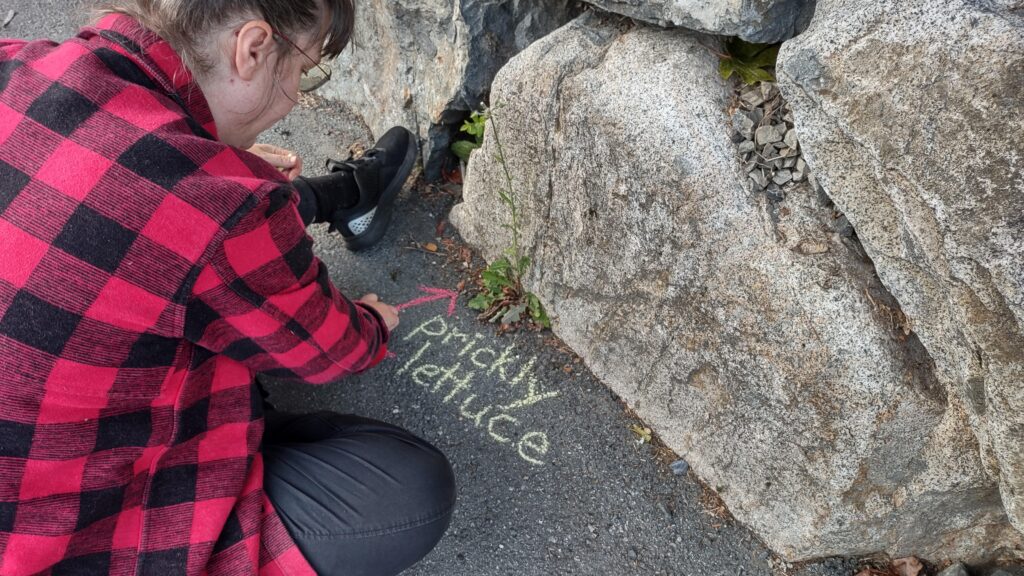
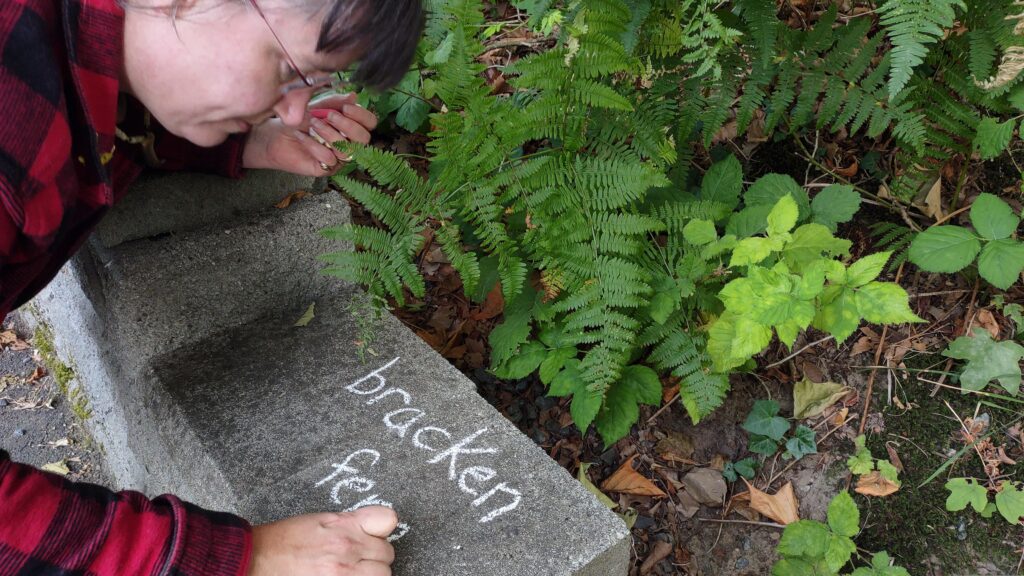
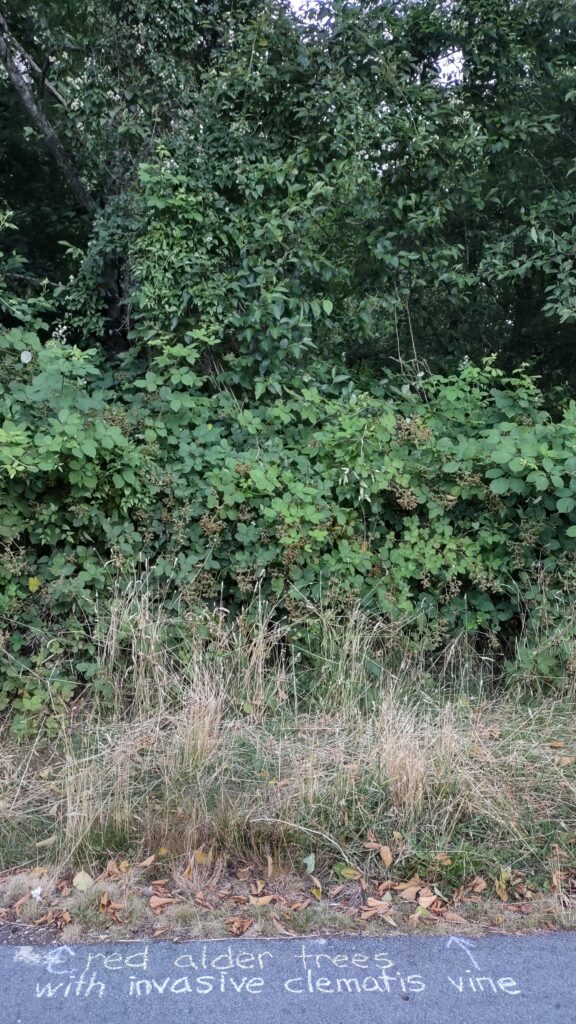
This has become one of my favourite things to do. Every year I go out and label the weeds and trees in the place with the highest foot-traffic on our island.
I hope people see these and begin to notice a bit of the world around them in ways they may not have, before. I hope people also go home and find the same weeds, there. Sure, it's the simplest kind of art.
I'm just chalking rocks, walls, and sidewalks with plant names! But I really feel it might be one of the most impactful works I've done.
And yes, if you're wondering, I do have municipal permission to do this! So the credit for this also goes to open-minded officials and other citizens who can appreciate the benefits of art and education in our communities. 🙂
As artists, we have the power, ability, and honour of building our future civilization. Some of us may be doing so intentionally; many not. But whether we're aware of it or not, we are responsible.
Sci-fi is often touted as predicting the future. But does it? Writers and other artists imagine plausible eventualities based on current directions and capabilities… and then they often happen. Maybe the artists are soothsayers, or more likely we're just creative… and humans have evolved by being resourceful. If we're given a wild idea, we take great pleasure in making the seemingly impossible happen. So maybe artists are visionaries. That's not a pat on the back. Most of us want to be seen as visionaries, I suspect, but it's a huge responsibility.
What are we putting out into the world? Books, movies, and other art that may very well have been intended to warn us away from a dystopian future might instead be creating it; putting the ideas for such dystopia into our minds so that our resourceful society will create it. I'm not talking about some evil genius who sits in their dark basement playing apocalypse video games and then thinks, "ooooh I could destroy the world… bwahahahahaaaa!" I'm talking about all of us becoming gradually more and more accustomed to seeing and hearing about such dystopian events so that as they happen, we don't stand up and stop them.
What are artists supposed to do? Become blind Pollyannas and make fluff? Cotton candy dreams with no real plot and no intrigue? No, of course not. Nobody would look, at all. People like to look at what terrifies us. And art needs to deal with our problems, too; not just look the other way. I'm totally not immune to creating work that deals with humanity's pain and failings. But I also feel that we need to be creating work that posits hopeful futures. We need to be imagining the world we want to see, instead of the one we're afraid of.
And luckily, we have nature to look at, for inspiration. Nature is resourceful and opportunistic and ruthless. And extremely beautiful. The whole of nature evolves because of these things, and humans are definitely part of that whole. Nature limits itself simply because it's impossible to keep living if one devours all one's resources at once. I keep an ecosystem-integrated food forest around my home, which teaches me this every year. This year we're having quite an infestation of flea beetles. In previous years it was cabbage moths and one year–spectacularly–it was mourning cloak butterflies. But each of these infestations either destroys it's own habitat and thereby starves itself out, or attracts some kind of predator that eats it alive. Nature limits greed. So, despite my current paltry pea crop, due to the flea beetle infestation, I'll still have food, because my garden is diverse, and next year I don't expect to have such an issue with flea beetles. They've destroyed so many of their resources and attracted so many predators that they can't be such a problem, next year. Humans are in the process of self-limiting, as well, painful though it is for us as individuals.
Contrast my garden flea beetle situation to a garden where all that's planted is peas (because: monocrop=money). The flea beetles now threaten the entire garden, as opposed to just the peas and the odd brassica or tomato, here and there. So now all we see as farmers is the flea beetle problem. And we blast them all to hell with pesticides. Now we have peas, and we make money, but we're poisoning ourselves and the land, and most of the other species that live on it. So in a couple of years of this practice, we've devastated our ability to grow peas, or perhaps anything at all on that piece of land, because we no longer have the diversity of life needed to sustain… life.
It doesn't take much vision to see that that way of farming (or living, or envisioning our human future) is hopeless. It takes a little more vision to imagine and create a hopeful future.
As an artist, I'd like to be one who plants more diversity, in preparation for new ways of living, instead of just imagining bleak futures for us to tumble numbly into. Humanity might indeed extinguish itself by imagining negative futures. But the life of this planet will go on. Yes, it will be utterly changed, because human folly is powerful, and we're destroying life at an ever-increasing rate. But some kind of collection of species (likely including some humans) will carry on beyond our rather short-lived civilization, and will develop its own rich community of life when it settles into the cradle that this planet offers. This new collection of species will imagine itself and grow into what it imagines. And, like my garden, the more diverse this new ecosystem is, the more resilient it will be.
I love to feel the responsibility of such a future. Let's imagine!
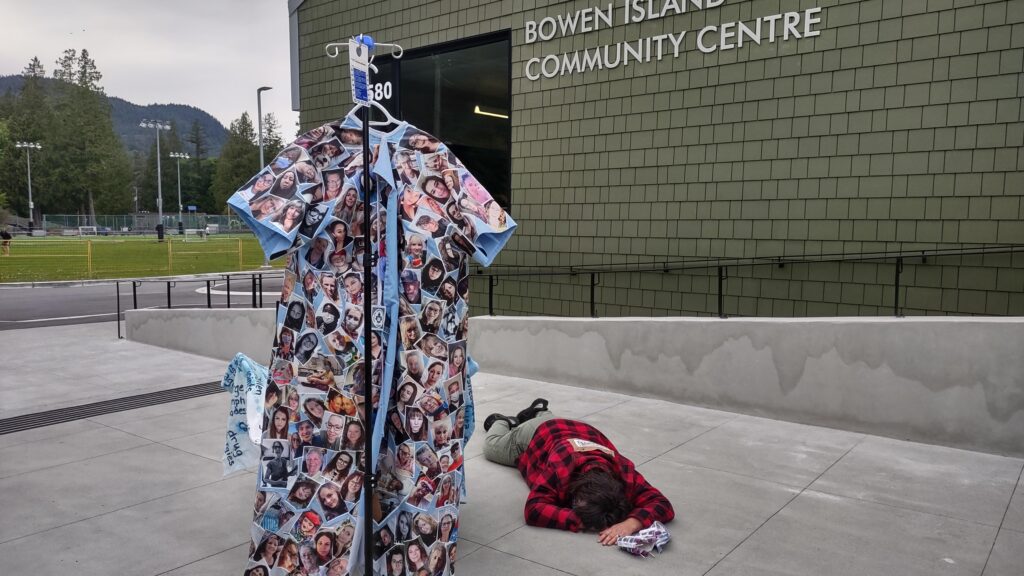
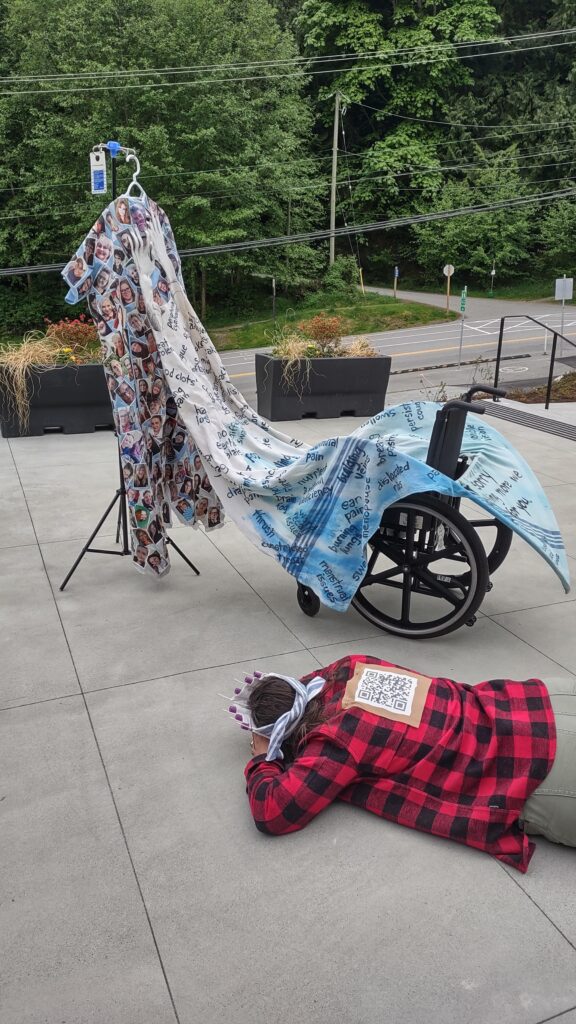
I'm so happy that the (dis)robe: Hospital Gown piece I made last year will be on display this autumn in Vancouver, but meanwhile… I get to wear it to an art event in my hometown, tonight!! This is will be the first time I've shown it locally, and I'm REALLY nervous. This piece is all about my disability, and to say people roll their eyes when I talk disability is an understatement. But this piece features other people from our community, too, so it's time to REPRESENT!!! Here I go!
Off to the Bowen Island Community Centre. 🙂
Will update this post with a photo, later, if someone takes one.
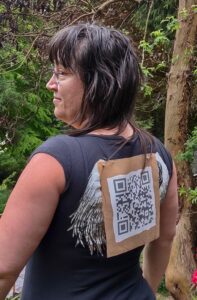
UPDATE: It was a pretty quiet event, but nice to meet some other artists and visit with friends. I think only one person scanned the QR but that's OK! Here are some photos from before I actually put the gown back on and went inside…
Thanks to my partner Markus, not only for these photos, but for always supporting me both in life and in art. If you're wondering where that QR code points, here's the link: https://emilyvanartist.noblogs.org/qr/
It happened like this. Just after we discussed the stage floor I was painting, the director cycled back to my house and knocked on the door again. "Emily?" He called into my house. "Emily, I forgot to ask. Could you make us a rooster prop? It's to look like it's been killed by a fox. Although that may or may not have actually happened."
I was astounded! And thrilled!! "Of COURSE I can!!" I knew the play was pretty serious — Dancing at Lughnasadh. So this prop was a serious prop. Well… as serious as a pretend killed rooster can be, I guess. I was deeply honoured that the director thought I'd be up for the task.
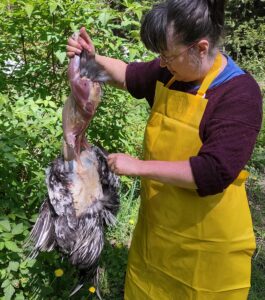
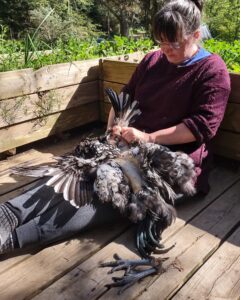
There is no way I can easily make a fabric rooster puppet that looks real, and dead. So the first thing to do was to find a rooster that was headed for a pot, anyway. I was given this guy. He was sadly doomed, after his owners had searched for a home, to no avail. So on the appointed day, I picked him up, thanked him for his donation to my freezer and the arts, and butchered him. He made meat, bone broth, liver pate for me to eat, and a pair of feet and a beautiful feathered pelt for the prop. I tried saving his beak, too, but didn't like how small and dark it was, and decided that this rooster prop was going to need a yellow beak.
Working the hide.
I've plucked and slaughtered a LOT of chickens in my life, and plenty of rabbits, too, whose skin comes off so easily, like peeling off a knee-sock from a foot. Rooster skin–with feathers, wings, and tail attached, is not like that!! It took some careful consideration to get it done properly, bones removed (all but the Pope's nose and the wing-tips), and with all the feathers still in tact.
I worked a long time to get the skin clean, and then I tried to dry him. I've never done taxidermy before, and it turns out a bird is not the easiest thing to start with. Then it turns out I also have no experience. Oh wait–I said that already. But it turned out to be a problem!! And this bird was fatty. I managed to dry his feet OK, but ended up removing the wings and tail feathers, as well as the ruff and saddle feathers. Ugh. All that work keeping his skin together, just to take him apart in the end!!!
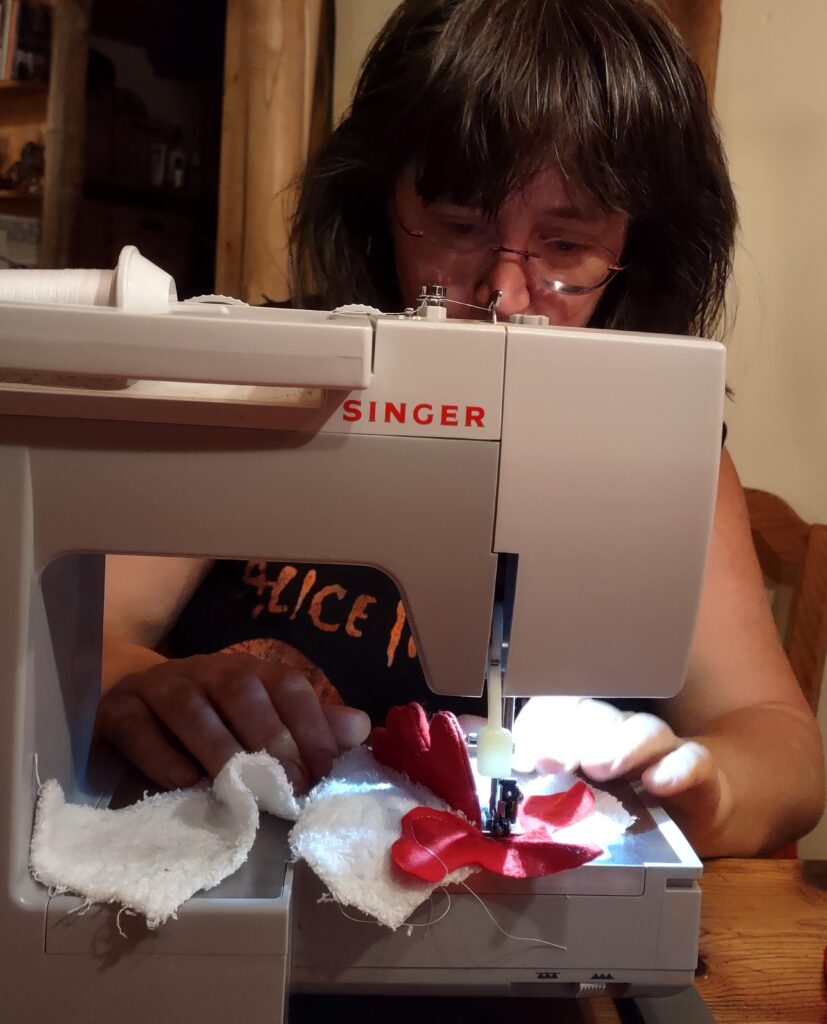
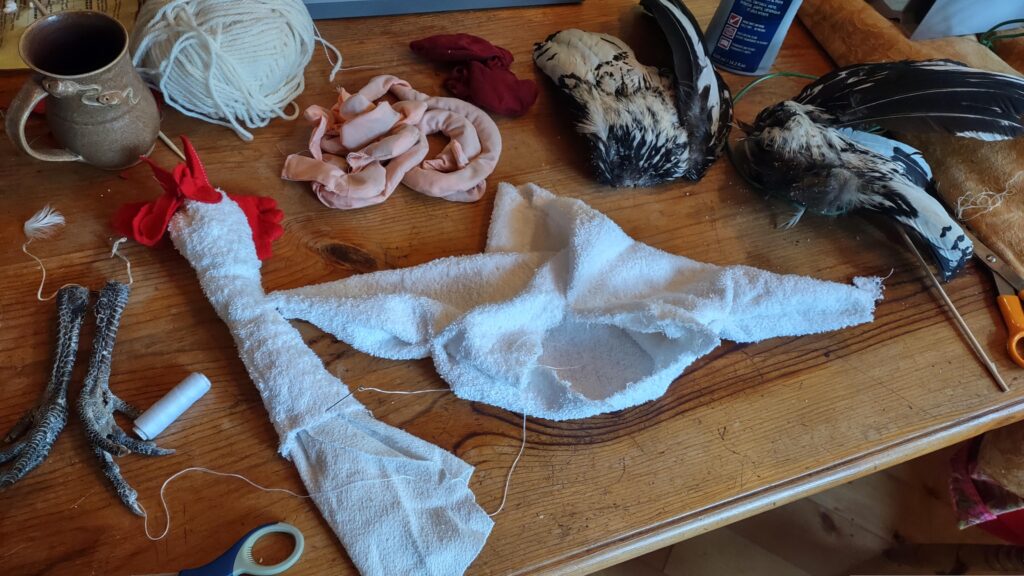
Anyway, I made him a body out of old terrycloth and felt, and a bit of armature wire for a basic spine and rib structure; broken sate skewers sewn into the wings, too. I first made his wattle out of felt, but it looked awful, so ended up making a more floppy one of red velvet with rocks inside for that floppy weight a rooster's long wattle can have. He has rocks in his head, too, so it can dangle down, limply. Appropriately for a dead guy. If you know, you know. The wings had to dangle, too, when he's turned upside down and hung by a foot.
Sewing the rooster's head out of terrycloth and felt.
Another part of dead roosters–especially those that may have been killed by a fox–is the protrusion of some guts. You know if you've cleaned a rooster, you reach in and grab the gizzard, and then the liver and intestines come out along with it. I didn't make this guy a gizzard, but I did make him some intestines and a liver. And I filled the intestines with lentils to make them dangle properly. Well, I hope he enjoyed his meal.
Various rooster parts in progress, waiting to come together.
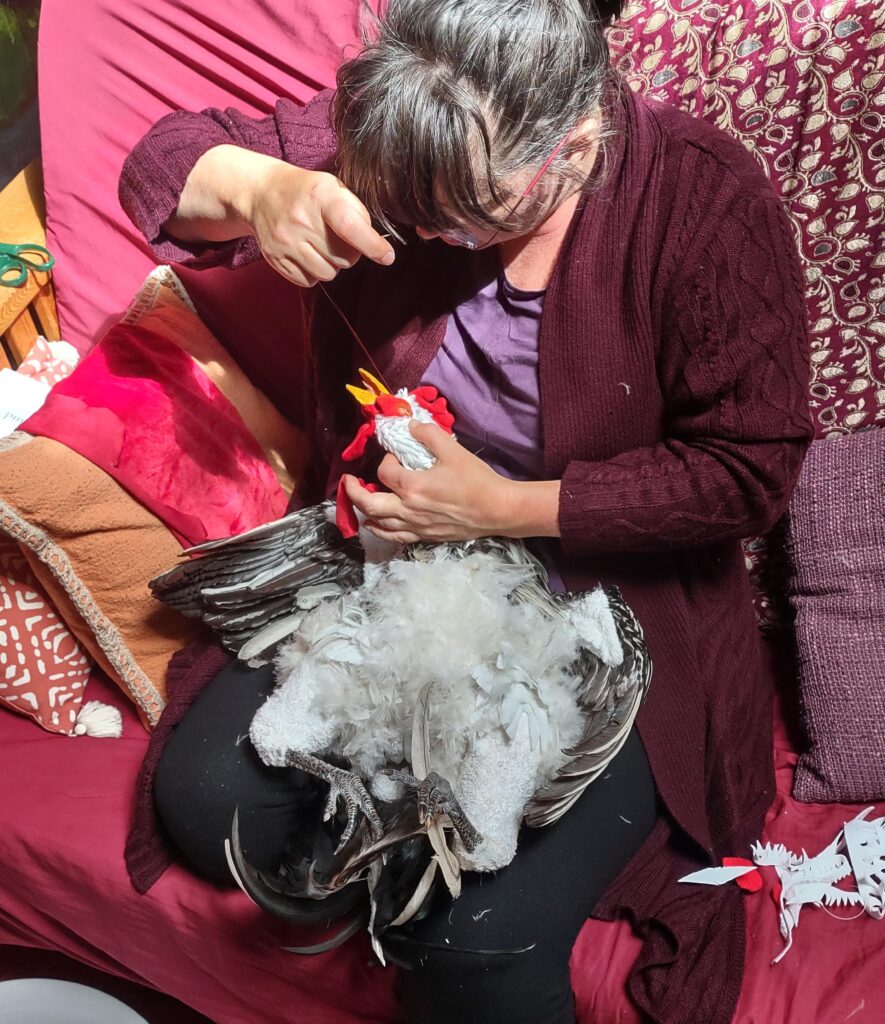
Then I had to sew on his feet and wing parts, and many many many feathers, both real and made of felt. I also painted his face and beak. Way better.
Sewing his hundreds of tiny white felt feathers on!
So… Here's my dead rooster prop! I hope you like him. I put up a video on my MakerTube if you'd like to see the finished puppet:
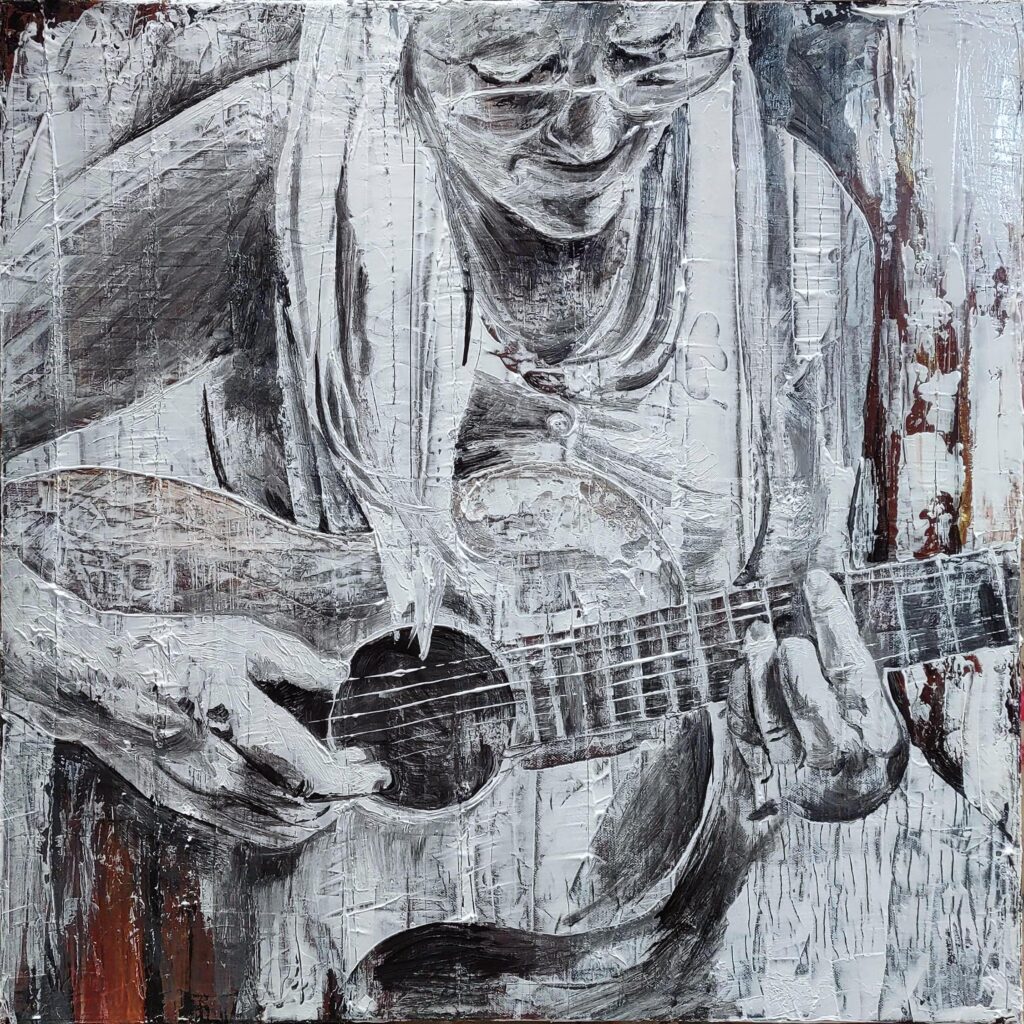
Acrylic portrait of my mother, Lyn van Lidth de Jeude, with her guitar.
My hands held on strong to the red plastic hand-grips of my BMX. No handlebar tassels for me, but I could get to where I was going when I needed to, and today I was rolling home, dragging the toes of my runners along the sharp shale of our driveway.
I could hear Mum’s voice and guitar getting slowly louder as I went. The door of our green and white metal-clad trailer stood open to the wind and the May bird-song, and the familiar sounds of my mother drifted out onto the afternoon. As I dumped my bike against the dog-house and stepped up the porch to the sounds I knew so well, her words filled my mind:
Everybody thinks my head's full of nothin’ Wants to put his special stuff in Fill the space with candy wrappers Keep out sex and revolution But there's no hole in my head Too bad*
I was mildly alarmed. Not so much because Mum was obviously singing about a gunshot to the head—horrific bloody murder was typical of the traditional ballads we sang together—but because she said 'sex'! Who wants to think about that anyway! I stood there with my mouth open, and Mum looked up from her guitar, her small hands pausing in mid-air formation, as if holding the song until I’d greeted her
“Hi.”
She smiled the beautiful upside-down rainbow of a smile that pulls the pointy sides of her lips up toward her cheeks. “Hi honey!” She called across our mustard-yellow carpet to the tiles where my runners held me fast to the floor. “Have you packed your bag for the folk retreat?”
“I hope you’re not singing that there.” I said without hesitation.
Mum’s pointy smile went flat and her eyes seemed to darken. “I hope I am!” She declared. “This is a Malvina Reynolds song! Not exactly folk, but definitely important to sing. You could sing it with me.”
She must be joking. I’d never sing that word. Too bad!
“It’s about being a woman,” Mum continued, totally oblivious, apparently, to my disgust.
Her hands began to sink, now, and I knew she was going to explain something. I didn’t want to hear it. But she did, anyway. Mum told me that Malvina Reynolds was born even before Grandma. That she wrote a song about ticky-tacky houses, just like the one Mum grew up in, in Mill Valley, where she knew how to find the bathroom in any of her friends’ homes because they were all exactly the same. Mum said Malvina knew what mattered in the world. She supposedly told her husband to drive their car so she could write the ticky-tacky song, because she knew when she needed to make her voice heard. Mum said Malvina was not afraid to speak and do the things that mattered, and I shouldn’t be, either.
Mum says a lot of things that Pappa and Daddy say are ‘wishful thinking’. But she never gives up.
Mum looked into my eyes, then, and then down at her hands as they began to pluck the strings again. I took off my runners as she began to play.
Call me a dupe of this and the other Call me a puppet on a string, they They don't know my head's full of me And that I have my own special thing
I thought about how Mum still makes the dinner while Pappa eats his peanuts and watches the news. I didn’t have a whole lot of respect for her, as a feminist. She eyed me as I walked by, and interjected into her song: “You know women weren’t even allowed to have a credit card until the year before you were born.” Then she smiled and continued:
And there's no hole in my head Too bad
Mum’s face looked so proud when she sang this song. Even though she said the word ‘sex.’ She said she’s not afraid of it. She said it was still legal, in some places, at that time, for husbands to rape their wives. Mum told me that she and Pappa had to sue Daddy for infidelity because even though they’d been separated for years, he refused to sue her for it, and without one of them suing the other, they weren’t allowed to have a divorce. And that’s just stupid. But Mum said things are changing. And every change matters.
I have lived since early childhood Figuring out what's going on, I I know what hurts, I know what's easy When to stand and when to run And there's no hole in my head Too bad
It’s been a long, long time since that day I first heard No Hole in My Head, played on my mother’s Washburn guitar and sung by her beautiful voice. But I can still hear it. Even though Mum died last year, and the months without her voice are piling up on the story of my life like the layers of plough-mud that eventually bury the whitest snow.
It’s spring, again. It’s almost May. I’m almost fifty years old, and women’s rights—the ones our mothers and grandmothers and great grandmothers fought and sang and laboured for—are being stripped from us, one by one, day by day, while we look the other way.
It’s not that we’re stupid or blind; some of us have just forgotten how important the work was for our mothers, and how beautiful. We’ve become distracted, almost as if it was somebody’s plan, by the necessities of working double jobs while raising kids in a society that is ever-harder to survive in. We’ve become distracted by the ticky-tacky houses that became the norm; by the products and the must-haves and the must-do’s and fear of not measuring up or out or small enough. We forgot to look away from the people who told us we can’t, and to write our own world that’s different, and hopeful and strong. We forgot that wishful thinking is exactly what dreams are made of, and that dreams are pathways to growth. Revolution. Societal evolution.
We forgot that we’re at the wheel. We forgot that we are powerful.
In my little memory-video of Mum on the couch with her guitar that sings only for her hands, her voice carries on:
So please stop shouting in my ear, there's Something I want to listen to, there's A kind of birdsong up somewhere, there's Feet walking the way I mean to go And there's no hole in my head Too bad
Mum loved birds. She knew all their voices and their migration and nesting habits. She created a garden where an incredible diversity of species could coexist and thrive, because she knew diversity was important in any system. Mum created a world where birds were welcome, safe, and thriving. She did the same for children, and anybody else whose circumstances made them feel weak or othered. She lifted people, and made them strong, with hopes they would lift others. Mum understood that others—especially those who are different from us—are an essential part of the whole, and she lifted their stories and voices. She loved adding harmonies and accompaniment to others’ songs. Mum worked to build the world she wanted to see, and she asked me to follow her lead, but she also followed mine.
I sang No Hole in My Head with my daughter and my son; I sang it at the folk retreat, too—even the word ‘sex’, because I don’t want to be held down by a word or an idea or a threat. I wrote my own songs and I drive my own car. I painted butterflies on my car, to make it beautiful but also to remind me that every small change leads to greater change, in the long run. I keep voting Green, even though they never win, and last year, for the first time, I elected a green candidate in my provincial riding. I will vote Green, again, because it’s right. Because I keep believing that we can build our dream. Together, we can build the world where all of us, and our ecology, matter.
Mum knew that grass-roots revolution isn’t a job for a leader or anybody with power; it’s a job for us all. The whole of us. No matter who gets elected, we have to keep working to fight for our rights and build our future. We have to make choices in every moment to follow the feet that are walking where we mean to go; to be the masses who are, inevitably, making the change. We have to stand up and speak out and not just break down the barriers we face, but turn to what’s beautiful and create the world we want to live in. We won’t all agree about how that world will look, but that’s exactly why it’s a job for all of us. If we all do what feels right, and we talk and listen and love, we will, as a whole, get to somewhere good.
It was hard work that our mothers did, building this world we’ve inherited. But it was also beautiful. Community is beautiful. Now it’s our own and our daughters' privilege to not bend to the world that crushes us; to not try to work within a system that holds us down, but to step out, sing loudly, and build this world, our way. Because there’s no hole in our head. Too bad.
* Words and music by Malvina Reynolds Copyright 1965 Schroder Music Co.(ASCAP) Renewed 1993. Used by permission. All rights reserved.
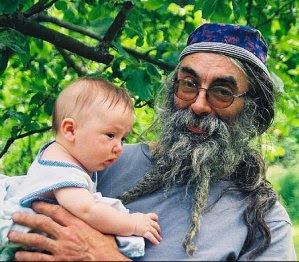
Ralph holding my then three-month-old son, Taliesin.
It was a cloudy day in a November of my childhood when Uncle Ralph gave me my first carving tools. Of course, he wasn’t called ‘uncle’ yet, at the time, but never mind. I was probably about ten, and it was a rough time in my childhood, for a lot of reasons. If I’m remembering the correct occasion, he arrived without Auntie Lidia, alone on his motorcycle, round leather riding goggles pinching in the top of his hair while the rest of it flew out behind him. Even his beard flew along beside him as he rode down our driveway. He’d come by for my birthday, and I remember his wonderfully long brown eyebrows and much longer braided beard leaning down to me with a most beautiful leather bag held out in his dark hands that always looked more weathered than you might expect for a man his age. "Here. Got you this.” He said, and opened the bag to show me all the different types of tools he’d packed into it.
I remember thinking how annoying it was that he said he’d ‘got’ it for me, when it was clearly his own bag. Eventually I realized the gift had been much more special for having been his own bag, than if he’d just bought me something at a store. It was a piece of his heart. And he’d given that gift to me at a time I needed not only to be seen, but to have an outlet for my pain. I suppose Uncle Ralph’s outlet was creativity—often with carving—so he gave that to me.
Uncle Ralph was always carving. We’d be sitting at the beach and he’d pull out his pocket-knife and just start whittling a piece of driftwood. He even seemed to sometimes have a little carving in his pocket, which he’d randomly start working on, as we sat somewhere. The parents of our community built a playground for our new school, and of course Ralph was one of them. He carved a driftwood log into a horse that became burnished by a couple generations of children who rode to our adventures at recess. Ralph gave us adventure. He was a printmaker, as well, and once did a project with the older kids at school, where he taught them to make self-portraits in relief out of cardboard, and then together with them built a cardboard bus, in the windows of which the kids put their cardboard selves. Then he laid a giant paper on the bus, and drove a steam roller over it to make a print! I’m a printmaker too, now, and I don’t have to tell you why.
When I got married, Uncle Ralph carved a wedding bowl for me, and he stood up to sing for me and Markus. He welcomed Markus into his life without any hesitation or awkwardness. Just treated him like family, instantly. After we moved back to my home island, and spent more time with our family, here, and as Markus’ beard got longer and longer, I once suggested Markus might braid it like Ralph’s. “No. That’s his thing,” Markus replied. Uncle Ralph is so cool his style is untouchable. And yet he’s one of the most open and accepting people you could meet.
He loved children. Not in the way that fawning adults often seem to ‘love children’, with affection and concern and more than a little superiority. Uncle Ralph related to children as if they were equals. That might mean he said somewhat inappropriate things, at times, leaving us staring blankly, where his bald humour bewildered us. But it also made us feel seen. He had four of his own children, and eventually a bunch of grand-children, but he still had time and acceptance for all of us hangers-on.
When my son Taliesin was little, he had a knit yellow toque with ear-flaps ending in long braided strings and tassels. He quite correctly identified that this was the sort of hat Uncle Ralph would wear, and used to dress up in that hat, sometimes with colourful vests and scarves, and call himself Uncle Ralph. When Tali was turning five, and had been digging away at a hole near the driveway he called his ‘mine,’ Uncle Ralph and Auntie Lidia arrived with yet another unexpectedly perfect birthday gift: A shovel. He’d bought my son a small, light-weight, but very functional shovel, and carved TALI into the handle, in ornate capital letters. Tali’s own shovel, for his own mine. One year, Tali only invited four people to his birthday: Jon and Rika (similarly unique and close adopted family of ours), and Uncle Ralph and Auntie Lidia. Tali stipulated that Uncle Ralph must bring his guitar. So he did.
Uncle Ralph and Auntie Lidia getting a tour of Taliesin's mine.
Uncle Ralph could be very loud and very quiet. At that small child’s birthday party he sat very quietly noodling on his guitar, creating a beautiful environment for our celebration. At other times he could be loud and even abrasive; shouting and joking and laughing, playing baseball, drinking beer, and dancing and dancing like you could never imagine his long hair tamed; his hands and legs quiet, or his face not wild. But also at a party—a big party—he was a safe place to go to. Often he’d be down by his creek, sat down by his makeshift barbecue, tending to his special salmon that everyone back up at the house was waiting for. I used to just go sit down there with him, quietly. Often it was just the two of us, maybe with an auntie or another kid. And he’d tell us about his plans and projects; the fish that were circling in a pool of the creek; any number of his amazing inventions. Or maybe he’d just sit carving, and then eventually hand us a beautifully decorated stick. We loved him.
Ralph became ‘uncle’ to us, really by word of mouth. He was one of a small group of cherished friends of my parents with whom we spent a lot of time, growing up. And at some point Gail told us she’d like us to call her Auntie. It felt like a gift, so I called her Auntie Gail, proudly. Then one day Lidia mentioned that if Gail was my auntie, then surely she was too, so, by extension, Ralph became my uncle. He never needed or asked for that name, but he also took to it like it had always been. I guess because it always was.
One day I was leading a class back from a forest adventure near Ralph and Lidia’s home, and I looked over their fence as we passed, to see him sitting on a chair in his yard, whittling. “Hi Uncle Ralph!” I called over the fence, and he looked up and smiled, as about a dozen of the kids I was with hurried over, hands and chins pulled up onto his fence, and shouted, “hi Uncle Ralph!!!” He just kept smiling, like this was nothing out of the ordinary, at all.
His hands kept working at the wood on his lap, as his eyes smiled out from his mess of hair and brows, and his lips called out the musical tone of his reply: “Helloo!”
It was maybe five or six years ago that I first knew he didn’t recognize me. I’d known he had dementia for quite a while, but it always seemed like a minor thing. He covered it up well, joking about his mistakes, and acting like they just didn’t matter. Maybe they didn’t; we knew him well enough to not feel too lost in the confusion, and we covered up for him, too. But that day at the store, I went up and gave him a hug, and I could see in his eyes that he was hugging me because it was the appropriate thing to do, not because he knew who I was. “Hi Uncle Ralph,” I said, and he answered, “can’t find where I parked my car.” He hadn’t driven for years, but he went on to describe a car he also hadn’t owned for years. I figured he’d walked down to the store, and when he started asking for Lidia, I knew he was scared, and just hoped Lidia was on her way to pick him up.
Lidia was the great love of Ralph’s life. I know from my own experience that living with a person like Ralph is adventurous and beautiful, and also challenging. And too, his love is profound. Maybe like a child’s love for his mother is profound. And in moments of uncertainty, Lidia was Ralph’s touchstone. This past Christmas, the last time I visited Ralph and Lidia before he went to hospital, Uncle Ralph wanted to leave the house he’d lived in for over forty years to ‘go home,’ but despite his confusion, he still spoke to Lidia as though he knew her. No matter where his mind went, she was at the foundation of his sense of security.
Just before Ralph died, lying small and thin and quiet, his feeble knees bent under the hospital blanket and his mostly white hair pulled back into a ponytail, he struggled to breathe even shallowly, but once in a while he shuddered, opened his eyes, and looked into Lidia’s, where she sat in front of him.
A few days later, after Ralph’s family had all gathered around and said goodbye, after his mind had carried its trove of stories and inventions to some other place, and his body had left the world we live in, I attended a paddle-making workshop that I’d signed up for many months before. We’d been tasked with finding some kind of learning or self-discovering in the experience of carving our paddles from 2×6 cut blanks. And although I struggle with following directions, I didn’t have to look for meaning, that day, because Uncle Ralph was there with me. As I pulled the draw-knife, manipulated the small plane, and eventually sanded my paddle to a nice smooth object, I felt enormous gratitude for this man who first inspired me to carve, but more than that, I realized that I was using carving to heal from the loss of him. In living, he gave me the tools to heal from his death.
Woman Story: Untitled 7 Artist: Emily van Lidth de Jeude
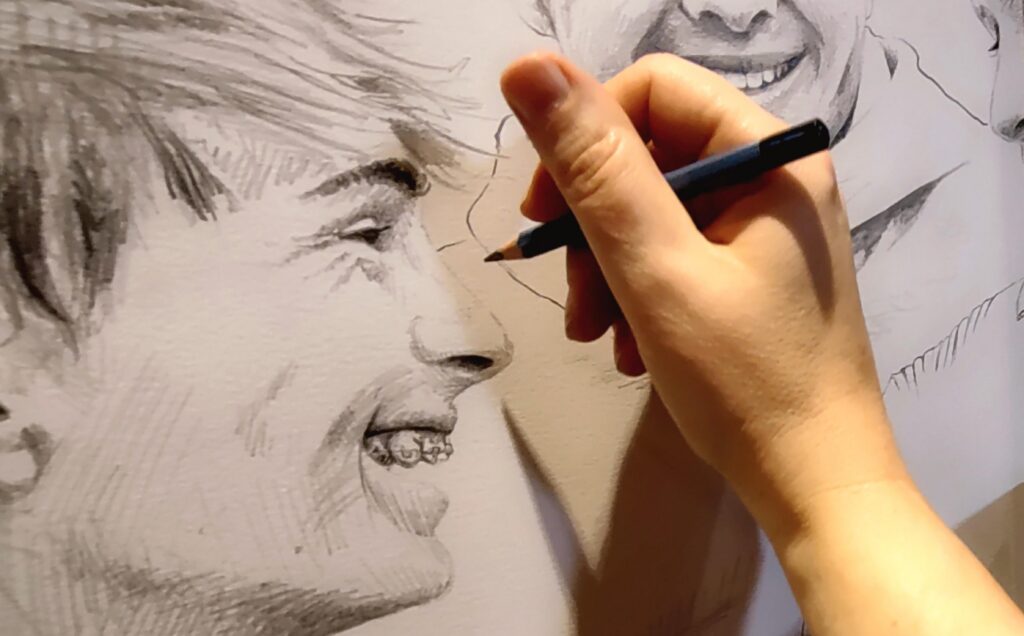
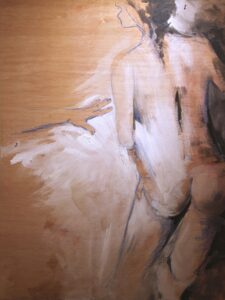
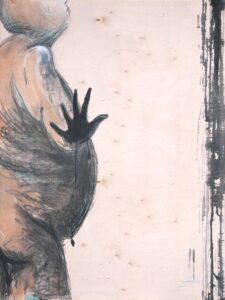
I once installed a show called Woman Story here in my home community. The core of Woman Story is a series of 24 portraits of bald, naked women drawn with graphite, crayon and acrylic wash onto reclaimed panels from my own home. They're actively expressing a complex array of experiences that inform woman-ness, but anonymously, because each of our stories might belong to any one of us.
At some point, a local I know distantly ‒ a retired judge and art collector ‒ came in to the gallery and sat down on the bench near the door. He stayed for about forty minutes. I eventually went to sit with him, and asked him what he thought of the show.
"Oh, I'm not here for the show." He answered. "I'm waiting for my ride."
"Ah. I see." What was I supposed to say next?
But he continued. "Is this your work?" He asked, bluntly.
"Yes."
"Well it's awful. An insult to women."
Woman Story: Untitled 18 Artist: Emily van Lidth de Jeude
I was completely shocked, but also curious, and asked, "Why do you feel that way?"
"They're bald," he answered, point blank. "Why would you be so disrespectful to women?"
"I drew them without hair in order to make them anonymous; to remove an identifier, and so their hairstyle doesn't speak to any potential prejudice or assumptions we make about people's hairstyle choices. But also to make their stories about everywoman."
He never once looked at me while he spoke. "They look like the bodies that came out of Buchenwald," he said. And then he was silent. And soon afterwards, his ride came.
Obviously, I could see his point. And, despite feeling regretful about possibly triggering trauma in people (my family definitely also carries trauma from WWII), I feel like maybe it's not a bad thing to have made this connection in my work. Because in war, women are also casualties. Women are also contributing to and leading both the offensive and the underground support systems. Women did come out of Buchenwald, dead. And women are found in shallow graves, abandoned vehicles, hospitals and landfills all over this world. It truly is awful, and I guess that's why I feel it needs to be told.
Here we are on the brink (or over the brink?) of WWIII, at the same time as we're experiencing a rise in femicide, exploitation, abuse and violence against women. It's not a coincidence. In our greed-based apathy we have allowed a very small handful of men to own and control our world. Most obviously, that's not acceptable! And what do strong women do when a situation is not acceptable? We make change. Women all over the world are protecting the vulnerable and building systems for survival, protection, and recovery, even as the war is only getting started.
Generally speaking, women are fully half of the world's population that knows from a deep generational place what exploitation, vulnerability and violence looks like ‒ and how to both survive and heal it. We're working throughout our communities, already, to build peace and resilience; to educate, support, and empower. Even to empower the women who foolishly allowed their fear to make them hate. We're working to bring and keep people together.
Woman Story: Untitled 16 Artist: Emily van Lidth de Jeude
We cannot rest. As born survivors, it's our strength and duty to not become bald bodies in concentration camps, mass graves, or landfills; to make sure our sisters, brothers, and children are also safe. To de-escalate fear and reactionary hatred before it harms us. A lot of us are already experienced with this. The rest of us can learn. We have to deal with our own crap and become our best selves, in order to show up for our world. And we have to start now.
There's work to do! I'm not talking about just directly protecting and defending, although there's a need for that, as well. I'm talking about building the world we need, so that it displaces the world of hate and greed that is being fed right now. And there are infinite ways we can do this. Some of us are out putting our bodies and voices on the line; putting ourselves in danger to inform and advocate. Some are donating money, time or skills to organizations that amplify our voices and work. Some of us are building networks and repositories for the protection of people, environment, information, culture, and as a whole, the future of our world. Some are educating and supporting our communities, so that we can have and maintain peace. And all of us, no matter what our lives look like or how limited we feel, can make conscious choices in every act we make to defy and devalue hatred, to promote love and peace, and to pull away from systems, corporations and ideologies that promote hatred.
Even when we feel weak, we can be strong. We are all challenged; women and men, too. That doesn't mean we're beaten. A challenge is, by definition, an opportunity to overcome. That's not just where we're at right now; it's who we are.
We are strong. We are capable. We are determined. We can do this.
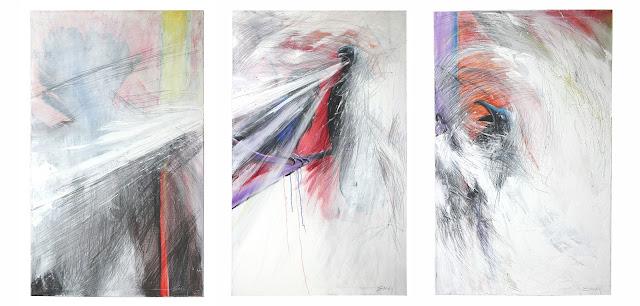
"Three Craws", oil and graphite on 3 stretched canvases. Emily van Lidth de Jeude
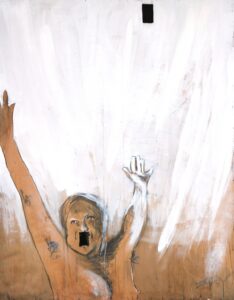
Songs of the Apocalypse is a series I’ve been working on since around the time my birth father died. He had lived a long time with Parkinson’s, but the circumstances of his death in hospital, while recovering from spinal surgery, are a complete mystery, and in that post-shock landscape of fear, confusion, and a resurgence of shallow-buried family traumas, his side of my family fell apart. So this series of paintings began as a way for me to deal with my emotions of that time. But of course those personal issues are deeply intertwined with the societal issues we all live with: helplessness in the face of climate change, capitalist, colonialist and patriarchal damage, global societal upheaval, and the fallout from those things. For example, many of my own childhood experiences are a direct result of my grandparents’ war traumas. Two of my grandparents come from families fleeing war and famine in Ukraine and Ireland. Others recently lived here through the great depression, and all of these unknowingly stored those experiences in the many generations to come. So those bigger-picture problems filtered down through the generations to effect even my own children’s health and genetic makeup, a hundred years later. Divorce, childhood trauma, and family strife are just microcosms of the bigger picture. So in dealing with individual portraits I’m also looking at our society as a whole. In looking at the wounds and the healing, I’m hoping to create psychological pathways for us all to heal from the greatest struggles we face.
My parents did everything they could to support me, given the understanding and tools of our time. They created a safe and nurtured life for me on a small island, and they continue to support me in my adulthood. But life cannot be perfect. Life is not about good and bad, but about all people constantly growing. And growing looks very messy.
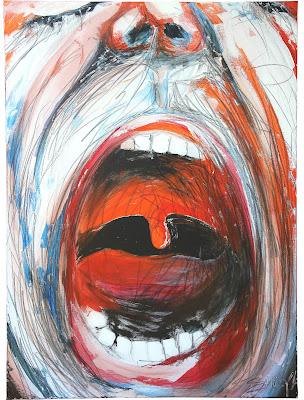
"(I open my mouth and) nothing comes out", oil and graphite on stretched canvas. Emily van Lidth de Jeude
The circumstances of my childhood were not what we consider to be ideal, but they’re also not at all uncommon. Like many of us, I live with intergenerational traumas from histories of war, colonialism, famine, and domestic abuse. These things are rarely spoken about, as our culture tends to look down upon expressing too much emotion or speaking about emotionally challenging topics. But the effects of my buried experiences are borne in my body as autoimmune diseases, and they’re in my paintings. The image above is one of the first I painted in the Songs of the Apocalypse series. It’s a depiction of my own face as it appears to me in dreams, screaming for all I’m worth to help the people I love (who are always suffering horrible fates in my dreams)… but no sound is coming out. And nobody hears me. As an artist I’m trying to break that helpless invisibility, not just for me but for all of us.
I am a woman in a world where one in three women has been the victim of physical or sexual violence, usually by a partner or close family member. So think of three women you know. Which one is it? Think of twelve women you know. How many of the four has told you their stories? I am a woman in a world where women are not only not expected to achieve, but are taught not to expect ourselves to achieve. A world where we’re expected to be happy to just survive.
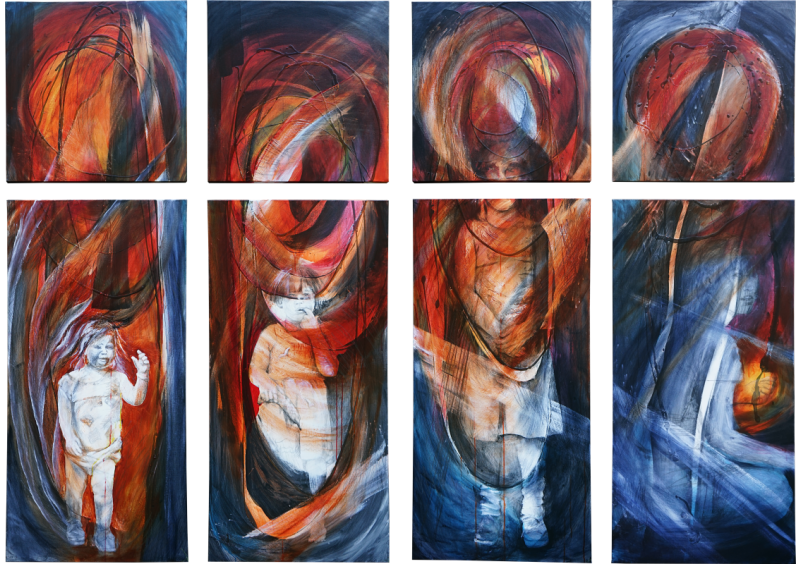
"Will You Love My Heart", oil and graphite on 8 stretched canvases. Emily van Lidth de Jeude
I don’t call myself a survivor because I want to do more than survive. This is a portrait of me at one, four, eleven and sixteen. It’s called Will You Love my Heart, and is painted to Sinéad O’Connor’s song, Love is Ours. It’s on exhibit July 24-August 18 at the Silk Purse Gallery in West Vancouver. As a synaesthete, I usually paint music, but not just any music. The song that inspires a painting will have a very specific meaning associated with my own memory, so what I’m painting is my visual experience of that song combined with my own memory and emotion. Love is Ours is about holding onto the pieces of our broken hearts and keeping each other alive. In our boxes of personal experience we grow out into the rest of the world, and then will we be loved? Or shoved back down into our private little trauma boxes? I’ve spent my whole life since my teens trying to get out of that box, to find love and healing, and grow into the many links between my heart and yours (yes you—we’re all connected).
I figure it’s a good idea to let my voice come out now, share my progress and hopefully inspire billions of others to do the same. That’s why I’m finally beginning to show the Songs of the Apocalypse series.
So think of those women again. Those 12 women, four of whom have been assaulted. Maybe you’re one of them. Maybe your child is, or your partner or your mother or your dearest friend. What can you do in this moment to raise her up out of the box built of her trauma? What can you do to break the walls of the box? How can you change even one thing about the space you give her; the voice you give her; the respect you give her, that could help her find her own way out of the box? And how does your love make her strong?
I’m a feminist artist with a loving, evolving male partner and a strong, courageous daughter, and an extremely emotionally-aware son. Being the strongest I can be strengthens the foundations for everyone, including all genders, ages and classes of people. It even will combat climate change, colonialism, the patriarchy, and capitalism, because as I become stronger I can lean less on the cultural norms that hold up those false shelters. Creating a world where I can come out of my box and thrive means creating a world where everyone can thrive. Equality doesn’t mean bringing anybody down. It means using the pathways created by love to hold each other up.
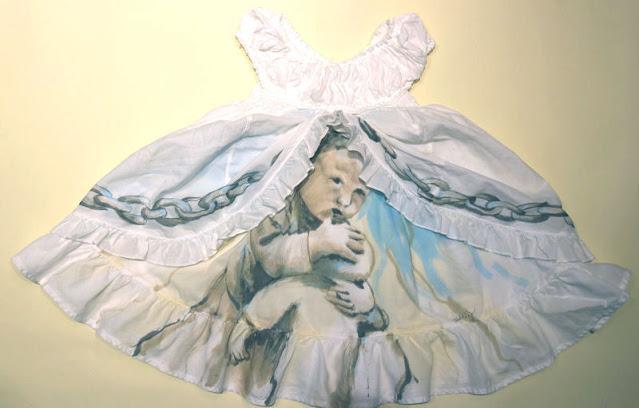
"Chain Dress", acrylic and stains on an altered child's dress. Emily van Lidth de Jeude
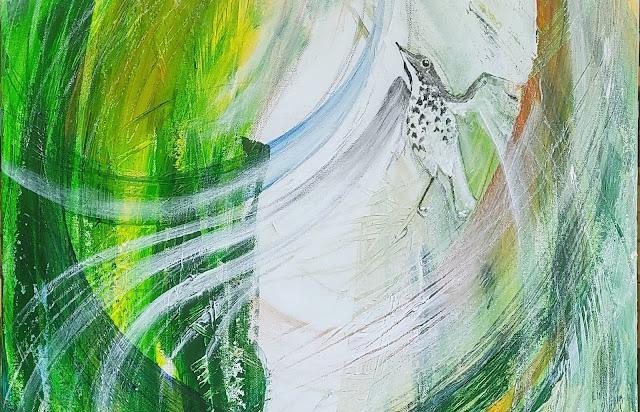
“Go and Make Yourself Content, My Love” (detail). Swainson's thrush in my mother’s garden, to the tune of the Unquiet Grave. Painted with acrylic, graphite and coloured pencil, by Emily van Lidth de Jeude.
I was walking down from my parents' house to mine, over the crest of their driveway where the wind blows steady. Not like the rest of the property, through which it tumbles this way and that, scatters just a few leaves, or bursts out of a single storming fern. Over the crest of the hill at the top of my parents' driveway, the wind passes smoothly and calmly, sometimes crisp and smelling of leaves, sometimes damp with the weight of snow and sometimes full of the heaviness of summer and dragonfly wings. I've walked here alone and with my children after Christmas dinner, my heart and belly and arms full of treasures. I've walked here holding my chest against hidden sobs when I couldn't be what the world wanted of me. I've walked on my parents' driveway even when they lived in a different house and I visited rarely, and always it has been a place of the wind and the gathering and freeing of perception and feelings. A place of reckoning or accepting. Not that night.
I was walking down from my parents' house on the evening we came home from our first trip to the Cancer Clinic, two weeks after the sudden and unexpected removal of a stage-four tumour from my mother's brain. I was walking down that driveway and there was no wind. The driveway felt flat, although it's not, and it's rocky, but the rocks were dead that evening, which they never are. The April grasses and blossoming trees were bereft of colour. Impossibly grey. There was no birdsong, no frogsong, not even the sound of leaves, and when I looked at the hillside I thought it might just go away, if my mother died. When my mother dies. She keeps reminding me: "We all have to die, sometime." But I don't want those words. That was one of the many logical thoughts that evaporated when the doctor told us we won't be returning from this trip. And we stared blankly into the empty air and our tears were silent.
I find the word "journey" as people use it for cancer absurd. We use it like we can pack for a trip and just take in the ride. But it's not that kind of ride.
Glioblastoma. Someone should make a horror carnival ride called Glioblastoma. You get in a little comfy bucket seat and it chucks you out into the sea. Then down a vortex you go, into a drain where you almost drown but NO! You're not allowed to drown! There are things to live for and places to see and you might have a few days or weeks or months or years of good life, so LIVE!!! And you can't feel your right side, and you can't find all the words that were here just yesterday, but now more than ever, you want to, need to LIVE!! So you come out of the vortex on the chemo train, where you get whipped back and forth over trestle and track without warning or reason through whacking slaps of sheer terror and poofy clouds of deep love and acceptance: A bird? NO! Slash! You're going to die! Slash! Maybe not so fast–Slash! Everybody is trying to help you–Slash! You're so strong–Slash!–Take some more pills–Slash! Love, love love–Slash!
Love can't save you and everybody's talking to you like a child–Slash! Now you're the wise one–Slash! Let's finish your sentences for you–Slash! We could get an ice-cream!
Slash! You get to meet the guy who will administer your death–Slash–but only when you want him to–Slash–Be GRATEful!!
Slash!
Nobody wants you to die!–Slash–Let's go shopping!–Slash
Why are you so tired? Slash.
Slash.
You fall out from the carnival ride one sunny morning, and you smile up at the sky and look for birds.
But there aren't any.
My mother loves birds. My whole life has been decorated with her hushed exclamations of "oh! A warbler!" and "Did you hear the snow geese go by this evening?" My mother hears things many of us don't notice, like the pips of babies and the tone of ducks that tells her whether they're coming or going. When my father gently delivered a helpless baby owl into my childhood, my mother raised it on chopped liver and caught mice until it grew up and flew to the trees. But she heard its voice separate from the other owls, and she answered it, and taught us to make the hungry-teenage-owl call, too: Psssshhht! Pssssssshhhhhhhttt! That owl and its offspring came back to visit us for decades.
Terminal cancer is a strange thing. We want a timeline. Something to hang a hat on. To work with. To put in the calendar, and at the same time we want to live in the moment and not have to plan for death or even how to visit with all the loved ones. But just to sit and hear the birds. Except the chaos of medical interventions, social supports and emotional upheaval means not a minute exists of just. Peace.
Until one day, we can't take the chaos anymore. Out of necessity we ignore the forms we're supposed to be filling out and decline the offers of new prescriptions, new dosages, delivered meals and all the services we know are needed. One day we just need to be.
This week I saw my father's eyes in a rare moment of stillness. They used to shine with his intensity; they used to sparkle and shoot beams of aliveness. But recently they've looked tired, and there were big wide tears balanced on his lower lids and he was just making a sandwich. I don't hear so much as I see, and I am starting to see again. I saw my brother's cheeks, this week, taut with small lines of agony as he pulled me into his arms and didn't let go. As he asked if he can take our mother to have her broken arm looked at. Cancer is not a journey. It's a horrible carnival ride, and sometimes we catch glimpses of the world, as we spin. Sometimes, also, we catch glimpses of the beauty that brought us here to begin with; that holds us up through the fear and the changes we didn't see coming. My parents walked out, hand in hand, today, to look at the blossoming of the world they share.
And I began to hear the birdsong, this evening. The teen-aged ravens are pillaging the robins' nests, to a great outcry, as you can imagine. We thought the black-headed grosbeak that my mother says only comes for a short time every spring had left, but it's been singing again. The wrens and towhees are hopping in the bushes, until they flit out to the pine, to make their plans. The offspring of our owl are impressing people along the trails, these days. And for some reason the flickers keep sitting around on the ground. My father says get the aphids out of my apple tree, but I can't reach them and we both know that's OK. Bats are out, tonight, delighting my peripheral vision. And as I walk up over the crest of my parents' driveway this evening, I hear the nighthawks dropping on their prey, all around me. The wind is warm, and it's summer now, and my parents are just watching a movie with a couple of mosquitoes like it's a normal evening. Just living this incredible life in an incredible world, and learning to step off the carnival ride and hear the birdsong.
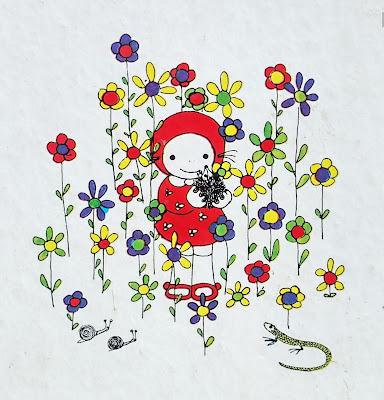
back cover illustration from Emily and Arthur, 1975
This morning I got up as I have almost every May morning for as long as I can remember, and went barefoot out of the house to wash my face in the dew and pick flowers for my mother. I don't know why I do it, and I don't know that my mother even knows I get that dew all over my face and feel so at peace in the world this way. Something inside me just feels this is right, so I do. I used to take my own children out to do it when they were little, but I don't think the practice has stuck with them in adulthood. Why do I do this? What makes it so important to my identity?
I came back home after visiting my mother to find this old book on my table. Emily and Arthur, by Domitille de Préssensé. It was there because my daughter and I were recently going through the children's books, reminiscing, and I'd pulled out a few of my old favourites.
In these old books from the 70's, I saw how I became me, and some of how my children became, as well. The girl in the image above is Emily. She's wearing red–always–and holding her beloved hedgehog Arthur among the flowers. She has interesting things in her house like a "long stocking" that I always thought must have been a wonderful thing to have. And because my name is Emily, I grew up thinking this little red-clothed Emily represented me. Is she the reason I love to wear red? Maybe! Red just feels like it belongs with me! I remember feeling a lot like the way this Emily looks, as a child. I remember the feeling I had one May morning when I went out to find my mother some flowers and got distracted looking at woodbugs on the log where I eventually broke off a beautiful Turkey Tail fungus to bring in for her. I remember when I handed her that beautiful Turkey Tail with a couple of flowers how it couldn't encapsulate all the beauty of the woodbugs on the log, or the special curve of the broken wood, or the smell of the bark or the happiness of my heart. But I hoped she knew it meant I loved her. I became that girl on the back of the book–the one who is delighted by small found things–and am now a mother and artist who is also just still Emily. Still wearing red and going into the flowers to be me. How many Emilys have been somehow defined by this book?
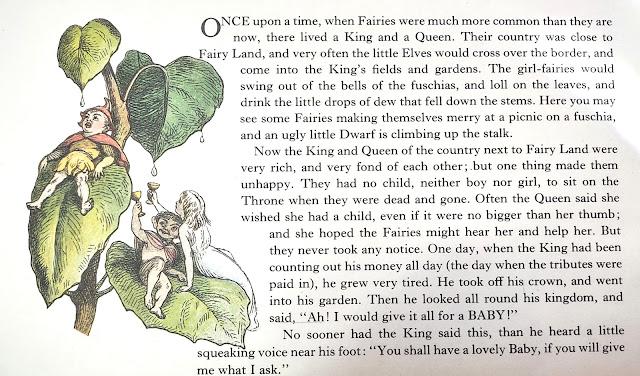
As a parent, and former educator, and as an artist I know how much our childhood experiences mean to our identities. I sat wondering this morning how the idea of washing my face in the dew came about. I feel like I've been doing it all my life, but I can't ever remember doing it with my mother. Then I saw another of the treasured childhood books, and I remembered: The fairies drink the dew! When I turned four, my father gave me a book called In Fairyland, Pictures from the Elf-World, by Richard Doyle. In this book the fairies dance and fly and race snails… and drink the dew! I remember trying to drink the dew off the plants as a child, imagining I was one of the fairies. I guess somehow this became part of my personal May Day celebration. This is how traditions are born, how they grow and change and define us. And… this is the power of art!
page 13 of Richard Doyle's "In Fairyland, Pictures from the Elf-World", 1870
I always knew these and other images were drawings made by artists. Even the text of Emily and Arthur is a hand-drawn piece of art. Now I can see its influence in my own birthday-card making, and I can see how Eric Carle's rainbow of fruits for the Hungry Caterpillar informed the way I set up any painting, now. Nothing is complete for me without a whole rainbow.
So what have I given my children through the books I chose for them? Some I'm not so proud of, I confess, and some I can see in their life-choices, now. Obviously they were also more drawn to the books that suited their personalities–this isn't a one-way system of influence. And I chose things that suited them. We know that every move we make as parents will have effects on our children's psyches, that every mistake we make will cost them in self-doubt and therapy dollars, one day, and we hope they'll carry our triumphs forward as courage and happiness into their adulthoods. Our children become themselves in the environment they're given.
But our sphere of influence doesn't end with our children. It grows from each of us into the world around us, whether we're artists or teachers or foresters, diplomats or farmers. We're all creating and influencing each other every day. The choices we make in the language we use, in every bit of media we consume, and in the products we bring into our lives all influence everyone we come into contact with. And through our contact we become ourselves, in community. Living with this in mind is self-determination. This is how we become, as a species, or perhaps even as a planetary ecology. It's good to remember that in everything we do, we have a choice.