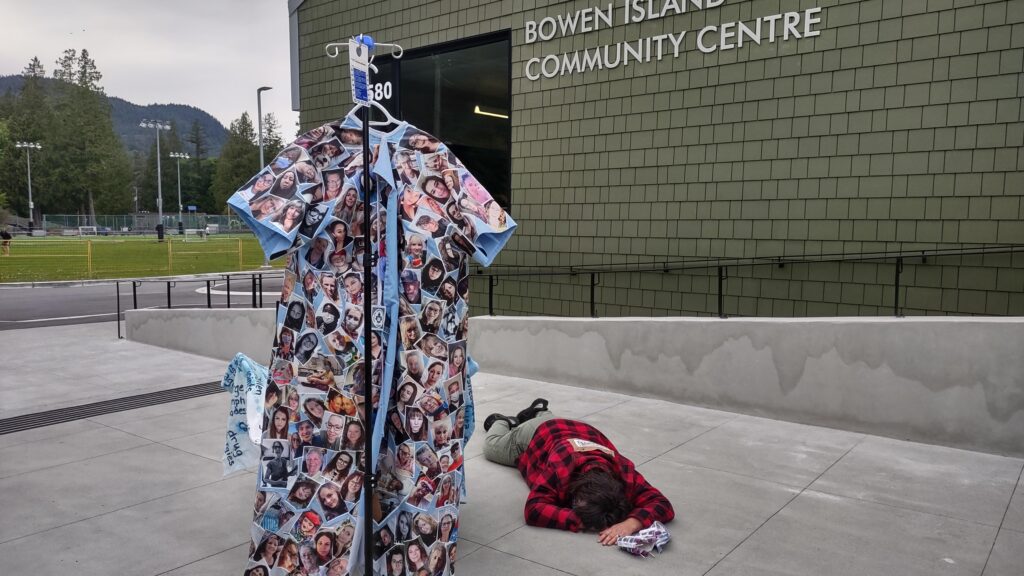
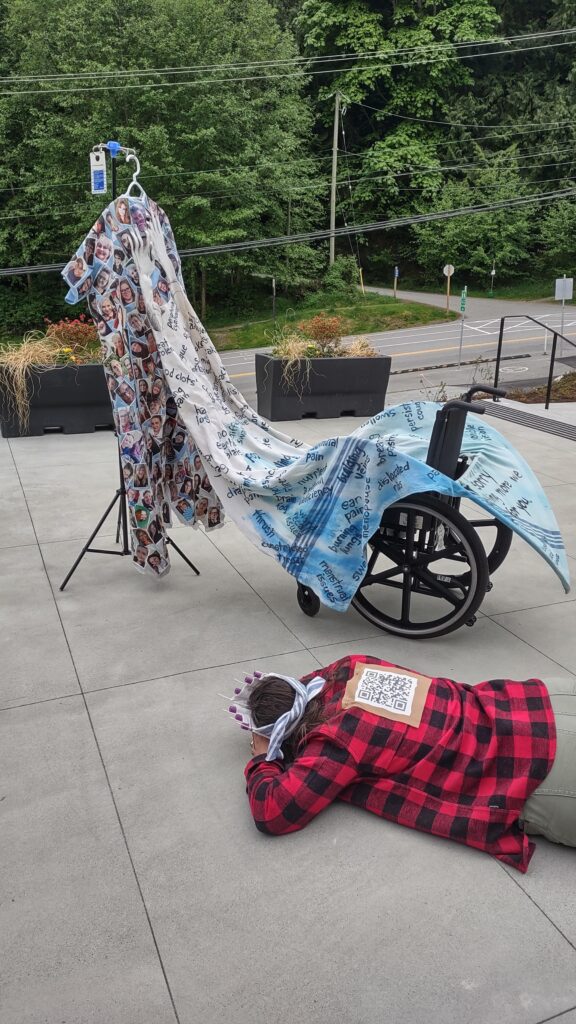
I'm so happy that the (dis)robe: Hospital Gown piece I made last year will be on display this autumn in Vancouver, but meanwhile… I get to wear it to an art event in my hometown, tonight!! This is will be the first time I've shown it locally, and I'm REALLY nervous. This piece is all about my disability, and to say people roll their eyes when I talk disability is an understatement. But this piece features other people from our community, too, so it's time to REPRESENT!!! Here I go!
Off to the Bowen Island Community Centre. 🙂
Will update this post with a photo, later, if someone takes one.
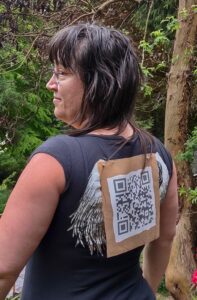
UPDATE: It was a pretty quiet event, but nice to meet some other artists and visit with friends. I think only one person scanned the QR but that's OK! Here are some photos from before I actually put the gown back on and went inside…
Thanks to my partner Markus, not only for these photos, but for always supporting me both in life and in art. If you're wondering where that QR code points, here's the link: https://emilyvanartist.noblogs.org/qr/
It happened like this. Just after we discussed the stage floor I was painting, the director cycled back to my house and knocked on the door again. "Emily?" He called into my house. "Emily, I forgot to ask. Could you make us a rooster prop? It's to look like it's been killed by a fox. Although that may or may not have actually happened."
I was astounded! And thrilled!! "Of COURSE I can!!" I knew the play was pretty serious — Dancing at Lughnasadh. So this prop was a serious prop. Well… as serious as a pretend killed rooster can be, I guess. I was deeply honoured that the director thought I'd be up for the task.
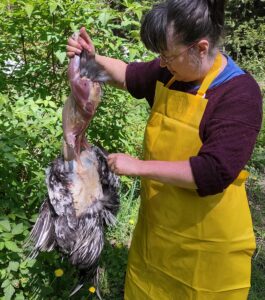
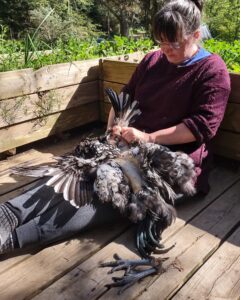
There is no way I can easily make a fabric rooster puppet that looks real, and dead. So the first thing to do was to find a rooster that was headed for a pot, anyway. I was given this guy. He was sadly doomed, after his owners had searched for a home, to no avail. So on the appointed day, I picked him up, thanked him for his donation to my freezer and the arts, and butchered him. He made meat, bone broth, liver pate for me to eat, and a pair of feet and a beautiful feathered pelt for the prop. I tried saving his beak, too, but didn't like how small and dark it was, and decided that this rooster prop was going to need a yellow beak.
Working the hide.
I've plucked and slaughtered a LOT of chickens in my life, and plenty of rabbits, too, whose skin comes off so easily, like peeling off a knee-sock from a foot. Rooster skin–with feathers, wings, and tail attached, is not like that!! It took some careful consideration to get it done properly, bones removed (all but the Pope's nose and the wing-tips), and with all the feathers still in tact.
I worked a long time to get the skin clean, and then I tried to dry him. I've never done taxidermy before, and it turns out a bird is not the easiest thing to start with. Then it turns out I also have no experience. Oh wait–I said that already. But it turned out to be a problem!! And this bird was fatty. I managed to dry his feet OK, but ended up removing the wings and tail feathers, as well as the ruff and saddle feathers. Ugh. All that work keeping his skin together, just to take him apart in the end!!!
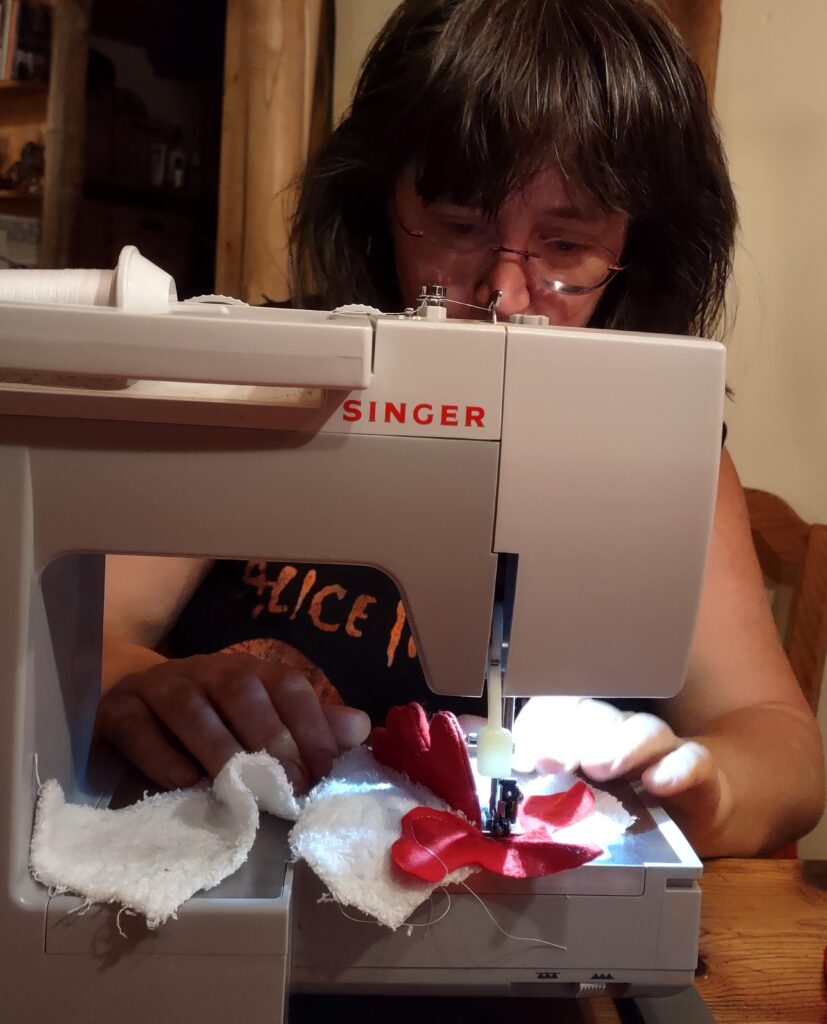
Anyway, I made him a body out of old terrycloth and felt, and a bit of armature wire for a basic spine and rib structure; broken sate skewers sewn into the wings, too. I first made his wattle out of felt, but it looked awful, so ended up making a more floppy one of red velvet with rocks inside for that floppy weight a rooster's long wattle can have. He has rocks in his head, too, so it can dangle down, limply. Appropriately for a dead guy. If you know, you know. The wings had to dangle, too, when he's turned upside down and hung by a foot.
Sewing the rooster's head out of terrycloth and felt.
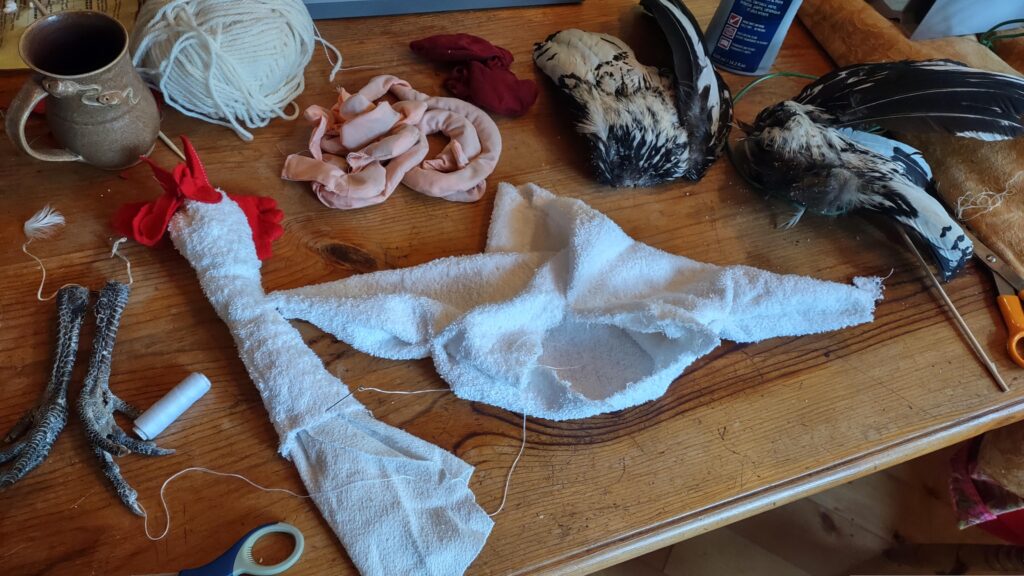
Another part of dead roosters–especially those that may have been killed by a fox–is the protrusion of some guts. You know if you've cleaned a rooster, you reach in and grab the gizzard, and then the liver and intestines come out along with it. I didn't make this guy a gizzard, but I did make him some intestines and a liver. And I filled the intestines with lentils to make them dangle properly. Well, I hope he enjoyed his meal.
Various rooster parts in progress, waiting to come together.
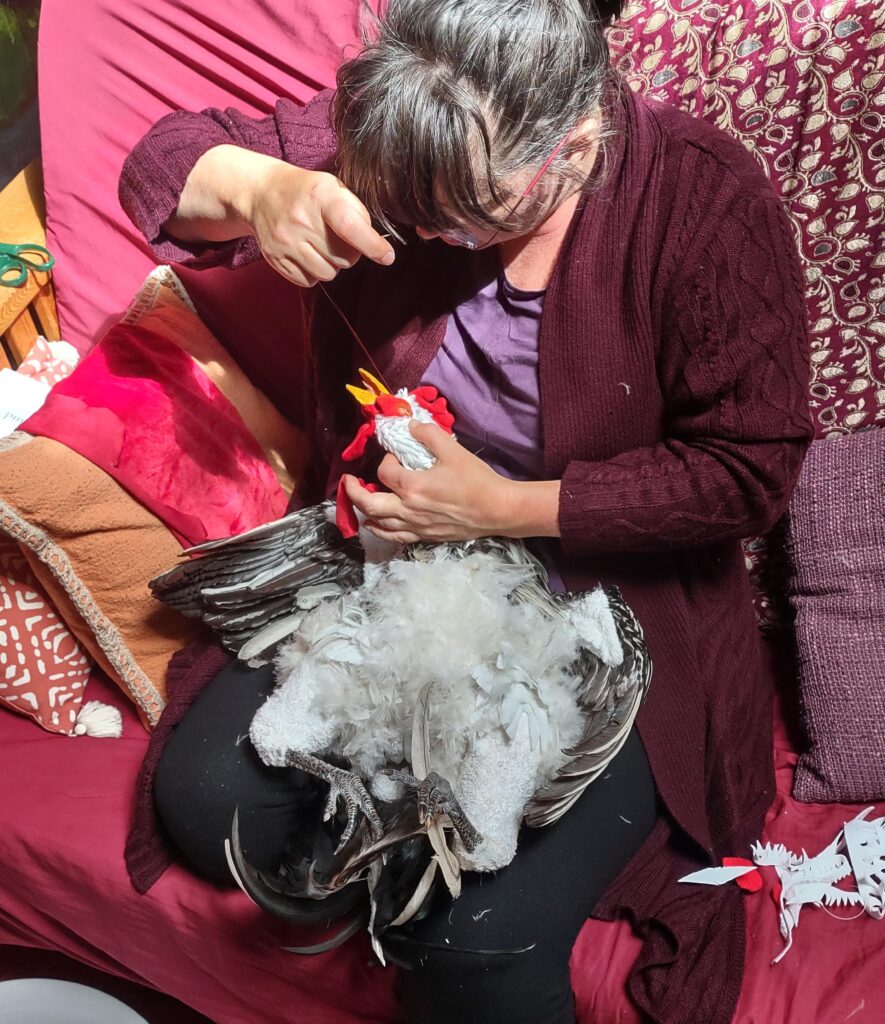
Then I had to sew on his feet and wing parts, and many many many feathers, both real and made of felt. I also painted his face and beak. Way better.
Sewing his hundreds of tiny white felt feathers on!
So… Here's my dead rooster prop! I hope you like him. I put up a video on my MakerTube if you'd like to see the finished puppet:
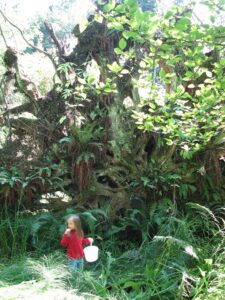
Taliesin picking berries in front of a root tower.
Once I lost my son in the forest. We were heading home through ferns taller than his three-year-old self, he carrying a harvest of licorice ferns and I carrying his baby sister and some oyster mushrooms. He followed along behind me, and when I turned around, he was gone. I called repeatedly. I retraced my steps. I gripped by baby girl to my chest and started running, panicking, and– there he was, nestled into a sword fern, chewing on a piece of licorice fern root. He looked up blandly at my stricken face and said "I'm just havin' some licorice root." His trance-like state may have been induced by the well-known calming medicine of licorice fern, or it may have been just his joyful state of mind after a couple of hours spent wandering the forest with his mother and sister.
My kids and I spent part of most days of their childhood out in the forest, exploring. That's what I did as a mother because it's what I knew to do from my own childhood, spent here in this same little west coast paradise. When my head hurts, I go outside. Maybe I chew an alder leaf like the wild aspirin that it is; maybe I just lift my face to the fresh air, sun or rain. When my heart hurts, I lie in the moss and let it soak up my tears. Licorice fern soothes me; so does the feeling of bark, or the creek water between my toes. When I'm hungry, I eat beans off the vine on my porch, or berries and other treats from the woods; when I'm hungry for adventure I go exploring in my medicine forest. I made up that word. Medicine Forest. It's like a permaculture food forest, but with emphasis on its healing power. My parents didn't purposely give me a medicine forest, but they did give it to me, and I'm passing it on to my children. Let me explain.
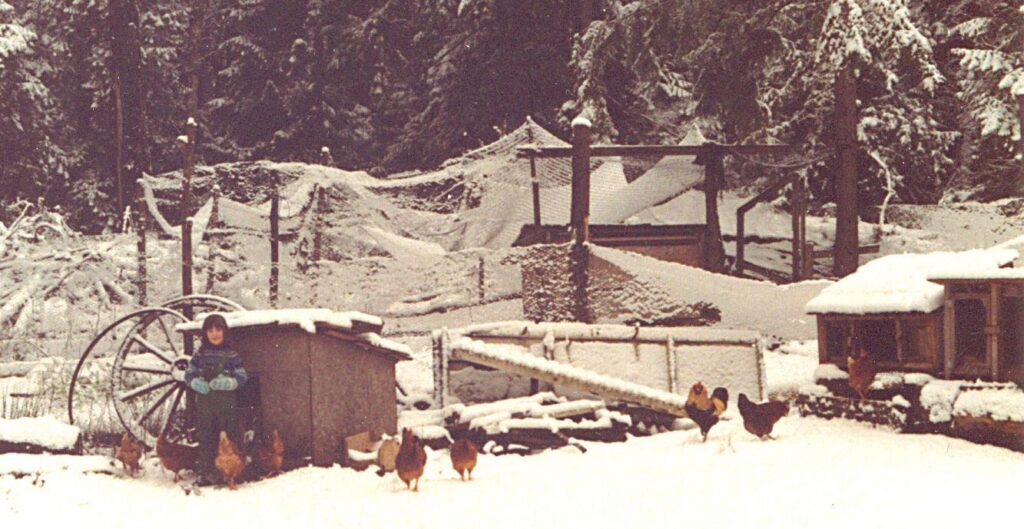
That's me with our chickens in the early 1980's, rabbit hutches on the right, and winter-covered veggie garden, behind.
I grew up in a pretty typical single family house – a modified double-wide mobile home, actually – on a five-acre piece of land that my parents purchased in 1980. This land was forest when they bought it. We used to come up here and have a picnic on the slope they hoped would one day be their building site. They let my brother and me free-range all over this place, climbing trees, damming creeks, digging great big holes and picking and using whatever plants we felt like, as they slowly cleared the land and built up what is now a developed property. We raised chickens, meat rabbits, and pigs (but only once because the experience was too heartbreaking for all of us to repeat). My parents grew food crops and allowed us to plant our own experimental gardens, while also insisting that we should help with the family food operations. My brother and I were never forced to kill or butcher animals, but because our parents nurtured our curiosity, we both knew how to clean a rabbit or chicken by the time we were twelve, and by the time we were fifteen we could cook a good family meal from the foods we'd grown or wildcrafted. We didn't even know the word wildcraft, though. We were just "picking nettles", or "finding a mushroom."
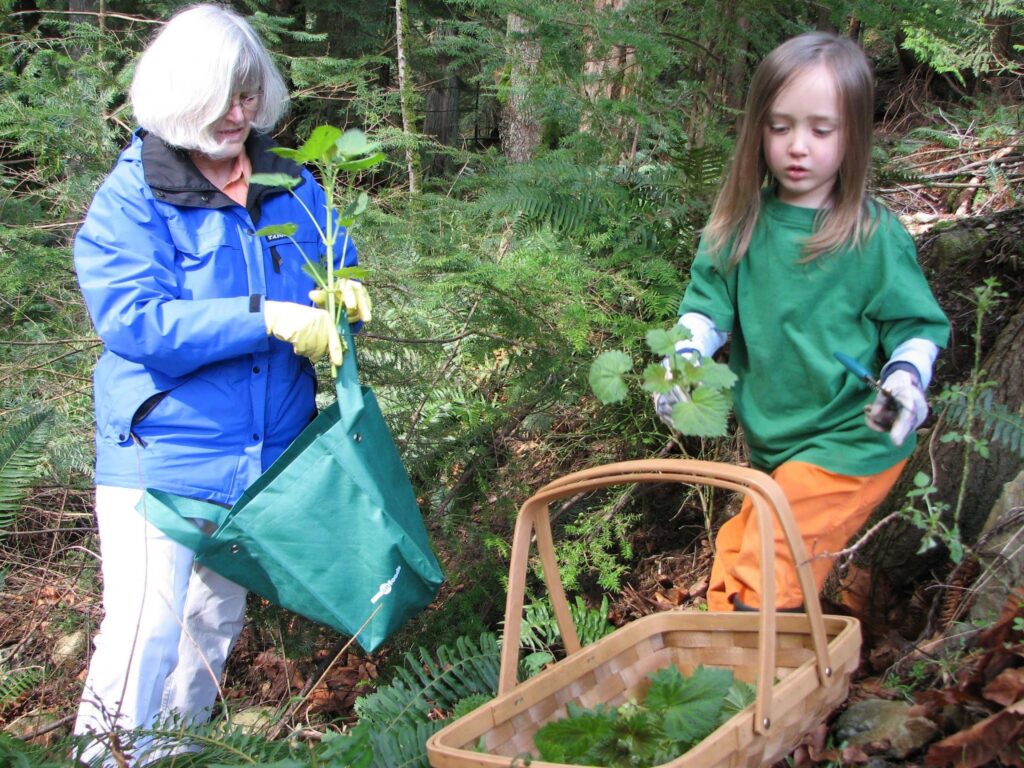
My son helping my mother pick nettles in the late 2000's.
Living in and with the forest our parents were busy turning into a home was just "life". We could pick indigenous trailing blackberries from the hillside, invasive Himalayan blackberries from the place Pappa was trying to get them out of the creek, or cultivated boysenberries from Mum's garden. Same difference. They all make good pie, if you don't eat them all before getting them home. And whether they make it home or not, your belly is full with the food, your heart is full of the joy, and your mind is full of knowing every detail of your home. That's a medicine forest. It's a place where everything is living and growing together — humans included. It's a place you've grown so connected to that just living there heals you from the inside out.
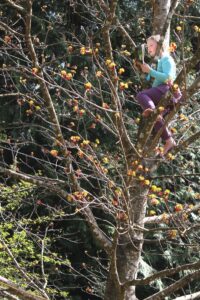
My daughter reading in a tree she knows every inch of.
Somehow through my own teaching and parenting over the years I have come to recognize that, just like the best learning happens when we're inspired by connections to our own experience, the best living happens when we're connected to everything around us. Think of it this way: you care much more about your own backyard than someone else's. You have a lot more interest in your own little potted plant than in the weed at the edge of the pavement, or some tree in a forest far away. So somebody teaching you about a baobab tree might have a bit of a tough job keeping your interest. But what if that tree was yours? My friend went to Africa and really got to know baobab trees – and they became hers. When we connect personally with things, they matter, and mattering strengthens our neural pathways. That's great for learning, but how does this have to do with my medicine forest? Well, this place matters to me. It matters so much that I've spent about thirty years of my life exploring here, both as a child and now with my own now-grown children. I know exactly which part of which slope of which creek has the best clay for sculpting, and which part will still have a pool of water and some desperately-hungry trout in August. I know where the elusive white slugs live. I know how berries' flavours change with the weather and with the time of day. This deep understanding of my little wilderness is my connection, and it's why this place is my medicine.
On top of being important to my own health, my experience of exploring this place has made me resourceful and resilient. We all learn more from observing the people around us than from being taught conventionally, and I learned from watching my parents develop this land; their need to be resourceful when we had no electricity, no toilet, or no income. I learned from watching them not just survive here, but keep working even in the face of failure to find joy and wellness in whatever this land and life had to offer. The moss is not my weeping pillow because I'm an idyllic child from a book about fairies; it's my pillow because sometimes I was just plain too sad, as a child, and the moss was what I found to comfort me. My kids didn't harvest nettles for brownie points or allowance; they donned gloves and harvested them just because that's what we do for Easter. They got stung and they complained to me, but they also delighted in testing their brawn by picking them bare-fingered or by eating them raw. They were building resilience, just like I once did. This year they both came home for Easter and actually wanted to go nettle picking. They want to reconnect to and eat food from their own ecology. We're in this ecosystem for better and worse and every day that falls in between. Like the plants, we'll thrive or die as part of this, so we're doing our best to thrive.
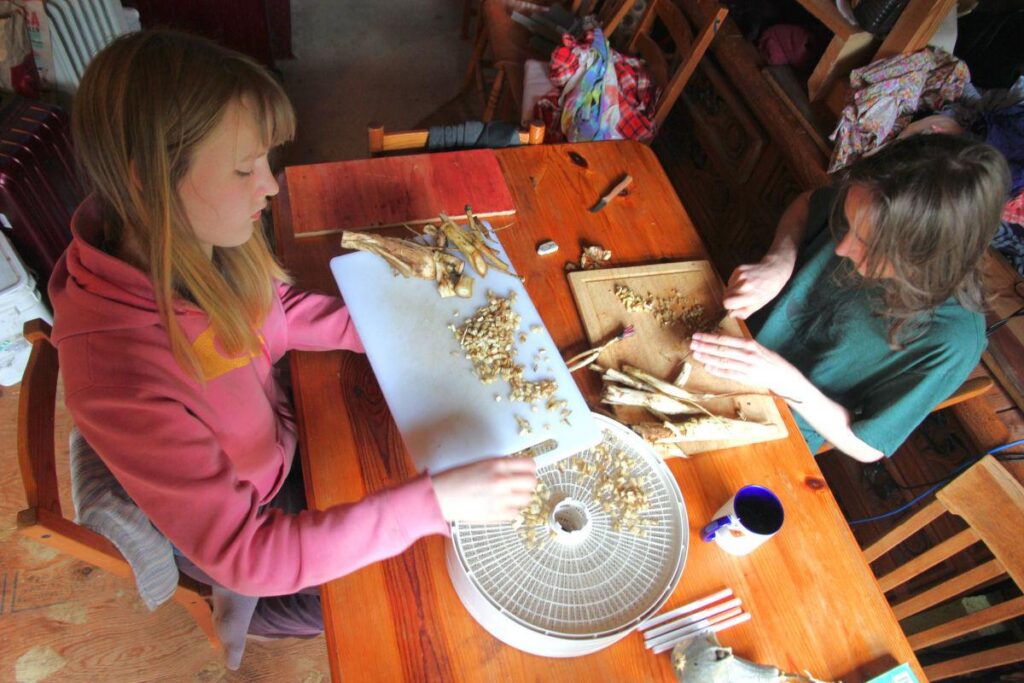
My kids at fifteen and eighteen processing wild burdock root for tea.
The business of gardening and developing the physical ecosystem is nowhere near as idyllic as I imagine it sounds. There are brutal realities in nature that hurt like hell. Our crops fail, our chickens get sick and I have to put them down; sometimes we fight and resent each other's impact in the ecosystem. Sometimes money is short, time runs out, and family or world tragedy makes us doubt we can succeed. But experiencing these things, feeling them and accepting them is part of the whole picture. My medicine forest is the ecological basket that holds our family, and the love and knowledge we cultivate here, among the weeds and the crops and the chickens, the weather and the water and our own bodies living. When I leave this place, my medicine forest is carried in the knowledge of my body and mind, to nourish and grow with other ecosystems. It's a conscious choice I make to see my surroundings and live in health with them, as a part of them.
In a monoculture garden, one invasion of a particularly voracious insect can wipe out a whole crop, with nothing remaining to re-seed. The earth itself becomes a barren place, unable to nurture new-fallen seeds without significant help from humans. In a food forest, insects may devour a plant here or there, but the diversity of the community will discourage any one plant or insect from taking over, and thus ensure that enough remains to keep the community thriving. The dead plants along with the dead insects and the droppings of all those who foraged in the forest will feed the earth, ensuring that all the fallen seeds have at least a chance to grow. In fact, the richness of the soil even means the earth will hold more water, making everything thrive more easily.
My parents have asked me how I came to know all these things, and I said "from you", because it was their willingness to let me explore that gave me the gift of knowing my ecosystem. It was their willingness to let me grow my own experimental gardens, and now to rent us a piece of their land and still let me grow my own experimental gardens that gave me the gift of my medicine forest. Sometimes they don't like the look of my unkempt yard, my son's experimental tree fort project, or the weed piles I leave laying around. But they let me and their grandchildren keep living and exploring here, because they're watching the growth of our medicine forest. And sometimes – just once in a long while – we discover things we can teach them, too. Explorative parenting is like that. It's looking at the whole family as a forest instead of one plant seeding another. Our family is like a forest of possibility, where everybody lives in community, exploring and discovering and balancing and sharing, as we all put our roots further and further down, and our branches further and further to the sky.
Woman Story: Untitled 7 Artist: Emily van Lidth de Jeude
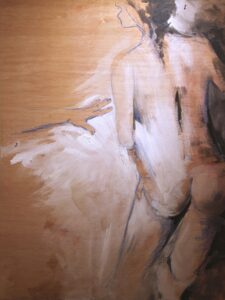
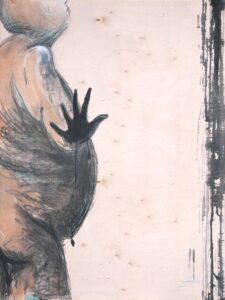
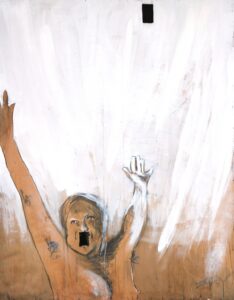
I once installed a show called Woman Story here in my home community. The core of Woman Story is a series of 24 portraits of bald, naked women drawn with graphite, crayon and acrylic wash onto reclaimed panels from my own home. They're actively expressing a complex array of experiences that inform woman-ness, but anonymously, because each of our stories might belong to any one of us.
At some point, a local I know distantly ‒ a retired judge and art collector ‒ came in to the gallery and sat down on the bench near the door. He stayed for about forty minutes. I eventually went to sit with him, and asked him what he thought of the show.
"Oh, I'm not here for the show." He answered. "I'm waiting for my ride."
"Ah. I see." What was I supposed to say next?
But he continued. "Is this your work?" He asked, bluntly.
"Yes."
"Well it's awful. An insult to women."
Woman Story: Untitled 18 Artist: Emily van Lidth de Jeude
I was completely shocked, but also curious, and asked, "Why do you feel that way?"
"They're bald," he answered, point blank. "Why would you be so disrespectful to women?"
"I drew them without hair in order to make them anonymous; to remove an identifier, and so their hairstyle doesn't speak to any potential prejudice or assumptions we make about people's hairstyle choices. But also to make their stories about everywoman."
He never once looked at me while he spoke. "They look like the bodies that came out of Buchenwald," he said. And then he was silent. And soon afterwards, his ride came.
Obviously, I could see his point. And, despite feeling regretful about possibly triggering trauma in people (my family definitely also carries trauma from WWII), I feel like maybe it's not a bad thing to have made this connection in my work. Because in war, women are also casualties. Women are also contributing to and leading both the offensive and the underground support systems. Women did come out of Buchenwald, dead. And women are found in shallow graves, abandoned vehicles, hospitals and landfills all over this world. It truly is awful, and I guess that's why I feel it needs to be told.
Here we are on the brink (or over the brink?) of WWIII, at the same time as we're experiencing a rise in femicide, exploitation, abuse and violence against women. It's not a coincidence. In our greed-based apathy we have allowed a very small handful of men to own and control our world. Most obviously, that's not acceptable! And what do strong women do when a situation is not acceptable? We make change. Women all over the world are protecting the vulnerable and building systems for survival, protection, and recovery, even as the war is only getting started.
Generally speaking, women are fully half of the world's population that knows from a deep generational place what exploitation, vulnerability and violence looks like ‒ and how to both survive and heal it. We're working throughout our communities, already, to build peace and resilience; to educate, support, and empower. Even to empower the women who foolishly allowed their fear to make them hate. We're working to bring and keep people together.
Woman Story: Untitled 16 Artist: Emily van Lidth de Jeude
We cannot rest. As born survivors, it's our strength and duty to not become bald bodies in concentration camps, mass graves, or landfills; to make sure our sisters, brothers, and children are also safe. To de-escalate fear and reactionary hatred before it harms us. A lot of us are already experienced with this. The rest of us can learn. We have to deal with our own crap and become our best selves, in order to show up for our world. And we have to start now.
There's work to do! I'm not talking about just directly protecting and defending, although there's a need for that, as well. I'm talking about building the world we need, so that it displaces the world of hate and greed that is being fed right now. And there are infinite ways we can do this. Some of us are out putting our bodies and voices on the line; putting ourselves in danger to inform and advocate. Some are donating money, time or skills to organizations that amplify our voices and work. Some of us are building networks and repositories for the protection of people, environment, information, culture, and as a whole, the future of our world. Some are educating and supporting our communities, so that we can have and maintain peace. And all of us, no matter what our lives look like or how limited we feel, can make conscious choices in every act we make to defy and devalue hatred, to promote love and peace, and to pull away from systems, corporations and ideologies that promote hatred.
Even when we feel weak, we can be strong. We are all challenged; women and men, too. That doesn't mean we're beaten. A challenge is, by definition, an opportunity to overcome. That's not just where we're at right now; it's who we are.
We are strong. We are capable. We are determined. We can do this.
The idea of homesteading or growing food is enjoying some increased popularity at the moment, supposedly because it’s rewarding, both from a human-connection standpoint as well as ethically/morally, with regards to climate change and ecological preservation. Also, of course, once you’ve become accustomed to the deliciousness of homegrown fresh foods, it can be hard to return to the comparatively dull stuff from grocery stores that has sat waiting for ages, and usually was farmed extractively. That stuff is empty of nutrients and joy! And with the rise of fascism (and fascist destruction of trade, farming, research and prosperity), I think we’ll soon have many more reasons to grow and preserve our own foods.
I grew up in a homesteading family, so it wasn't difficult for me to tumble back into this rewarding life, as an adult with children. But, especially for people who are new to it, I know homesteading (or even just growing a little food) can seem really, really daunting. I keep seeing videos of homesteaders and food farmers “giving up”–either because they faced too many disappointments, or because other adventures called to them. If you’re one of those people who wants to grow food but has been put off by all the discouraging news out there, I’m writing this for you! I want to help you avoid some of the most common pitfalls, and find some serious hope and joy from growing food. The thing is, many of those homestead failures didn’t have to be failures. These people lacked a few of the basic ingredients for homesteading. I’ll talk about those ingredients in a minute. But first… the biggest deterrent to people growing food is lack of land, time or money. So let’s deal with those first.
I have no land! OK. So you’re like most people. That’s OK! You can still grow food. The most obvious solution is to grow plants on a balcony or window. You can totally buy some expensive little gadgets like grow lights to help you with this, but it’s not even necessary. Just choose plants that don’t need a lot of light or space. The simplest is sprouts. Given two square feet of counter space, you can grow a huge variety of incredibly nutritious sprouts.
Easiest: Bean Sprouts Buy the cheapest beans you want (whatever type you like but mung beans grow fast, so are great starters!). Soak a cup (or two if you have a big family) in at least twice as much water, overnight. Then strain them, rinse them, and spread them onto a baking tray lined with a woven cotton dish cloth (or whatever piece of fabric). Rinse them once or twice a day.
When you see them start to split, or little tiny points appear, they’re ready to eat! You can let them go a bit longer if you want to have a bit of a crunchy sprout. They’ll be delicious cooked like regular beans (and much more easily digestible), but can also be marinated for bean salad, or eaten fresh.
Almost as Easy: Pea or Sunflower Shoots Buy whole peas or sunflower seeds (for planting; not packaged for eating!) Soak them overnight in a bowl of water, and then lay them on a planting tray full of soil. They barely need any soil, and can literally be dumped in a heap, or in dense rows. Put the tray on a windowsill, as they do need some light when they green up.
When it’s mild weather, they can also be planted outside, in this way. Simply wait for them to shoot up about 4-6 inches, and then snip them off with scissors. The peas will actually continue to grow and can be harvested a few more times.
When they’re spent, throw the remaining roots and stubs into your compost. The peas especially are amazing nitrogen fixers, and can even just be dug into the soil to feed whatever you grow there, next.
Alfalfa Sprouts(or clover, fenugreek, mustard, etc.) This takes a tiny bit more time every day than the other two, but they’re SO delicious. I do recommend buying seeds intended for sprouting, here.
Prepare a wide-mouth canning jar (at least a pint or a litre or so), by cutting a piece of sturdy mesh that can be placed over the top and held in place by a canning ring. You can buy sprouting-screens for such jars, but it’s totally unnecessary.
Put 1 to 2 tbsp of seeds in the bottom of the jar, add some water, then the mesh and ring on top, and allow to soak for at least a few hours, or overnight. Then strain the water out through the mesh. Fill with fresh water, swirl around, and strain again. Leave the jar sitting open side down in a shallow bowl or on a (clean) dish rack. The seeds should be sitting against the mesh in the bottom corner of the jar, but not fully covering it. Repeat this rinse-swirl-strain process three times a day until your sprouts are starting to green up (tiny leaves will be developing at the end of the long stems). Then rinse and enjoy them!
Other than Sprouts: Small and Borrowed Spaces So, obviously, sprouts are not the only thing you can grow on a counter. Buy or make planters out of whatever containers you like, and experiment away! Lots of people grow herbs inside, but veggies are possible too!
And if you have a balcony, even more is possible. I used to grow all kinds of veggies on my 3x8ft balcony in Vancouver, Canada. I had a screen of beans on one side (for shade as well as harvesting), squash growing along the railing (I had to hang little hammocks to hold the fruits as they got heavy), all kinds of herbs and heat-loving veggies, as well as a couple of tomatoes, and a 1x1m mini-lawn for my cats to roll on. We were very happy.
Of course, if you don’t have a balcony or windowsill at all, or just would like to grow much more than that, you may be able to work somebody else’s land. This relates to community-building, which I’ll talk about in a bit, for obvious reasons. But an increasing number of people are willing to allow others to grow food in their otherwise-unused yards, especially if they also get to enjoy the produce. Community gardens are another such non-homeowner option.
🌱
I have no time! This is such an unfortunate reality for the majority, these days. Especially for those with kids or low-paying multi-jobs. Obviously, there are some things you can do (like sprouts, above) that can still be do-able, given enough forethought (and maybe a reminder to rinse and eat them!) But if you want to grow more than just sprouts, a mind-shift might be necessary.
For us, the pandemic gave us a reason to let go of kids’ activities and start a proper garden (after a few years of development, our kids have now moved out, and we grow most of our own food on less than 1/4 acre). A garden (or balcony planters) can take as little as a handful of hours per week, in the busiest growing season. And obviously, the more you grow, the more land you utilize, and the more variety you grow, the more time you’ll need. But I do have a few time-saving ideas:
No-Till Regenerative Gardening I won’t go into detail, here, but I’d highly recommend watching a few YouTube/etc. videos about it. This is what we’ve been doing. At it’s core, it’s about feeding the soil and working with the ecology you have, instead of stripping it. This involves allowing some weeds to grow where they want, allowing the soil layers to remain in-tact by not ploughing, tilling, or weeding too aggressively, and watching which plants grow best where, to allow the garden to evolve in the way that works best for the plants you’re trying to grow. A lot of “allowing.” But… the more we “allow” things to grow as they need to, the less work we have to do in fighting them.
Grow Fruit Trees! Fruit trees do need to be pruned at least once a year (twice can be better for some), and they’d benefit from some thoughtful planting and maintenance of the ground around them, but on the whole they can produce a lot of food for very little effort. The same is true of many perennial plants, including berry shrubs, asparagus, Jerusalem artichoke, and many others.
Be a Lazy Gardener Some things really do need to be done, in the garden: adding compost in early spring, seeding (maybe even starting seeds indoors if you’re in a changeable climate place like I am), and pulling out weeds and veggies that outcompete others. But a pristine and orderly garden is not even a happy garden! Plants LOVE to be mixed up. Most also love to be left alone to grow! Gardening may not even take as much time as you think it will.
Call in the Insects Insects are generous garden helpers. They pollinate, of course, but when we ensure a great diversity of insects (and insect species), they balance their own populations, keeping invading hordes of veggie-demolishing insects to a minimum. The greater diversity of insects we have, the fewer issues we’ll have from destructive insects. And they work for free! Well… almost. You have to pay them with flowers. Add a bunch of different types of flowers to attract insects. Clumps of marigolds, asters, violets, sweet peas—even perennials like rhododendrons and other flowering shrubs if that suits your fancy! Whatever is easy to grow, and makes you happy. Clovers are not only excellent insect-attractors, but also, being related to peas and beans, put much-needed nitrogen into the soil. They do take a bit of pulling-back, though, as they can easily grow into a bed and take over. I grow low-growing clovers between raised beds, and mulch the extras into my compost, as well.
Plant a No-Mow Lawn Mowing lawns is not only a scourge on our air quality, but it's also a massive waste of time! We replaced our lawn with a low-growing no-mow lawn of sedges, small daisies and other flowers, and low-growing pink clovers. I never mow, anymore, and my lawn stays lush and green all summer!
Plant Thoughtfully Check out useful companion plants for the veggies you choose, so that everything you grow can thrive. Always research, to understand the needs of your plants and the kind of plant community they enjoy. This will also help you diversify and create a garden that sustains itself, with little management needed from you.
Share Your Yard If you have a yard, and a desire to eat homegrown food, but no time to grow it, consider allowing someone else to garden in your yard! Set some ground-rules, especially with regard to bylaws, invasive plants, and access, but then give as much freedom as possible to the person or people using your land. Trust them to make good decisions, and put your effort into building a relationship with them. You’re building a community. 💚
🌱
I Have No Money! So… this is an increasing majority of people. And probably the hardest obstacle to overcome. I’ve been passionate about growing at least a little of my own food since I left home at 18, so I have learned a few basic cost-saving tricks along the way.
Save seeds A LOT of veggies are just plain easy to save seeds from. The biggest issue you’ll have is cross-pollination, so plant just one type of each thing every year (like one type of bean, one type of pea, one type of lettuce, etc. etc.) That will save you accidentally creating useless hybrids. In most climates, the most commonly-grown veggies (and tomatoes and cucumbers and squashes) are easy to save seeds from. YouTube, again, will help you out with the specifics.
Don’t waste money! There’s a massive industry out there making money off new gardeners who don’t know there are cheaper options. From grow-towers to veggie-starts to chemical fertilizers, there is an infinite list of things you don’t need. What you really do need is this:
Good Soil: You can buy it bagged if you’re growing indoors or on a balcony, but if you have land to grow on, get it delivered in bulk, or better yet, amend the soil you already have.
Compost: Buy a little, the first year, and start making your own (unless you’re composting inside, a good old compost heap, caged to keep out rodents, is your best bet—feed it constantly!)
Mulch to Keep Down Weeds: newspapers for small spaces, or arborists’ chips for larger plots. See https://getchipdrop.com/
Seeds: share with your community! Look for seed libraries, and talk to your neighbours. You don’t need to buy from seed growers, but if you do, just a few is enough.
Gloves: (Only if you’re dealing with weeds like blackberries.)
A Shovel: A small trowel is fine unless you have a large plot; then you’ll also want a spade.
Pots: Whether big pots for balcony growing or smaller pots and trays for windowsill growing or seed-starting, these should be free. There are SO many people throwing away their used nursery pots every year. Ask your gardening neighbours, or check your local recycling depot.
Garden in Community The more people share the costs and the labour, the easier and cheaper gardening becomes. Not to mention more enjoyable, more fruitful, and with bigger harvests, since everyone learns from each other.
🌱
Ingredients for Success OK, so I mentioned the basic ingredients for happy homesteading. I meant that in the same way the main ingredient in Mama’s cornbread is love. It really is—it was for my Mama, and now I’m the Mama I know what that means!! And it’s the same with gardening. The ingredients are love, commitment, and patience. Just like raising children! And baking. 🙂
I’m truly not just being poetic. Here’s what I mean:
Love You have to LOVE this. Deeply. If you’re growing food because you think you should, or because someone else told you to, it’s going to be a slog. But if you have good reasons for doing it, it veers into the realm of love, and then you’ll weather all the storms. Some good reasons I and other successful gardeners have are because it brings us enormous joy, because it gives us wonderful food, and because it makes us feel we’re doing something to improve our world. What is your reason to love growing food? Maybe you don’t have one yet. You can start with just purpose, and given commitment and patience, love will grow.
Commitment It’s not going to be a breeze. Growing food is a constant learning curve. Especially if you’re going the regenerative route, but shopping at stores that constantly try to sell you harmful industrial-farming products. You’ll use them and they’ll damage your soil or set back your progress and you’ll lose faith. And even if you really commit to regenerative farming, you’re going to have failures, because that’s simply how ecology works. It’s a balance that’s eked from an infinite complex diversity and many failures. But we commit to that—the complex diversity—and we weather the storms, and find solutions, and really… we grow into it.
Look at the word commit. It begins with bring together (co). Like community, coworker, etc. Commitment is about coming together not only with other people, but also with the task at hand. And in this case, that’s creating and nurturing a harmonious ecology that will produce food for us to eat. In other words, it’s about making ourselves co-participants in our ecology. That realization, alone, will make gardening easier and more successful. It’s not a project you’re overseeing; it’s a community of plants, insects, minerals, and weather that you’re a part of.
Oh… and quitting? You can’t quit. You’re not co- anything, if you quit. So grow a pair of potatoes and keep at it.
Patience It will take years to have any kind of garden feeling whole. That’s because it has to go through many cycles (a year is a cycle) just for the soil nutrients to find an equilibrium, and from that basis, the diverse ecology of the plants, insects and animals. And it also just takes a few seasons for you to get to know all your co-ecosystem-inhabitants.
I’ve seen multiple homesteading “influencers” give up after a year or two. That’s like putting your toes into the opening of a shoe and declaring it doesn’t fit. No. You have to put it on, lace it up, and then walk around in it. And even then, you probably have to wear it for a few weeks or months before it really feels great. It’s the same with gardening. So… find a reason to love it, commit to it, and then be patient. And when you struggle, go find regenerative solutions for the ecosystem you’re growing into.
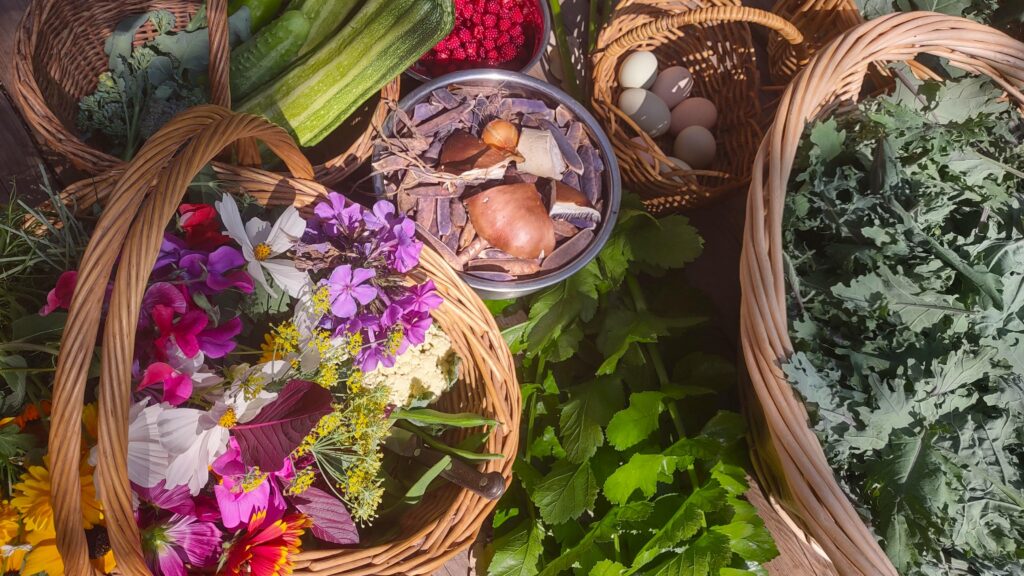
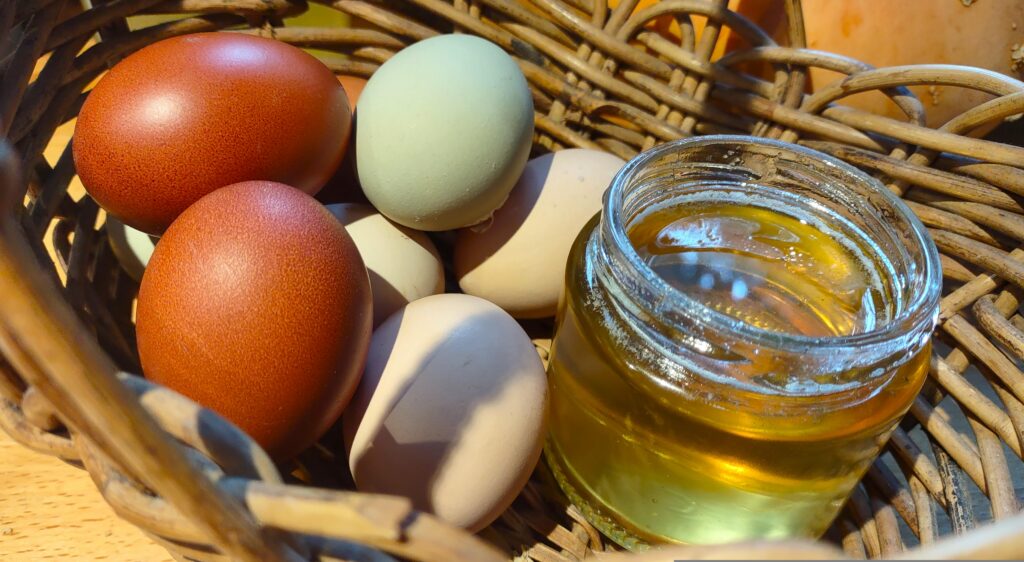
We had a beautiful moment, yesterday, when two young women who grew up next door to us brought us a jar of honey in trade for our chickens' eggs. They're just visiting their parents' house, as they both moved out years ago, now, and it was lovely to catch up a bit, and chat about what flowers the bees were drinking from.
Here's how it works: Both my and these young women's parents bought land, when it was affordable, here. Our parents grow and tend to a plethora of flowers, fruit trees and vegetables. Their parents keep bees that drink from the flowers in both of our yards (and pollinate the veggies and fruits we grow, as well!) and we keep chickens, who not only fertilize our veggie garden, but provide eggs and meat that we can trade for this gorgeous honey… made partially from the nectar of our own flowers. The neighbours on the other side of us grow corn that for some reason we can't grow just a couple hundred feet to the west, so we delight in fresh corn, in August, in addition to all the crops we grow ourselves, and buy from others in the neighbourhood. All of us have to give away zucchini and other too-plentiful crops to the broader community, as well. And we teach people how to do what we do, because the more people do this, the richer we'll all be.
It seems really too idyllic to be true, but this is the dream my parents had in the seventies, and through three generations we've now managed to carry it on, to some extent. And it's the foundation of what it truly means to buy local.
Now here we are clenching our teeth, watching a bunch of fascists try to take over a rather large chunk of the world, munching through Hitler's playbook one vile action at a time. Whether you're here or there, or whether you're repulsed or scared by their actions, eating local is a good idea. In fact, eating local has always been a good idea, because it's sustainable. And now maybe the trade war or the scarcity caused by fascists kicking a large percentage of farm workers out of their countries will push more people to eat local, too. I hate to think there might be a silver-lining to all of this, but also I'd rather build that silver lining than only wither away amongst the negatives. I think maybe that silver lining is bigger than food, too. I think now we can we use our frantic flee from fascism as a leg-up on the way to save humanity from pernicious greed.
And it doesn't matter what country we live in, either. All of us are going to be affected by the trade-war, and all are going to be affected by food and labour shortages. But we don't have to suffer. Yesterday I saw someone asking where to get fresh local produce in winter. Well… we live up north, so we probably can't, unless it's from a greenhouse. So the question is not so much how to simply buy locally, but how to change our diets and expectations in order to buy locally.
Me? I only eat fresh corn in the summer. That's when it's abundant, here. And frankly, it tastes a lot better than whatever well-travelled corn is available in the stores in other seasons. Maybe I freeze some of my neighbour's corn in the summer, and can add it to a nice Spanish rice or pot of chili, right now. Because it's winter. I'm eating a lot of veggies, legumes, fruits and meats that I dried or froze last summer, along with some fresh greens that I'm growing on my windowsill and under a grow-light (pea-shoots, alfalfa sprouts, and a few lettuces). In fact, even if you don't store food yourself, the best-tasting food in the grocery store during a northern winter was flash-frozen fresh from local farms, last summer. A bag of frozen broccoli is much more delicious than those slightly grey imported broccolis in the fresh produce section.
It definitely takes a little more planning to eat what's locally grown and seasonally available, instead of just going for fresh avocados, tomatoes and apples, year-round. But I like a small challenge, and to be honest, it's not much of a challenge after you've done it for a year or two, and mostly… it's so enjoyable! That fresh corn that I only eat in summer? It's not only more delicious because it's fresh and comes from my smiling neighbours' hands; it's also more delicious because we only eat it during one month of the year! It's like Christmas treats: by the time we get back around to Christmas, we're craving that stuff! Scarcity makes things delicious.
But what about expense; affordability? Have you seen the prices at the local farmers' market?! This kind of seasonal local eating is only for the privileged, right? Well yes, to some degree I can see that line of thinking. I have a huge privilege in being able to farm on the land I rent, but my family is also on the lower end of the middle class, and we've managed to make these choices by prioritizing where we spend our money. Instead of taking vacations, we built a garden; instead of owning a home, we rent. We cut expenses wherever we can, and spend a little more on the things we feel matter most: a healthy home and meaningful time with our children. We spend more than most people on ethical, partly-foraged meat, because raising our own chickens, buying neighbours' lambs, local, sustainably-caught seafood, and local grass-fed beef and dairy is very expensive! So we minimize our consumption of it, and we supplement with legumes and pulses. I buy some dried and grow/dry some myself, and then I just soak them overnight, move them to a tray for sprouting, and cook them in a day or two, whenever I feel like it. We pay pennies per cup of food, this way. Unless we add expensive cheese, which… I confess happens more than it should!
But boxed cereals, cookies, prepared foods; even canned foods–these I consider a waste of money. Our culture spends a lot on processed foods that don't nourish us, and deplete not only our finances but also our land and cultural heritage. Learning to cook from scratch is a huge benefit not only to our health, but also to our pocketbooks. It's true that it takes more time, but for our family this became quality time. By the time my kids moved out they were fully capable of growing food and cooking from scratch. I can't imagine a more important skill, but it's also a point of bonding for us, as we still get together to make and share meals.
How about a useful list. I'm in the Pacific Northwest, and can only talk about my own experience, really. So here it is, a list of common locally-produced foods from my region. I'd be happy to hear yours!
Fruits:
Spring: blossoms! (OK it's not a fruit but you can see my reasoning…)
Summer: all kinds of berries, grapes, and stone-fruits
Late summer: figs, kiwis, more berries, tomatoes
Autumn: apples, pears, quinces, tomatoes
Early winter: persimmons,
Winter: stored apples (still fresh), jams, canned fruits, frozen fruits, and dried fruits
Greens:
Spring: Pea shoots, edible-pod peas, spinach, lettuces, overwintered kale and broccoli, wild greens
Summer: Lettuce, Chard, kale, cabbages, broccoli, green beans, shelled green peas, celery
Autumn: same as summer, plus spinach
Winter: some fresh kale, stored cabbages, frozen or dried greens, and fresh sprouts/shoots
Summer: turnips, celeriac, carrots, beets, cauliflower, new potatoes, peppers, eggplants, artichokes, sunchokes, zucchini and other summer squashes
Autumn: same as summer, plus potatoes, winter squashes
Winter: seaweeds, stored potatoes, carrots, sunchokes and squashes, canned or frozen other things, dried seaweeds, peas, beans and lentils
Grains:
Autumn: most of our local grains are harvested in late summer or autumn, and of course they store on our shelves all year, after that. We have quite a few available in our area, despite not being the prairie: oats, barley, wheat, rye, corn, buckwheat and sorghum are what I'm aware of.
Nuts and seeds:
Autumn: mainly hazelnuts (indigenous, here!), but also some walnuts, hemp seeds, pine nuts, beechnuts, and chestnuts.
Animal products: (not by season because some can vary, and most can also be stored frozen)
meat: fish, invertebrates, poultry, larger birds, rodents, lamb, pig, and beef. I believe it's more sustainable to only eat locally and ethically-grown meat, and to eat it only rarely, supplementing with eggs, legumes and pulses, as well.
eggs: although many non-industrially-farmed chickens produce fewer eggs in the winter, it does depend on the breed and the conditions, so it's absolutely possible to have fresh eggs all year round.
dairy: we have lots of local sustainable small dairies here, producing cow, goat, and sheep products!
Sweeteners: (mostly made in autumn; stored all year)
maple syrup, barley syrup, honey, corn syrup, and beet sugar.
apples, grapes, figs
Salt, spices, etc.:
we do actually have sea salt produced on the west coast!
many herbs, peppers, seeds, spices, etc. are grown here and preserved before winter.
seaweeds, kelps
What to cook! This is just some of my favourites:
Spring: all the flowery salads, dairy, eggs, and bright fresh greens! Also legume/pea salads, wild-green and egg sandwiches.
Summer: (Do I have to say this, even?) ABUNDANCE of fresh and grilled foods!!! We even make our own ice cream by putting frozen fruit, honey and local cream into the food processor!
Autumn: pies (fruit and savoury), hearty soups, hot potato and grain dishes.
Winter: chili, stews, & casseroles made with dried and frozen produce, baked desserts of grains and dried fruits,
I'm getting hungry writing this list. Yum. Every region of this earth has its own delicious range of available nutritious foods in every season. We can not only survive but absolutely thrive by embracing the goodness of the places we call home. Tomorrow, I'm going to make a fruit-filled bread with my eggs, honey, local butter, home-dried apples, and some locally-grown oats I can grind into flour using my handy little mill. 💛
"Escaping the Nest" (detail), by Emily van Lidth de Jeude
You can only get pushed and pushed and pushed to a certain point, and then it becomes easier to take a leap to somewhere else. That happened to us with our first child, as we tried to find his place in the landscape of school options, and nothing–just nothing–felt good to him. We had heard about some mysterious people who just didn't send their kids to school at all: unschoolers. Terrifying. But after some research, I timidly told our son's Kindergarten principal that we'd be joining the unschoolers. And to my shock, he agreed it was a good idea for our boy! I was scared, but we jumped. And suddenly we felt so free.
So the thing about jumping is that you do get this feeling of freedom, but then you have to land, and land running. I guess we've mastered that, now. We embraced the landing of our unschooling choice, and took step after stumbling step over the next ten or so years, until we discovered our kids (because our daughter chose to unschool as well) were fully capable teens running their own show. And now they're happy, independent adults, still running their own show. We made it! But it wasn't just lucky. It was planned.
You don't jump out of a plane with no preparation. Or at least I hope you don't. I jumped into the unschooling world after a bit of research and some deep heart-searching, because I needed to be sure I could give up my career for this. And I did. I bit the bullet and did it, and we're all OK!! The thing is about making big life-changes: you have to run with it. Don't go timidly. You go with intention, and determination to keep taking the next step, even as you're just starting the first one.
Same for getting married, for maintaining what has sometimes been a difficult marriage, for buying a new car, for taking a huge road-trip with the kids, for some of my biggest art projects, for growing our own food, for my kids when they decided to move out and support themselves, and now… for leaving fascist media in the dust, even though it feels like the whole world depends on it.
Yep. This week I spent every spare minute researching and planning for my leap away from Meta, Paypal, Amazon, and Windows. (I never used X to begin with.) Poof! In two weeks I'll be free of all of them. And yes that includes their hard-copy shops like Whole Foods. Done.
Is it scary? YES!! Especially because most of my friends and even my own kids are not following suit. I've only managed to find a few dozen of my community members on BlueSky, and even fewer on Mastodon. But I have faith that number will grow and, on the whole, I feel delighted. (Edited a year later to add: While there are indeed more locals on BlueSky, I have basically abandoned it now, because Mastodon is far better, and far more open-minded.)
I think I'm in the free-fall stage of taking a leap. I'm buoyed by that feeling of weightless joy that I feel at the top of a swing's arc. I made profiles on BlueSky and Mastodon, and spent two days messaging contacts on Meta and asking for their email addresses and phone numbers. My Contacts folders are now a thing of beauty.
But the best part is that I've had a few really wonderful conversations (by text and email) with some friends I've not spoken to in years. It turns out I was seeing almost nothing of what my friends posted on Meta, and now I'm finally connecting with these people! Even my European cousins are jumping off WhatsApp and we've moved our cousins-chat to Signal. With a little faith, all this turns out to be easy. It's like a refreshment for my heart and mind! Remember when we used to just call each other for a visit? Or simply drop by? I hope that becomes normal, again.
So, I need a parachute, right? That list of friends' contacts is my parachute. I spent a good long time creating it, and I trust that it will hold me. I've been researching where to get goods locally to replace the things I shamefully relied on getting through Amazon. Additionally, I'll have to learn to use a Linux operating system. That's going to be my next big task. Thankfully I live with a man who has some experience with it, so I know I'll manage. And even one of the locals who's also migrating off of Meta has offered to coach me. We have a beautiful community.
I guess the thing about taking a big leap is to just do it. In all of these situations I got pushed so far I couldn't not jump. In this case, I just know that there is no possible way I can live with myself if I support or am even associated with fascist companies. Being confronted by the irrefutable fascism of these people has pushed me off their platforms. Period. Now I just have to hit the ground running, and I think I can manage that. See you on the other side!
*I'm aware that many people feel we have to stay on these media to transform them. But that's just not me. I like working from the ground up, and now I'm off to help with building something better. For more details on why I'm leaving fascist media, etc. please check out my previous post: My Grandmother's Cocoa and How We Overcome Fascism
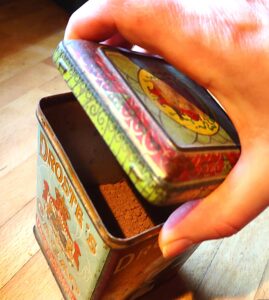
On my shelf is this old can of cocoa. It says "Droste" and gives a weight "For Eng. and the Colonies". For me, this can of cocoa carries more than 1lb of memories and warnings.
When I was in my early teens I went to the kitchen of our double-wide trailer, stood at the upper extension of my tip-toes, and slid this red and blue metal can off our harvest-yellow fridge. It had been there as long as I could remember, and I'm not sure why this day, of all others, I finally made hot chocolate for myself, but I did. And since I'd looked in that can many times, I knew where to find my ingredients.
Maybe fifteen minutes later I sat on the couch, fully proud and enjoying my first self-made hot-chocolate. I found something crunchy in my mouth and, already a fan of chocolate-covered coffee beans, I crunched away at the small bean and said, "aw, Mum! You got your coffee beans in the cocoa."
"I can't imagine how," she said, disinterested. And I began to crunch another. But I thought better of it, and took it out of my mouth to see. It was a beetle! A small, black, coffee-bean-shaped beetle, desiccated and swirled with all its brethren into my hot chocolate.
"Gross!!" I yelled, and hurried to the kitchen to begin rinsing my mouth and spitting vigorously into the sink.
Mum followed me. "Where did you get the cocoa?" She asked, with a wry smile.
"From the cocoa can! On the fridge!"
She began laughing. "Oh that's Grootmoeder's. From before the war!"
'Before the war.' Or, in Grootmoeder's words, 'in former days'—this was a topic we all heard about quite often, as storytelling was part of the way my grandmother dealt with her trauma from that time, along with keeping mementos. Our cocoa can was apparently one of those mementos. It was a reminder to her and to future generations of the terrifying shaking of planes overhead, of a deep gnawing in her empty stomach and a deeper fear that the baby in her arms would die of starvation. It was a reminder of the days she slipped under cover of night over rubble and into farmers' fields to steal tulip bulbs to stay alive, but never ever ever used the cocoa. Why? Because she needed a sign of hope that one day cocoa would not be just a relic of 'former days'.
"Former days' were when Grootmoeder made chocolate treats for my grandfather, read the news and medical journals as compensation for giving up her dream of becoming a doctor in order to get married. When personal sorrows such as hers competed for space in her mind with the news telling of Hitler's determination to invade Poland, and other such worrisome things. I mean, it wasn't as though Hitler was actually new news. His rise to power began the year Grootmoeder was born, so to a young woman on the verge of starting a family, it wasn't exactly alarming. And besides, who wants to be alarmed? Who wants to set aside the demands of daily life to fight for something that may not be such a big deal, especially to a young, privileged, non-jewish Dutch woman? And what could she, a nineteen-year-old, possibly do to help the situation, anyway? She wanted to, of course, but her dream of becoming a doctor was in the process of being shoved under the carpet, and even if war should happen, she wouldn't be tending to injured soldiers.
Five years later she was nursing a baby from her own starving body, while trying to cook tulip bulbs on a dark, makeshift flame, while the buildings around her crumbled. And hidden away with other treasures was a can of cocoa that said "For Eng. and Colonies Net. 1lb." The fact that that cocoa came from a vast landscape of colonial murder and exploitation on the other side of the world, just to be processed and sold not only to my privileged grandmother but also back to the people still colonizing the out-of-sight-out-of-mind Americas was, truly, out-of-mind, to my grandmother, in former days. She had other things to worry about.
As Canadians, on the day after the new regime in America started Nazi-soluting their crowds, freeing violent fascist leaders from prison, and declaring their intentions of annexing various regions of the world, including Canada, we may feel similarly. Maybe it's more important to get our kids to school, today; to keep the peace in a community that's feeling the climatic and geo-political stresses and starting to fray at the edges. Maybe we're too stunned by the US government's sudden and bold conversion to what looks very much like a dictatorship (sweeping unilateral powers handed to the President, reworking of the official government website to remove the constitution and replace it with military imagery, declarations of intent to take over other territories, and commentary about there never being another election). Maybe we Canadians have our own pending elections and fascist contenders to worry about, and, like in the US, where about a third of potential voters didn't vote at all, the silent many could very well determine the outcome. And besides, our neighbours are all angry with us for not speaking up about their causes often enough.
Maybe it seems all hopeless and we just curl up with a hot cocoa for some Netflix hygge time. Maybe you don't want to hear me compare this Canadian moment to that time my grandmother was turning twelve and the Dutch National Socialist Movement was founded, in her country. Because did that really matter, compared to what was happening in Germany? And it was all just "news". What could she have done, anyway?
And here this can sits, on my shelf in Canada, with fresher cocoa in it, and I am self-medicating my very real personal traumas and fears about the future of my world with cocoa that, while supposedly ethically farmed and produced, hearkens back to pre-WWII and reminds me that we're all making choices in all our various moments that may be the difference between eating cocoa and eating tulip bulbs.
We have mundane obligations—yes. We do need to keep ourselves fed and our minds and communities peaceful. And we have opportunities in every action we take to courageously love through our fear. My teenaged grandmother watched the rise of fascism in her country and I'm watching it now, in mine. And all of us have, I feel, the responsibility to work to end short-sighted, morally blind, and greed-motivated thinking in our own communities. Because all fascist leaders began as children in communities, somewhere. All of us have influence on people who may one day oppress us or our loved ones. So that's where we need to do our work.
For me, the work looks like this:
Educating myself (with factually and ethically sound sources) on everything I can possibly learn, but especially the functioning of our current society, so that I might better understand the implications and consequences of my daily actions.
Deleting my accounts (and thus no longer supporting or being exploited by) Amazon, Twitter, Paypal, Meta, Oracle, Microsoft, and anything else I soon may find to be associated with the group of mega-billionaires now running the fascist uprising.
Seeking to understand and have compassion for others, while still speaking out (gently) when others are causing harm—especially if they don't see it, themselves.
Building community: volunteering and supporting others who volunteer in my community. Being engaged in public processes and informed about past, current and future events.
Spreading factual information (hopefully non-combatively) in every way I can.
Voting at all levels of government. And encouraging others to vote, as well.
I posted recently on a home-canning group I'm a member of, and mentioned something about "hard times ahead". Instantly a bunch of other canners jumped on my comment with laughy-faces and remarks about the coming golden age of America, promised by their newly-elected leader. They were obviously canning the Kool-Aid.
Let us not be fooled by a smiling face on a can of cocoa or a militarized website. I'm the granddaughter of a Dutch woman who nursed her baby from a starving body, and I'm married to the grandson of a Nazi soldier whose family was impoverished, shunned, and living in extreme fear, after the war. Both of our families carry immense trauma from that time. The last time fascism took hold like it is right now, everybody on every side of all the borders suffered, except the richest few. That's always the way.
This coming 'golden age' is not for America, it's for the richest few. It's a return to feudalism, and we are the exploited masses. (Watch Yanis Varoufakis explain this, here: https://www.youtube.com/watch?v=X3FdIyNMaFY) If you're reading this, you're unlikely to be one of the richest few, so we're all serfs in this boat, together. It's not the 'other people' (however you want to define your personal xenophobic preferences) who are causing the problem. It's the people massaging our fears. And together with the diversity of all the other serfs, we're the majority. We can build the future we want to see.
We are not powerless. We overcome the fascism by refusing to fight, vilify or other our fellow citizens. We overcome the oppression put upon us by creating local abundance and resilience in our own communities. We overcome the fear used to control us by opening our arms to embrace each other. That is how we win.
… ……. … Editing this post to add relevant links, for those wanting to understand more about the current regime:
Why leave Meta (beyond their end of fact-checking, diversity employment, and their permissive stance on hate-speech against lgbtq and immigrants (yes–it's worse!)): https://www.youtube.com/watch?v=X3FdIyNMaFY
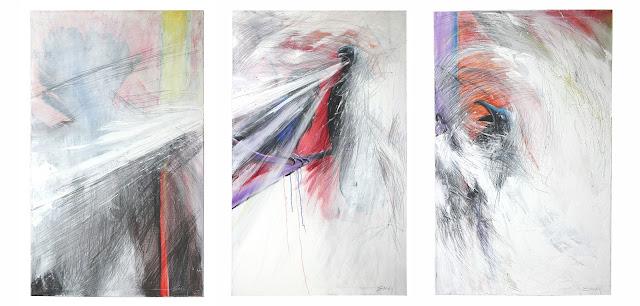
"Three Craws", oil and graphite on 3 stretched canvases. Emily van Lidth de Jeude
Songs of the Apocalypse is a series I’ve been working on since around the time my birth father died. He had lived a long time with Parkinson’s, but the circumstances of his death in hospital, while recovering from spinal surgery, are a complete mystery, and in that post-shock landscape of fear, confusion, and a resurgence of shallow-buried family traumas, his side of my family fell apart. So this series of paintings began as a way for me to deal with my emotions of that time. But of course those personal issues are deeply intertwined with the societal issues we all live with: helplessness in the face of climate change, capitalist, colonialist and patriarchal damage, global societal upheaval, and the fallout from those things. For example, many of my own childhood experiences are a direct result of my grandparents’ war traumas. Two of my grandparents come from families fleeing war and famine in Ukraine and Ireland. Others recently lived here through the great depression, and all of these unknowingly stored those experiences in the many generations to come. So those bigger-picture problems filtered down through the generations to effect even my own children’s health and genetic makeup, a hundred years later. Divorce, childhood trauma, and family strife are just microcosms of the bigger picture. So in dealing with individual portraits I’m also looking at our society as a whole. In looking at the wounds and the healing, I’m hoping to create psychological pathways for us all to heal from the greatest struggles we face.
My parents did everything they could to support me, given the understanding and tools of our time. They created a safe and nurtured life for me on a small island, and they continue to support me in my adulthood. But life cannot be perfect. Life is not about good and bad, but about all people constantly growing. And growing looks very messy.
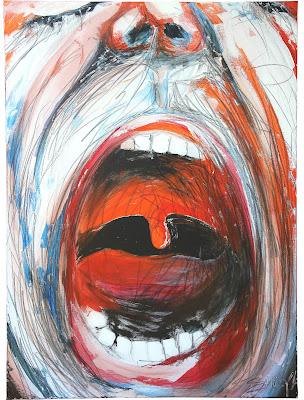
"(I open my mouth and) nothing comes out", oil and graphite on stretched canvas. Emily van Lidth de Jeude
The circumstances of my childhood were not what we consider to be ideal, but they’re also not at all uncommon. Like many of us, I live with intergenerational traumas from histories of war, colonialism, famine, and domestic abuse. These things are rarely spoken about, as our culture tends to look down upon expressing too much emotion or speaking about emotionally challenging topics. But the effects of my buried experiences are borne in my body as autoimmune diseases, and they’re in my paintings. The image above is one of the first I painted in the Songs of the Apocalypse series. It’s a depiction of my own face as it appears to me in dreams, screaming for all I’m worth to help the people I love (who are always suffering horrible fates in my dreams)… but no sound is coming out. And nobody hears me. As an artist I’m trying to break that helpless invisibility, not just for me but for all of us.
I am a woman in a world where one in three women has been the victim of physical or sexual violence, usually by a partner or close family member. So think of three women you know. Which one is it? Think of twelve women you know. How many of the four has told you their stories? I am a woman in a world where women are not only not expected to achieve, but are taught not to expect ourselves to achieve. A world where we’re expected to be happy to just survive.
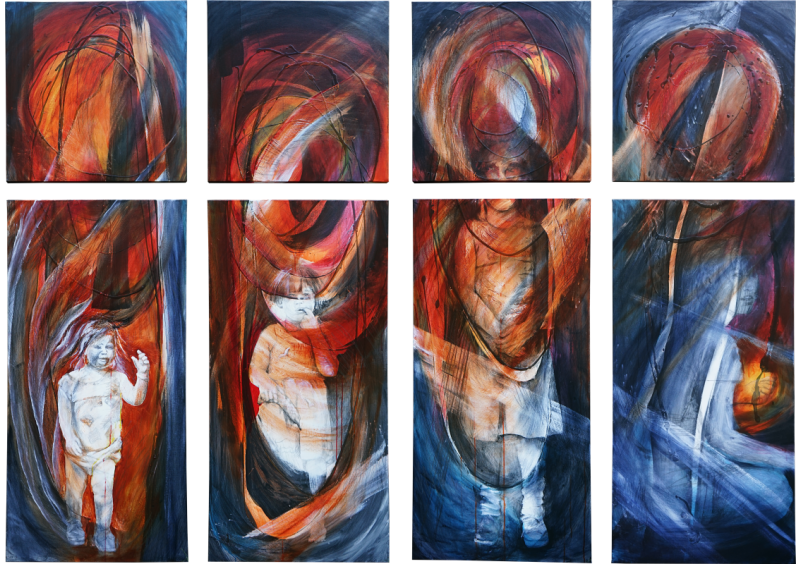
"Will You Love My Heart", oil and graphite on 8 stretched canvases. Emily van Lidth de Jeude
I don’t call myself a survivor because I want to do more than survive. This is a portrait of me at one, four, eleven and sixteen. It’s called Will You Love my Heart, and is painted to Sinéad O’Connor’s song, Love is Ours. It’s on exhibit July 24-August 18 at the Silk Purse Gallery in West Vancouver. As a synaesthete, I usually paint music, but not just any music. The song that inspires a painting will have a very specific meaning associated with my own memory, so what I’m painting is my visual experience of that song combined with my own memory and emotion. Love is Ours is about holding onto the pieces of our broken hearts and keeping each other alive. In our boxes of personal experience we grow out into the rest of the world, and then will we be loved? Or shoved back down into our private little trauma boxes? I’ve spent my whole life since my teens trying to get out of that box, to find love and healing, and grow into the many links between my heart and yours (yes you—we’re all connected).
I figure it’s a good idea to let my voice come out now, share my progress and hopefully inspire billions of others to do the same. That’s why I’m finally beginning to show the Songs of the Apocalypse series.
So think of those women again. Those 12 women, four of whom have been assaulted. Maybe you’re one of them. Maybe your child is, or your partner or your mother or your dearest friend. What can you do in this moment to raise her up out of the box built of her trauma? What can you do to break the walls of the box? How can you change even one thing about the space you give her; the voice you give her; the respect you give her, that could help her find her own way out of the box? And how does your love make her strong?
I’m a feminist artist with a loving, evolving male partner and a strong, courageous daughter, and an extremely emotionally-aware son. Being the strongest I can be strengthens the foundations for everyone, including all genders, ages and classes of people. It even will combat climate change, colonialism, the patriarchy, and capitalism, because as I become stronger I can lean less on the cultural norms that hold up those false shelters. Creating a world where I can come out of my box and thrive means creating a world where everyone can thrive. Equality doesn’t mean bringing anybody down. It means using the pathways created by love to hold each other up.
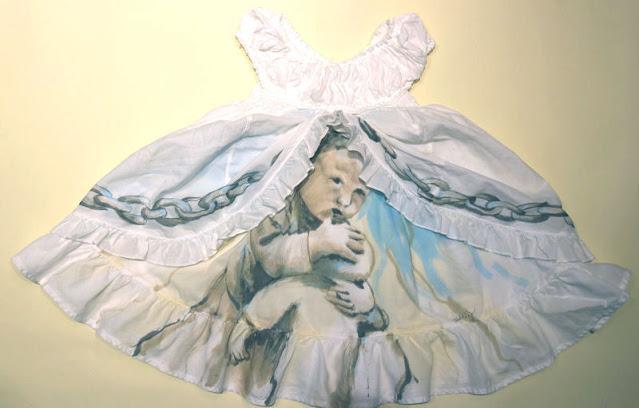
"Chain Dress", acrylic and stains on an altered child's dress. Emily van Lidth de Jeude
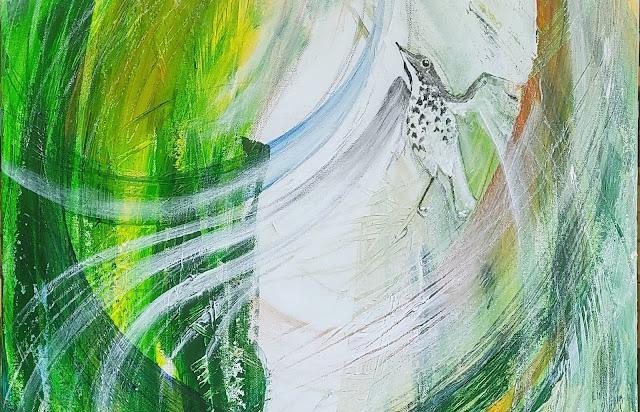
“Go and Make Yourself Content, My Love” (detail). Swainson's thrush in my mother’s garden, to the tune of the Unquiet Grave. Painted with acrylic, graphite and coloured pencil, by Emily van Lidth de Jeude.
I was walking down from my parents' house to mine, over the crest of their driveway where the wind blows steady. Not like the rest of the property, through which it tumbles this way and that, scatters just a few leaves, or bursts out of a single storming fern. Over the crest of the hill at the top of my parents' driveway, the wind passes smoothly and calmly, sometimes crisp and smelling of leaves, sometimes damp with the weight of snow and sometimes full of the heaviness of summer and dragonfly wings. I've walked here alone and with my children after Christmas dinner, my heart and belly and arms full of treasures. I've walked here holding my chest against hidden sobs when I couldn't be what the world wanted of me. I've walked on my parents' driveway even when they lived in a different house and I visited rarely, and always it has been a place of the wind and the gathering and freeing of perception and feelings. A place of reckoning or accepting. Not that night.
I was walking down from my parents' house on the evening we came home from our first trip to the Cancer Clinic, two weeks after the sudden and unexpected removal of a stage-four tumour from my mother's brain. I was walking down that driveway and there was no wind. The driveway felt flat, although it's not, and it's rocky, but the rocks were dead that evening, which they never are. The April grasses and blossoming trees were bereft of colour. Impossibly grey. There was no birdsong, no frogsong, not even the sound of leaves, and when I looked at the hillside I thought it might just go away, if my mother died. When my mother dies. She keeps reminding me: "We all have to die, sometime." But I don't want those words. That was one of the many logical thoughts that evaporated when the doctor told us we won't be returning from this trip. And we stared blankly into the empty air and our tears were silent.
I find the word "journey" as people use it for cancer absurd. We use it like we can pack for a trip and just take in the ride. But it's not that kind of ride.
Glioblastoma. Someone should make a horror carnival ride called Glioblastoma. You get in a little comfy bucket seat and it chucks you out into the sea. Then down a vortex you go, into a drain where you almost drown but NO! You're not allowed to drown! There are things to live for and places to see and you might have a few days or weeks or months or years of good life, so LIVE!!! And you can't feel your right side, and you can't find all the words that were here just yesterday, but now more than ever, you want to, need to LIVE!! So you come out of the vortex on the chemo train, where you get whipped back and forth over trestle and track without warning or reason through whacking slaps of sheer terror and poofy clouds of deep love and acceptance: A bird? NO! Slash! You're going to die! Slash! Maybe not so fast–Slash! Everybody is trying to help you–Slash! You're so strong–Slash!–Take some more pills–Slash! Love, love love–Slash!
Love can't save you and everybody's talking to you like a child–Slash! Now you're the wise one–Slash! Let's finish your sentences for you–Slash! We could get an ice-cream!
Slash! You get to meet the guy who will administer your death–Slash–but only when you want him to–Slash–Be GRATEful!!
Slash!
Nobody wants you to die!–Slash–Let's go shopping!–Slash
Why are you so tired? Slash.
Slash.
You fall out from the carnival ride one sunny morning, and you smile up at the sky and look for birds.
But there aren't any.
My mother loves birds. My whole life has been decorated with her hushed exclamations of "oh! A warbler!" and "Did you hear the snow geese go by this evening?" My mother hears things many of us don't notice, like the pips of babies and the tone of ducks that tells her whether they're coming or going. When my father gently delivered a helpless baby owl into my childhood, my mother raised it on chopped liver and caught mice until it grew up and flew to the trees. But she heard its voice separate from the other owls, and she answered it, and taught us to make the hungry-teenage-owl call, too: Psssshhht! Pssssssshhhhhhhttt! That owl and its offspring came back to visit us for decades.
Terminal cancer is a strange thing. We want a timeline. Something to hang a hat on. To work with. To put in the calendar, and at the same time we want to live in the moment and not have to plan for death or even how to visit with all the loved ones. But just to sit and hear the birds. Except the chaos of medical interventions, social supports and emotional upheaval means not a minute exists of just. Peace.
Until one day, we can't take the chaos anymore. Out of necessity we ignore the forms we're supposed to be filling out and decline the offers of new prescriptions, new dosages, delivered meals and all the services we know are needed. One day we just need to be.
This week I saw my father's eyes in a rare moment of stillness. They used to shine with his intensity; they used to sparkle and shoot beams of aliveness. But recently they've looked tired, and there were big wide tears balanced on his lower lids and he was just making a sandwich. I don't hear so much as I see, and I am starting to see again. I saw my brother's cheeks, this week, taut with small lines of agony as he pulled me into his arms and didn't let go. As he asked if he can take our mother to have her broken arm looked at. Cancer is not a journey. It's a horrible carnival ride, and sometimes we catch glimpses of the world, as we spin. Sometimes, also, we catch glimpses of the beauty that brought us here to begin with; that holds us up through the fear and the changes we didn't see coming. My parents walked out, hand in hand, today, to look at the blossoming of the world they share.
And I began to hear the birdsong, this evening. The teen-aged ravens are pillaging the robins' nests, to a great outcry, as you can imagine. We thought the black-headed grosbeak that my mother says only comes for a short time every spring had left, but it's been singing again. The wrens and towhees are hopping in the bushes, until they flit out to the pine, to make their plans. The offspring of our owl are impressing people along the trails, these days. And for some reason the flickers keep sitting around on the ground. My father says get the aphids out of my apple tree, but I can't reach them and we both know that's OK. Bats are out, tonight, delighting my peripheral vision. And as I walk up over the crest of my parents' driveway this evening, I hear the nighthawks dropping on their prey, all around me. The wind is warm, and it's summer now, and my parents are just watching a movie with a couple of mosquitoes like it's a normal evening. Just living this incredible life in an incredible world, and learning to step off the carnival ride and hear the birdsong.