How I'm Leaving Big Fascist Tech in the Dust

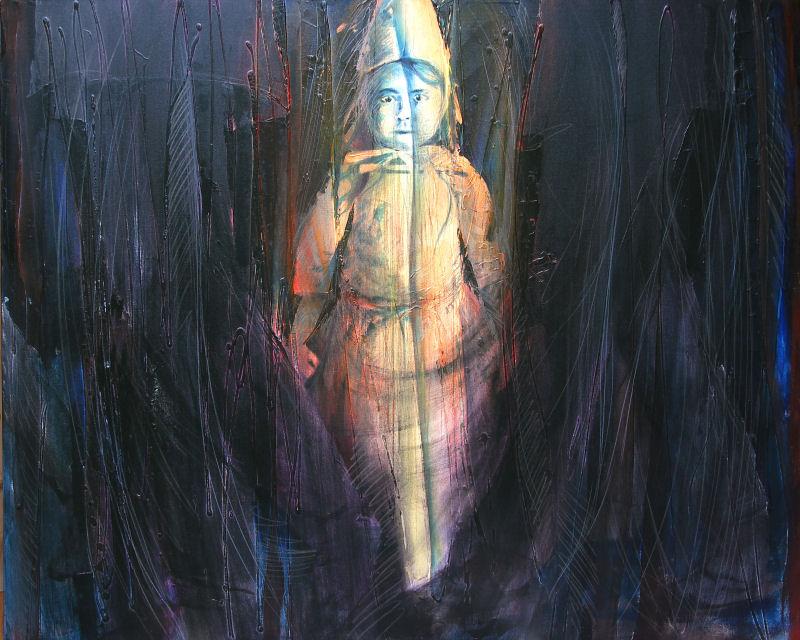
Painting by artist Emily van Lidth de Jeude, showing a mostly black sea of adult legs in pants and shoes, walking by. In the centre of the image is one lit person: A small child in a party dress and hat, fists clenched at her sides and her face looking stern and perhaps horrified. She looks out from the sea of passing legs with indignation. The title of this life-size painting is "Did you shuffle of the pavements just to let your betters pass."
"Did you shuffle off the pavements just to let your betters pass?"
Oil and graphite on canvas. Artist Emily van Lidth de Jeude

Thijs’ face remained open and calm as he described his childhood memory of his Jewish neighbours being removed to whatever fate they met: “I remember the SS or Germans going upstairs, kicking them down the stairs, so they rolled right on our sidewalk, in front of our door.” I was interviewing him for an installation about the concept and feeling of ‘home’, and this was part of his response. I think that I, too, looked unphased by this story. We both have lived so long in a society that treats such traumatic experiences as passing news, and turns to chemicals, distraction, or denial to keep from dwelling on the horror.

But it IS horror. It’s horror every time a starving Palestinian child tries to get food and is blown to pieces, but still alive, briefly, to witness the cries of his mother. It’s horror every time a child holds the dead face of his parent, living only in terror, oblivious to what life will be like as an orphan of genocide, however short that life may be. It’s horror every time a girl, a child; a desperate woman is captured, owned, and brutalized to feed some sick person’s illness, and then silenced, for the good of the nation, or at least for the benefit of those profiting off the nation. It’s horror every single time a person of colour, an indigenous person, a woman, or a poor person is kidnapped by brutal masked agents of terror, hiding behind anonymity and the letters I, C, and E, or simply balaclavas. It’s horror while these people sit rotting in internment camps created with the intention of brutalizing their bodies, minds, and futures. It’s horror when a child is raised with such depravity that they applied for the jobs that mean brutalizing their fellow citizens; that they are willing to create more such depravity in hopes of rising above it, for the good of the nation. For the good of the family. It’s horror when we turn away, because it hurts so much to see, and blindly, through chosen ignorance, raise our own children to be unphased by the horrors that we condone, for the good of the family.

It’s easy to buy cheap milk eked out of tortured beasts on tortured stolen indigenous land because my children need calcium, to bubble their water with a machine made on stolen Palestinian land, and to turn their eyes away from the news, towards a screen filled with shiny ads. To turn my own eyes away from how those ads are harming them, because I need time to make their dinner, and it's easier. It’s easy to allow the fascist few to benefit from our choices, for the good of the family. For the good of the nation.

What family?! What nation?! What kind of monsters are we that we can look but refuse to see?! I hear a siren right now outside my window, and I’m scared because I know that siren means someone in my community is scared, too, right now. 

I can’t turn away. I can’t be the person who allows these horrors to happen, while I avert my eyes. Neither can you. I know that, because you probably looked at the news, today. You’re reading this, right now. Not to numb yourself, not to bolster ignorance, but to SEE. You’re trying to see. You’re looking to bolster community by being willing to share the suffering of others.

We know we’re bound to each other as humans. We know each child stripped of dignity, health, safety, love and life by the greed of the tiny fascist few is a part of us. We know, even, that those greedy few are part of us, so like we need to weed them out of our society, we need to weed the tendency to greed and ignorance from our own psyches. We need to rise up as individuals to save the whole of us.

I know this all sounds very big-picture. Very abstract. We want something actionable. We want to reject the rise of greed, hate, and fascism. But how? I’m working on that. I can’t say how it will look for you, but I can, at least, describe what I’m doing, and hope it helps inspire you to make whatever choices make sense in your life.

Ending Reliance on Fascist Corporations

Those photos of Trump surrounded by the tech billionaires whose private jet flights we fund with our digital existence were very enlightening, to me. I can no longer pretend a single one of them is good. Not even if they tout vaccines for impoverished populations or free transit. They’re a huge piece of the fascist landscape, and I can’t be supporting them. Obviously, it’s difficult to just quit these giants in a world that they’ve carefully arranged to be mandatory opt-in. In fact, we pay for the right to use these systems that we’ve been convinced we can’t live without!

Well, I’ve been dumping the tech giants at a steady pace for about six months, now, and I’m here to tell you it’s not only less daunting than I feared; it’s liberating!! It feels wonderful!! So here’s a list of the great alternatives I’ve found. And of course there are many more! Luckily, we live in a whole world full of caring, creative individuals, working in community to build a better world.

*NOTE: Rebel Tech Alliance, one of the groups building this better world, recently contacted me regarding this article, to point me to their amazing resource for this exact information! Do check it out; they've compiled a very useful list of options! https://www.rebeltechalliance.org/stopusingbigtech.html

…and here are my choices:

Facebook/Instagram/Twitter ⟶ Mastodon 
Mastodon, with it’s cute little Elephant logo, is wonderful for connecting to like-minded community. A bit of an adjustment in terms of how posting works, but not difficult, by any means. Yes, it’s part of a whole landscape of options, but you don’t even need to understand that to use and enjoy it!

WhatsApp ⟶ Signal 
For some reason I had the idea that Signal was for right-wing people. (?) Once I joined, I discovered that wasn’t true at all. It’s just for people. Some might be right-wing, but I wouldn’t know, just like you wouldn’t know that about your phone contacts list. It is, after all, just an app you can use for free video, phonecalling, and messaging, that uses your contacts list. But it’s an app that’s not stealing and selling your data. And yes it’s free.

News sources ⟶ Al Jazeera and local sources
Obviously, this depends on where you are. But Al Jazeera definitely has a more open view of world events than any mainstream North American news sources I’ve looked at. And I augment my news intake by subscribing to local and indigenous sources that have more to say about my specific local interests.

Blogger/Website ⟶ Autistici/Noblogs 
Yeah!! I haven’t moved my domain name over yet, but I was honoured to be accepted by the good people who create and maintain Autistici. I’m slowly transferring all my previous content to my site there, and will redirect my domain name when I’m ready. This (moving all my content) is definitely the most daunting task I’ve undertaken, but it’s worth it, not to be chained to Google/Blogger.

Web/Chrome ⟶ Mozilla Firefox
Mozilla is an amazing group of people fighting very hard to maintain fair and open internet. They make Thunderbird, which is a great email reader/system (I’ve been using it for decades), and Firefox, which is possibly the best, safest, most versatile web browser out there. Yes, it’s WAY better than Chrome!! Mozilla’s browsers are free, but you can donate if you want to. Of course the US fascist regime has cut their funding, so now is a great time to donate to such things!!

Gmail ⟶ Autistici
I got a free email account with Autisici too, and use Mozilla Thunderbird to access it.

Spotify ⟶ Bandcamp 
I never used Spotify to begin with because the musicians I know were losing out to it from the beginning. But Bandcamp is where many of them publish, so that's what I use, or (for big-name musicians) I buy directly from their websites. Also, Bandcamp makes an expressed point of banning AI. Right on!!

YouTube ⟶ MakerTube 
Part of the PeerTube system, MakerTube allows creatives to upload very similarly to YouTube, but without the ads, constant AI spam, and data domination. And free, too, of course! I’m also slowly migrating my content to my new MakerTube account: https://makertube.net/c/emilyartist/videos
(For video-watching, PeerTube definitely doesn't have the amount or variety of content that YouTube has, yet, but it's increasing every day! And it's real, unlike the AI dumping-ground that YouTube has become.)

Google ⟶ Ecosia 
On both phone and laptop, I search with Ecosia. I’ve installed it as the default search engine on my Firefox browser. While Google uses ads to raise their already astronomical profits and fund fascism, Ecosia provides the same search, but uses the ad revenue to fund reforestation. I am, however, increasingly irritated by Ecosia's deep dies to AI, and the increasingly useless search results. I may end up switching to something like Duck Duck Go.

Windows ⟶ Linux Ubuntu
This was the scariest change for me, but it turned out to be both simple and amazing!! Not only are there incredibly robust and useful (free, open-source, decentralized) alternatives for every single application I previously bought or subscribed to, but the platform itself is only slightly different from the platforms we’re used to. Also: There’s an amazing community of Linux users ready to help me when I have a question! 

Next I plan to replace the Android on my phone with Ubuntu touch, which will apparently relate seamlessly with my laptop, and be free (from costs, data insecurity, AND fascism!) I’m also going to get a fully repairable Fairphone

Here are some of the apps I use, on Ubuntu. They're also available for use on Windows. Every single one of these is actually better than what it replaced for me. And free.

Word/Spreadsheet/pdf Processor ⟶ LibreOffice
Image Editor ⟶ GIMP
Video Editor ⟶ Kdenlive
Audio Editor ⟶ Audacity
Video Player ⟶ VLC (plays all kinds of things that popular players can’t)

There was one program I couldn’t get an alternative for, which is Blurb’s BookWright app. This worried me, because I do use it frequently. But it turns out there’s an easy fix for this issue! I installed Wine from the Ubuntu store, which emulates Windows, and thusly runs BookWright for me, effortlessly. That’s what’s going on in the background. What I see is just the BookWright app logo on my desktop, and it runs like there’s no background at all. 🙂

Freedom and Human Rights

At some point I realized that in almost every country, it’s illegal to live without buying or renting space on the planet. Sure, there are organizations trying to help those who can’t afford the luxury of shelter, but their goal is still to get people earning enough money to rent space. Eating is the same. You must make enough money to pay someone else to produce food, because growing it, while not always illegal, is at least only available to those who pay for space to grow it. As corporations like Nestle commandeer water resources, and municipalities begin taxing citizens for water-use, but not corporations for draining aquifers, many are now also unable to afford water. We always have to pay for our right to live. And who makes that money? Those depraved billionaires, of course. The only way to keep the basic human rights of taking up space, eating and drinking, is to exercise those rights.

I’ve noticed, personally, that when I go into the city, I feel like I need to pay for food or entertainment, if I want to sit down. To buy a cookie if I want to use a toilet. Cities offer parks and benches, of course, but I feel like there’s a growing expectation that if we’re using the spaces, we should be paying someone. The right to simply rest should not belong to the wealthy.

So taking up space is part of exercising our rights. Drink from the creek. Begin to care where it’s coming from, and who’s polluting it. Sit on the sidewalk and learn to see your neighbours. Encourage them to sit on the sidewalk, too. Plant food crops in disregarded soil. We have the right to live a good life on this earth, with the gifts this earth gives to all animals. Live it.

Activism

I’ve been severely limited by disability these last few years, and haven’t attended a single protest. Luckily, protests are not the only way to act against tyranny! They may not even be the most effective way! My auntie reminded me of this when she sent me this poem, yesterday. With a dizzying array of health problems like strokes and pneumonias that have put most of her career as a poet, performer, educator and author on hold, she still managed to write this poem, record it, and send it out. So I took one minute out of my morning and shared it on my MakerTube and Mastodon! We can ALWAYS do something. 

Maybe the something looks like growing our own food, and sharing the bounty with neighbours. Maybe it looks like writing to people in position to make political or corporate change. Maybe we can make change by choosing how and where we spend our money, or earn it. Maybe we reject industries and products we know to be harmful. My son messaged me yesterday to say he sadly forgot to ask for oat-milk in his cappuccino. Why? I asked him. His answer was that the dairy industry is terrible. We didn’t talk about the coffee industry, but it’s a small thing to request oat milk instead of dairy. Maybe coffee is next. We make a journey by taking one step at a time, and every step matters.

The solution to so many of the world’s problems seems to be thoughtfulness. Awareness. Like when I talked about drinking from a stream, to allow us to take stock of who’s polluting that stream, we need to go through our lives with our eyes open, so that we are compelled to make the changes necessary to live well.

The people who profit off of our ignorance pay big money to maintain that ignorance. But we still have the power to open our eyes. To witness and make choices. When Thijs watched his Jewish neighbours rolled out onto the street he didn’t look away. In fact, eighty-odd years later, he’s still telling the story. Still using his traumatic experience of witnessing genocide to educate; to help all of us to open our eyes. 

We’re all witnessing genocide, today. We’re all witnessing a rise of fascism that is stunning in its similarity to what Thijs and many of our elders experienced less than a hundred years ago. It’s up to each of us to not turn away. To not accept. To not condone. To not support fascism. 

I know it's not so simple. We're funnelled into supporting fascism with every breath we take. But this is war, now. We're dying from our apathy, and the only thing that will save us is taking responsibility for the change. Nobody else is going to do it for us. As Sinéad O'Connor sang in "Drink Before the War", "Somebody cut out your eyes, you refuse to see". They can force us all they want, but the choice to see or not to see is still ours.

It’s up to each of us to build the world that feeds the many instead of the few. It’s up to each of us to look at our own hands and be sure they’re doing work we’re proud of. It’s up to each of us to open our eyes and become aware of the consequences of every action we take, and only take actions we’re proud of. For the good of the family. For the good of all people, and the future and ecology that feeds us, we must open our eyes and choose to see.
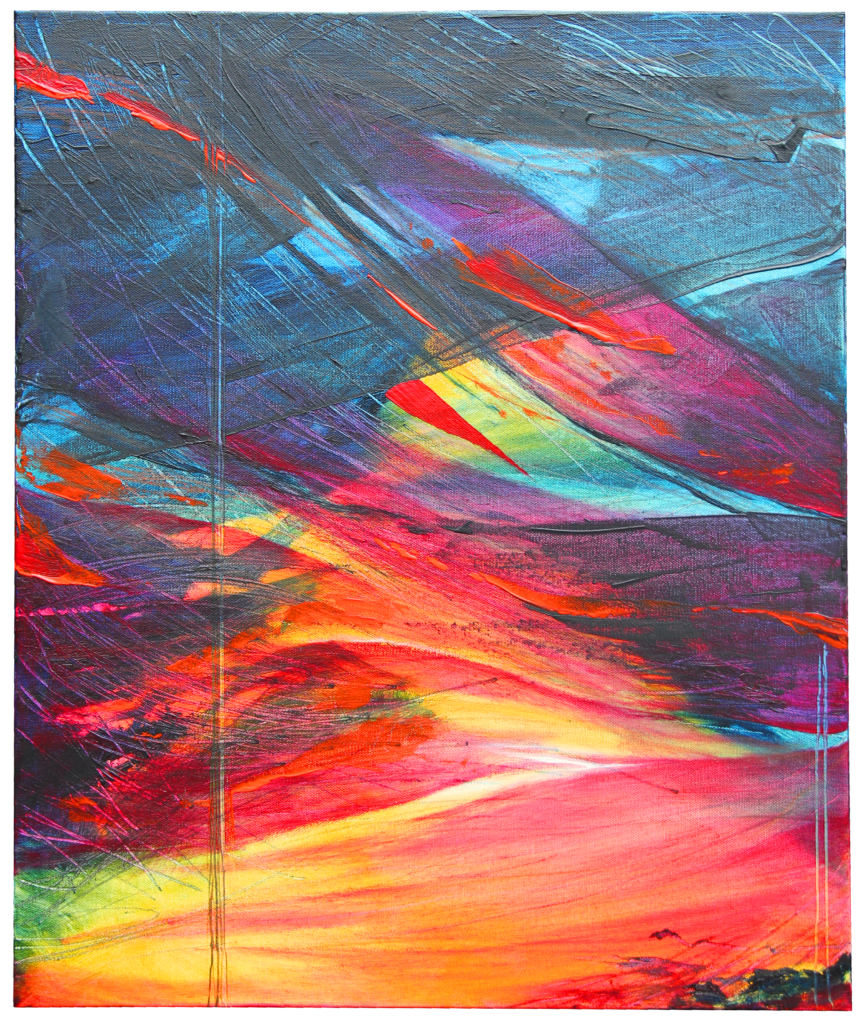
An abstract oil painting in red, orange, yellow, green brilliant blue, dark blue and black. It is reminiscent of explosions and fire in the night, with many crossing lines, a bit like a landscape. Named after Sinead O'Connor's song, Drink Before the War.
"Drink Before the War" 
Oil and graphite on canvas. Artist Emily van Lidth de Jeude
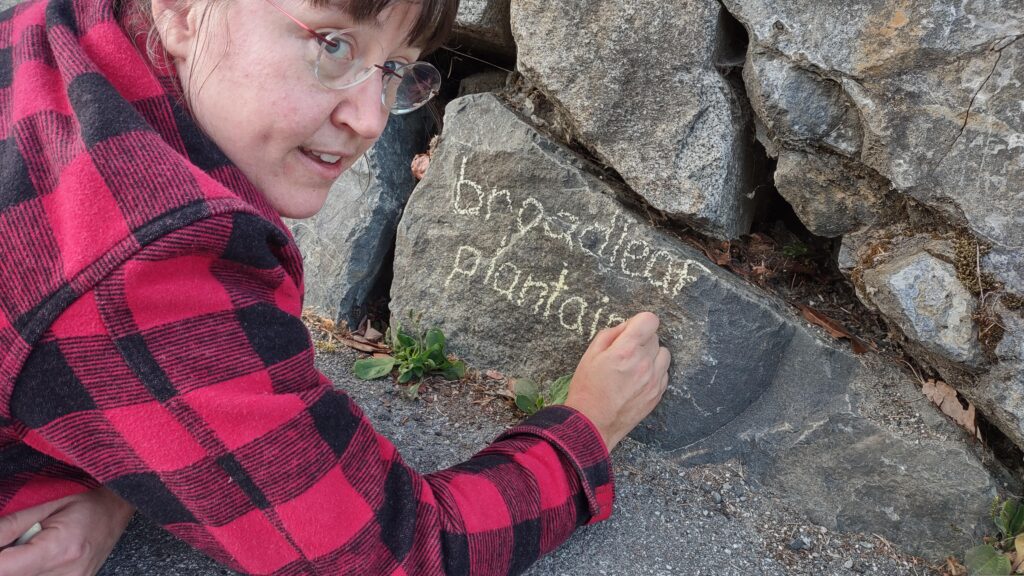
Labelling Weeds: Art for Public Engagement

Close-up photo of artist Emily van Lidth de Jeude, with brown hair in buns and a red and black lumber jacket, printing the words "broadleaf plantain" on a rock with chalk. There are small plantain plants growing out from under the rock.

This has become one of my favourite things to do. Every year I go out and label the weeds and trees in the place with the highest foot-traffic on our island.

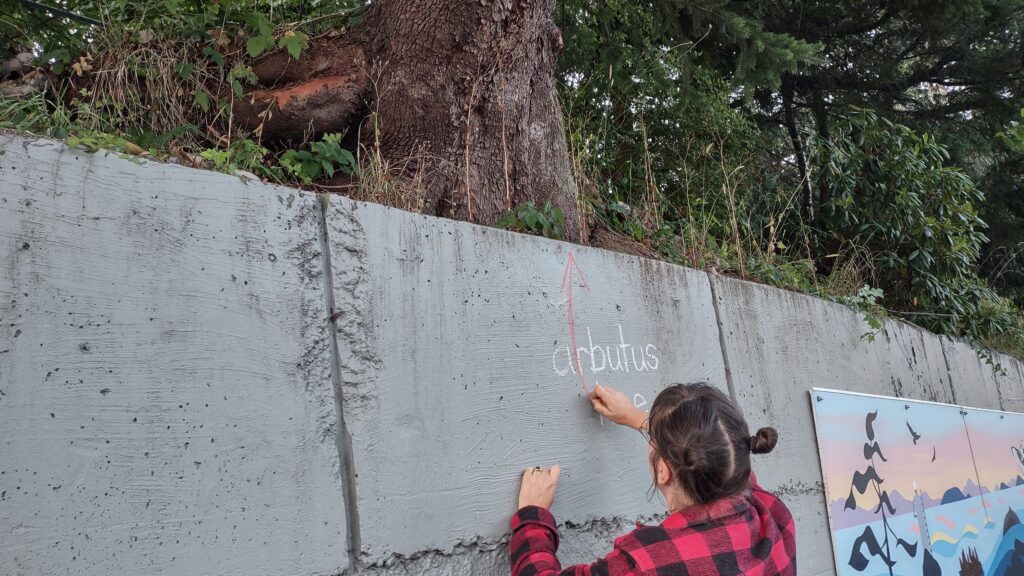
Photo of the back of artist Emily van Lidth de Jeude, with brown hair in buns and a red and black lumber jacket, printing the words "arbutus tree" on a concrete block wall, and a red arrow pointing up to the base of a large arbutus tree that is growing ontop of the wall.

I hope people see these and begin to notice a bit of the world around them in ways they may not have, before. I hope people also go home and find the same weeds, there. Sure, it's the simplest kind of art.

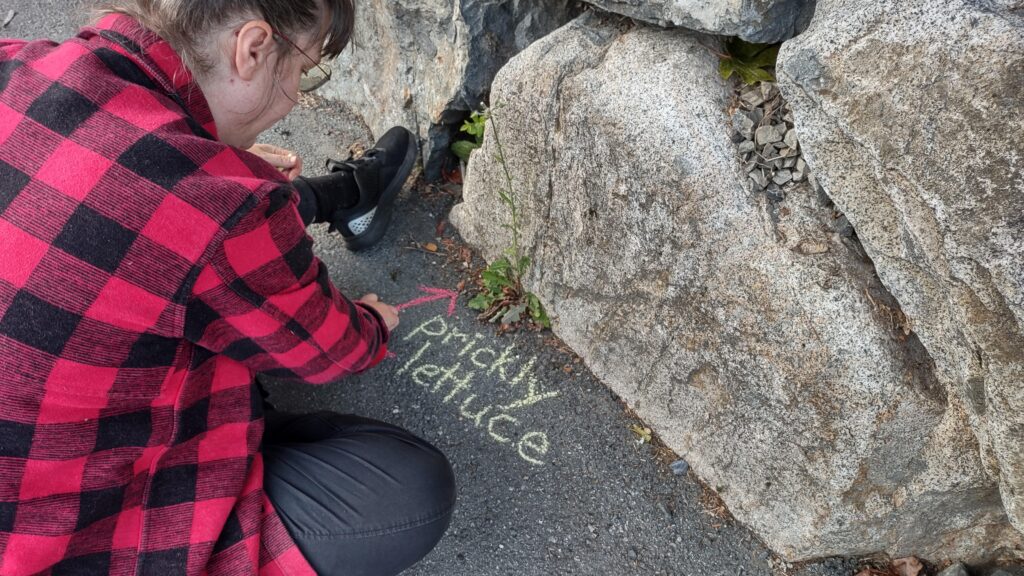
Close-up photo of artist Emily van Lidth de Jeude, with brown hair in buns and a red and black lumber jacket, sitting on the pavement next to a rock wall with a small plant growing out at the bottom. She he printing the words "prickly lettuce" in chalk, on the pavement.

I'm just chalking rocks, walls, and sidewalks with plant names! But I really feel it might be one of the most impactful works I've done.

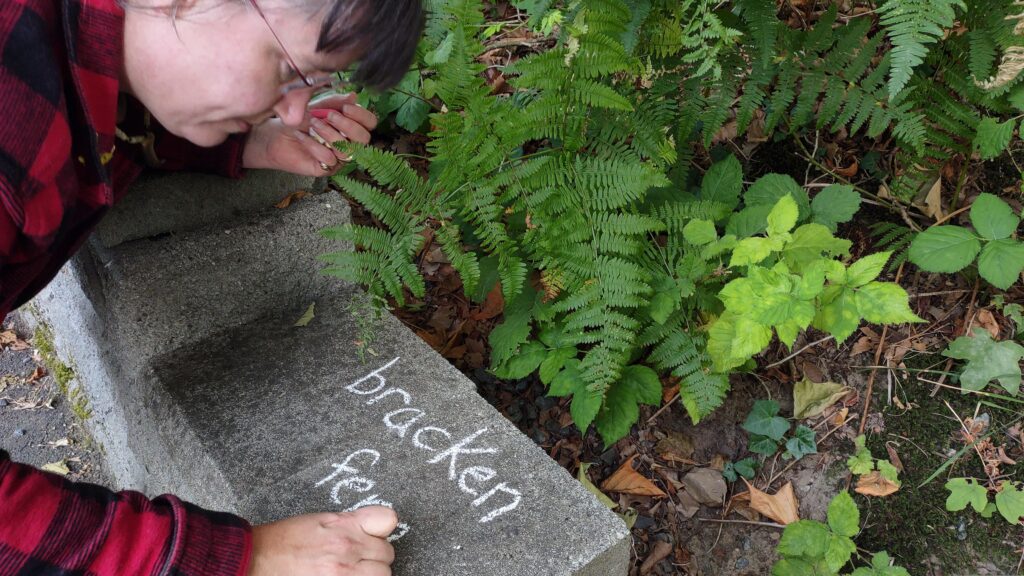
Close-up photo of artist Emily van Lidth de Jeude, with brown hair in buns and a red and black lumber jacket, printing the words "bracken fern" ontop of a small concrete block wall. There are bracken ferns growing on the other side of the wall from where Emily is standing.

And yes, if you're wondering, I do have municipal permission to do this! So the credit for this also goes to open-minded officials and other citizens who can appreciate the benefits of art and education in our communities. 🙂

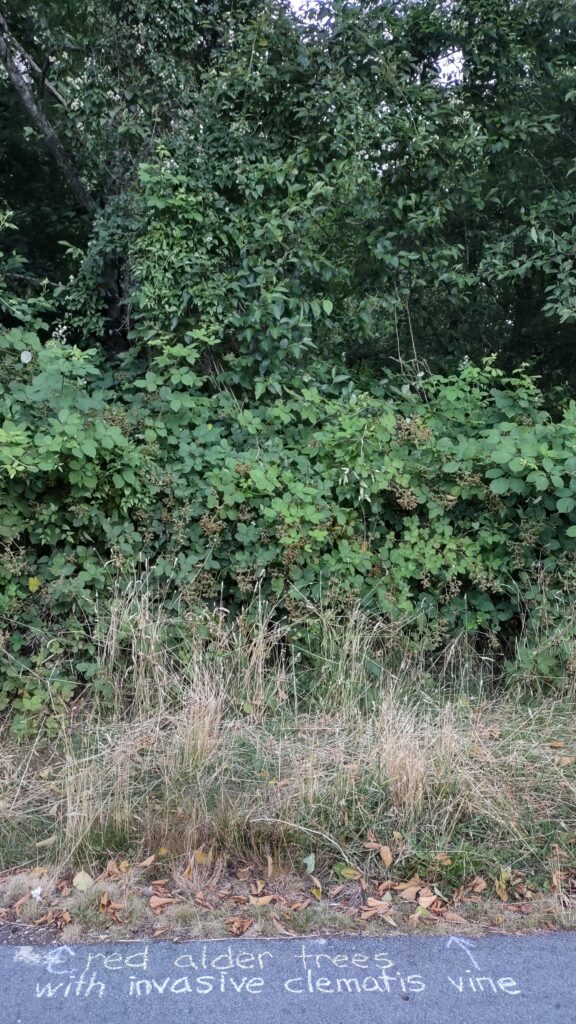
A photo of a sidewalk with the words "red alder tree with invasive clematis vine", written in chalk on the pavement. Beside the pavement is dry grass, then blackberry bushes, then above those red alder trees filled with invasive clematis vines, flowering white.

It’s Our Job, as Artists, to Imagine Hopeful Futures

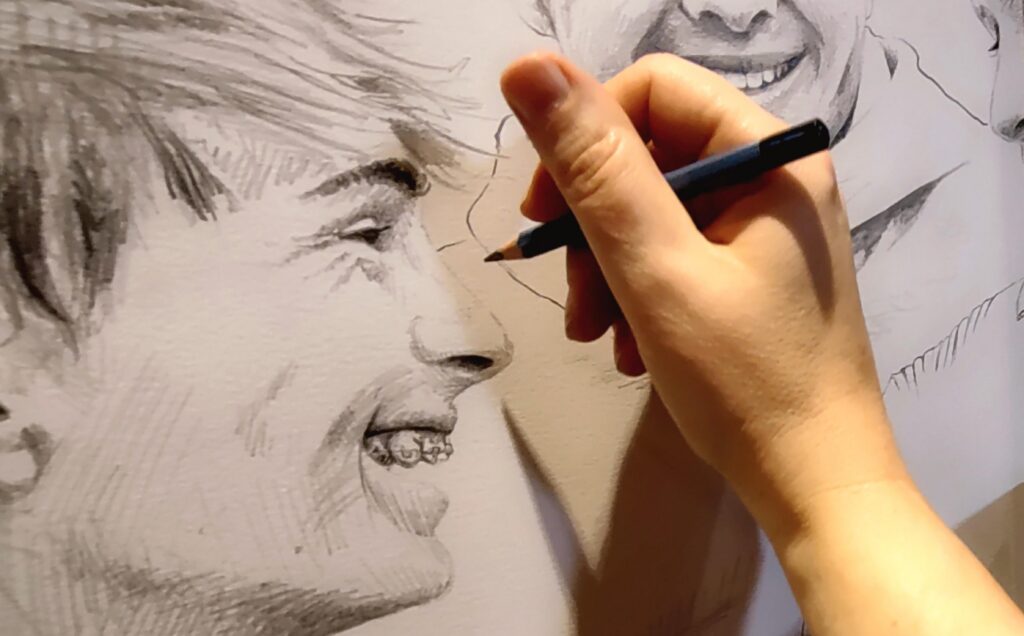
A photo of the artist's hand holding a pencil, drawing a portrait of two boys laughing joyfully.

As artists, we have the power, ability, and honour of building our future civilization. Some of us may be doing so intentionally; many not. But whether we're aware of it or not, we are responsible.

Sci-fi is often touted as predicting the future. But does it? Writers and other artists imagine plausible eventualities based on current directions and capabilities… and then they often happen. Maybe the artists are soothsayers, or more likely we're just creative… and humans have evolved by being resourceful. If we're given a wild idea, we take great pleasure in making the seemingly impossible happen. So maybe artists are visionaries. That's not a pat on the back. Most of us want to be seen as visionaries, I suspect, but it's a huge responsibility.

What are we putting out into the world? Books, movies, and other art that may very well have been intended to warn us away from a dystopian future might instead be creating it; putting the ideas for such dystopia into our minds so that our resourceful society will create it. I'm not talking about some evil genius who sits in their dark basement playing apocalypse video games and then thinks, "ooooh I could destroy the world… bwahahahahaaaa!" I'm talking about all of us becoming gradually more and more accustomed to seeing and hearing about such dystopian events so that as they happen, we don't stand up and stop them.

What are artists supposed to do? Become blind Pollyannas and make fluff? Cotton candy dreams with no real plot and no intrigue? No, of course not. Nobody would look, at all. People like to look at what terrifies us. And art needs to deal with our problems, too; not just look the other way. I'm totally not immune to creating work that deals with humanity's pain and failings. But I also feel that we need to be creating work that posits hopeful futures. We need to be imagining the world we want to see, instead of the one we're afraid of.

And luckily, we have nature to look at, for inspiration. Nature is resourceful and opportunistic and ruthless. And extremely beautiful. The whole of nature evolves because of these things, and humans are definitely part of that whole. Nature limits itself simply because it's impossible to keep living if one devours all one's resources at once. I keep an ecosystem-integrated food forest around my home, which teaches me this every year. This year we're having quite an infestation of flea beetles. In previous years it was cabbage moths and one year–spectacularly–it was mourning cloak butterflies. But each of these infestations either destroys it's own habitat and thereby starves itself out, or attracts some kind of predator that eats it alive. Nature limits greed. So, despite my current paltry pea crop, due to the flea beetle infestation, I'll still have food, because my garden is diverse, and next year I don't expect to have such an issue with flea beetles. They've destroyed so many of their resources and attracted so many predators that they can't be such a problem, next year. Humans are in the process of self-limiting, as well, painful though it is for us as individuals. 

Contrast my garden flea beetle situation to a garden where all that's planted is peas (because: monocrop=money). The flea beetles now threaten the entire garden, as opposed to just the peas and the odd brassica or tomato, here and there. So now all we see as farmers is the flea beetle problem. And we blast them all to hell with pesticides. Now we have peas, and we make money, but we're poisoning ourselves and the land, and most of the other species that live on it. So in a couple of years of this practice, we've devastated our ability to grow peas, or perhaps anything at all on that piece of land, because we no longer have the diversity of life needed to sustain… life. 

It doesn't take much vision to see that that way of farming (or living, or envisioning our human future) is hopeless. It takes a little more vision to imagine and create a hopeful future.  

As an artist, I'd like to be one who plants more diversity, in preparation for new ways of living, instead of just imagining bleak futures for us to tumble numbly into. Humanity might indeed extinguish itself by imagining negative futures. But the life of this planet will go on. Yes, it will be utterly changed, because human folly is powerful, and we're destroying life at an ever-increasing rate. But some kind of collection of species (likely including some humans) will carry on beyond our rather short-lived civilization, and will develop its own rich community of life when it settles into the cradle that this planet offers. This new collection of species will imagine itself and grow into what it imagines. And, like my garden, the more diverse this new ecosystem is, the more resilient it will be.

I love to feel the responsibility of such a future. Let's imagine!  

How to Be a Safe Space for Our Own Children and Others

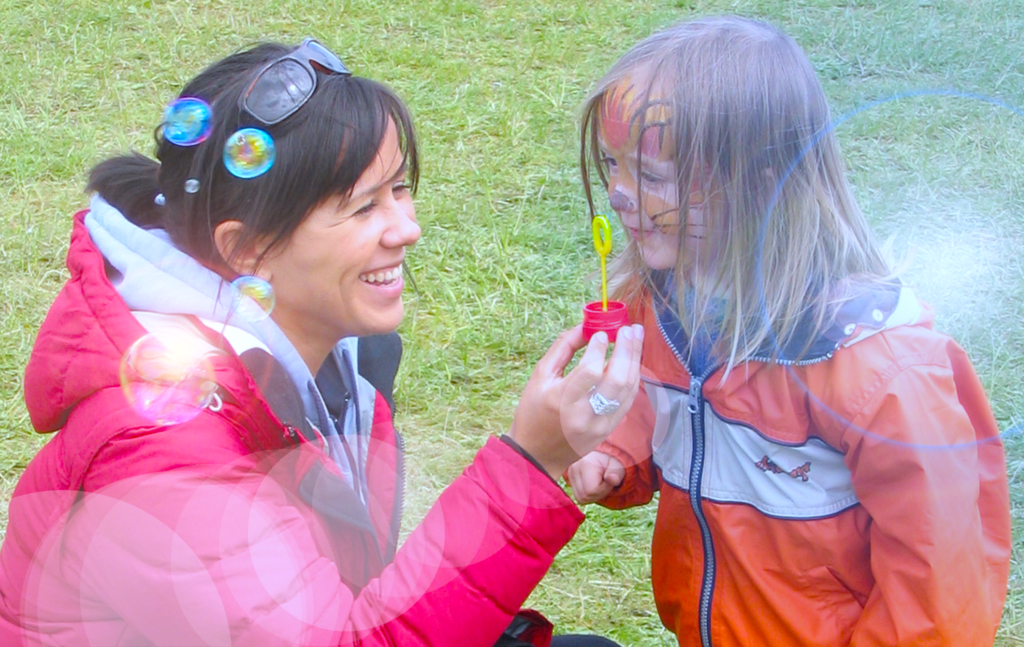
A young boy with long blond hair and his face painted like a tiger blows rainbow bubbles through a bubble wand that's being held by a smiling Hispanic woman who has long black hair.

In 2023 the CDC released this report, which pertains to data that has since been removed from the CDC’s website, because it referred to what the Trump administration calls “harmful” “gender ideologies.” But here’s the meat of the report. The first statistics are referring to teen girls:

  • Nearly 1 in 3 (30%) seriously considered attempting suicide—up nearly 60% from a decade ago.
  • 1 in 5 (18%) experienced sexual violence in the past year—up 20% since 2017, when CDC started monitoring this measure.
  • More than 1 in 10 (14%) had ever been forced to have sex—up 27% since 2019 and the first increase since CDC began monitoring this measure.

The report also found more than half (52%) of LGBQ+ students had recently experienced poor mental health and, concerningly, that more than 1 in 5 (22%) attempted suicide in the past year. Trend data are not available for students who identify as LGBQ+ due to changes in survey methods.

Findings by race and ethnicity also show high and worsening levels of persistent sadness or hopelessness across all racial and ethnic groups; and that reported suicide attempts increased among Black youth and White youth.

***

Let that sink in. What did you think? What did you feel? I am in tears.

My tears are not because I’m a parent of two beautiful newly-fledged children whose safety I fear for every day. They’re not because I’m a woman who knows from personal experience as well as any woman does that the increasing rate of sexual violence still only begins to touch the true horror of our lives as objects. My tears are not even because one of my children is female, and now attends frat parties. My tears are because this damned report says ‘LGBQ+’. My tears are because there is no T.

My tears are because, among the many children I’ve taught and known and loved over the years are a couple handfuls of trans kids, whose stories and hearts and lives matter. Because the rate of depression, suicide, and violence that looks alarming in this CDC report is much higher for trans kids than for anybody else, and it’s not documented, here. My tears are for Marlin, my beautiful trans cousin who struggled with extreme depression and finally killed himself just after Trump was elected, the first time.

And my tears are pointless. Just like hopes and prayers are pointless. All the billions of tears shed for the children we’ve lost will not save all the children we have yet to lose. Our tears are pointless. We have to act.

And what if we don’t know any trans kids? What if our kids are straight, cisgender*, white, wealthy and male? Why should we care? We should care because, in a world where it’s OK to erase people for being trans, it is also OK to erase people for being gay, disabled, non-white, female, or poor. And eventually to erase anyone, for looking different in any small way; for making a mistake or getting sick. And even if our kids are among the privileged few, that world is not a safe place to be. A safe world values everyone. Even the rich. Even trans kids. And besides, we don’t actually know how our kids identify, especially if we haven’t built a world where they feel safe enough to tell us. So what can we do to build this safe world?

My first act after the gut-kick of seeing trans children erased is to write this article. And I will never, ever shut up. I will write more and open my mouth more, and speak up against every ignorant human who tries to tell me they’re saving the children by persecuting trans kids (yeah this isn’t my first walk around the block, in this regard). I will keep wearing the ally pin my kids gave me a couple of years ago, not only because I’m so very proud that they see who I am, but mostly because I know that some frightened child might see the rainbow on my lapel and know that I care; that I will stick up for them, even when they don’t know about it. I wish I had known what Marlin was going through before he died. I wish I’d been able to help him. I wish millions of us had built a safe world for him to grow into, long before he changed his pronouns.

I’ve been asking myself since I was a teenager how I can support LGBTQ+ people in my community. Ever since a boy my age followed my friend and me home, nagging us—either of us—to date him. So I told him we were gay. It was a lie, and half-joking (I had NO idea at that point the severity of what LGBTQ+ people were experiencing.) I thought I could throw him off by making us unavailable to him. His response was, “well that’s a waste of two beautiful girls!” It stuck with me forever. I still think about it. The fact that we were unavailable to men made us a waste. Worthless. That response lit a fire under my butt that has never been extinguished.

It turned out my friend actually was gay, as was my other best friend at the time. And as the years went on, I discovered that more and more of the people I loved were treading the terrifying social swamp of being unavailable to straight cis white men. At around the same time, I found a porno magazine (in the possession of ten-year-old boys) with a photo-rich article about a man converting a lesbian by raping her. That lit another fire. Literally. I stole the magazine and burned it.

And then I had kids. And I had to protect them from the harms leering at them from every corner. And as the number of trans kids we knew grew and grew, and as my own kids educated me about gender and inclusivity, the fire under my butt grew and grew, too. And then we lost Marlin. And now he and every other trans kid I know has been erased. Now the fire is so big I’m a damned rocket. And what are you?

How are you going to protect your kids? How will you make sure they know that if they come home with a new girlfriend or boyfriend or non-binary partner you’ll be delighted, enthusiastic and welcoming? What about if they come home with a new name or pronouns? Will you learn what they know, and follow? Will you stand up for their rights when they decide to start hormone therapy? Will you wear the trans flag when you take them to the doctor?

We adults often think we’ve learned all the stuff. We think it’s up to us to teach the children, but it’s the other way around. We need them to show us how to use our phones, and we need them to teach us about gender and sexuality. Because they know. Yeah. Sexuality. Let go of your pearls. Our kids knew before we taught them the word ‘vagina’. Some of them were raped before that. We need them to teach us what they know, and we need to be open to hearing it. We also need to admit when we’re wrong.

A bunch of years ago, I was walking home with my young teenage daughter, and announced that I was so proud she was non-binary. I was also proud of myself for having recently learned this word.

“Um…” she faltered. “I’m not sure you know what that word means.”

I swallowed. “I thought it means you don’t see or stereotype people for their genders. Like it’s not all black and white. I’m proud that you see the diversity of people.”

“No, Mama.” She corrected me gently. “It means you don’t subscribe to gender binary.”

“Right? That’s sort of what I said, right?”

“No, like personally you don’t subscribe. For your identity. If I was non-binary, I wouldn’t consider myself male or female. I would probably use the pronouns they/them.” She walked on beside me like what she was explaining was just part of everyday knowledge, and I guess to her, it was. “I’m definitely female,” she said. “And Tali is definitely male. Even Marlin was definitely male. But if someone is non-binary they wouldn’t be either one. They’d be non-binary.”

At the mention of Marlin, the conversation became a lot less jovial. I was sorry I hadn’t understood, and I felt very small. Sad. Like suddenly maybe my misunderstanding presented a hazard to my daughter’s safety, even though she is cis. What else did I not understand? But she was forgiving, and understanding of my mistake. “Sorry, Mama,” she said.

“It’s OK.” I swallowed my shame and carried on. “So do you have any non-binary friends?” Out of respect for her friends’ privacy, she couldn’t tell me. And I was proud of that, too.

I’ve learned a lot. It turns out non-binary people can also identify as male or female. The gender umbrella is diverse!! And it’s OK to be confused. It’s a great place from which to build curiosity. My kids moved out a few years ago now, and are still my greatest teachers in many ways, especially where culture, inclusivity, and love are concerned.

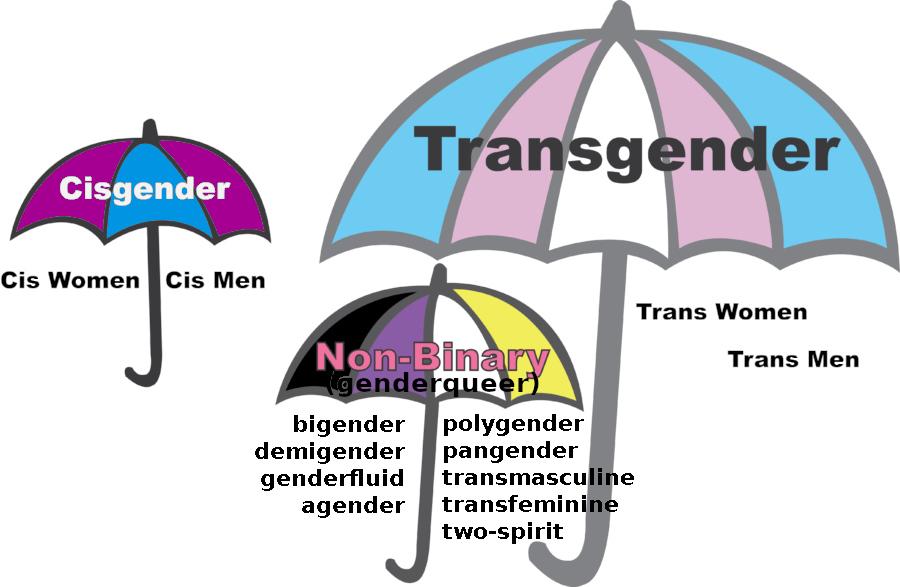
Three umbrellas provide a visualization for gender identity terminologies. On the left, a dark pink and blue umbrella (cisgender flag colours) says 'cisgender', and shelters the words 'cis women' and 'cis men'. On the right, a large umbrella in the colours pastel blue, pastel pink and white (trans flag colours) says 'transgender, and shelters the words 'trans women' and 'trans men', as well as a smaller umbrella, that says 'non-binary', and 'genderqueer' in parentheses. This non-binary umbrella is black, purple, white and yellow--the colours of the non-binary flag. Under this non-binary umbrella is a list of words representing some of the many diverse non-binary identities: bigender, demigender, genderfluid, agender, polygender, pangender, transmasculine, transfeminine, and two-spirit.
graphic used and adapted with permission from Gayta Science

Love. Yes, there has to be a fire under our butt. And it has to be fuelled by love. Where the rise of fascism is tearing at the already-shredded fabric of our diverse society, we have to wipe away our tears and start building, with love.

How do we build a safe and inclusive society? We have to swallow our fear and pride and shame and speak up at every opportunity, to wear the colours that show we’re safe adults, to teach other adults what our children teach us, and mostly we have to listen with open arms and open hearts, because many of our children are light-years ahead of us in doing this work. The answer is openness and curiosity.

What I think this all comes down to is that as people with a certain amount of privilege, and sometimes very little understanding of the LGBTQ+ world, we cis parents can still be part of the solution. We can look at the children we love with curiosity and respect. We can amplify their voices and knowledge and build the world they envision. And we can see and support the many safe spaces that empowered LGBTQ+ people are building, already. Because they are powerful. We are powerful. And when our power comes from love, we are all empowered, together.

My cousin Starry, Marlin’s mother, has been a guiding light for me, in my efforts to expand my mind, following the loss of Marlin. When he died, most of us in the family didn’t even know he was ‘he’, or calling himself Marlin. We hadn’t built the kind of safe space in our relationship that he needed to be himself, with us. It was Starry who informed me who he was, despite her pain. Starry, as you might imagine, suffered deeply with the loss of her child. And as the years have gone by, she not only received support in her loss from trans youth, but has also intentionally made herself and her presence a safe space for LGBTQ+ people. She continuously educates herself, and has three trans “foster daughters”, now. Loving others doesn’t only help those we love, it helps us too. Love is always the answer.

So let’s go. It’s Pride season, but it should always be Pride season. Let’s stoke our fires and make sure we’re building and supporting safe spaces, with love.

***

My own children, as well as Marlin’s surviving family members gave their consent to my mentioning of them, in this article. Consent-seeking is part of building safe spaces. I’m grateful for advice and feedback on the article from my own children, and Starry’s friends. Listening and hearing others’ opinions is part of building safe spaces.

Definitions, Links

*The word cisgender (often shortened to cis; sometimes cissexual) describes a person whose gender identity corresponds to their sex assigned at birth, i.e., someone who is not transgender. (Wikipedia: https://en.wikipedia.org/wiki/Cisgender)

A transgender (often shortened to trans) person has a gender identity different from that typically associated with the sex they were assigned at birth. (Wikipedia: https://en.wikipedia.org/wiki/Transgender)

Non-binary or genderqueer gender identities are those that are outside the male/female gender binary. Non-binary identities often fall under the transgender umbrella since non-binary people typically identify with a gender that is different from the sex assigned to them at birth, although some non-binary people do not consider themselves transgender. (Wikipedia: https://en.wikipedia.org/wiki/Non-binary) AKA: gender non-conforming.

CDC Report: U.S. Teen Girls Experiencing Increased Sadness and Violencehttps://www.cdc.gov/media/releases/2023/p0213-yrbs.html

How to Be an Ally: https://queerintheworld.com/best-lgbt-ally/

Fascist Ideology: https://en.wikipedia.org/wiki/Fascism_and_ideology

The Safe Zone: An incredibly informative site, which also offers resources and training for allyship. https://thesafezoneproject.com

TransWhat? A very informative site created by trans teen, Adam, which I highly recommend for further reading! https://transwhat.org/

Gayta Science: Using data science to visualize and promote understanding of LGBTQ+ issues. https://www.gaytascience.com/

Performance in My Home Community!

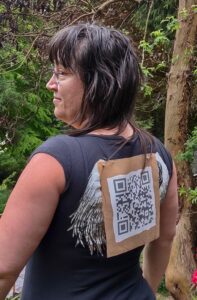
Artist Emily van Lidth de Jeude wearing a black t-shirt with wings on the back, and with a large QR code pinned to the back of her shirt. The QR code leads to a webpage that explains the (dis)robe: Hospital Gown project.

I'm so happy that the (dis)robe: Hospital Gown piece I made last year will be on display this autumn in Vancouver, but meanwhile… I get to wear it to an art event in my hometown, tonight!! This is will be the first time I've shown it locally, and I'm REALLY nervous. This piece is all about my disability, and to say people roll their eyes when I talk disability is an understatement. But this piece features other people from our community, too, so it's time to REPRESENT!!! Here I go! 

Off to the Bowen Island Community Centre. 🙂

Will update this post with a photo, later, if someone takes one. 

UPDATE:
It was a pretty quiet event, but nice to meet some other artists and visit with friends. I think only one person scanned the QR but that's OK! Here are some photos from before I actually put the gown back on and went inside…

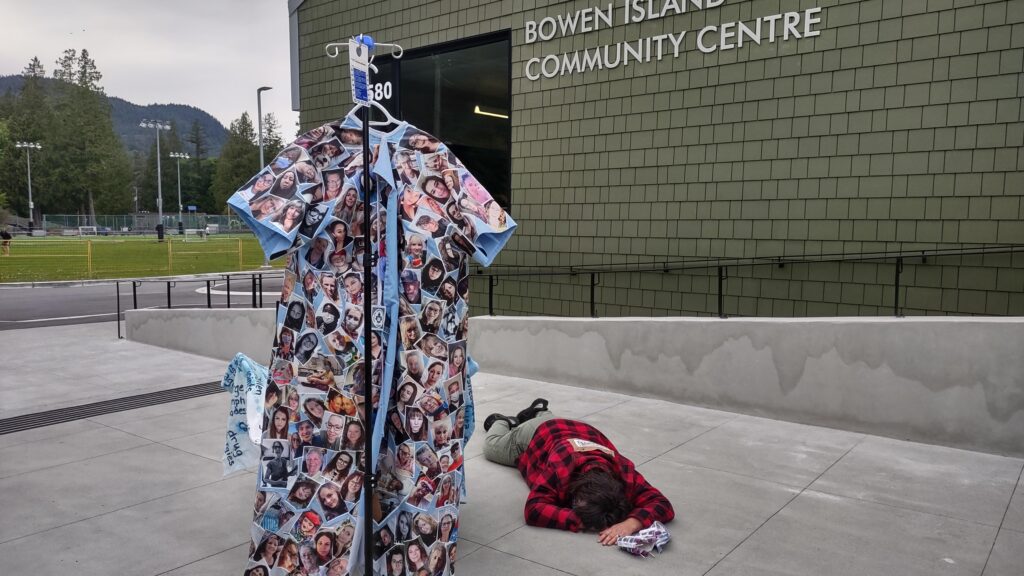
A photo of a blue hospital gown covered with the faces of over 300 Long Covid patients, hanging from an IV pole, standing on the concrete patio outside a building that says Bowen Island Community Centre. Artist Emily van Lidth de Jeude is lying on the ground, wearing a red lumber jacket, green pants, and with a QR code pinned to her back.
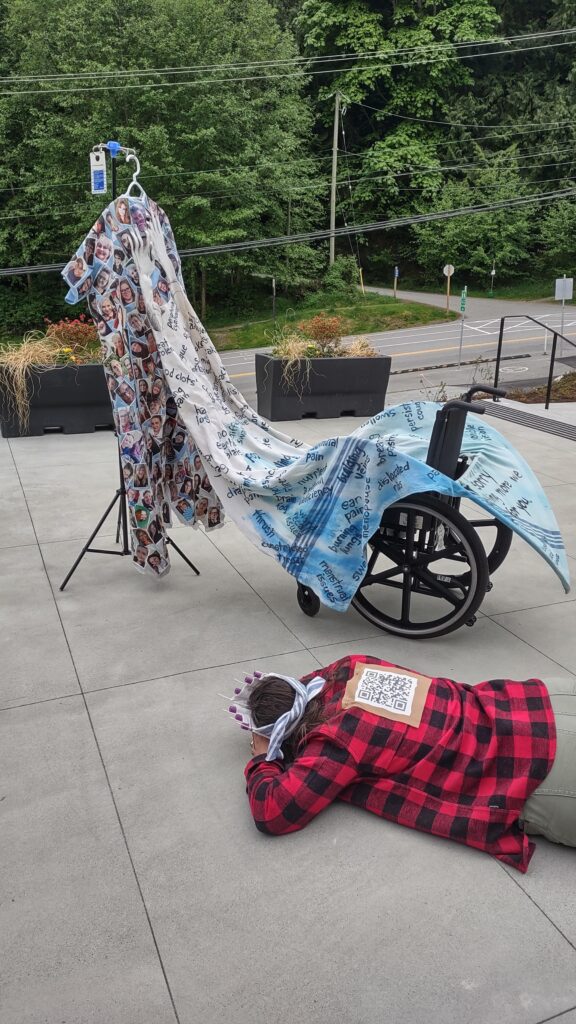
A different view of the blue hospital gown covered with the faces of over 300 Long Covid patients, hanging from an IV pole, standing on the concrete patio of the Bowen Island Community Centre, with planter boxes and a road, behind it. The back of the gown is now visible, where a long train made of a hospital blanket is attached to and covering a wheelchair. The train is covered with the names of common symptoms of Long Covid, and is attached to the back of the gown with a pair of white fabric hands. Artist Emily van Lidth de Jeude is lying on the ground, wearing a red lumber jacket, green pants, and with a QR code pinned to her back. She is wearing a crown made of hospital blanket, blood vials, and covid testing kits.
Thanks to my partner Markus, not only for these photos, but for always supporting me both in life and in art. If you're wondering where that QR code points, here's the link: https://emilyvanartist.noblogs.org/qr/

I Made a Dead Rooster Prop!

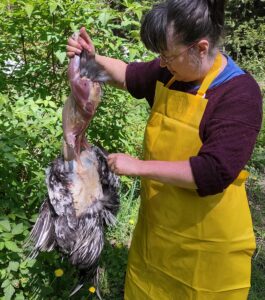
Artist Emily van Lidth de Jeude wearing a burgundy sweater and yellow plastic apron, holding up a skinned chicken by its hind legs. In her left hand she's holding a sharp knife, slowly working the pelt off of the wings.
Skinning the rooster.

It happened like this. Just after we discussed the stage floor I was painting, the director cycled back to my house and knocked on the door again. "Emily?" He called into my house. "Emily, I forgot to ask. Could you make us a rooster prop? It's to look like it's been killed by a fox. Although that may or may not have actually happened."

I was astounded! And thrilled!! "Of COURSE I can!!" I knew the play was pretty serious — Dancing at Lughnasadh. So this prop was a serious prop. Well… as serious as a pretend killed rooster can be, I guess. I was deeply honoured that the director thought I'd be up for the task.

There is no way I can easily make a fabric rooster puppet that looks real, and dead. So the first thing to do was to find a rooster that was headed for a pot, anyway. I was given this guy. He was sadly doomed, after his owners had searched for a home, to no avail. So on the appointed day, I picked him up, thanked him for his donation to my freezer and the arts, and butchered him. He made meat, bone broth, liver pate for me to eat, and a pair of feet and a beautiful feathered pelt for the prop. I tried saving his beak, too, but didn't like how small and dark it was, and decided that this rooster prop was going to need a yellow beak.

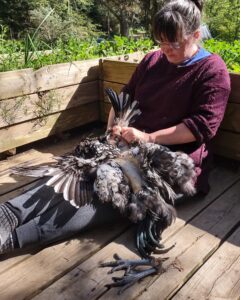
Artist Emily van Lidth de Jeude, sitting on a porch, leaning against vegetable planter boxes full of clover, onions, and spinach, while working a whole rooster hide on her lap. The rooster's drying feet are sitting beside her on the porch.
Working the hide.

I've plucked and slaughtered a LOT of chickens in my life, and plenty of rabbits, too, whose skin comes off so easily, like peeling off a knee-sock from a foot. Rooster skin–with feathers, wings, and tail attached, is not like that!! It took some careful consideration to get it done properly, bones removed (all but the Pope's nose and the wing-tips), and with all the feathers still in tact.

I worked a long time to get the skin clean, and then I tried to dry him. I've never done taxidermy before, and it turns out a bird is not the easiest thing to start with. Then it turns out I also have no experience. Oh wait–I said that already. But it turned out to be a problem!! And this bird was fatty. I managed to dry his feet OK, but ended up removing the wings and tail feathers, as well as the ruff and saddle feathers. Ugh. All that work keeping his skin together, just to take him apart in the end!!!

Anyway, I made him a body out of old terrycloth and felt, and a bit of armature wire for a basic spine and rib structure; broken sate skewers sewn into the wings, too. I first made his wattle out of felt, but it looked awful, so ended up making a more floppy one of red velvet with rocks inside for that floppy weight a rooster's long wattle can have. He has rocks in his head, too, so it can dangle down, limply. Appropriately for a dead guy. If you know, you know. The wings had to dangle, too, when he's turned upside down and hung by a foot.

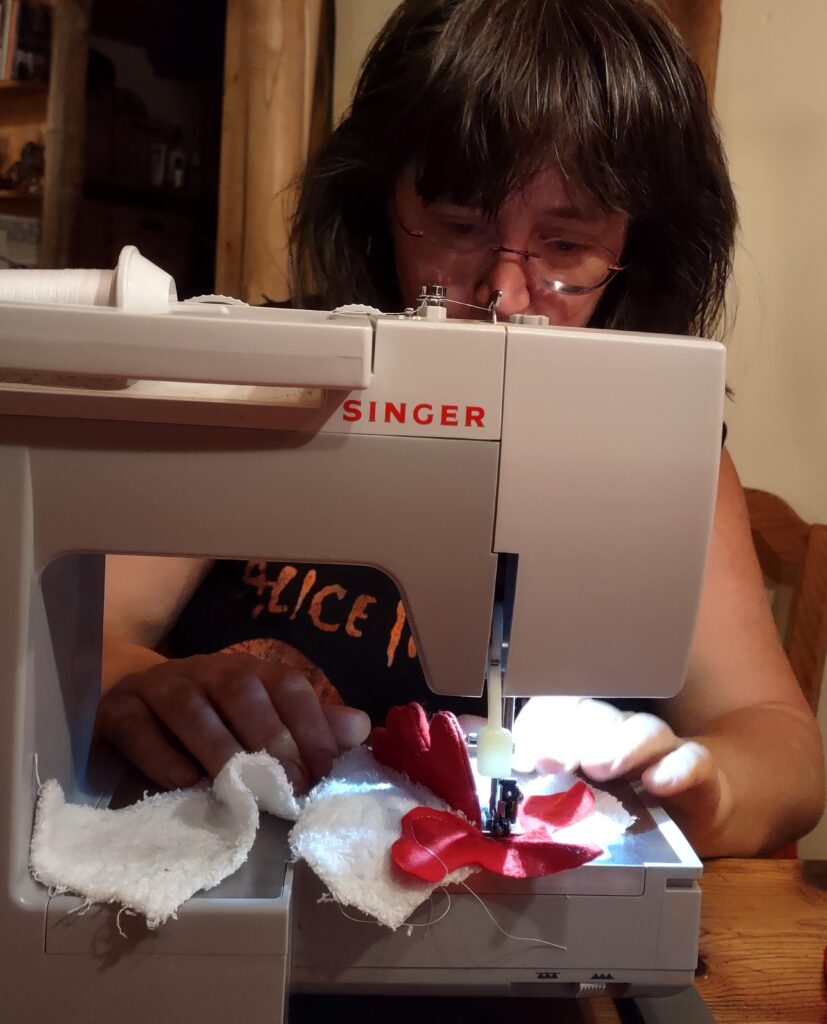
Artist Emily van Lidth de Jeude, seated at her sewing machine, wearing an Alice In Chains t-shirt, sewing a rooster head out of white terrycloth and red felt.
Sewing the rooster's head out of terrycloth and felt.

Another part of dead roosters–especially those that may have been killed by a fox–is the protrusion of some guts. You know if you've cleaned a rooster, you reach in and grab the gizzard, and then the liver and intestines come out along with it. I didn't make this guy a gizzard, but I did make him some intestines and a liver. And I filled the intestines with lentils to make them dangle properly. Well, I hope he enjoyed his meal.

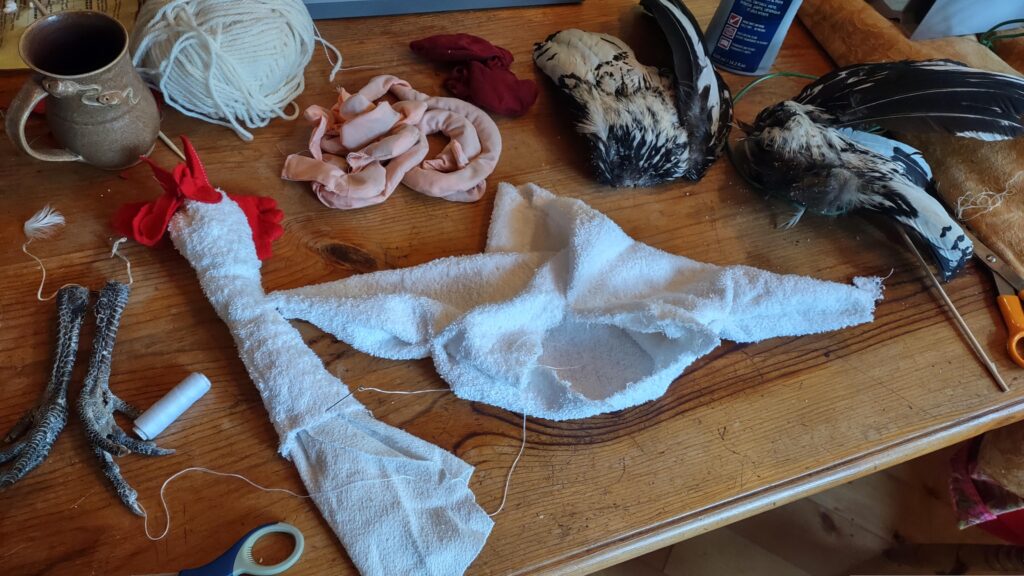
On a table is a spread of rooster-puppet parts: Two dried rooster feet, a stuffed neck and head made of fabrics, a yet-unstuffed body made of white terrycloth, two real rooster wings, a heap of intestines made of pink cotton and stuffed with dry lentils, and a liver made of burgundy fabric. Also on the table are thread, scissors, yarn, glue, feathers, wooden skewers, and a cup of tea.
Various rooster parts in progress, waiting to come together.

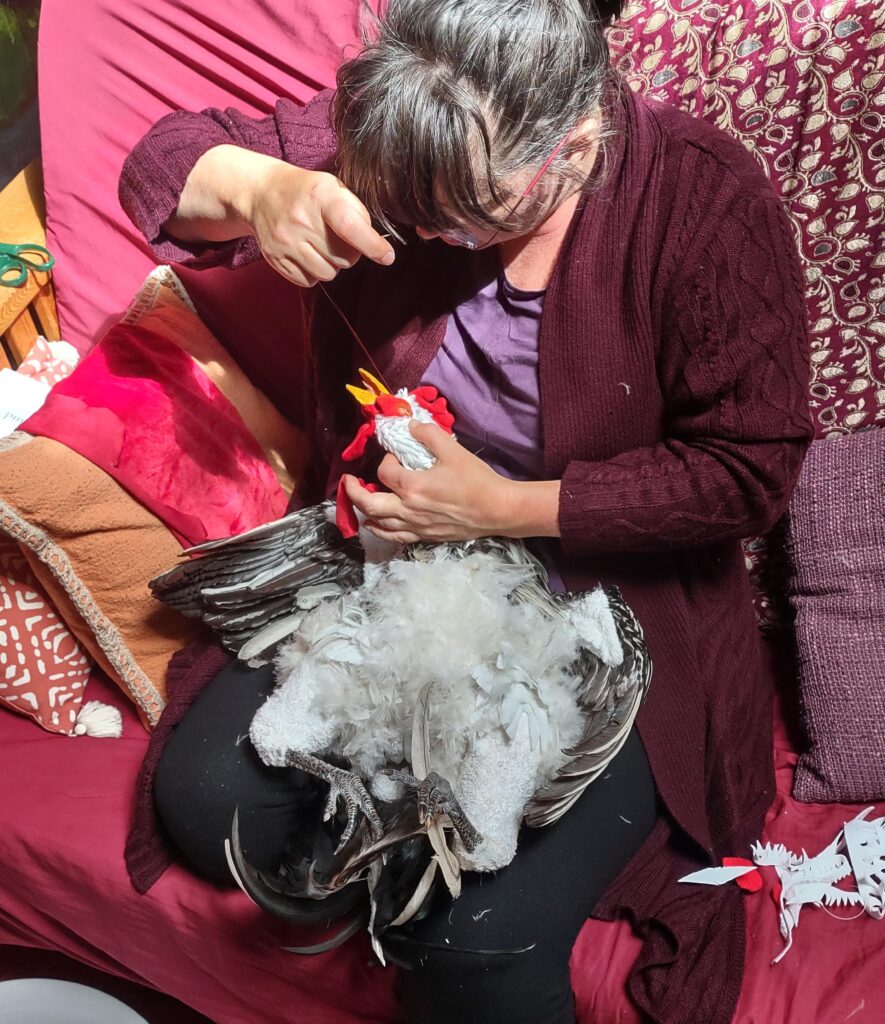
Then I had to sew on his feet and wing parts, and many many many feathers, both real and made of felt. I also painted his face and beak. Way better.

Artist Emily van Lidth de Jeude sits on a couch surrounded by brightly-coloured pillows, holding the nearly-complete rooster puppet on her lap. She tenderly holds his head in her left hand, while sewing tiny white felt feathers onto his face with her right hand. Beside her on the couch is a small pile pieces waiting to be attached: white felt feathers in two sizes, and red felt wattles.
Sewing his hundreds of tiny white felt feathers on!

So… Here's my dead rooster prop! I hope you like him. I put up a video on my MakerTube if you'd like to see the finished puppet:

https://makertube.net/w/cB27cL8EMFQXF27GkXXC4g

The Medicine Forest my Parents Gave Me: how exploring and knowing our place in the ecosystem builds resilience

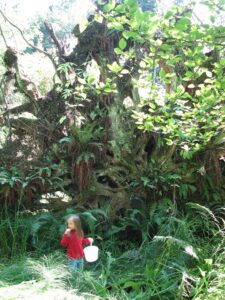
A young long-haired boy in a red turtleneck and jeans stands with a bucket and a handfull of greens held to his mouth, in a grassy forest. He's in front of a huge wall of roots -- an upturned tree -- that is six times taller than he is.
Taliesin picking berries in front of a root tower.

Once I lost my son in the forest. We were heading home through ferns taller than his three-year-old self, he carrying a harvest of licorice ferns and I carrying his baby sister and some oyster mushrooms. He followed along behind me, and when I turned around, he was gone. I called repeatedly. I retraced my steps. I gripped by baby girl to my chest and started running, panicking, and– there he was, nestled into a sword fern, chewing on a piece of licorice fern root. He looked up blandly at my stricken face and said "I'm just havin' some licorice root." His trance-like state may have been induced by the well-known calming medicine of licorice fern, or it may have been just his joyful state of mind after a couple of hours spent wandering the forest with his mother and sister.  

My kids and I spent part of most days of their childhood out in the forest, exploring. That's what I did as a mother because it's what I knew to do from my own childhood, spent here in this same little west coast paradise. When my head hurts, I go outside. Maybe I chew an alder leaf like the wild aspirin that it is; maybe I just lift my face to the fresh air, sun or rain. When my heart hurts, I lie in the moss and let it soak up my tears. Licorice fern soothes me; so does the feeling of bark, or the creek water between my toes. When I'm hungry, I eat beans off the vine on my porch, or berries and other treats from the woods; when I'm hungry for adventure I go exploring in my medicine forest. I made up that word. Medicine Forest. It's like a permaculture food forest, but with emphasis on its healing power. My parents didn't purposely give me a medicine forest, but they did give it to me, and I'm passing it on to my children. Let me explain.

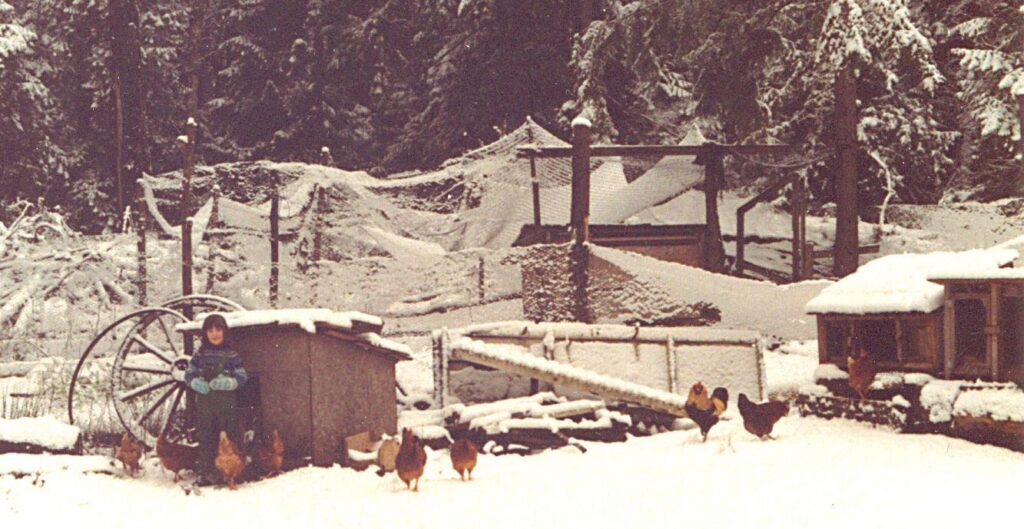
A young girl in a blue sweater and mittens stands in the snow among a whole bunch of chickens, some standing wooden wagon wheels, and various small coops and garden fences.
That's me with our chickens in the early 1980's, rabbit hutches on the right, and winter-covered veggie garden, behind.

I grew up in a pretty typical single family house – a modified double-wide mobile home, actually – on a five-acre piece of land that my parents purchased in 1980. This land was forest when they bought it. We used to come up here and have a picnic on the slope they hoped would one day be their building site. They let my brother and me free-range all over this place, climbing trees, damming creeks, digging great big holes and picking and using whatever plants we felt like, as they slowly cleared the land and built up what is now a developed property. We raised chickens, meat rabbits, and pigs (but only once because the experience was too heartbreaking for all of us to repeat). My parents grew food crops and allowed us to plant our own experimental gardens, while also insisting that we should help with the family food operations. My brother and I were never forced to kill or butcher animals, but because our parents nurtured our curiosity, we both knew how to clean a rabbit or chicken by the time we were twelve, and by the time we were fifteen we could cook a good family meal from the foods we'd grown or wildcrafted. We didn't even know the word wildcraft, though. We were just "picking nettles", or "finding a mushroom."

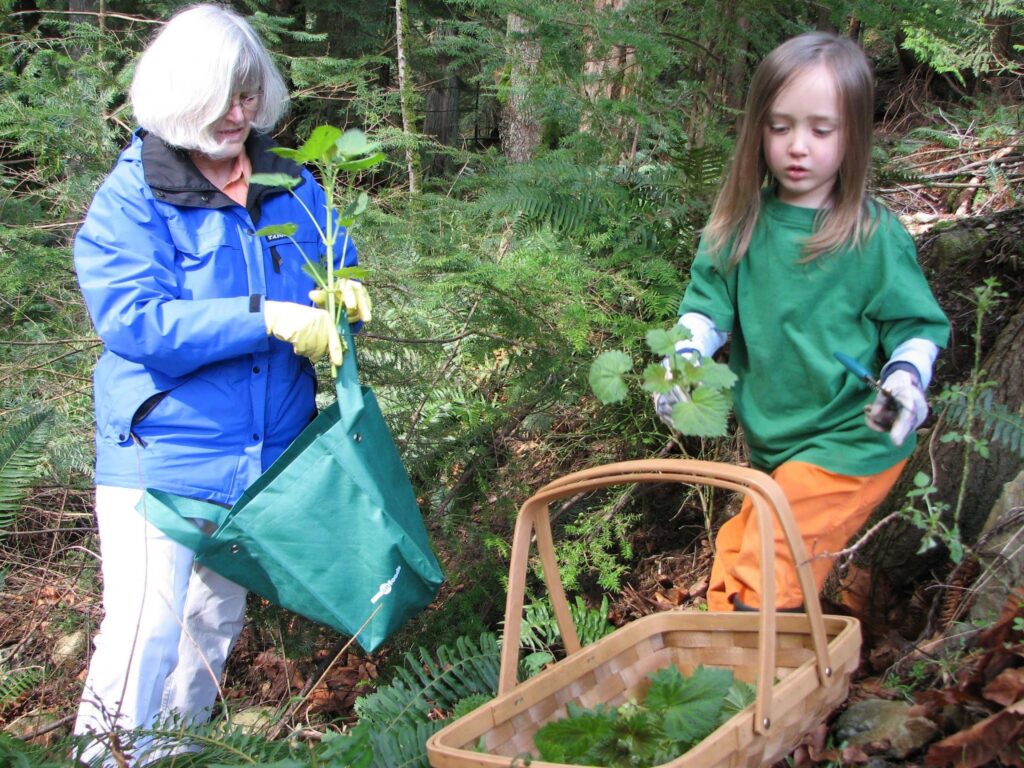
A white-haired woman and a young long-haired boy stand among ferns and nettles and wild berry plants, picking nettles and putting them into a shopping bag and a wicker basket.
My son helping my mother pick nettles in the late 2000's.

Living in and with the forest our parents were busy turning into a home was just "life". We could pick indigenous trailing blackberries from the hillside, invasive Himalayan blackberries from the place Pappa was trying to get them out of the creek, or cultivated boysenberries from Mum's garden. Same difference. They all make good pie, if you don't eat them all before getting them home. And whether they make it home or not, your belly is full with the food, your heart is full of the joy, and your mind is full of knowing every detail of your home. That's a medicine forest. It's a place where everything is living and growing together — humans included. It's a place you've grown so connected to that just living there heals you from the inside out.

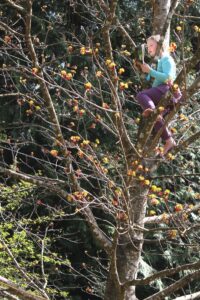
A young girl with long hair, shirt, pants, and bare feet, sits among the upper branches of a maple tree, her arms woven through the branches, holding a book she is reading.
My daughter reading in a tree she knows every inch of.

Somehow through my own teaching and parenting over the years I have come to recognize that, just like the best learning happens when we're inspired by connections to our own experience, the best living happens when we're connected to everything around us. Think of it this way: you care much more about your own backyard than someone else's. You have a lot more interest in your own little potted plant than in the weed at the edge of the pavement, or some tree in a forest far away. So somebody teaching you about a baobab tree might have a bit of a tough job keeping your interest. But what if that tree was yours? My friend went to Africa and really got to know baobab trees – and they became hers. When we connect personally with things, they matter, and mattering strengthens our neural pathways. That's great for learning, but how does this have to do with my medicine forest? Well, this place matters to me. It matters so much that I've spent about thirty years of my life exploring here, both as a child and now with my own now-grown children. I know exactly which part of which slope of which creek has the best clay for sculpting, and which part will still have a pool of water and some desperately-hungry trout in August. I know where the elusive white slugs live. I know how berries' flavours change with the weather and with the time of day. This deep understanding of my little wilderness is my connection, and it's why this place is my medicine.

On top of being important to my own health, my experience of exploring this place has made me resourceful and resilient. We all learn more from observing the people around us than from being taught conventionally, and I learned from watching my parents develop this land; their need to be resourceful when we had no electricity, no toilet, or no income. I learned from watching them not just survive here, but keep working even in the face of failure to find joy and wellness in whatever this land and life had to offer. The moss is not my weeping pillow because I'm an idyllic child from a book about fairies; it's my pillow because sometimes I was just plain too sad, as a child, and the moss was what I found to comfort me. My kids didn't harvest nettles for brownie points or allowance; they donned gloves and harvested them just because that's what we do for Easter. They got stung and they complained to me, but they also delighted in testing their brawn by picking them bare-fingered or by eating them raw. They were building resilience, just like I once did. This year they both came home for Easter and actually wanted to go nettle picking. They want to reconnect to and eat food from their own ecology. We're in this ecosystem for better and worse and every day that falls in between. Like the plants, we'll thrive or die as part of this, so we're doing our best to thrive.

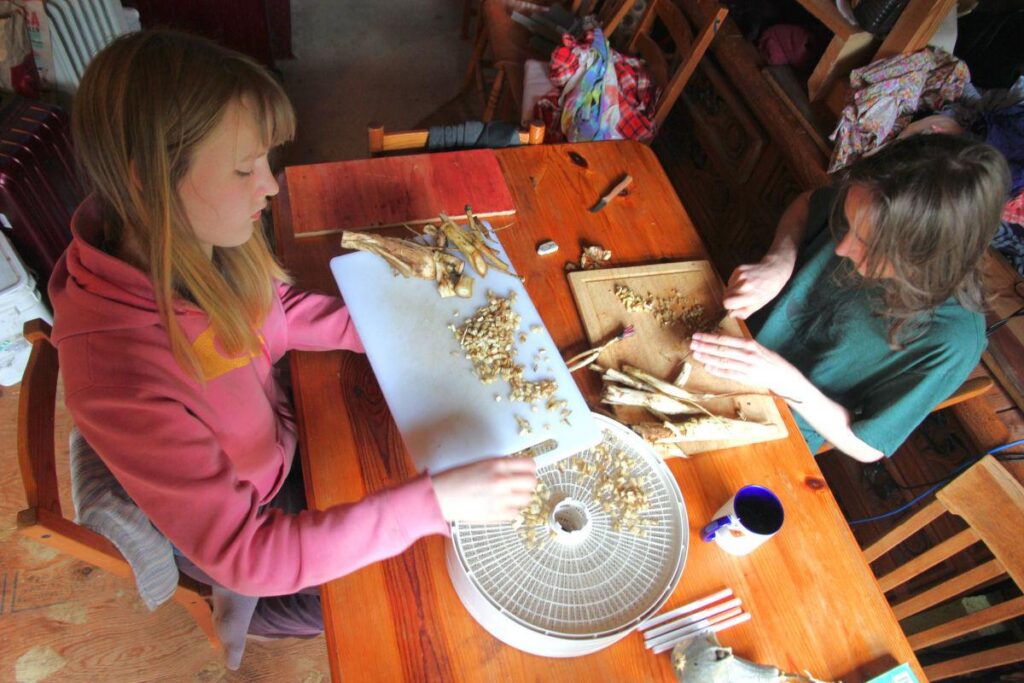
Two teenagers sit at a table, cutting burdock root into small pieces and laying them on dehydrator trays, for drying.
My kids at fifteen and eighteen processing wild burdock root for tea.

The business of gardening and developing the physical ecosystem is nowhere near as idyllic as I imagine it sounds. There are brutal realities in nature that hurt like hell. Our crops fail, our chickens get sick and I have to put them down; sometimes we fight and resent each other's impact in the ecosystem. Sometimes money is short, time runs out, and family or world tragedy makes us doubt we can succeed. But experiencing these things, feeling them and accepting them is part of the whole picture. My medicine forest is the ecological basket that holds our family, and the love and knowledge we cultivate here, among the weeds and the crops and the chickens, the weather and the water and our own bodies living. When I leave this place, my medicine forest is carried in the knowledge of my body and mind, to nourish and grow with other ecosystems. It's a conscious choice I make to see my surroundings and live in health with them, as a part of them. 

In a monoculture garden, one invasion of a particularly voracious insect can wipe out a whole crop, with nothing remaining to re-seed. The earth itself becomes a barren place, unable to nurture new-fallen seeds without significant help from humans. In a food forest, insects may devour a plant here or there, but the diversity of the community will discourage any one plant or insect from taking over, and thus ensure that enough remains to keep the community thriving. The dead plants along with the dead insects and the droppings of all those who foraged in the forest will feed the earth, ensuring that all the fallen seeds have at least a chance to grow. In fact, the richness of the soil even means the earth will hold more water, making everything thrive more easily.

My parents have asked me how I came to know all these things, and I said "from you", because it was their willingness to let me explore that gave me the gift of knowing my ecosystem. It was their willingness to let me grow my own experimental gardens, and now to rent us a piece of their land and still let me grow my own experimental gardens that gave me the gift of my medicine forest. Sometimes they don't like the look of my unkempt yard, my son's experimental tree fort project, or the weed piles I leave laying around. But they let me and their grandchildren keep living and exploring here, because they're watching the growth of our medicine forest. And sometimes – just once in a long while – we discover things we can teach them, too. Explorative parenting is like that. It's looking at the whole family as a forest instead of one plant seeding another. Our family is like a forest of possibility, where everybody lives in community, exploring and discovering and balancing and sharing, as we all put our roots further and further down, and our branches further and further to the sky.

See my Outdoor Explorations video on this topic, here: https://www.youtube.com/watch?v=ytWMYS6qTOE

How Women Create the World We Want to See

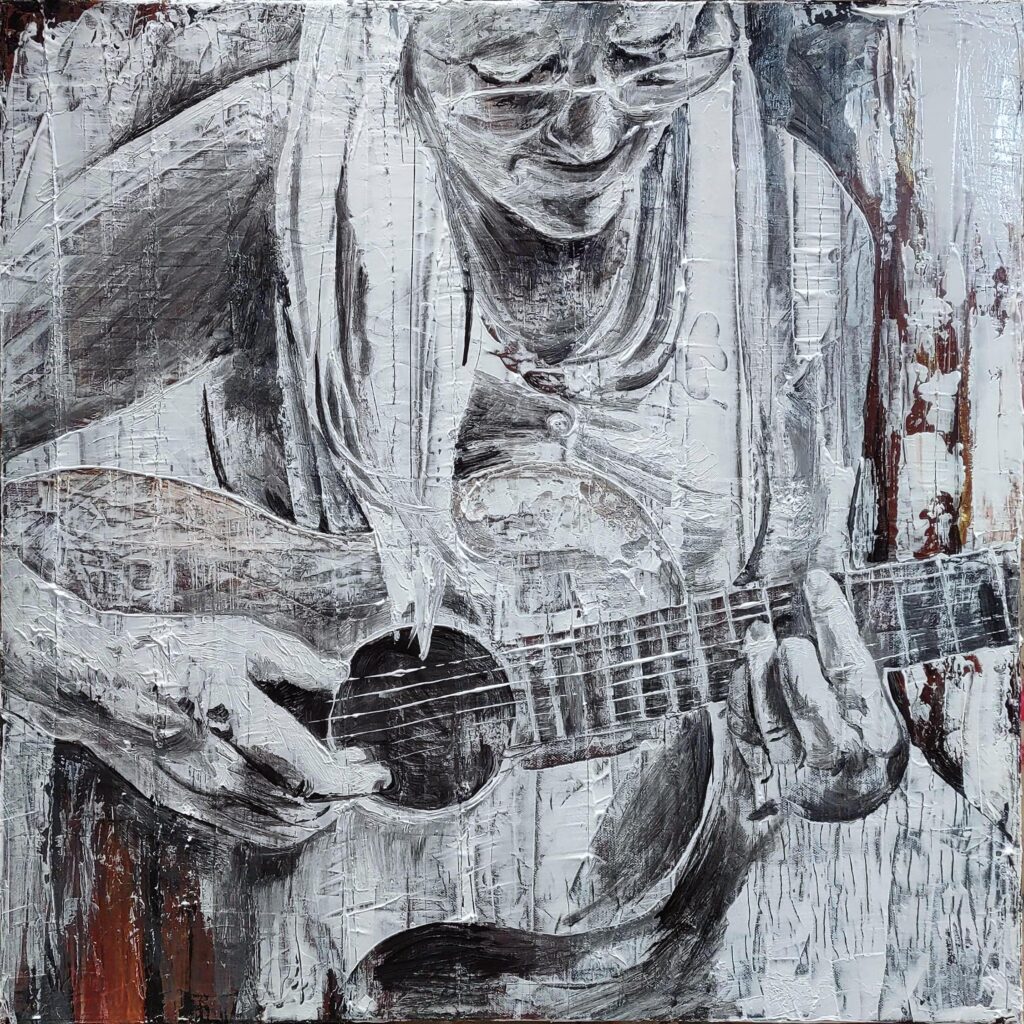
Black and white painting of a woman smiling, eyes and long straight hair cast down over a classical guitar that she is playing.
Acrylic portrait of my mother, Lyn van Lidth de Jeude, with her guitar.

My hands held on strong to the red plastic hand-grips of my BMX. No handlebar tassels for me, but I could get to where I was going when I needed to, and today I was rolling home, dragging the toes of my runners along the sharp shale of our driveway.

I could hear Mum’s voice and guitar getting slowly louder as I went. The door of our green and white metal-clad trailer stood open to the wind and the May bird-song, and the familiar sounds of my mother drifted out onto the afternoon. As I dumped my bike against the dog-house and stepped up the porch to the sounds I knew so well, her words filled my mind:

Everybody thinks my head's full of nothin’
Wants to put his special stuff in
Fill the space with candy wrappers
Keep out sex and revolution
But there's no hole in my head
Too bad*

I was mildly alarmed. Not so much because Mum was obviously singing about a gunshot to the head—horrific bloody murder was typical of the traditional ballads we sang together—but because she said 'sex'! Who wants to think about that anyway! I stood there with my mouth open, and Mum looked up from her guitar, her small hands pausing in mid-air formation, as if holding the song until I’d greeted her

“Hi.”

She smiled the beautiful upside-down rainbow of a smile that pulls the pointy sides of her lips up toward her cheeks. “Hi honey!” She called across our mustard-yellow carpet to the tiles where my runners held me fast to the floor. “Have you packed your bag for the folk retreat?”

“I hope you’re not singing that there.” I said without hesitation.

Mum’s pointy smile went flat and her eyes seemed to darken. “I hope I am!” She declared. “This is a Malvina Reynolds song! Not exactly folk, but definitely important to sing. You could sing it with me.”

She must be joking. I’d never sing that word. Too bad!

“It’s about being a woman,” Mum continued, totally oblivious, apparently, to my disgust.

Her hands began to sink, now, and I knew she was going to explain something. I didn’t want to hear it. But she did, anyway. Mum told me that Malvina Reynolds was born even before Grandma. That she wrote a song about ticky-tacky houses, just like the one Mum grew up in, in Mill Valley, where she knew how to find the bathroom in any of her friends’ homes because they were all exactly the same. Mum said Malvina knew what mattered in the world. She supposedly told her husband to drive their car so she could write the ticky-tacky song, because she knew when she needed to make her voice heard. Mum said Malvina was not afraid to speak and do the things that mattered, and I shouldn’t be, either.

Mum says a lot of things that Pappa and Daddy say are ‘wishful thinking’. But she never gives up.

Mum looked into my eyes, then, and then down at her hands as they began to pluck the strings again. I took off my runners as she began to play.

Call me a dupe of this and the other
Call me a puppet on a string, they
They don't know my head's full of me
And that I have my own special thing

I thought about how Mum still makes the dinner while Pappa eats his peanuts and watches the news. I didn’t have a whole lot of respect for her, as a feminist. She eyed me as I walked by, and interjected into her song: “You know women weren’t even allowed to have a credit card until the year before you were born.” Then she smiled and continued:

And there's no hole in my head
Too bad

Mum’s face looked so proud when she sang this song. Even though she said the word ‘sex.’ She said she’s not afraid of it. She said it was still legal, in some places, at that time, for husbands to rape their wives. Mum told me that she and Pappa had to sue Daddy for infidelity because even though they’d been separated for years, he refused to sue her for it, and without one of them suing the other, they weren’t allowed to have a divorce. And that’s just stupid. But Mum said things are changing. And every change matters.

I have lived since early childhood
Figuring out what's going on, I
I know what hurts, I know what's easy
When to stand and when to run
And there's no hole in my head
Too bad

It’s been a long, long time since that day I first heard No Hole in My Head, played on my mother’s Washburn guitar and sung by her beautiful voice. But I can still hear it. Even though Mum died last year, and the months without her voice are piling up on the story of my life like the layers of plough-mud that eventually bury the whitest snow.

It’s spring, again. It’s almost May. I’m almost fifty years old, and women’s rights—the ones our mothers and grandmothers and great grandmothers fought and sang and laboured for—are being stripped from us, one by one, day by day, while we look the other way.

It’s not that we’re stupid or blind; some of us have just forgotten how important the work was for our mothers, and how beautiful. We’ve become distracted, almost as if it was somebody’s plan, by the necessities of working double jobs while raising kids in a society that is ever-harder to survive in. We’ve become distracted by the ticky-tacky houses that became the norm; by the products and the must-haves and the must-do’s and fear of not measuring up or out or small enough. We forgot to look away from the people who told us we can’t, and to write our own world that’s different, and hopeful and strong. We forgot that wishful thinking is exactly what dreams are made of, and that dreams are pathways to growth. Revolution. Societal evolution.

We forgot that we’re at the wheel.
We forgot that we are powerful.

In my little memory-video of Mum on the couch with her guitar that sings only for her hands, her voice carries on:

So please stop shouting in my ear, there's
Something I want to listen to, there's
A kind of birdsong up somewhere, there's
Feet walking the way I mean to go
And there's no hole in my head
Too bad

Mum loved birds. She knew all their voices and their migration and nesting habits. She created a garden where an incredible diversity of species could coexist and thrive, because she knew diversity was important in any system. Mum created a world where birds were welcome, safe, and thriving. She did the same for children, and anybody else whose circumstances made them feel weak or othered. She lifted people, and made them strong, with hopes they would lift others. Mum understood that others—especially those who are different from us—are an essential part of the whole, and she lifted their stories and voices. She loved adding harmonies and accompaniment to others’ songs. Mum worked to build the world she wanted to see, and she asked me to follow her lead, but she also followed mine.

I sang No Hole in My Head with my daughter and my son; I sang it at the folk retreat, too—even the word ‘sex’, because I don’t want to be held down by a word or an idea or a threat. I wrote my own songs and I drive my own car. I painted butterflies on my car, to make it beautiful but also to remind me that every small change leads to greater change, in the long run. I keep voting Green, even though they never win, and last year, for the first time, I elected a green candidate in my provincial riding. I will vote Green, again, because it’s right. Because I keep believing that we can build our dream. Together, we can build the world where all of us, and our ecology, matter.

Mum knew that grass-roots revolution isn’t a job for a leader or anybody with power; it’s a job for us all. The whole of us. No matter who gets elected, we have to keep working to fight for our rights and build our future. We have to make choices in every moment to follow the feet that are walking where we mean to go; to be the masses who are, inevitably, making the change. We have to stand up and speak out and not just break down the barriers we face, but turn to what’s beautiful and create the world we want to live in. We won’t all agree about how that world will look, but that’s exactly why it’s a job for all of us. If we all do what feels right, and we talk and listen and love, we will, as a whole, get to somewhere good.

It was hard work that our mothers did, building this world we’ve inherited. But it was also beautiful. Community is beautiful. Now it’s our own and our daughters' privilege to not bend to the world that crushes us; to not try to work within a system that holds us down, but to step out, sing loudly, and build this world, our way. Because there’s no hole in our head. Too bad.

*
Words and music by Malvina Reynolds
Copyright 1965 Schroder Music Co.(ASCAP) Renewed 1993.
Used by permission. All rights reserved.

Ralph

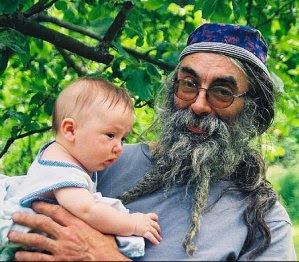
A close-up photo of a man holding a baby under an apple tree. The man has long grey and black hair and a braided beard. He is wearing a purple hat and a blue T-shirt, and holding the baby who is wearing a white summer shirt with pale blue trim.
Ralph holding my then three-month-old son, Taliesin.

It was a cloudy day in a November of my childhood when Uncle Ralph gave me my first carving tools. Of course, he wasn’t called ‘uncle’ yet, at the time, but never mind. I was probably about ten, and it was a rough time in my childhood, for a lot of reasons. If I’m remembering the correct occasion, he arrived without Auntie Lidia, alone on his motorcycle, round leather riding goggles pinching in the top of his hair while the rest of it flew out behind him. Even his beard flew along beside him as he rode down our driveway. He’d come by for my birthday, and I remember his wonderfully long brown eyebrows and much longer braided beard leaning down to me with a most beautiful leather bag held out in his dark hands that always looked more weathered than you might expect for a man his age. "Here. Got you this.” He said, and opened the bag to show me all the different types of tools he’d packed into it.

I remember thinking how annoying it was that he said he’d ‘got’ it for me, when it was clearly his own bag. Eventually I realized the gift had been much more special for having been his own bag, than if he’d just bought me something at a store. It was a piece of his heart. And he’d given that gift to me at a time I needed not only to be seen, but to have an outlet for my pain. I suppose Uncle Ralph’s outlet was creativity—often with carving—so he gave that to me.

Uncle Ralph was always carving. We’d be sitting at the beach and he’d pull out his pocket-knife and just start whittling a piece of driftwood. He even seemed to sometimes have a little carving in his pocket, which he’d randomly start working on, as we sat somewhere. The parents of our community built a playground for our new school, and of course Ralph was one of them. He carved a driftwood log into a horse that became burnished by a couple generations of children who rode to our adventures at recess. Ralph gave us adventure. He was a printmaker, as well, and once did a project with the older kids at school, where he taught them to make self-portraits in relief out of cardboard, and then together with them built a cardboard bus, in the windows of which the kids put their cardboard selves. Then he laid a giant paper on the bus, and drove a steam roller over it to make a print! I’m a printmaker too, now, and I don’t have to tell you why.

When I got married, Uncle Ralph carved a wedding bowl for me, and he stood up to sing for me and Markus. He welcomed Markus into his life without any hesitation or awkwardness. Just treated him like family, instantly. After we moved back to my home island, and spent more time with our family, here, and as Markus’ beard got longer and longer, I once suggested Markus might braid it like Ralph’s. “No. That’s his thing,” Markus replied. Uncle Ralph is so cool his style is untouchable. And yet he’s one of the most open and accepting people you could meet.

He loved children. Not in the way that fawning adults often seem to ‘love children’, with affection and concern and more than a little superiority. Uncle Ralph related to children as if they were equals. That might mean he said somewhat inappropriate things, at times, leaving us staring blankly, where his bald humour bewildered us. But it also made us feel seen. He had four of his own children, and eventually a bunch of grand-children, but he still had time and acceptance for all of us hangers-on.

When my son Taliesin was little, he had a knit yellow toque with ear-flaps ending in long braided strings and tassels. He quite correctly identified that this was the sort of hat Uncle Ralph would wear, and used to dress up in that hat, sometimes with colourful vests and scarves, and call himself Uncle Ralph. When Tali was turning five, and had been digging away at a hole near the driveway he called his ‘mine,’ Uncle Ralph and Auntie Lidia arrived with yet another unexpectedly perfect birthday gift: A shovel. He’d bought my son a small, light-weight, but very functional shovel, and carved TALI into the handle, in ornate capital letters. Tali’s own shovel, for his own mine. One year, Tali only invited four people to his birthday: Jon and Rika (similarly unique and close adopted family of ours), and Uncle Ralph and Auntie Lidia. Tali stipulated that Uncle Ralph must bring his guitar. So he did.

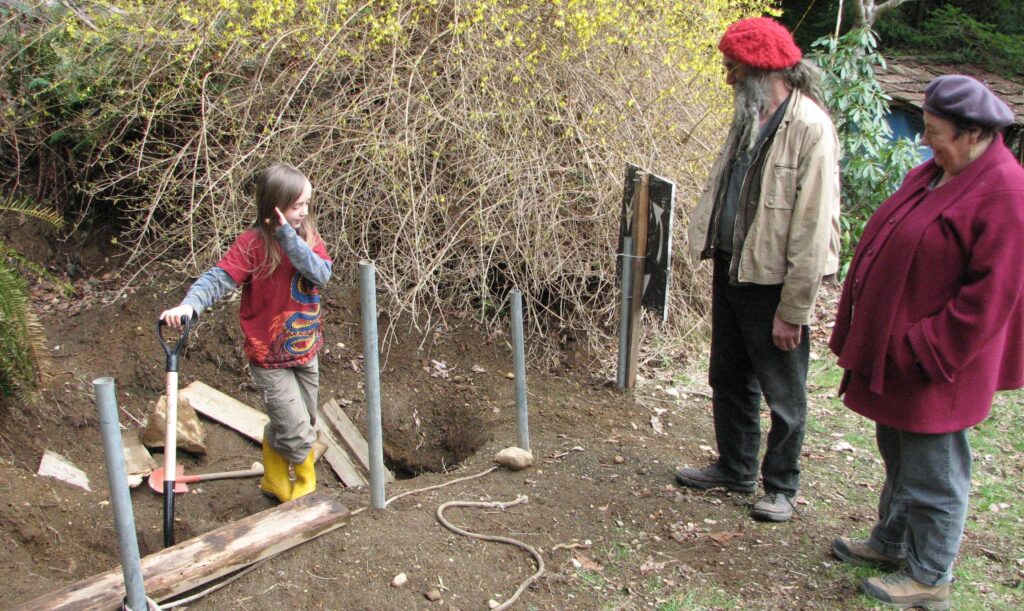
A young boy stands in a small hole in the dirt, holding a shovel in his hand, and surrounded by strewn pieces of wood. A man with a grey beard and long hair stands with a short grey-haired woman, looking at the boy as he describes the "mining work" he is doing.
Uncle Ralph and Auntie Lidia getting a tour of Taliesin's mine.

Uncle Ralph could be very loud and very quiet. At that small child’s birthday party he sat very quietly noodling on his guitar, creating a beautiful environment for our celebration. At other times he could be loud and even abrasive; shouting and joking and laughing, playing baseball, drinking beer, and dancing and dancing like you could never imagine his long hair tamed; his hands and legs quiet, or his face not wild. But also at a party—a big party—he was a safe place to go to. Often he’d be down by his creek, sat down by his makeshift barbecue, tending to his special salmon that everyone back up at the house was waiting for. I used to just go sit down there with him, quietly. Often it was just the two of us, maybe with an auntie or another kid. And he’d tell us about his plans and projects; the fish that were circling in a pool of the creek; any number of his amazing inventions. Or maybe he’d just sit carving, and then eventually hand us a beautifully decorated stick. We loved him.

Ralph became ‘uncle’ to us, really by word of mouth. He was one of a small group of cherished friends of my parents with whom we spent a lot of time, growing up. And at some point Gail told us she’d like us to call her Auntie. It felt like a gift, so I called her Auntie Gail, proudly. Then one day Lidia mentioned that if Gail was my auntie, then surely she was too, so, by extension, Ralph became my uncle. He never needed or asked for that name, but he also took to it like it had always been. I guess because it always was.

One day I was leading a class back from a forest adventure near Ralph and Lidia’s home, and I looked over their fence as we passed, to see him sitting on a chair in his yard, whittling. “Hi Uncle Ralph!” I called over the fence, and he looked up and smiled, as about a dozen of the kids I was with hurried over, hands and chins pulled up onto his fence, and shouted, “hi Uncle Ralph!!!” He just kept smiling, like this was nothing out of the ordinary, at all.

His hands kept working at the wood on his lap, as his eyes smiled out from his mess of hair and brows, and his lips called out the musical tone of his reply: “Helloo!”

It was maybe five or six years ago that I first knew he didn’t recognize me. I’d known he had dementia for quite a while, but it always seemed like a minor thing. He covered it up well, joking about his mistakes, and acting like they just didn’t matter. Maybe they didn’t; we knew him well enough to not feel too lost in the confusion, and we covered up for him, too. But that day at the store, I went up and gave him a hug, and I could see in his eyes that he was hugging me because it was the appropriate thing to do, not because he knew who I was. “Hi Uncle Ralph,” I said, and he answered, “can’t find where I parked my car.” He hadn’t driven for years, but he went on to describe a car he also hadn’t owned for years. I figured he’d walked down to the store, and when he started asking for Lidia, I knew he was scared, and just hoped Lidia was on her way to pick him up.

Lidia was the great love of Ralph’s life. I know from my own experience that living with a person like Ralph is adventurous and beautiful, and also challenging. And too, his love is profound. Maybe like a child’s love for his mother is profound. And in moments of uncertainty, Lidia was Ralph’s touchstone. This past Christmas, the last time I visited Ralph and Lidia before he went to hospital, Uncle Ralph wanted to leave the house he’d lived in for over forty years to ‘go home,’ but despite his confusion, he still spoke to Lidia as though he knew her. No matter where his mind went, she was at the foundation of his sense of security.

Just before Ralph died, lying small and thin and quiet, his feeble knees bent under the hospital blanket and his mostly white hair pulled back into a ponytail, he struggled to breathe even shallowly, but once in a while he shuddered, opened his eyes, and looked into Lidia’s, where she sat in front of him.

A few days later, after Ralph’s family had all gathered around and said goodbye, after his mind had carried its trove of stories and inventions to some other place, and his body had left the world we live in, I attended a paddle-making workshop that I’d signed up for many months before. We’d been tasked with finding some kind of learning or self-discovering in the experience of carving our paddles from 2×6 cut blanks. And although I struggle with following directions, I didn’t have to look for meaning, that day, because Uncle Ralph was there with me. As I pulled the draw-knife, manipulated the small plane, and eventually sanded my paddle to a nice smooth object, I felt enormous gratitude for this man who first inspired me to carve, but more than that, I realized that I was using carving to heal from the loss of him. In living, he gave me the tools to heal from his death.

Goodbye, Uncle Ralph.

He would say, ‘hey, bye.’

Women in Wartime: Yes We Can

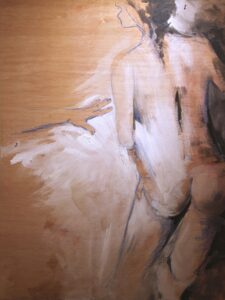
A drawing of a young woman, seen from behind, pulling away to the right from a hand on the left, and yelling towards the left, as if escaping and fending off another person, just off the panel. Artist is Emily van Lidth de Jeude.
Woman Story: Untitled 7 Artist: Emily van Lidth de Jeude
I once installed a show called Woman Story here in my home community. The core of Woman Story is a series of 24 portraits of bald, naked women drawn with graphite, crayon and acrylic wash onto reclaimed panels from my own home. They're actively expressing a complex array of experiences that inform woman-ness, but anonymously, because each of our stories might belong to any one of us.

At some point, a local I know distantly ‒ a retired judge and art collector ‒ came in to the gallery and sat down on the bench near the door. He stayed for about forty minutes. I eventually went to sit with him, and asked him what he thought of the show.

"Oh, I'm not here for the show." He answered. "I'm waiting for my ride."

"Ah. I see." What was I supposed to say next?

But he continued. "Is this your work?" He asked, bluntly. 

"Yes."

"Well it's awful. An insult to women."

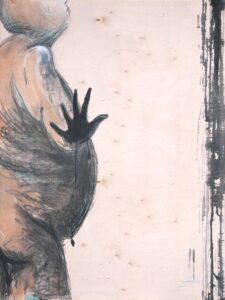
A reclaimed raw wood panel with a drawing of a powerful woman holding standing, facing to the right, holding a silhouetted hand up to the viewer in an act of defiance. Artist is Emily van Lidth de Jeude.
Woman Story: Untitled 18 Artist: Emily van Lidth de Jeude
I was completely shocked, but also curious, and asked, "Why do you feel that way?"

"They're bald," he answered, point blank. "Why would you be so disrespectful to women?"

"I drew them without hair in order to make them anonymous; to remove an identifier, and so their hairstyle doesn't speak to any potential prejudice or assumptions we make about people's hairstyle choices. But also to make their stories about everywoman."

He never once looked at me while he spoke. "They look like the bodies that came out of Buchenwald," he said. And then he was silent. And soon afterwards, his ride came.

Obviously, I could see his point. And, despite feeling regretful about possibly triggering trauma in people (my family definitely also carries trauma from WWII), I feel like maybe it's not a bad thing to have made this connection in my work. Because in war, women are also casualties. Women are also contributing to and leading both the offensive and the underground support systems. Women did come out of Buchenwald, dead. And women are found in shallow graves, abandoned vehicles, hospitals and landfills all over this world. It truly is awful, and I guess that's why I feel it needs to be told.

Here we are on the brink (or over the brink?) of WWIII, at the same time as we're experiencing a rise in femicide, exploitation, abuse and violence against women. It's not a coincidence. In our greed-based apathy we have allowed a very small handful of men to own and control our world. Most obviously, that's not acceptable! And what do strong women do when a situation is not acceptable? We make change. Women all over the world are protecting the vulnerable and building systems for survival, protection, and recovery, even as the war is only getting started.

Generally speaking, women are fully half of the world's population that knows from a deep generational place what exploitation, vulnerability and violence looks like ‒ and how to both survive and heal it. We're working throughout our communities, already, to build peace and resilience; to educate, support, and empower. Even to empower the women who foolishly allowed their fear to make them hate. We're working to bring and keep people together. 

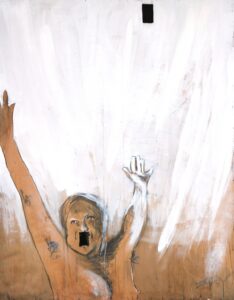
A reclaimed raw wood panel with a drawing of a powerful shouting woman, visible only from her breasts up, and with her arms raised in the air.  There is a rectangular hole where her mouth should be, which used to be a hole for an electrical outlet in the wall this panel came from. Artist is Emily van Lidth de Jeude.
Woman Story: Untitled 16 Artist: Emily van Lidth de Jeude
We cannot rest. As born survivors, it's our strength and duty to not become bald bodies in concentration camps, mass graves, or landfills; to make sure our sisters, brothers, and children are also safe. To de-escalate fear and reactionary hatred before it harms us. A lot of us are already experienced with this. The rest of us can learn. We have to deal with our own crap and become our best selves, in order to show up for our world. And we have to start now.

There's work to do! I'm not talking about just directly protecting and defending, although there's a need for that, as well. I'm talking about building the world we need, so that it displaces the world of hate and greed that is being fed right now. And there are infinite ways we can do this. Some of us are out putting our bodies and voices on the line; putting ourselves in danger to inform and advocate. Some are donating money, time or skills to organizations that amplify our voices and work. Some of us are building networks and repositories for the protection of people, environment, information, culture, and as a whole, the future of our world. Some are educating and supporting our communities, so that we can have and maintain peace. And all of us, no matter what our lives look like or how limited we feel, can make conscious choices in every act we make to defy and devalue hatred, to promote love and peace, and to pull away from systems, corporations and ideologies that promote hatred.

Even when we feel weak, we can be strong. We are all challenged; women and men, too. That doesn't mean we're beaten. A challenge is, by definition, an opportunity to overcome. That's not just where we're at right now; it's who we are

We are strong. We are capable. We are determined. We can do this.