It happened like this. Just after we discussed the stage floor I was painting, the director cycled back to my house and knocked on the door again. "Emily?" He called into my house. "Emily, I forgot to ask. Could you make us a rooster prop? It's to look like it's been killed by a fox. Although that may or may not have actually happened."
I was astounded! And thrilled!! "Of COURSE I can!!" I knew the play was pretty serious — Dancing at Lughnasadh. So this prop was a serious prop. Well… as serious as a pretend killed rooster can be, I guess. I was deeply honoured that the director thought I'd be up for the task.
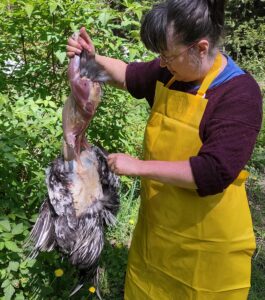
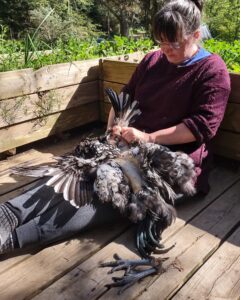
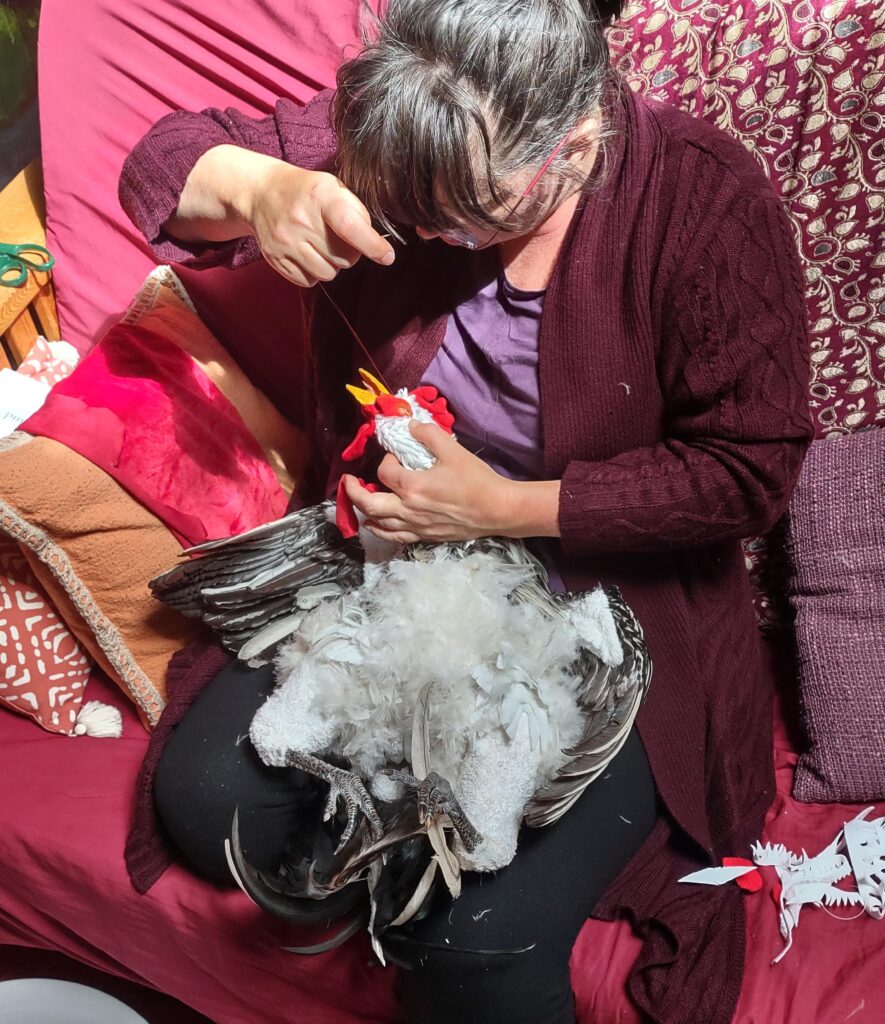
There is no way I can easily make a fabric rooster puppet that looks real, and dead. So the first thing to do was to find a rooster that was headed for a pot, anyway. I was given this guy. He was sadly doomed, after his owners had searched for a home, to no avail. So on the appointed day, I picked him up, thanked him for his donation to my freezer and the arts, and butchered him. He made meat, bone broth, liver pate for me to eat, and a pair of feet and a beautiful feathered pelt for the prop. I tried saving his beak, too, but didn't like how small and dark it was, and decided that this rooster prop was going to need a yellow beak.
Working the hide.
I've plucked and slaughtered a LOT of chickens in my life, and plenty of rabbits, too, whose skin comes off so easily, like peeling off a knee-sock from a foot. Rooster skin–with feathers, wings, and tail attached, is not like that!! It took some careful consideration to get it done properly, bones removed (all but the Pope's nose and the wing-tips), and with all the feathers still in tact.
I worked a long time to get the skin clean, and then I tried to dry him. I've never done taxidermy before, and it turns out a bird is not the easiest thing to start with. Then it turns out I also have no experience. Oh wait–I said that already. But it turned out to be a problem!! And this bird was fatty. I managed to dry his feet OK, but ended up removing the wings and tail feathers, as well as the ruff and saddle feathers. Ugh. All that work keeping his skin together, just to take him apart in the end!!!
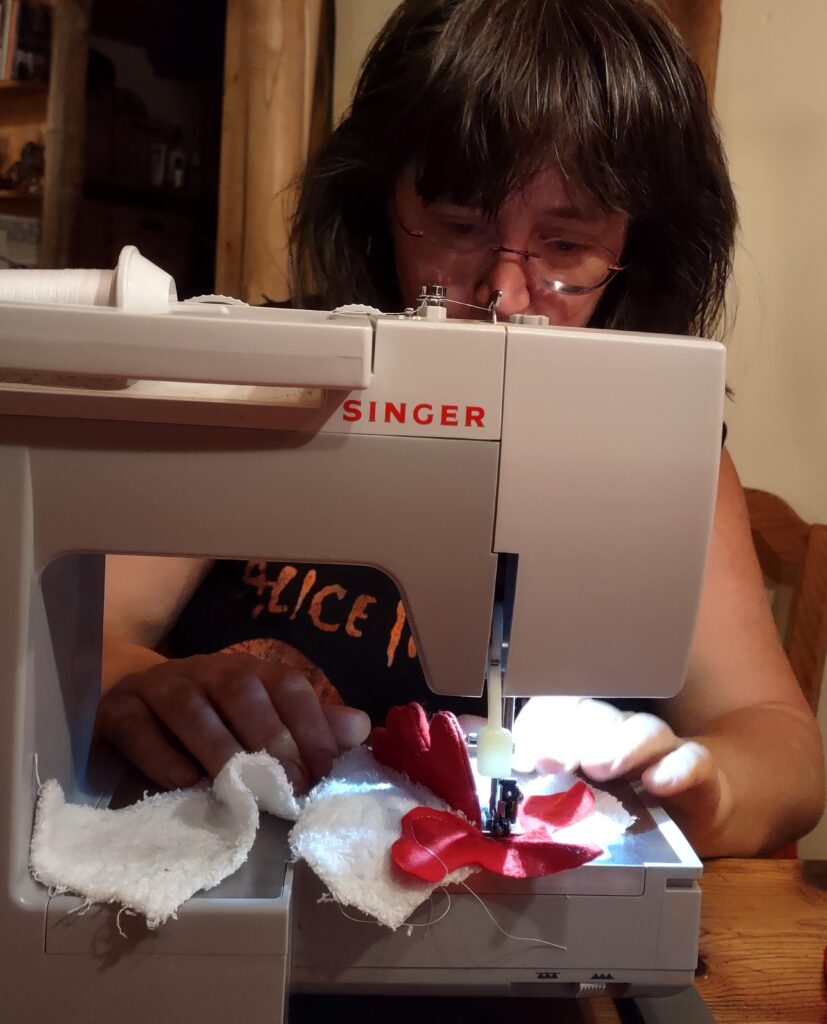
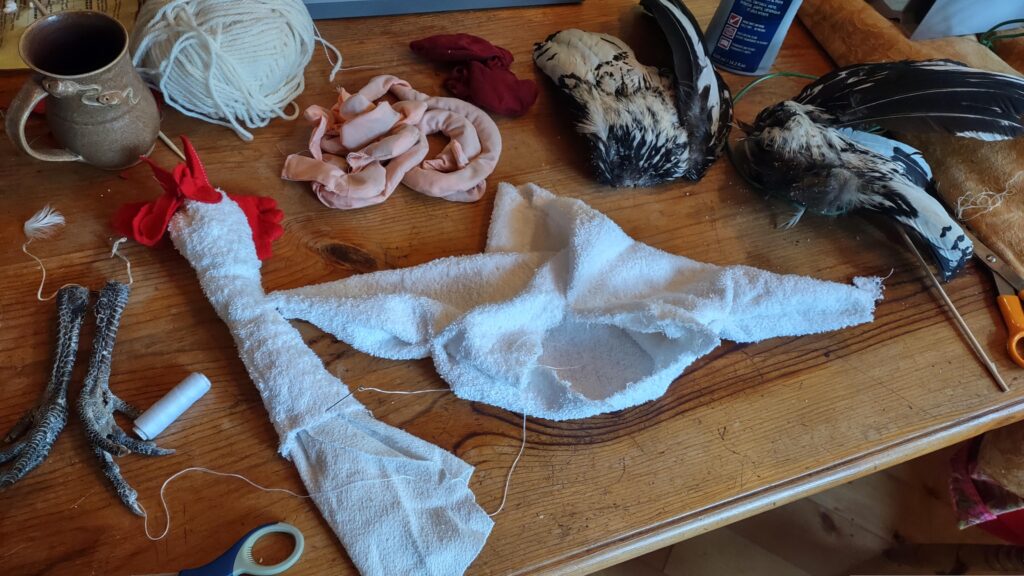
Anyway, I made him a body out of old terrycloth and felt, and a bit of armature wire for a basic spine and rib structure; broken sate skewers sewn into the wings, too. I first made his wattle out of felt, but it looked awful, so ended up making a more floppy one of red velvet with rocks inside for that floppy weight a rooster's long wattle can have. He has rocks in his head, too, so it can dangle down, limply. Appropriately for a dead guy. If you know, you know. The wings had to dangle, too, when he's turned upside down and hung by a foot.
Sewing the rooster's head out of terrycloth and felt.
Another part of dead roosters–especially those that may have been killed by a fox–is the protrusion of some guts. You know if you've cleaned a rooster, you reach in and grab the gizzard, and then the liver and intestines come out along with it. I didn't make this guy a gizzard, but I did make him some intestines and a liver. And I filled the intestines with lentils to make them dangle properly. Well, I hope he enjoyed his meal.
Various rooster parts in progress, waiting to come together.
Then I had to sew on his feet and wing parts, and many many many feathers, both real and made of felt. I also painted his face and beak. Way better.
Sewing his hundreds of tiny white felt feathers on!
So… Here's my dead rooster prop! I hope you like him. I put up a video on my MakerTube if you'd like to see the finished puppet:
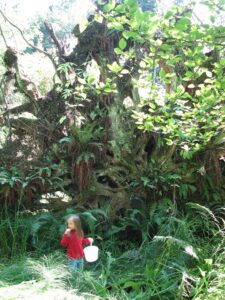
Taliesin picking berries in front of a root tower.
Once I lost my son in the forest. We were heading home through ferns taller than his three-year-old self, he carrying a harvest of licorice ferns and I carrying his baby sister and some oyster mushrooms. He followed along behind me, and when I turned around, he was gone. I called repeatedly. I retraced my steps. I gripped by baby girl to my chest and started running, panicking, and– there he was, nestled into a sword fern, chewing on a piece of licorice fern root. He looked up blandly at my stricken face and said "I'm just havin' some licorice root." His trance-like state may have been induced by the well-known calming medicine of licorice fern, or it may have been just his joyful state of mind after a couple of hours spent wandering the forest with his mother and sister.
My kids and I spent part of most days of their childhood out in the forest, exploring. That's what I did as a mother because it's what I knew to do from my own childhood, spent here in this same little west coast paradise. When my head hurts, I go outside. Maybe I chew an alder leaf like the wild aspirin that it is; maybe I just lift my face to the fresh air, sun or rain. When my heart hurts, I lie in the moss and let it soak up my tears. Licorice fern soothes me; so does the feeling of bark, or the creek water between my toes. When I'm hungry, I eat beans off the vine on my porch, or berries and other treats from the woods; when I'm hungry for adventure I go exploring in my medicine forest. I made up that word. Medicine Forest. It's like a permaculture food forest, but with emphasis on its healing power. My parents didn't purposely give me a medicine forest, but they did give it to me, and I'm passing it on to my children. Let me explain.
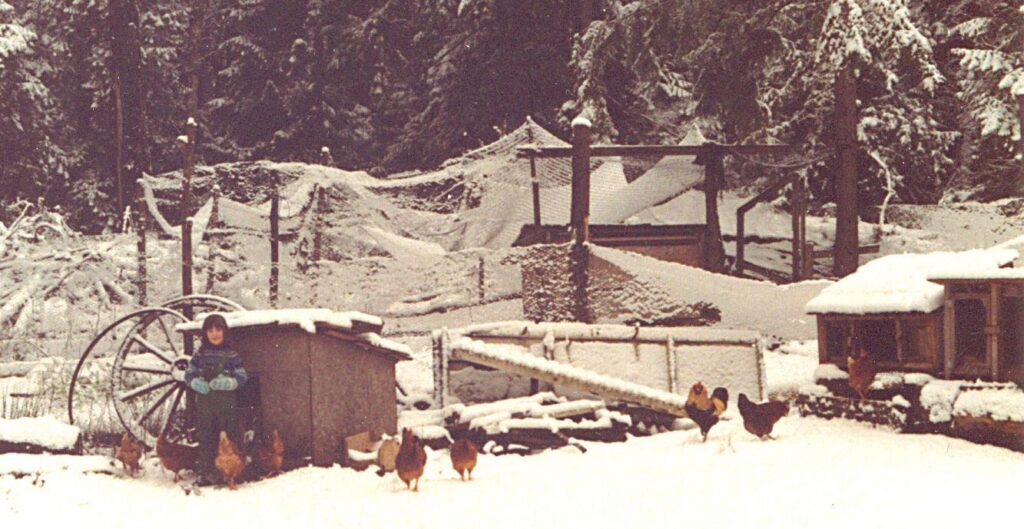
That's me with our chickens in the early 1980's, rabbit hutches on the right, and winter-covered veggie garden, behind.
I grew up in a pretty typical single family house – a modified double-wide mobile home, actually – on a five-acre piece of land that my parents purchased in 1980. This land was forest when they bought it. We used to come up here and have a picnic on the slope they hoped would one day be their building site. They let my brother and me free-range all over this place, climbing trees, damming creeks, digging great big holes and picking and using whatever plants we felt like, as they slowly cleared the land and built up what is now a developed property. We raised chickens, meat rabbits, and pigs (but only once because the experience was too heartbreaking for all of us to repeat). My parents grew food crops and allowed us to plant our own experimental gardens, while also insisting that we should help with the family food operations. My brother and I were never forced to kill or butcher animals, but because our parents nurtured our curiosity, we both knew how to clean a rabbit or chicken by the time we were twelve, and by the time we were fifteen we could cook a good family meal from the foods we'd grown or wildcrafted. We didn't even know the word wildcraft, though. We were just "picking nettles", or "finding a mushroom."
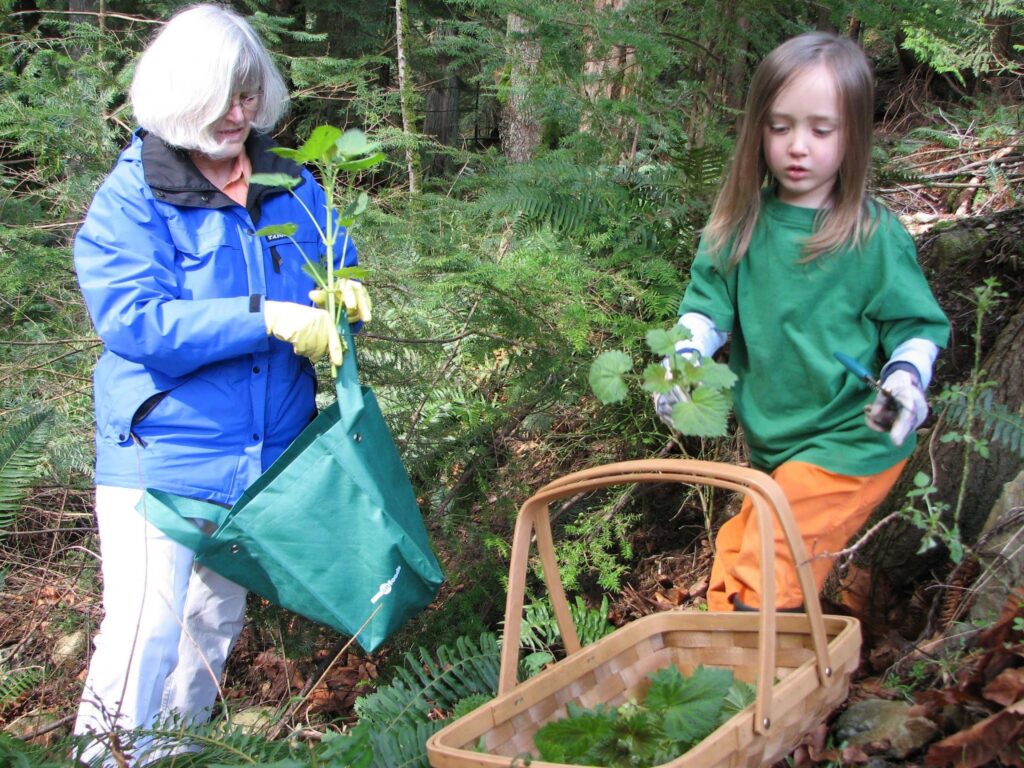
My son helping my mother pick nettles in the late 2000's.
Living in and with the forest our parents were busy turning into a home was just "life". We could pick indigenous trailing blackberries from the hillside, invasive Himalayan blackberries from the place Pappa was trying to get them out of the creek, or cultivated boysenberries from Mum's garden. Same difference. They all make good pie, if you don't eat them all before getting them home. And whether they make it home or not, your belly is full with the food, your heart is full of the joy, and your mind is full of knowing every detail of your home. That's a medicine forest. It's a place where everything is living and growing together — humans included. It's a place you've grown so connected to that just living there heals you from the inside out.
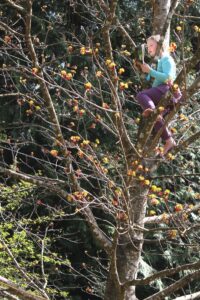
My daughter reading in a tree she knows every inch of.
Somehow through my own teaching and parenting over the years I have come to recognize that, just like the best learning happens when we're inspired by connections to our own experience, the best living happens when we're connected to everything around us. Think of it this way: you care much more about your own backyard than someone else's. You have a lot more interest in your own little potted plant than in the weed at the edge of the pavement, or some tree in a forest far away. So somebody teaching you about a baobab tree might have a bit of a tough job keeping your interest. But what if that tree was yours? My friend went to Africa and really got to know baobab trees – and they became hers. When we connect personally with things, they matter, and mattering strengthens our neural pathways. That's great for learning, but how does this have to do with my medicine forest? Well, this place matters to me. It matters so much that I've spent about thirty years of my life exploring here, both as a child and now with my own now-grown children. I know exactly which part of which slope of which creek has the best clay for sculpting, and which part will still have a pool of water and some desperately-hungry trout in August. I know where the elusive white slugs live. I know how berries' flavours change with the weather and with the time of day. This deep understanding of my little wilderness is my connection, and it's why this place is my medicine.
On top of being important to my own health, my experience of exploring this place has made me resourceful and resilient. We all learn more from observing the people around us than from being taught conventionally, and I learned from watching my parents develop this land; their need to be resourceful when we had no electricity, no toilet, or no income. I learned from watching them not just survive here, but keep working even in the face of failure to find joy and wellness in whatever this land and life had to offer. The moss is not my weeping pillow because I'm an idyllic child from a book about fairies; it's my pillow because sometimes I was just plain too sad, as a child, and the moss was what I found to comfort me. My kids didn't harvest nettles for brownie points or allowance; they donned gloves and harvested them just because that's what we do for Easter. They got stung and they complained to me, but they also delighted in testing their brawn by picking them bare-fingered or by eating them raw. They were building resilience, just like I once did. This year they both came home for Easter and actually wanted to go nettle picking. They want to reconnect to and eat food from their own ecology. We're in this ecosystem for better and worse and every day that falls in between. Like the plants, we'll thrive or die as part of this, so we're doing our best to thrive.
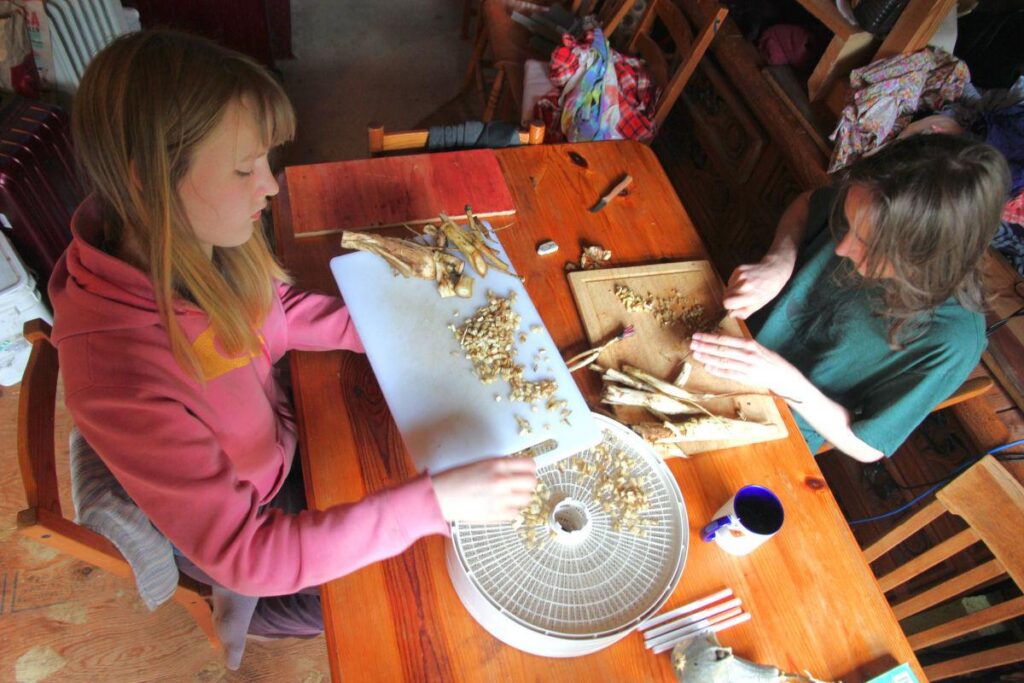
My kids at fifteen and eighteen processing wild burdock root for tea.
The business of gardening and developing the physical ecosystem is nowhere near as idyllic as I imagine it sounds. There are brutal realities in nature that hurt like hell. Our crops fail, our chickens get sick and I have to put them down; sometimes we fight and resent each other's impact in the ecosystem. Sometimes money is short, time runs out, and family or world tragedy makes us doubt we can succeed. But experiencing these things, feeling them and accepting them is part of the whole picture. My medicine forest is the ecological basket that holds our family, and the love and knowledge we cultivate here, among the weeds and the crops and the chickens, the weather and the water and our own bodies living. When I leave this place, my medicine forest is carried in the knowledge of my body and mind, to nourish and grow with other ecosystems. It's a conscious choice I make to see my surroundings and live in health with them, as a part of them.
In a monoculture garden, one invasion of a particularly voracious insect can wipe out a whole crop, with nothing remaining to re-seed. The earth itself becomes a barren place, unable to nurture new-fallen seeds without significant help from humans. In a food forest, insects may devour a plant here or there, but the diversity of the community will discourage any one plant or insect from taking over, and thus ensure that enough remains to keep the community thriving. The dead plants along with the dead insects and the droppings of all those who foraged in the forest will feed the earth, ensuring that all the fallen seeds have at least a chance to grow. In fact, the richness of the soil even means the earth will hold more water, making everything thrive more easily.
My parents have asked me how I came to know all these things, and I said "from you", because it was their willingness to let me explore that gave me the gift of knowing my ecosystem. It was their willingness to let me grow my own experimental gardens, and now to rent us a piece of their land and still let me grow my own experimental gardens that gave me the gift of my medicine forest. Sometimes they don't like the look of my unkempt yard, my son's experimental tree fort project, or the weed piles I leave laying around. But they let me and their grandchildren keep living and exploring here, because they're watching the growth of our medicine forest. And sometimes – just once in a long while – we discover things we can teach them, too. Explorative parenting is like that. It's looking at the whole family as a forest instead of one plant seeding another. Our family is like a forest of possibility, where everybody lives in community, exploring and discovering and balancing and sharing, as we all put our roots further and further down, and our branches further and further to the sky.
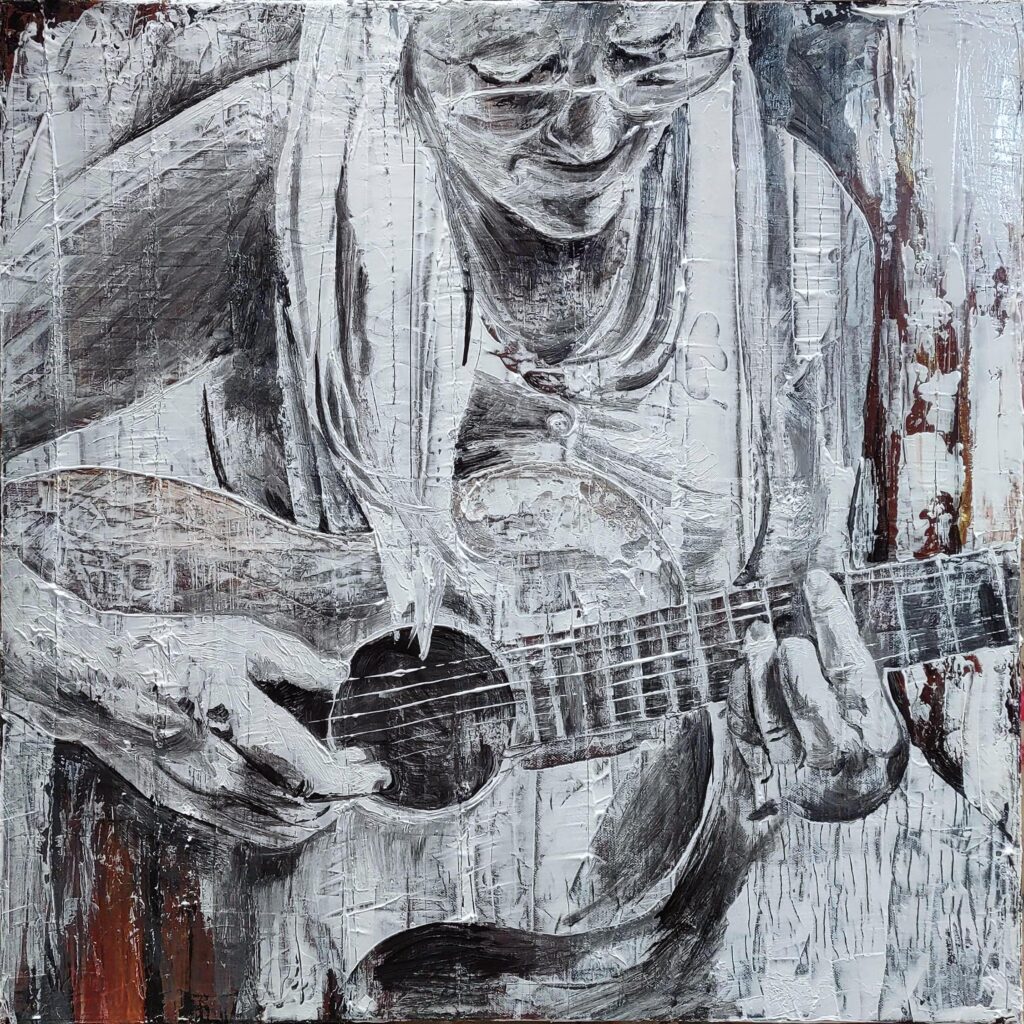
Acrylic portrait of my mother, Lyn van Lidth de Jeude, with her guitar.
My hands held on strong to the red plastic hand-grips of my BMX. No handlebar tassels for me, but I could get to where I was going when I needed to, and today I was rolling home, dragging the toes of my runners along the sharp shale of our driveway.
I could hear Mum’s voice and guitar getting slowly louder as I went. The door of our green and white metal-clad trailer stood open to the wind and the May bird-song, and the familiar sounds of my mother drifted out onto the afternoon. As I dumped my bike against the dog-house and stepped up the porch to the sounds I knew so well, her words filled my mind:
Everybody thinks my head's full of nothin’ Wants to put his special stuff in Fill the space with candy wrappers Keep out sex and revolution But there's no hole in my head Too bad*
I was mildly alarmed. Not so much because Mum was obviously singing about a gunshot to the head—horrific bloody murder was typical of the traditional ballads we sang together—but because she said 'sex'! Who wants to think about that anyway! I stood there with my mouth open, and Mum looked up from her guitar, her small hands pausing in mid-air formation, as if holding the song until I’d greeted her
“Hi.”
She smiled the beautiful upside-down rainbow of a smile that pulls the pointy sides of her lips up toward her cheeks. “Hi honey!” She called across our mustard-yellow carpet to the tiles where my runners held me fast to the floor. “Have you packed your bag for the folk retreat?”
“I hope you’re not singing that there.” I said without hesitation.
Mum’s pointy smile went flat and her eyes seemed to darken. “I hope I am!” She declared. “This is a Malvina Reynolds song! Not exactly folk, but definitely important to sing. You could sing it with me.”
She must be joking. I’d never sing that word. Too bad!
“It’s about being a woman,” Mum continued, totally oblivious, apparently, to my disgust.
Her hands began to sink, now, and I knew she was going to explain something. I didn’t want to hear it. But she did, anyway. Mum told me that Malvina Reynolds was born even before Grandma. That she wrote a song about ticky-tacky houses, just like the one Mum grew up in, in Mill Valley, where she knew how to find the bathroom in any of her friends’ homes because they were all exactly the same. Mum said Malvina knew what mattered in the world. She supposedly told her husband to drive their car so she could write the ticky-tacky song, because she knew when she needed to make her voice heard. Mum said Malvina was not afraid to speak and do the things that mattered, and I shouldn’t be, either.
Mum says a lot of things that Pappa and Daddy say are ‘wishful thinking’. But she never gives up.
Mum looked into my eyes, then, and then down at her hands as they began to pluck the strings again. I took off my runners as she began to play.
Call me a dupe of this and the other Call me a puppet on a string, they They don't know my head's full of me And that I have my own special thing
I thought about how Mum still makes the dinner while Pappa eats his peanuts and watches the news. I didn’t have a whole lot of respect for her, as a feminist. She eyed me as I walked by, and interjected into her song: “You know women weren’t even allowed to have a credit card until the year before you were born.” Then she smiled and continued:
And there's no hole in my head Too bad
Mum’s face looked so proud when she sang this song. Even though she said the word ‘sex.’ She said she’s not afraid of it. She said it was still legal, in some places, at that time, for husbands to rape their wives. Mum told me that she and Pappa had to sue Daddy for infidelity because even though they’d been separated for years, he refused to sue her for it, and without one of them suing the other, they weren’t allowed to have a divorce. And that’s just stupid. But Mum said things are changing. And every change matters.
I have lived since early childhood Figuring out what's going on, I I know what hurts, I know what's easy When to stand and when to run And there's no hole in my head Too bad
It’s been a long, long time since that day I first heard No Hole in My Head, played on my mother’s Washburn guitar and sung by her beautiful voice. But I can still hear it. Even though Mum died last year, and the months without her voice are piling up on the story of my life like the layers of plough-mud that eventually bury the whitest snow.
It’s spring, again. It’s almost May. I’m almost fifty years old, and women’s rights—the ones our mothers and grandmothers and great grandmothers fought and sang and laboured for—are being stripped from us, one by one, day by day, while we look the other way.
It’s not that we’re stupid or blind; some of us have just forgotten how important the work was for our mothers, and how beautiful. We’ve become distracted, almost as if it was somebody’s plan, by the necessities of working double jobs while raising kids in a society that is ever-harder to survive in. We’ve become distracted by the ticky-tacky houses that became the norm; by the products and the must-haves and the must-do’s and fear of not measuring up or out or small enough. We forgot to look away from the people who told us we can’t, and to write our own world that’s different, and hopeful and strong. We forgot that wishful thinking is exactly what dreams are made of, and that dreams are pathways to growth. Revolution. Societal evolution.
We forgot that we’re at the wheel. We forgot that we are powerful.
In my little memory-video of Mum on the couch with her guitar that sings only for her hands, her voice carries on:
So please stop shouting in my ear, there's Something I want to listen to, there's A kind of birdsong up somewhere, there's Feet walking the way I mean to go And there's no hole in my head Too bad
Mum loved birds. She knew all their voices and their migration and nesting habits. She created a garden where an incredible diversity of species could coexist and thrive, because she knew diversity was important in any system. Mum created a world where birds were welcome, safe, and thriving. She did the same for children, and anybody else whose circumstances made them feel weak or othered. She lifted people, and made them strong, with hopes they would lift others. Mum understood that others—especially those who are different from us—are an essential part of the whole, and she lifted their stories and voices. She loved adding harmonies and accompaniment to others’ songs. Mum worked to build the world she wanted to see, and she asked me to follow her lead, but she also followed mine.
I sang No Hole in My Head with my daughter and my son; I sang it at the folk retreat, too—even the word ‘sex’, because I don’t want to be held down by a word or an idea or a threat. I wrote my own songs and I drive my own car. I painted butterflies on my car, to make it beautiful but also to remind me that every small change leads to greater change, in the long run. I keep voting Green, even though they never win, and last year, for the first time, I elected a green candidate in my provincial riding. I will vote Green, again, because it’s right. Because I keep believing that we can build our dream. Together, we can build the world where all of us, and our ecology, matter.
Mum knew that grass-roots revolution isn’t a job for a leader or anybody with power; it’s a job for us all. The whole of us. No matter who gets elected, we have to keep working to fight for our rights and build our future. We have to make choices in every moment to follow the feet that are walking where we mean to go; to be the masses who are, inevitably, making the change. We have to stand up and speak out and not just break down the barriers we face, but turn to what’s beautiful and create the world we want to live in. We won’t all agree about how that world will look, but that’s exactly why it’s a job for all of us. If we all do what feels right, and we talk and listen and love, we will, as a whole, get to somewhere good.
It was hard work that our mothers did, building this world we’ve inherited. But it was also beautiful. Community is beautiful. Now it’s our own and our daughters' privilege to not bend to the world that crushes us; to not try to work within a system that holds us down, but to step out, sing loudly, and build this world, our way. Because there’s no hole in our head. Too bad.
* Words and music by Malvina Reynolds Copyright 1965 Schroder Music Co.(ASCAP) Renewed 1993. Used by permission. All rights reserved.
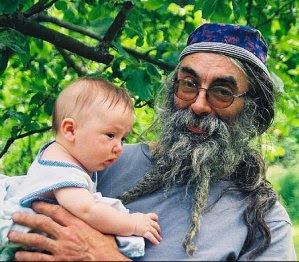
Ralph holding my then three-month-old son, Taliesin.
It was a cloudy day in a November of my childhood when Uncle Ralph gave me my first carving tools. Of course, he wasn’t called ‘uncle’ yet, at the time, but never mind. I was probably about ten, and it was a rough time in my childhood, for a lot of reasons. If I’m remembering the correct occasion, he arrived without Auntie Lidia, alone on his motorcycle, round leather riding goggles pinching in the top of his hair while the rest of it flew out behind him. Even his beard flew along beside him as he rode down our driveway. He’d come by for my birthday, and I remember his wonderfully long brown eyebrows and much longer braided beard leaning down to me with a most beautiful leather bag held out in his dark hands that always looked more weathered than you might expect for a man his age. "Here. Got you this.” He said, and opened the bag to show me all the different types of tools he’d packed into it.
I remember thinking how annoying it was that he said he’d ‘got’ it for me, when it was clearly his own bag. Eventually I realized the gift had been much more special for having been his own bag, than if he’d just bought me something at a store. It was a piece of his heart. And he’d given that gift to me at a time I needed not only to be seen, but to have an outlet for my pain. I suppose Uncle Ralph’s outlet was creativity—often with carving—so he gave that to me.
Uncle Ralph was always carving. We’d be sitting at the beach and he’d pull out his pocket-knife and just start whittling a piece of driftwood. He even seemed to sometimes have a little carving in his pocket, which he’d randomly start working on, as we sat somewhere. The parents of our community built a playground for our new school, and of course Ralph was one of them. He carved a driftwood log into a horse that became burnished by a couple generations of children who rode to our adventures at recess. Ralph gave us adventure. He was a printmaker, as well, and once did a project with the older kids at school, where he taught them to make self-portraits in relief out of cardboard, and then together with them built a cardboard bus, in the windows of which the kids put their cardboard selves. Then he laid a giant paper on the bus, and drove a steam roller over it to make a print! I’m a printmaker too, now, and I don’t have to tell you why.
When I got married, Uncle Ralph carved a wedding bowl for me, and he stood up to sing for me and Markus. He welcomed Markus into his life without any hesitation or awkwardness. Just treated him like family, instantly. After we moved back to my home island, and spent more time with our family, here, and as Markus’ beard got longer and longer, I once suggested Markus might braid it like Ralph’s. “No. That’s his thing,” Markus replied. Uncle Ralph is so cool his style is untouchable. And yet he’s one of the most open and accepting people you could meet.
He loved children. Not in the way that fawning adults often seem to ‘love children’, with affection and concern and more than a little superiority. Uncle Ralph related to children as if they were equals. That might mean he said somewhat inappropriate things, at times, leaving us staring blankly, where his bald humour bewildered us. But it also made us feel seen. He had four of his own children, and eventually a bunch of grand-children, but he still had time and acceptance for all of us hangers-on.
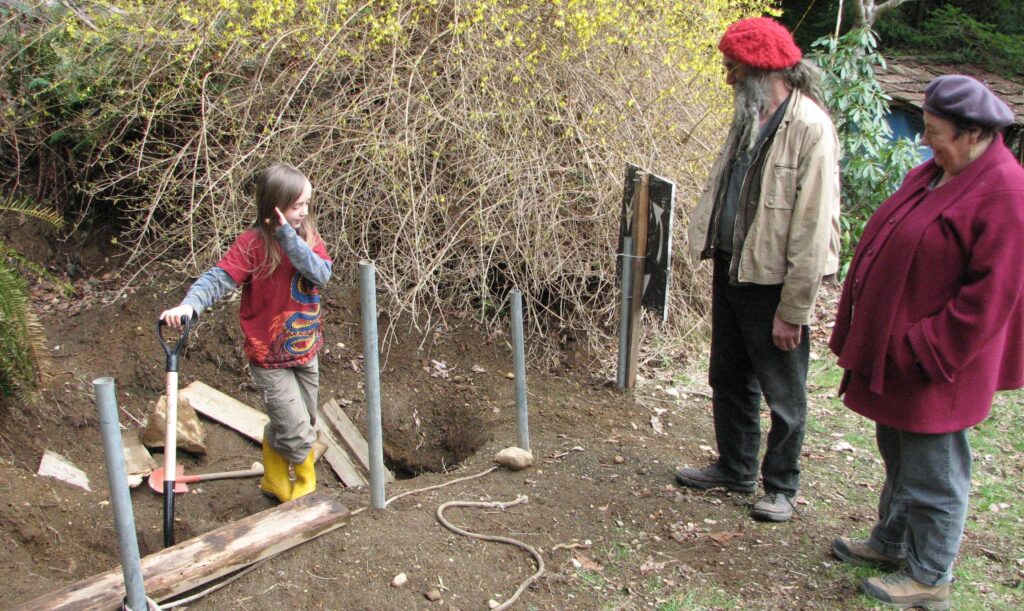
When my son Taliesin was little, he had a knit yellow toque with ear-flaps ending in long braided strings and tassels. He quite correctly identified that this was the sort of hat Uncle Ralph would wear, and used to dress up in that hat, sometimes with colourful vests and scarves, and call himself Uncle Ralph. When Tali was turning five, and had been digging away at a hole near the driveway he called his ‘mine,’ Uncle Ralph and Auntie Lidia arrived with yet another unexpectedly perfect birthday gift: A shovel. He’d bought my son a small, light-weight, but very functional shovel, and carved TALI into the handle, in ornate capital letters. Tali’s own shovel, for his own mine. One year, Tali only invited four people to his birthday: Jon and Rika (similarly unique and close adopted family of ours), and Uncle Ralph and Auntie Lidia. Tali stipulated that Uncle Ralph must bring his guitar. So he did.
Uncle Ralph and Auntie Lidia getting a tour of Taliesin's mine.
Uncle Ralph could be very loud and very quiet. At that small child’s birthday party he sat very quietly noodling on his guitar, creating a beautiful environment for our celebration. At other times he could be loud and even abrasive; shouting and joking and laughing, playing baseball, drinking beer, and dancing and dancing like you could never imagine his long hair tamed; his hands and legs quiet, or his face not wild. But also at a party—a big party—he was a safe place to go to. Often he’d be down by his creek, sat down by his makeshift barbecue, tending to his special salmon that everyone back up at the house was waiting for. I used to just go sit down there with him, quietly. Often it was just the two of us, maybe with an auntie or another kid. And he’d tell us about his plans and projects; the fish that were circling in a pool of the creek; any number of his amazing inventions. Or maybe he’d just sit carving, and then eventually hand us a beautifully decorated stick. We loved him.
Ralph became ‘uncle’ to us, really by word of mouth. He was one of a small group of cherished friends of my parents with whom we spent a lot of time, growing up. And at some point Gail told us she’d like us to call her Auntie. It felt like a gift, so I called her Auntie Gail, proudly. Then one day Lidia mentioned that if Gail was my auntie, then surely she was too, so, by extension, Ralph became my uncle. He never needed or asked for that name, but he also took to it like it had always been. I guess because it always was.
One day I was leading a class back from a forest adventure near Ralph and Lidia’s home, and I looked over their fence as we passed, to see him sitting on a chair in his yard, whittling. “Hi Uncle Ralph!” I called over the fence, and he looked up and smiled, as about a dozen of the kids I was with hurried over, hands and chins pulled up onto his fence, and shouted, “hi Uncle Ralph!!!” He just kept smiling, like this was nothing out of the ordinary, at all.
His hands kept working at the wood on his lap, as his eyes smiled out from his mess of hair and brows, and his lips called out the musical tone of his reply: “Helloo!”
It was maybe five or six years ago that I first knew he didn’t recognize me. I’d known he had dementia for quite a while, but it always seemed like a minor thing. He covered it up well, joking about his mistakes, and acting like they just didn’t matter. Maybe they didn’t; we knew him well enough to not feel too lost in the confusion, and we covered up for him, too. But that day at the store, I went up and gave him a hug, and I could see in his eyes that he was hugging me because it was the appropriate thing to do, not because he knew who I was. “Hi Uncle Ralph,” I said, and he answered, “can’t find where I parked my car.” He hadn’t driven for years, but he went on to describe a car he also hadn’t owned for years. I figured he’d walked down to the store, and when he started asking for Lidia, I knew he was scared, and just hoped Lidia was on her way to pick him up.
Lidia was the great love of Ralph’s life. I know from my own experience that living with a person like Ralph is adventurous and beautiful, and also challenging. And too, his love is profound. Maybe like a child’s love for his mother is profound. And in moments of uncertainty, Lidia was Ralph’s touchstone. This past Christmas, the last time I visited Ralph and Lidia before he went to hospital, Uncle Ralph wanted to leave the house he’d lived in for over forty years to ‘go home,’ but despite his confusion, he still spoke to Lidia as though he knew her. No matter where his mind went, she was at the foundation of his sense of security.
Just before Ralph died, lying small and thin and quiet, his feeble knees bent under the hospital blanket and his mostly white hair pulled back into a ponytail, he struggled to breathe even shallowly, but once in a while he shuddered, opened his eyes, and looked into Lidia’s, where she sat in front of him.
A few days later, after Ralph’s family had all gathered around and said goodbye, after his mind had carried its trove of stories and inventions to some other place, and his body had left the world we live in, I attended a paddle-making workshop that I’d signed up for many months before. We’d been tasked with finding some kind of learning or self-discovering in the experience of carving our paddles from 2×6 cut blanks. And although I struggle with following directions, I didn’t have to look for meaning, that day, because Uncle Ralph was there with me. As I pulled the draw-knife, manipulated the small plane, and eventually sanded my paddle to a nice smooth object, I felt enormous gratitude for this man who first inspired me to carve, but more than that, I realized that I was using carving to heal from the loss of him. In living, he gave me the tools to heal from his death.