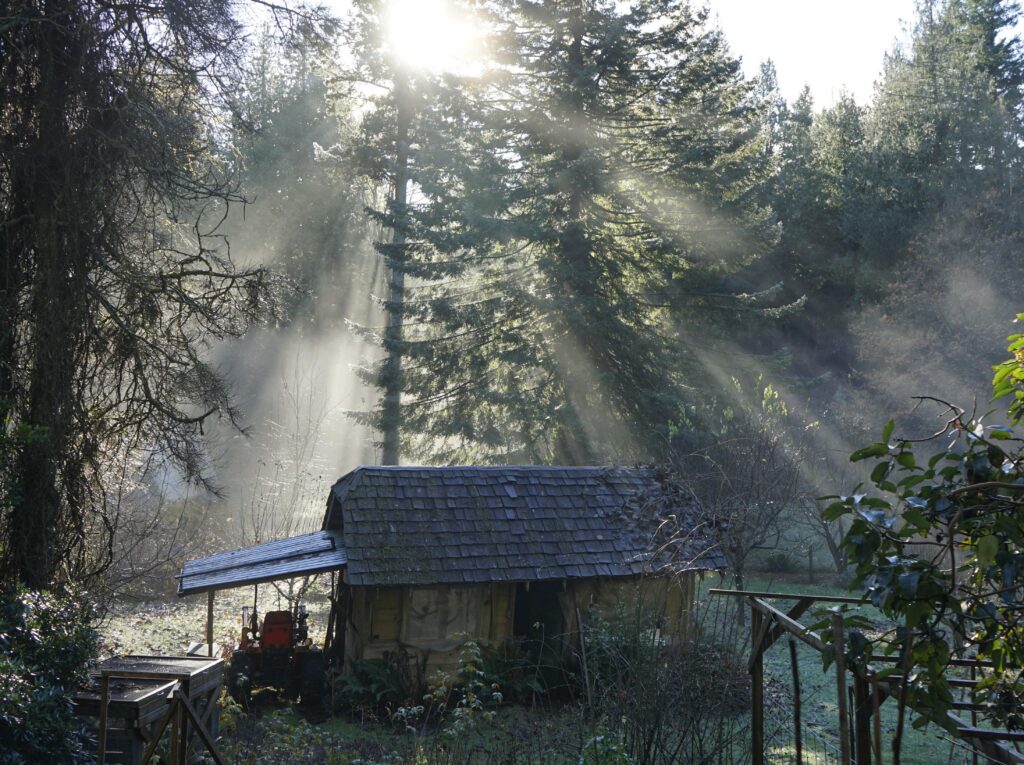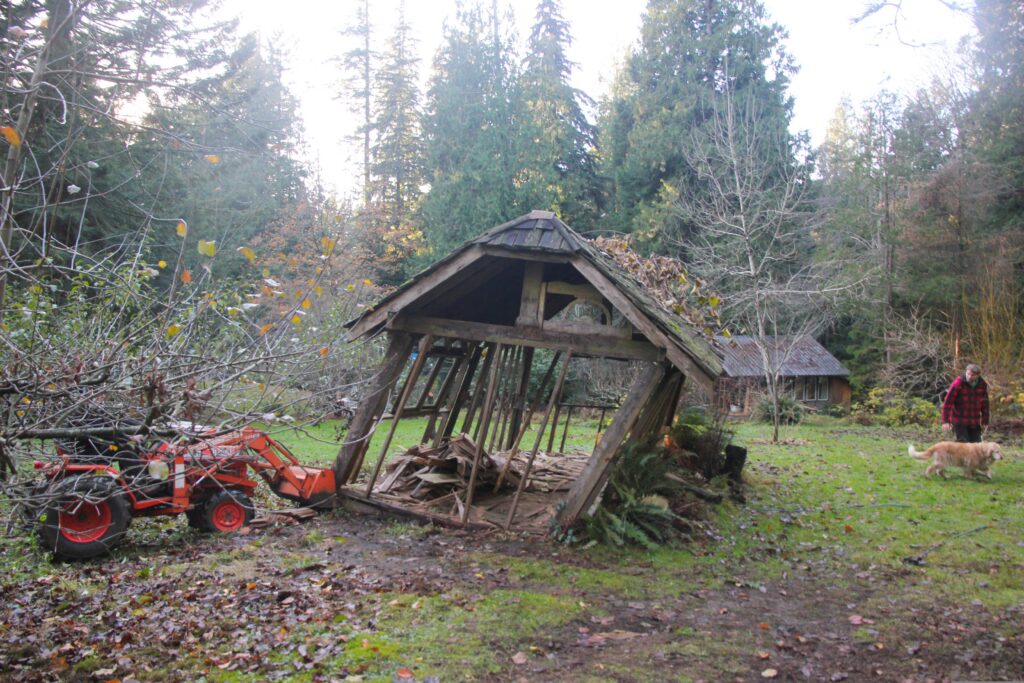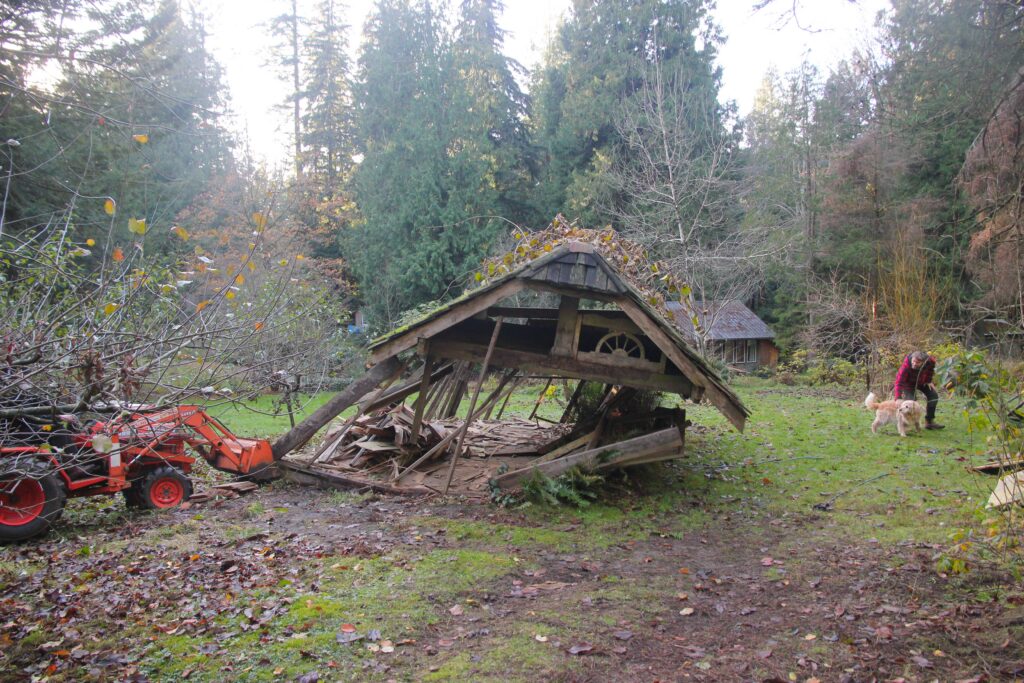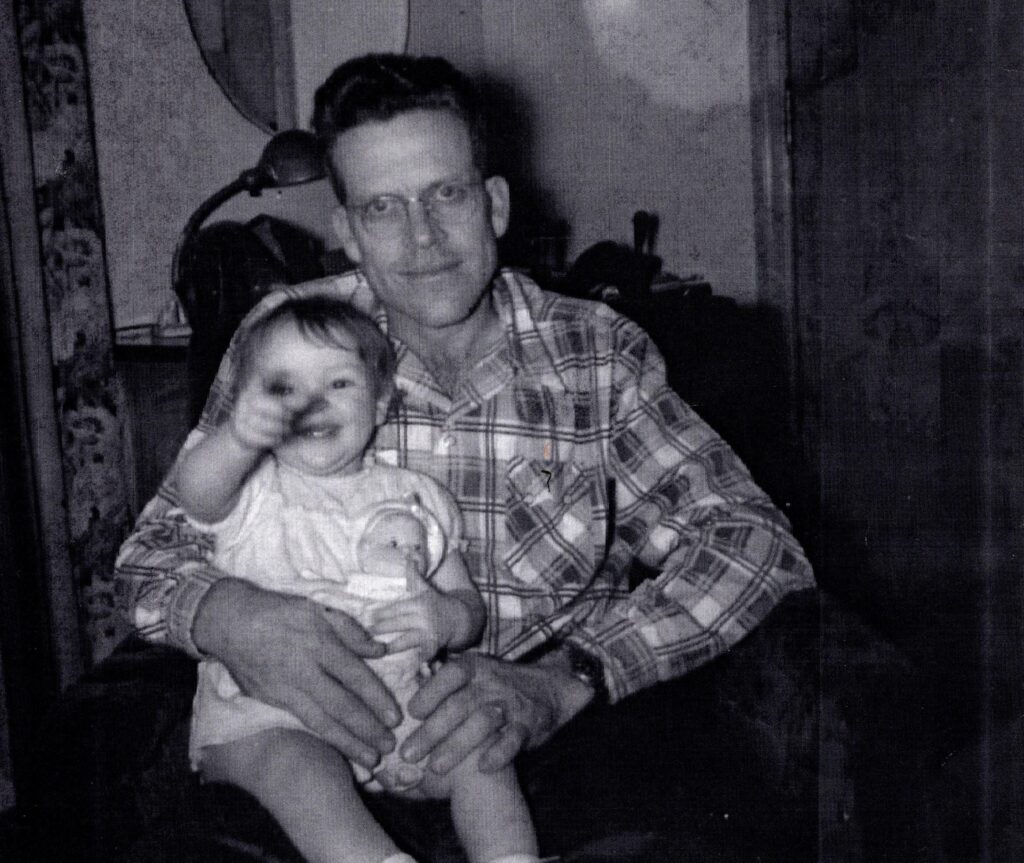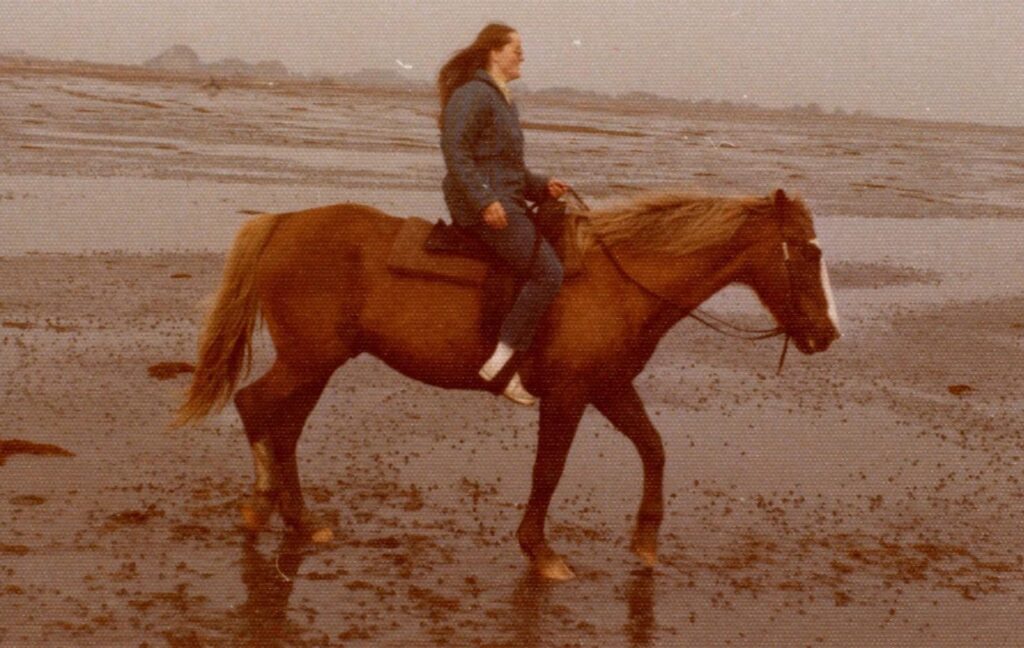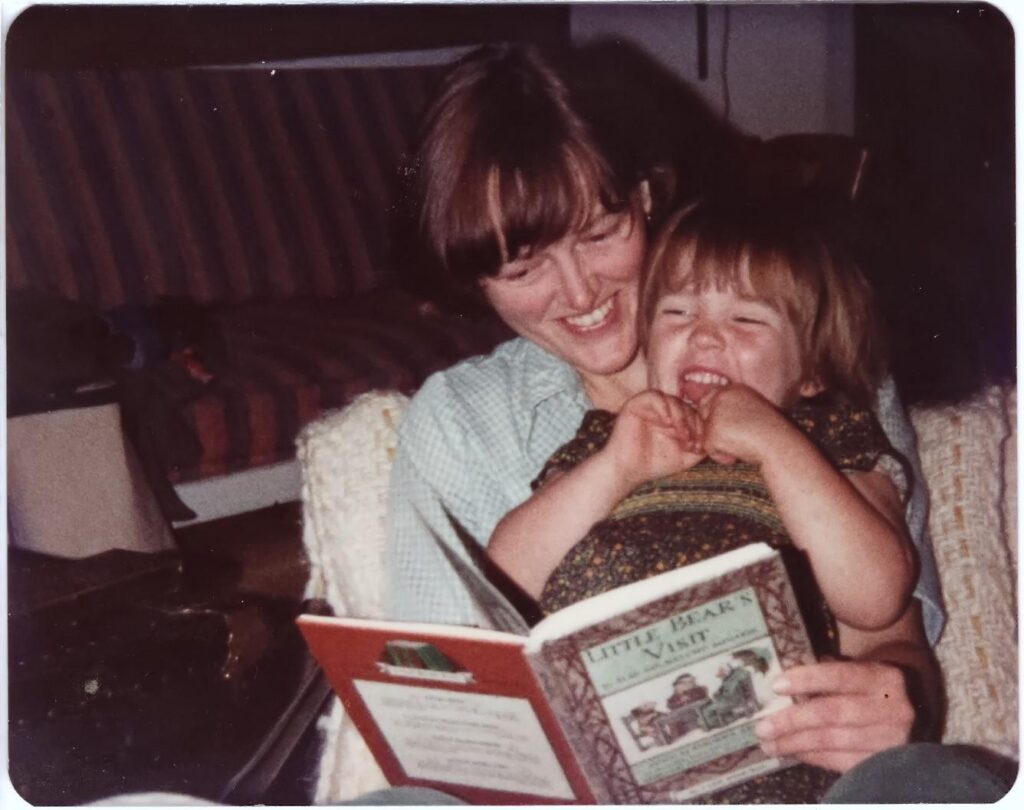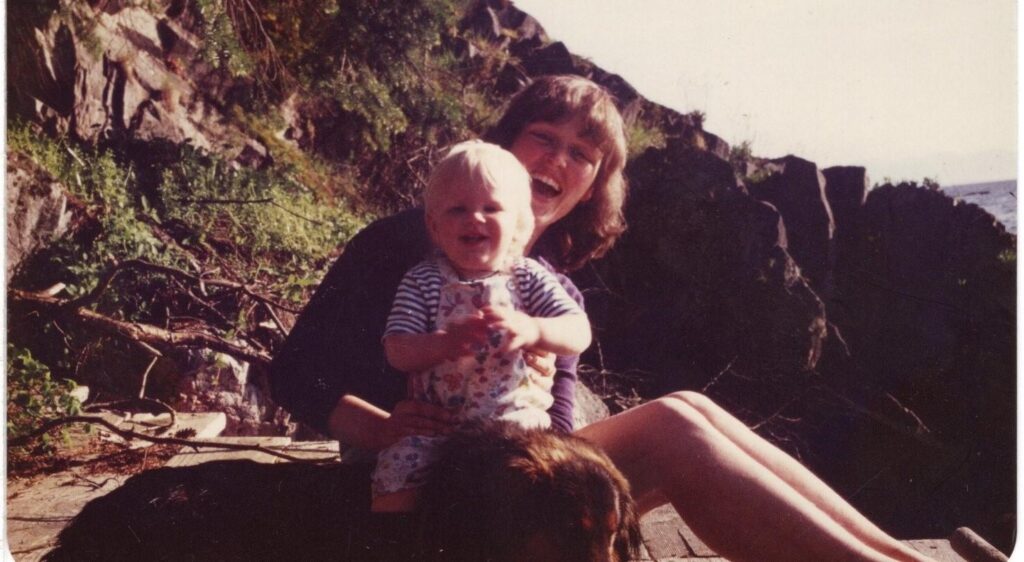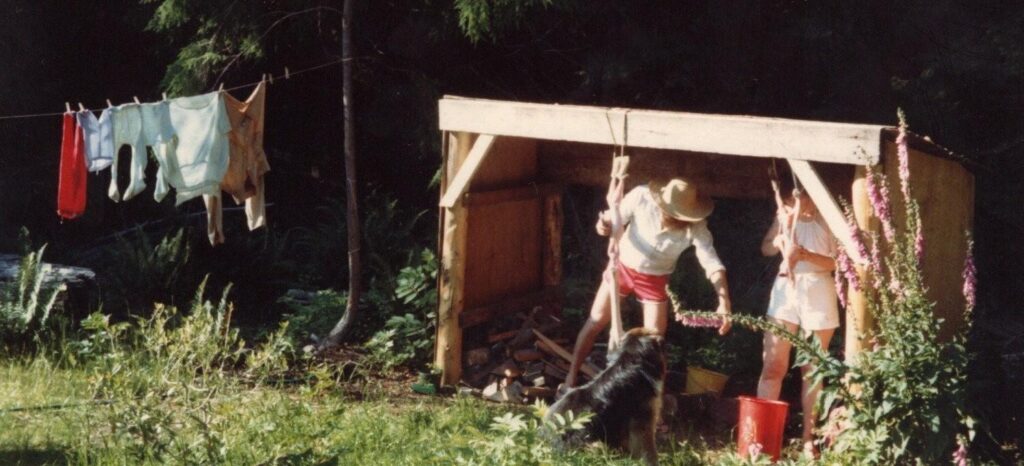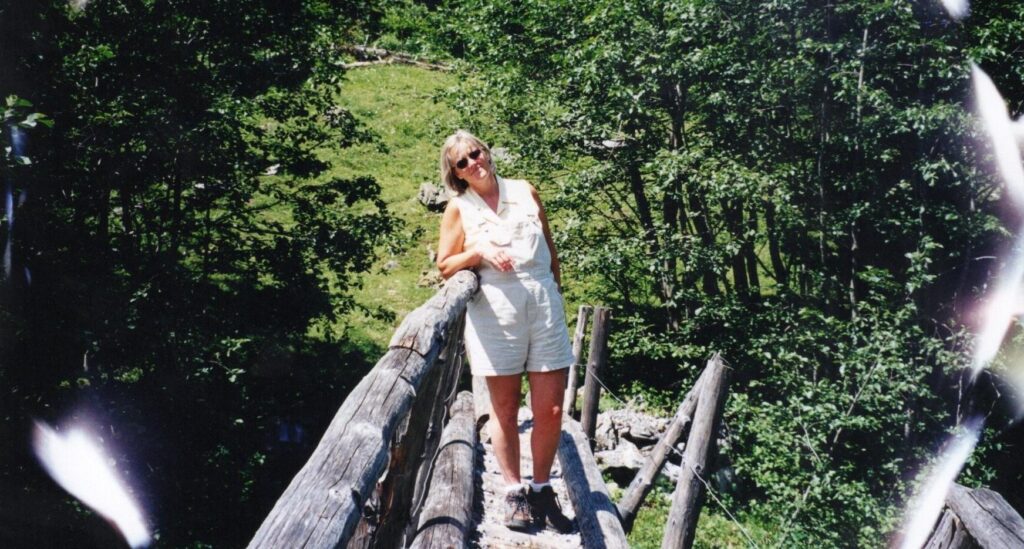
Pappa built this shed in 1983, when I was seven. With his confident hands he cut the trees on this land, bucked them up, and built a whole life for us, this building being one of the first big things. He used logs for a foundation, and built a frame of scrap wood and home-milled beams and planks. He used a simple froe to cut hundreds of cedar shakes for the roof, and when he was finished he installed the headboard from my brother’s bunk-bed as a ship’s wheel at the end of the hayloft, and he added a little electric propeller to the front door, so we could pretend we were flying a plane.
My brother and I and all our friends slept many nights in the hayloft, convinced there weren’t any spiders, by night, even though by day the palm-sized wolf spiders crouched between many of the shakes over our heads. We could sleep with our heads by the steering wheel and watch the stars run by.
This is the shed where we slaughtered rabbits, raised chickens, hosted haunted houses and tea parties, and eventually made some carpentry projects. It’s the shed my own children think of as the steam train, for the way its roof steams in the winter chill. And after forty-one years, its life is over. The logs that support its sturdy plank-floor have rotted away, and the shed is listing dangerously.
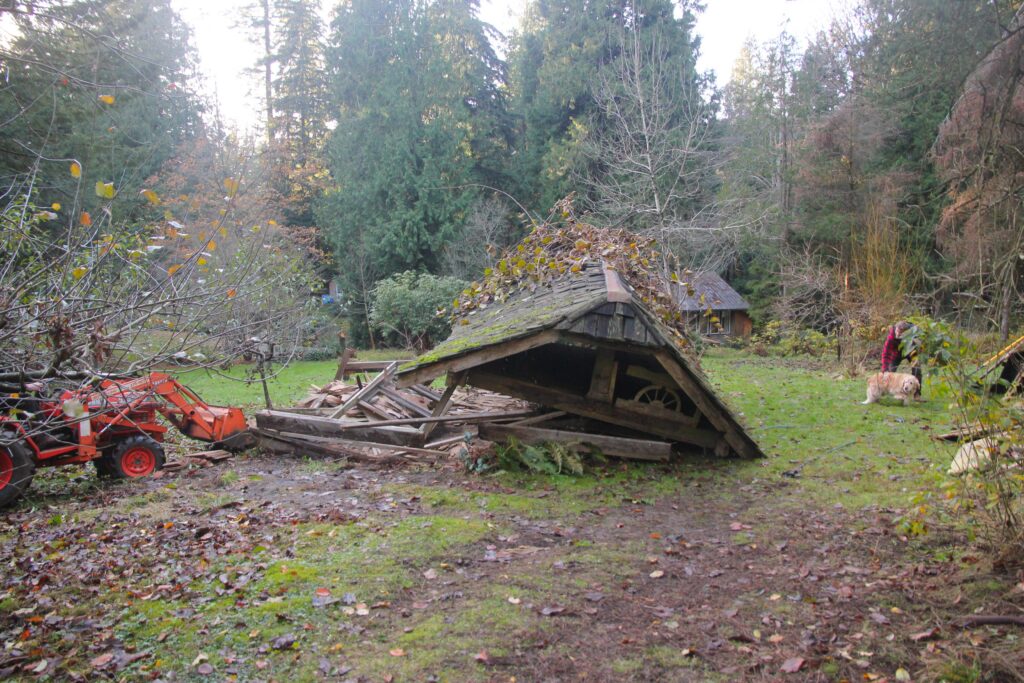
So this weekend, after slowly emptying it of two generations’ worth of tools and other “useful things”, Pappa pushed it over with his tractor.
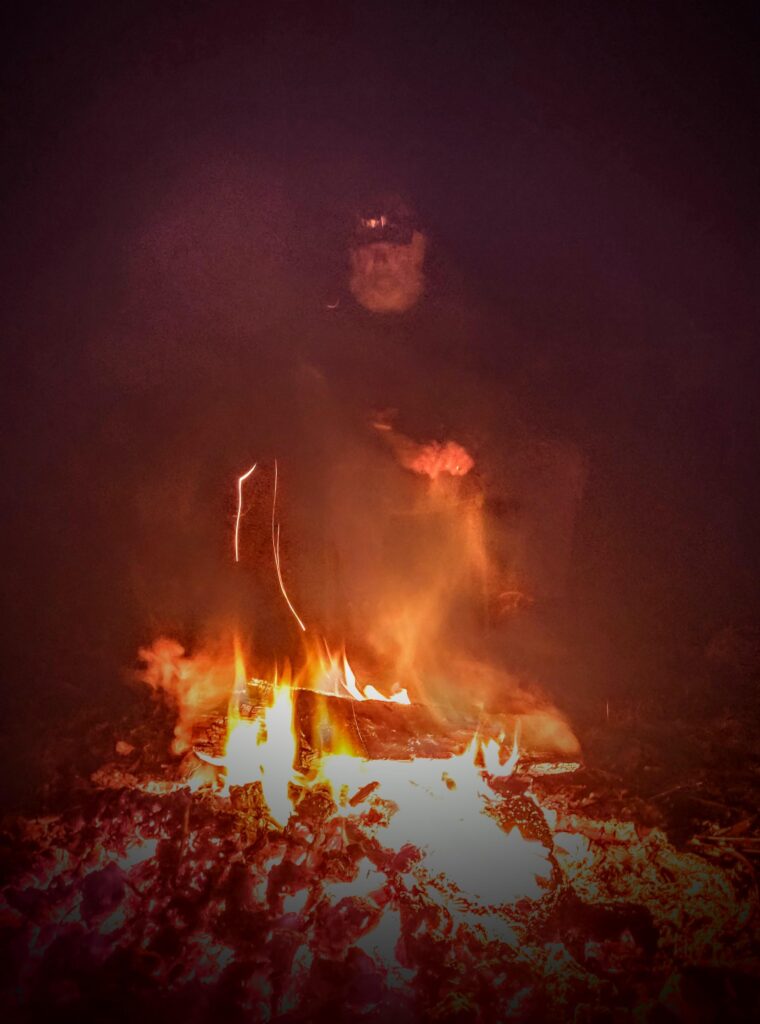
It’s hard to see it go, in a year that already gutted our family, but in a way, this evening’s hot dog roast over the flaming pieces of the shed was a kind of letting go. Maybe fire leaves devastation in its wake. Maybe it takes and takes ravenously. But it also cleans.
I feel a bit like I was washed by the flames, tonight. I wonder if that’s how my mother’s flesh and bone felt, as it was burning up in the crematorium. Now she’s become the heat that rose up into that spectacular sunset on the night she burned, and her bones, the tiniest white fragments—molecules mixing with the humus and mineral earth. I hope she feels clean, now. Things look different around her without the shed.
When people talk about severely traumatic events, they often refer to "The Before Times". I heard this during Covid, when we could look back at carefree parties and hugs with our grandparents. I felt this when my father died, and his half of my family crumbled, and I remembered all the beautiful times we'd spent together, not knowing they were our last.
The Before Times are always somehow fanciful. All the negativity disappears and we pine for those Before Times like unrequited dreams. We long for and resent our lost innocence. Before I had Long Covid, I could just walk around on the streets and up the mountains and down into the valleys. In the After Times of Long Covid, I sat in my car and watched people walk by on the sidewalk, wondering how they did it. Walking seems miraculous, now. Those times when I could just call my Dad up to tell him about my day seem like magical memories. Those times when our children played together in the blissful company of grandparents who are now gone seem miraculous, now–now that we're in the After Times, where we are jaded and distrustful and fearful. We're in the After Times, where we are wiser. Supposedly. Wisdom, too, is not what we thought it was, when we were innocent.
I'm still waiting to feel wiser about my mother's death. I know I'm in the After Times, now, but I've just stepped over the threshold and I'm totally lost. People keep offering me pieces of wisdom, and every time I think, "Ah-ha! That's something that can help me on my journey!" And I stick the wisdom into my little threadbare bag of emotional tricks to pull out when it will inevitably be required on my Big Adventure Into the After Times. Like: "It's OK to cry; that means you're connecting with your mother," and "Mourning is a sickness. Like Long Covid. You've learned to integrate and adapt to that sickness; you can do it again." And every time these words feel like they came directly from the Deep Dark Mystical Universe of the After Times, where people are wiser and all the ones who've lost their mothers were apparently waiting around to catch my fall, and pull me into their embrace. Thank you.
Mum's little purse with her handkerchief.
And those pieces of wisdom hang out of my little threadbare bag of tricks; their invisible heavy tendrils dragging on the ground as I wander along. This is my bag, now. It was my mother's very fancy purse when I was small. She kept her handkerchief in it, and a thin Lancôme lipstick, and a smaller, matching purse for money. It carries the Memories That Kept Little Me Safe, when it was hers, and not mine, and I didn't understand this little bag. Now it's mine, in the After Times, and I'm filling it with the Advices of the Wise Ones.
One of the things I couldn't have known in the Before Times is the value of tears. I remember my mother's tears hitting this bag, inconceivably, as she reached in to get her lipstick, because they sometimes fell when nothing seemed to be the matter at all. And I remember them hitting this little bag; how it darkened with the damp, and how my mother swore at her own tears. Now I see the tears in the eyes of these Wise Ones; the weight and vulnerability and frankness of being The Ones Who Held Everything Together in the Before Times, but then the tether broke.
Now we're floating. Lost. Nothing is together and we are free like we never wanted to be. We have tears falling when nothing seemed to be the matter at all, but their dampness leaves stains that are inconceivable to those who haven't yet arrived in the After Times. Now I'm one of these Wise Ones and these tears are my welcome mat. And my wisdom-offerers are crying, because even after all the years of living in the After Times, the sorrow is not less. It's just integrated. And it's good to know someone understands. Accepts my tears. Our mothers are gone.
The sorrow doesn't get less. It just gets integrated. That was one of the mystical advices offered to me in the Before Times, but I didn't understand it. I just added it my little threadbare bag of advices, where it sat unused on my mother's shelf, in the times when I didn't know what that bag was for; nor how to use it or what it meant, or even how it was possible at all. People gave me this advice and I couldn't see it, because I was in the Before Times. We can't fathom what we have never seen. So my bag sat on a shelf in my mother's house, quietly, being hers.
But now I'm here in the After Times. My beautiful Mama was wiped off the earth so that everything that was so real and tangible before feels now like a cruel slap in the face; a memory of wonder and longing: her arms around me; her little red purse and strange assortment of French lipsticks; her mystical explanation that soon it will be my turn to understand; her tears telling me goodbye; her voice and her song and her love. Now I'm the wise one because I live in the After Times, with my sisters and my aunties and even my dead mother. Now I'm the wise one because I have the experience none of us ever wanted to have.
Now I meet the people whose mothers are aging; dying maybe slowly or imminently or in some far-off unknown and terrifying future, and suddenly they look to me like I'm a keeper of this horrible wisdom. But I look away from their searching gaze and into my Little Threadbare Bag of Advices From the Wise Ones of the After Times, and I wonder if I'm supposed to dispense these now, or wait. The answer is wait. These people who have not yet lost their mothers are still living in that blissful and mystical Before Time, and none of the Advices will help them because they don't yet know the horror.
This Bag of After Times Advices is like a set of unlabelled keys to a house of horrors. You can't know which keys fit which doors because you can't yet see the doors. We can't fathom what we've never seen.
Don't think you need to be prepared. You can't look over the threshold. You will have to reach the After Times, eventually. But not now.
Right now, you still live in the Before Times. Do that, instead. Live those Before Times like they are your last. Because they are; all of them are. Live them with your children and your parents and your friends and the lost ones and the found ones. Because one day you will look back and say "Why did I waste those Before Times not knowing how magical and mystically beautiful they were?!" And you'll put that too into your own Little Bag of After Times Advices, and you will look at those who haven't crossed over yet, and understand that nobody can give advice to the uninitiated, because we can't fathom what we've never seen.
Anyway, it doesn't matter how much you treasure your Before Times, it will never be enough. The more you love, the more you lose, but the losing is a kind of sublime sorrow that means you loved. So love. Just love.
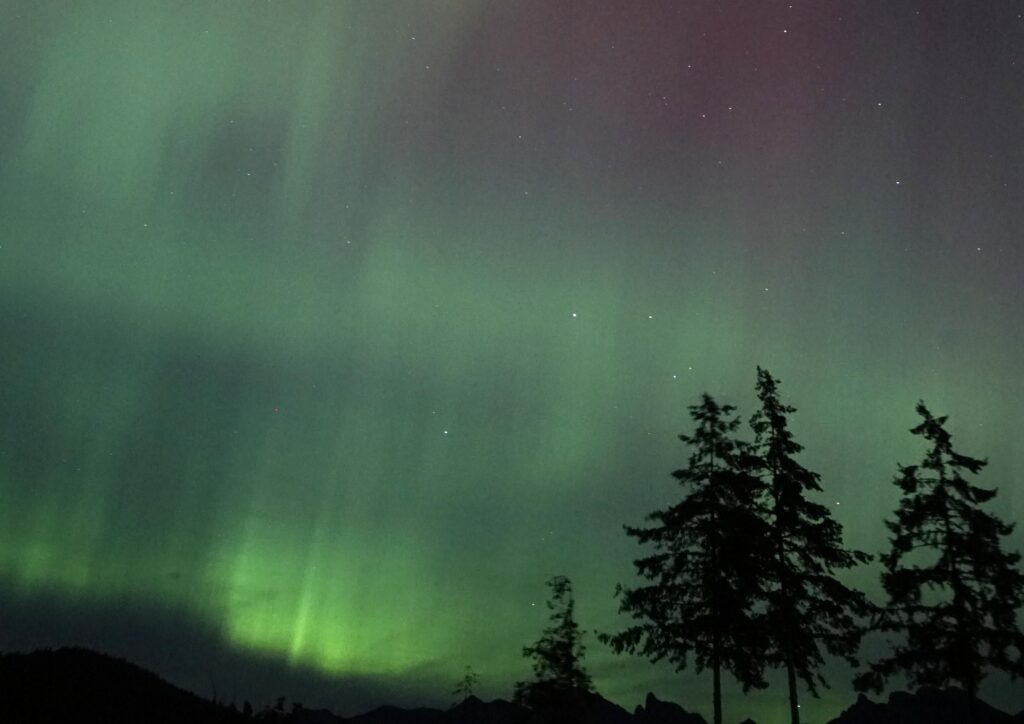
I went out to see the auroras last night, and I cried. And it was beautiful, and I cried. I had to force myself to leave the house, because my grief feels like a prison, sometimes, but I went anyway. It was the first time ever I saw the aurora dance, and I was heartbroken not to be sharing it with my mother, so I told myself she was everywhere. In the auroras. That's one of the Advices From My Little Bag. Then I met another person on this horrible beautiful threshold of the After Times, and I did not open my Little Bag of Advices. We just cried. And in the dancing lights, I saw her tears.
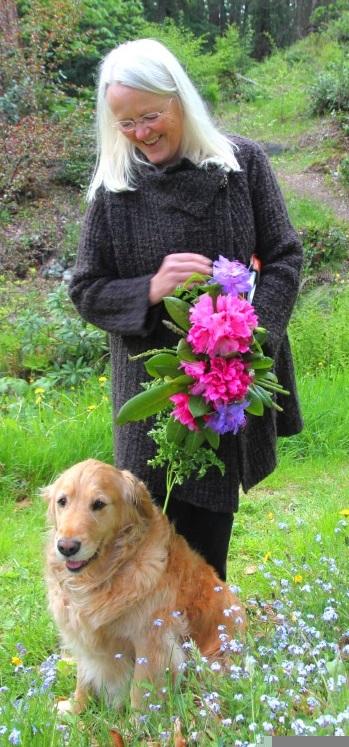
Our mother and life partner, a lover of song and beauty. A singer, a gardener, wife, mother, grandmother, friend, teacher, and creator and spreader of love, died peacefully on September 18th 2024, five months after receiving her brain tumour diagnosis.
Lyn van Lidth de Jeude helped raise countless children in her 40 year career as an early childhood educator, infant development consultant, and music therapist. Through her dedication and constant love for every child in her care, Lyn worked tirelessly to ensure that they all started off with a strong foundation.
While you may not have guessed it, Lyn was born in Daytona Beach Florida, and a piece of her identity was her deep ranching roots in the Black Hills of South Dakota. Her father Horatio Ham, an engineer, moved the family of 5 kids many times until the final move north to West Vancouver. Once here, Lyn attended West Van High and Capilano College ending with a degree in music therapy.
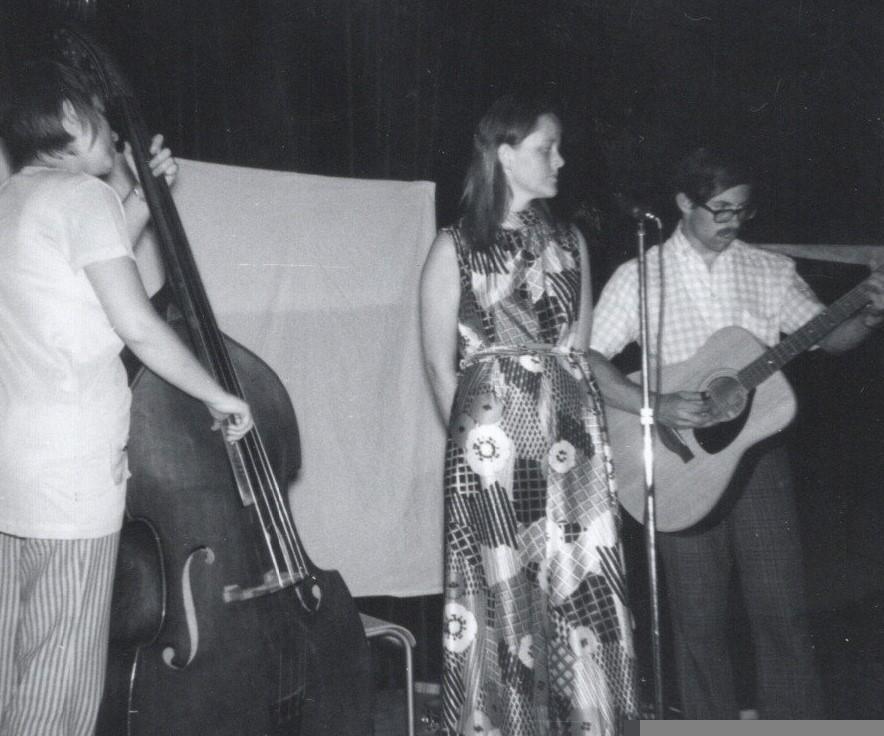
Music was always a fundamental part of her life. From her many many years with the Vancouver folk song society to her participation in Bowen Island choirs (the Madrigals, Song Roots, and the Community Choir). She also instilled the love of music in her children and shared her songs whenever she could.
Lyn and her husband Everhard moved to Bowen Island in 1978. As she engaged in life with her young family, Lyn quickly grew to love her community and developed deep friendships, choosing to see her friends as family and treating them as such.
In 1993, the family moved to the interior, where Lyn worked as a music therapist and infant development consultant in Kamloops. Lyn and Everhard returned to Bowen Island in 2006, where Lyn again joined the Bowen Children's Centre, with a desire to give back to her own community.
Throughout her life it was most important to love, help, and respect people who needed it. From volunteering at the Nook or the Recycling Depot, the Garden Club or the Conservancy, or delivering food for the Legion, or the countless other community endeavours, Lyn loved to help.
She is survived by her family and many, many friends.
Shortly before she died, Lyn dictated the following message, which she asked us to pass on to her loved ones after her death:
For the people I love, My time is finished, now. I would like you to know how much you mean to me. I have appreciated the connections and love we’ve shared. I hope you will continue to find beauty in the world. Lyn
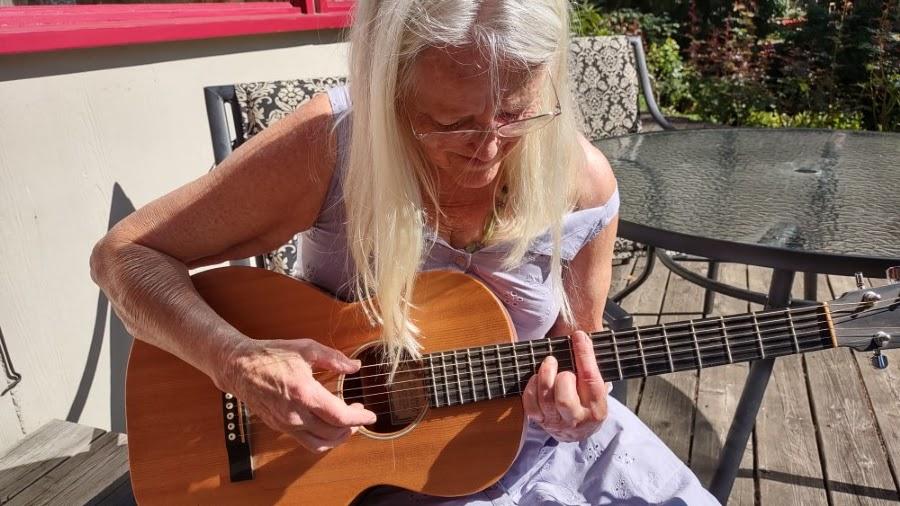
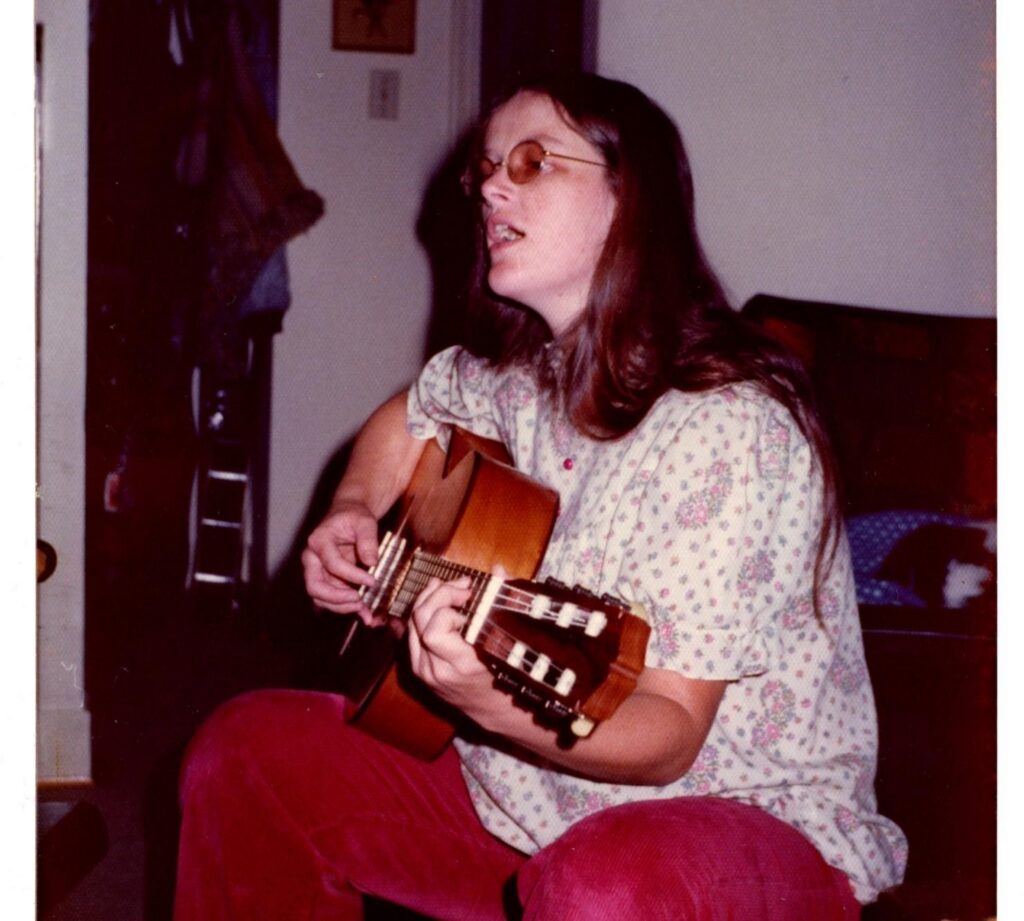
Lyn playing guitar on her own porch.
More links, videos and photos for those who might want to spend some time remembering the beauty that was Lyn:
Lyn reading Emily's favourite story, where the gnome loses his shoes and they come to find him!Watch Lyn reading a funny catalogue with her grandson, here: https://youtu.be/WBWCPy9LpXM
Lyn, baby Adrian, and Chis Chila.
Lyn and Everhard on their first homestead, slaughtering rabbits. Everhard is feeding the kidneys to Chis Chila.Lyn in Switzerland, smiling at the love of her life, Everhard, behind the camera. 1999
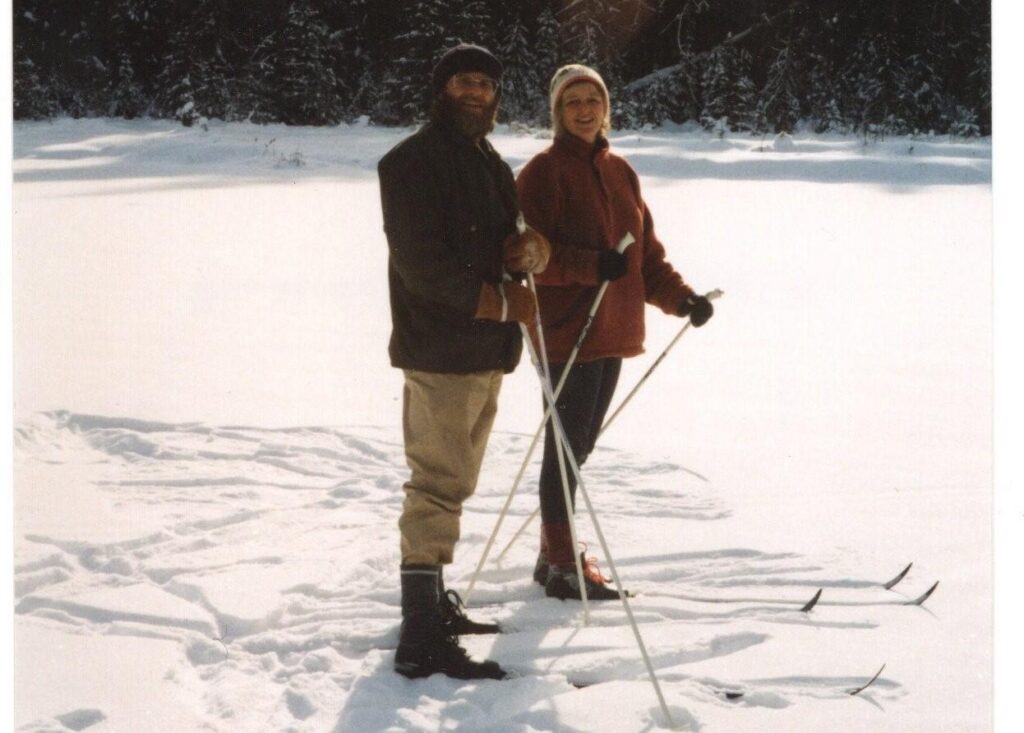
Lyn and Everhard skiing in the interior.
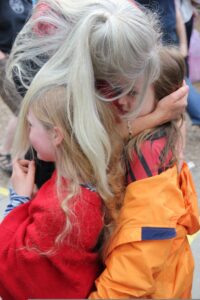
Lyn's love for her grandchildren was perfect. This photo was taken at her retirement party.Watch Lyn singing traditional Canadian folksongs with her granddaughter's class, here: https://youtu.be/LQ7VeLUyZz8
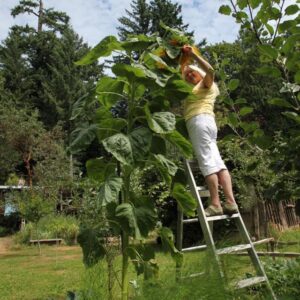
Lyn measuring her award-winning sunflower that was over 13 feet tall!
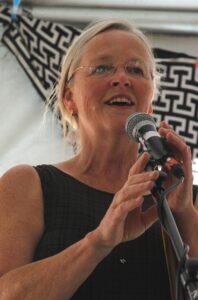
Lyn singing a traditional ballad at the Princeton Traditional Music Festival.Watch Lyn singing at the PTMF, here: https://youtu.be/VrBNiLGm_0Q
Adrian and Lyn on Adrian's 40th birthday.
Everhard and Lyn at friends' wedding celebration.
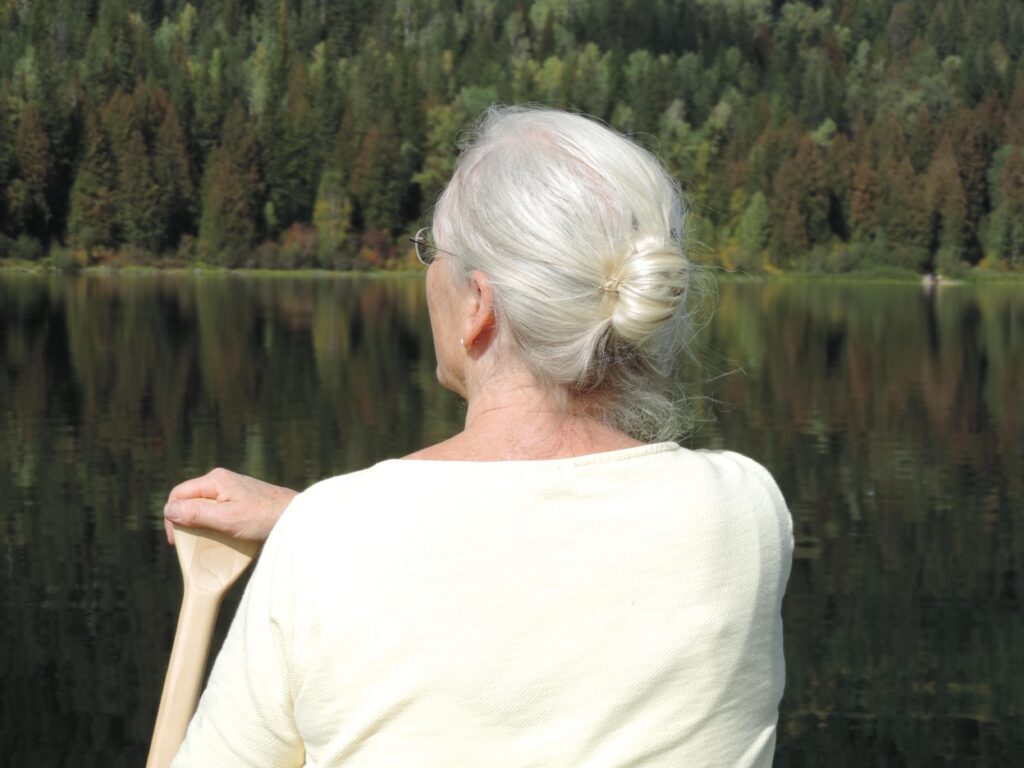
Lyn paddling in BC's interior. Photo by Everhard.
Adrian, Lyn and Taliesin with the happiest dog in the world, Kalea.
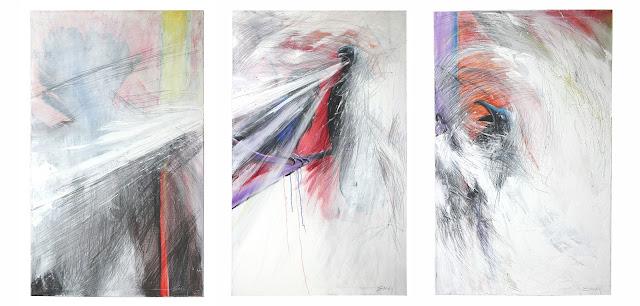
"Three Craws", oil and graphite on 3 stretched canvases. Emily van Lidth de Jeude
Songs of the Apocalypse is a series I’ve been working on since around the time my birth father died. He had lived a long time with Parkinson’s, but the circumstances of his death in hospital, while recovering from spinal surgery, are a complete mystery, and in that post-shock landscape of fear, confusion, and a resurgence of shallow-buried family traumas, his side of my family fell apart. So this series of paintings began as a way for me to deal with my emotions of that time. But of course those personal issues are deeply intertwined with the societal issues we all live with: helplessness in the face of climate change, capitalist, colonialist and patriarchal damage, global societal upheaval, and the fallout from those things. For example, many of my own childhood experiences are a direct result of my grandparents’ war traumas. Two of my grandparents come from families fleeing war and famine in Ukraine and Ireland. Others recently lived here through the great depression, and all of these unknowingly stored those experiences in the many generations to come. So those bigger-picture problems filtered down through the generations to effect even my own children’s health and genetic makeup, a hundred years later. Divorce, childhood trauma, and family strife are just microcosms of the bigger picture. So in dealing with individual portraits I’m also looking at our society as a whole. In looking at the wounds and the healing, I’m hoping to create psychological pathways for us all to heal from the greatest struggles we face.
My parents did everything they could to support me, given the understanding and tools of our time. They created a safe and nurtured life for me on a small island, and they continue to support me in my adulthood. But life cannot be perfect. Life is not about good and bad, but about all people constantly growing. And growing looks very messy.
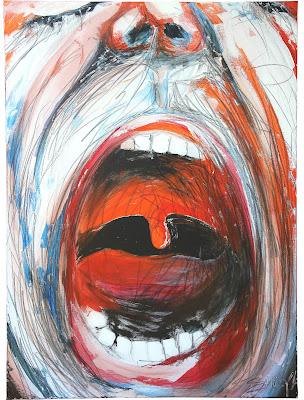
"(I open my mouth and) nothing comes out", oil and graphite on stretched canvas. Emily van Lidth de Jeude
The circumstances of my childhood were not what we consider to be ideal, but they’re also not at all uncommon. Like many of us, I live with intergenerational traumas from histories of war, colonialism, famine, and domestic abuse. These things are rarely spoken about, as our culture tends to look down upon expressing too much emotion or speaking about emotionally challenging topics. But the effects of my buried experiences are borne in my body as autoimmune diseases, and they’re in my paintings. The image above is one of the first I painted in the Songs of the Apocalypse series. It’s a depiction of my own face as it appears to me in dreams, screaming for all I’m worth to help the people I love (who are always suffering horrible fates in my dreams)… but no sound is coming out. And nobody hears me. As an artist I’m trying to break that helpless invisibility, not just for me but for all of us.
I am a woman in a world where one in three women has been the victim of physical or sexual violence, usually by a partner or close family member. So think of three women you know. Which one is it? Think of twelve women you know. How many of the four has told you their stories? I am a woman in a world where women are not only not expected to achieve, but are taught not to expect ourselves to achieve. A world where we’re expected to be happy to just survive.
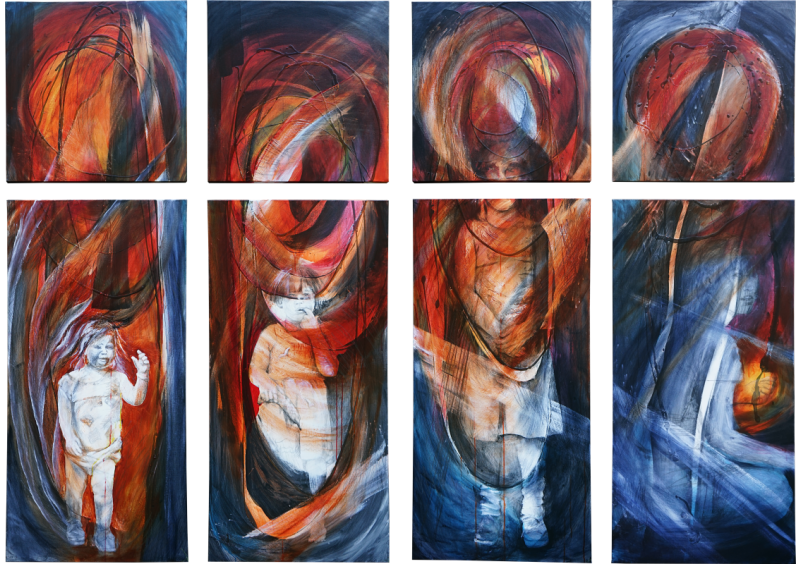
"Will You Love My Heart", oil and graphite on 8 stretched canvases. Emily van Lidth de Jeude
I don’t call myself a survivor because I want to do more than survive. This is a portrait of me at one, four, eleven and sixteen. It’s called Will You Love my Heart, and is painted to Sinéad O’Connor’s song, Love is Ours. It’s on exhibit July 24-August 18 at the Silk Purse Gallery in West Vancouver. As a synaesthete, I usually paint music, but not just any music. The song that inspires a painting will have a very specific meaning associated with my own memory, so what I’m painting is my visual experience of that song combined with my own memory and emotion. Love is Ours is about holding onto the pieces of our broken hearts and keeping each other alive. In our boxes of personal experience we grow out into the rest of the world, and then will we be loved? Or shoved back down into our private little trauma boxes? I’ve spent my whole life since my teens trying to get out of that box, to find love and healing, and grow into the many links between my heart and yours (yes you—we’re all connected).
I figure it’s a good idea to let my voice come out now, share my progress and hopefully inspire billions of others to do the same. That’s why I’m finally beginning to show the Songs of the Apocalypse series.
So think of those women again. Those 12 women, four of whom have been assaulted. Maybe you’re one of them. Maybe your child is, or your partner or your mother or your dearest friend. What can you do in this moment to raise her up out of the box built of her trauma? What can you do to break the walls of the box? How can you change even one thing about the space you give her; the voice you give her; the respect you give her, that could help her find her own way out of the box? And how does your love make her strong?
I’m a feminist artist with a loving, evolving male partner and a strong, courageous daughter, and an extremely emotionally-aware son. Being the strongest I can be strengthens the foundations for everyone, including all genders, ages and classes of people. It even will combat climate change, colonialism, the patriarchy, and capitalism, because as I become stronger I can lean less on the cultural norms that hold up those false shelters. Creating a world where I can come out of my box and thrive means creating a world where everyone can thrive. Equality doesn’t mean bringing anybody down. It means using the pathways created by love to hold each other up.
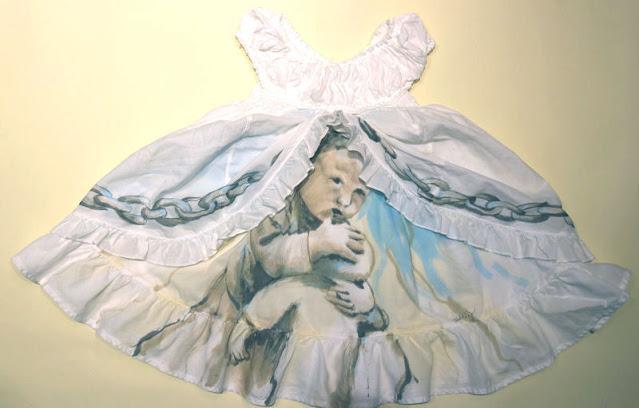
"Chain Dress", acrylic and stains on an altered child's dress. Emily van Lidth de Jeude
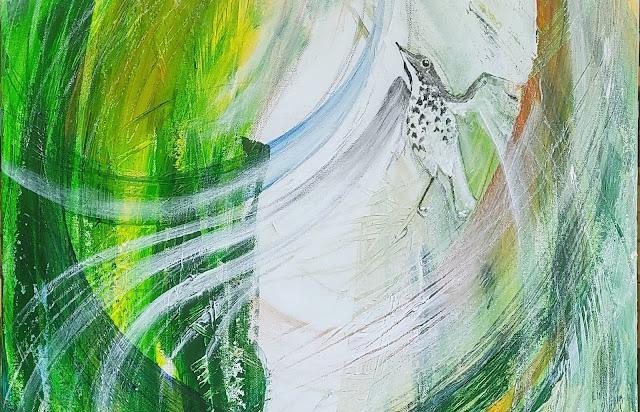
“Go and Make Yourself Content, My Love” (detail). Swainson's thrush in my mother’s garden, to the tune of the Unquiet Grave. Painted with acrylic, graphite and coloured pencil, by Emily van Lidth de Jeude.
I was walking down from my parents' house to mine, over the crest of their driveway where the wind blows steady. Not like the rest of the property, through which it tumbles this way and that, scatters just a few leaves, or bursts out of a single storming fern. Over the crest of the hill at the top of my parents' driveway, the wind passes smoothly and calmly, sometimes crisp and smelling of leaves, sometimes damp with the weight of snow and sometimes full of the heaviness of summer and dragonfly wings. I've walked here alone and with my children after Christmas dinner, my heart and belly and arms full of treasures. I've walked here holding my chest against hidden sobs when I couldn't be what the world wanted of me. I've walked on my parents' driveway even when they lived in a different house and I visited rarely, and always it has been a place of the wind and the gathering and freeing of perception and feelings. A place of reckoning or accepting. Not that night.
I was walking down from my parents' house on the evening we came home from our first trip to the Cancer Clinic, two weeks after the sudden and unexpected removal of a stage-four tumour from my mother's brain. I was walking down that driveway and there was no wind. The driveway felt flat, although it's not, and it's rocky, but the rocks were dead that evening, which they never are. The April grasses and blossoming trees were bereft of colour. Impossibly grey. There was no birdsong, no frogsong, not even the sound of leaves, and when I looked at the hillside I thought it might just go away, if my mother died. When my mother dies. She keeps reminding me: "We all have to die, sometime." But I don't want those words. That was one of the many logical thoughts that evaporated when the doctor told us we won't be returning from this trip. And we stared blankly into the empty air and our tears were silent.
I find the word "journey" as people use it for cancer absurd. We use it like we can pack for a trip and just take in the ride. But it's not that kind of ride.
Glioblastoma. Someone should make a horror carnival ride called Glioblastoma. You get in a little comfy bucket seat and it chucks you out into the sea. Then down a vortex you go, into a drain where you almost drown but NO! You're not allowed to drown! There are things to live for and places to see and you might have a few days or weeks or months or years of good life, so LIVE!!! And you can't feel your right side, and you can't find all the words that were here just yesterday, but now more than ever, you want to, need to LIVE!! So you come out of the vortex on the chemo train, where you get whipped back and forth over trestle and track without warning or reason through whacking slaps of sheer terror and poofy clouds of deep love and acceptance: A bird? NO! Slash! You're going to die! Slash! Maybe not so fast–Slash! Everybody is trying to help you–Slash! You're so strong–Slash!–Take some more pills–Slash! Love, love love–Slash!
Love can't save you and everybody's talking to you like a child–Slash! Now you're the wise one–Slash! Let's finish your sentences for you–Slash! We could get an ice-cream!
Slash! You get to meet the guy who will administer your death–Slash–but only when you want him to–Slash–Be GRATEful!!
Slash!
Nobody wants you to die!–Slash–Let's go shopping!–Slash
Why are you so tired? Slash.
Slash.
You fall out from the carnival ride one sunny morning, and you smile up at the sky and look for birds.
But there aren't any.
My mother loves birds. My whole life has been decorated with her hushed exclamations of "oh! A warbler!" and "Did you hear the snow geese go by this evening?" My mother hears things many of us don't notice, like the pips of babies and the tone of ducks that tells her whether they're coming or going. When my father gently delivered a helpless baby owl into my childhood, my mother raised it on chopped liver and caught mice until it grew up and flew to the trees. But she heard its voice separate from the other owls, and she answered it, and taught us to make the hungry-teenage-owl call, too: Psssshhht! Pssssssshhhhhhhttt! That owl and its offspring came back to visit us for decades.
Terminal cancer is a strange thing. We want a timeline. Something to hang a hat on. To work with. To put in the calendar, and at the same time we want to live in the moment and not have to plan for death or even how to visit with all the loved ones. But just to sit and hear the birds. Except the chaos of medical interventions, social supports and emotional upheaval means not a minute exists of just. Peace.
Until one day, we can't take the chaos anymore. Out of necessity we ignore the forms we're supposed to be filling out and decline the offers of new prescriptions, new dosages, delivered meals and all the services we know are needed. One day we just need to be.
This week I saw my father's eyes in a rare moment of stillness. They used to shine with his intensity; they used to sparkle and shoot beams of aliveness. But recently they've looked tired, and there were big wide tears balanced on his lower lids and he was just making a sandwich. I don't hear so much as I see, and I am starting to see again. I saw my brother's cheeks, this week, taut with small lines of agony as he pulled me into his arms and didn't let go. As he asked if he can take our mother to have her broken arm looked at. Cancer is not a journey. It's a horrible carnival ride, and sometimes we catch glimpses of the world, as we spin. Sometimes, also, we catch glimpses of the beauty that brought us here to begin with; that holds us up through the fear and the changes we didn't see coming. My parents walked out, hand in hand, today, to look at the blossoming of the world they share.
And I began to hear the birdsong, this evening. The teen-aged ravens are pillaging the robins' nests, to a great outcry, as you can imagine. We thought the black-headed grosbeak that my mother says only comes for a short time every spring had left, but it's been singing again. The wrens and towhees are hopping in the bushes, until they flit out to the pine, to make their plans. The offspring of our owl are impressing people along the trails, these days. And for some reason the flickers keep sitting around on the ground. My father says get the aphids out of my apple tree, but I can't reach them and we both know that's OK. Bats are out, tonight, delighting my peripheral vision. And as I walk up over the crest of my parents' driveway this evening, I hear the nighthawks dropping on their prey, all around me. The wind is warm, and it's summer now, and my parents are just watching a movie with a couple of mosquitoes like it's a normal evening. Just living this incredible life in an incredible world, and learning to step off the carnival ride and hear the birdsong.
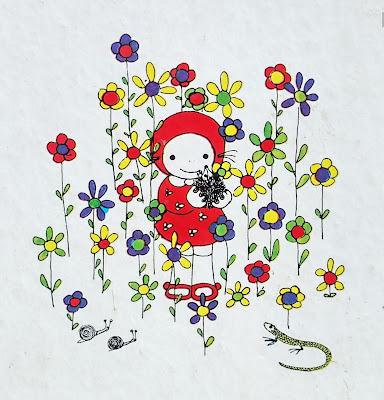
back cover illustration from Emily and Arthur, 1975
This morning I got up as I have almost every May morning for as long as I can remember, and went barefoot out of the house to wash my face in the dew and pick flowers for my mother. I don't know why I do it, and I don't know that my mother even knows I get that dew all over my face and feel so at peace in the world this way. Something inside me just feels this is right, so I do. I used to take my own children out to do it when they were little, but I don't think the practice has stuck with them in adulthood. Why do I do this? What makes it so important to my identity?
I came back home after visiting my mother to find this old book on my table. Emily and Arthur, by Domitille de Préssensé. It was there because my daughter and I were recently going through the children's books, reminiscing, and I'd pulled out a few of my old favourites.
In these old books from the 70's, I saw how I became me, and some of how my children became, as well. The girl in the image above is Emily. She's wearing red–always–and holding her beloved hedgehog Arthur among the flowers. She has interesting things in her house like a "long stocking" that I always thought must have been a wonderful thing to have. And because my name is Emily, I grew up thinking this little red-clothed Emily represented me. Is she the reason I love to wear red? Maybe! Red just feels like it belongs with me! I remember feeling a lot like the way this Emily looks, as a child. I remember the feeling I had one May morning when I went out to find my mother some flowers and got distracted looking at woodbugs on the log where I eventually broke off a beautiful Turkey Tail fungus to bring in for her. I remember when I handed her that beautiful Turkey Tail with a couple of flowers how it couldn't encapsulate all the beauty of the woodbugs on the log, or the special curve of the broken wood, or the smell of the bark or the happiness of my heart. But I hoped she knew it meant I loved her. I became that girl on the back of the book–the one who is delighted by small found things–and am now a mother and artist who is also just still Emily. Still wearing red and going into the flowers to be me. How many Emilys have been somehow defined by this book?
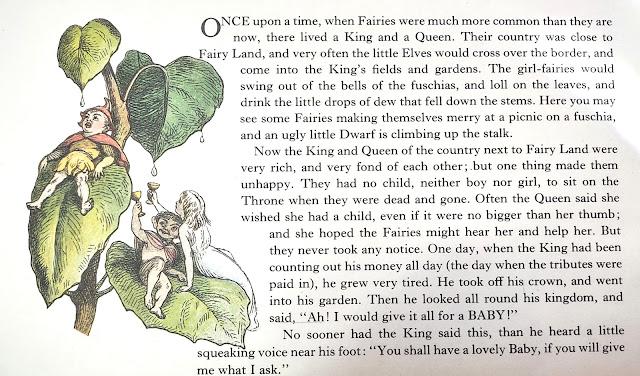
As a parent, and former educator, and as an artist I know how much our childhood experiences mean to our identities. I sat wondering this morning how the idea of washing my face in the dew came about. I feel like I've been doing it all my life, but I can't ever remember doing it with my mother. Then I saw another of the treasured childhood books, and I remembered: The fairies drink the dew! When I turned four, my father gave me a book called In Fairyland, Pictures from the Elf-World, by Richard Doyle. In this book the fairies dance and fly and race snails… and drink the dew! I remember trying to drink the dew off the plants as a child, imagining I was one of the fairies. I guess somehow this became part of my personal May Day celebration. This is how traditions are born, how they grow and change and define us. And… this is the power of art!
page 13 of Richard Doyle's "In Fairyland, Pictures from the Elf-World", 1870
I always knew these and other images were drawings made by artists. Even the text of Emily and Arthur is a hand-drawn piece of art. Now I can see its influence in my own birthday-card making, and I can see how Eric Carle's rainbow of fruits for the Hungry Caterpillar informed the way I set up any painting, now. Nothing is complete for me without a whole rainbow.
So what have I given my children through the books I chose for them? Some I'm not so proud of, I confess, and some I can see in their life-choices, now. Obviously they were also more drawn to the books that suited their personalities–this isn't a one-way system of influence. And I chose things that suited them. We know that every move we make as parents will have effects on our children's psyches, that every mistake we make will cost them in self-doubt and therapy dollars, one day, and we hope they'll carry our triumphs forward as courage and happiness into their adulthoods. Our children become themselves in the environment they're given.
But our sphere of influence doesn't end with our children. It grows from each of us into the world around us, whether we're artists or teachers or foresters, diplomats or farmers. We're all creating and influencing each other every day. The choices we make in the language we use, in every bit of media we consume, and in the products we bring into our lives all influence everyone we come into contact with. And through our contact we become ourselves, in community. Living with this in mind is self-determination. This is how we become, as a species, or perhaps even as a planetary ecology. It's good to remember that in everything we do, we have a choice.
I could see him drifting across the polished concrete floor of the convention centre, blue-jacketed arms spread into a perfect reflection of the very wide smile that punctuated his neatly-trimmed ebony beard. He was studying the very sad-looking portrait of my recently-divorced brother that adorns the train of the gown I had on display. He circled the gown slowly, hands splayed as if to catch every bit of story it offered, taking it in with sparkling eyes and smiling, smiling, until he looked into mine, and said, "did you make this?"
"Yes," I answered. "It's called '(dis)robe: Nursing Gown'. Tell me about your big smile!" And he told me he felt seen. We talked for a long while about how crippling our societal expectations can be for people of all genders. We talked about how trapped the painted man looked, even though he held the mannequin by a dog-collared lead. We talked about how the patriarchy crushes all but the wealthiest people–it was never about men versus women; it's just a few billion pawns fighting for survival under the shoe of someone much more powerful. And what if we were to work together, instead?
I just finished a four-day stint of exhibiting some of my wearable art pieces at the Art Vancouver fair. This gave me opportunity to reflect quite a bit on why I do what I do. My purpose as an artist hasn't changed, but it has deepened and I suppose I feel it more intensely, now. I'm here to connect people with each other, with their own authenticity, and with a more equitable, sustainable future. My art is a conversation-opener. Conversations like the one I had with this blue-jacketed man are the cornerstone of social change. They're the space where the change takes root in our hearts.
See those two people talking at the back of the image below? They're talking. Their hearts are making change. During this show I also spoke with many children who wondered what was "going on with the boobies" on that Nursing Gown, or whether they could touch the insects on the Gaia Gown, and I saw children pull their mothers around the skirt to identify the flowers they knew. People wondered where they might wear such unusual dresses, or why anybody would want to. "Definitely not to work!" One of them exclaimed.
The main piece of this winter's artistic journey for me was the Long Covid gown, '(dis)robe: Hospital Gown' (image at the top). It involved over 300 selfies contributed by Covid long-haulers from around the world, transferred to an altered donated hospital gown. From the back of the gown, trailing from a drawing of my son's hands (because when my Long Covid was at its worst, he used to help me walk by gently pushing my back), was a hospital-blanket train covered in some of the most common symptoms of Long Covid. These are the symptoms that millions of people worldwide live with every day, often confined to home or bed, invisibly. So the train is supported by a wheelchair that is also partially hidden. There's symbolism in everything I do, and this was my opportunity to give a voice to the millions of people who, like me, live mostly invisibly with Long Covid. And when I got too exhausted (shaky, blurred vision, heart palpitations) from wearing the gown and talking to people, I could just step back and sit in that wheelchair. A purpose-built wearable art piece! This is what comes of making art that truly deals with my own personal experience.
I invited many people from the Long Covid community to attend, so it was no surprise that this was a conversation piece for long-haulers, nurses and other health professionals. Some people even came to delight in finding their own faces on the gown! But it was also a chance for us all to be visible to others–many of whom had never realized Long Covid was happening in the world. Education is change-making.
This weekend was, for me, an opportunity to see other people becoming; changing, evolving, and questioning themselves. It was an opportunity to hug so very many lovely souls, and to express gratitude for their thoughts and opinions. There were people just visiting from afar, people who came to support artist friends, and people who were also showing work at the fair, or working to organize. There were people who came just to buy a pretty painting, but ended up chatting about climate change, gender politics, and the healthcare system. My own display confronted people with sometimes-difficult topics, and yet they bravely engaged. This reminded me that while we sometimes want to hide from challenges, humans are mostly courageous, and generous with our intentions.
I was not the only artist there trying to change the world through art. Humanity is a great kaleidoscopic spectrum of beautiful people, reaching across so many circumstantial divides to connect and thrive. We're like all the network of roots, mycelium, compost and microorganisms in the forest floor: a vibrant bubbling potion of hope, and a foundation for continued life. In following our own paths with so many tentative, compassionate feelers, we're finding our way.
One damp autumn day, I crossed the dirt and wood-chip playground to the swings, where I saw a girl a couple of years younger than I was, and also the bottom of her grade's social heap, swinging on the best swing. You know the best swing? It's the one that is for some reason not spun up out of reach by the older kids, and the most visible to the playground supervisor, so other kids don't bother trying to haul you out of it. During those years, I spent all recesses and lunch hours either hiding on the bluffs, up in a tree, or firmly glued to that swing and swinging fiercely back-and-forth, back-and-forth, daring people to come near me with a glare they never noticed. But this day, this younger girl's thick brown hair flew back-and-forth, back-and-forth over her raincoated shoulders. I stood at the pole of the swing-set and ground my boots into the dirt. When nobody was looking, I told her passing face that I was magic and would turn her into a rock if she didn't get off and give me the swing.
When I was a kid I was near the bottom of the social heap. The kids who hurt me the most were also hurt the most by their parents, or by other kids at the school. It's normalized, in our culture, to turn and dish out to someone else a cruelty that was served to us. School, career-building, politics, capitalism–they're all just games of getting ahead of others, and put us in a position where we feel that "getting ahead" is the same as "prosperity". It's an illusion, but our longstanding capitalist social structure leads us to believe in it at the cost of vision and community.
Israel is flexing its playground seniority in Gaza. It feels heartless to compare genocide to playground bullying, but I want to point out that in accepting what we see as insignificant cruelty in our privileged day-to-day as a necessary cost of getting ahead, we also pave the way to accept greater and greater atrocities. I understand from my playground experience how easy it feels to commit some lesser act of cruelty against another person when I've been hurt. So by extrapolation, I get that maybe if your people has been persecuted for thousands of years, and even in living memory was the pointed victim of horrific acts of genocide, it might seem less than horrible for (some members) of that people to commit genocide against the next victim down the chain. I mean, aren't we all just making gains by stepping up upon the backs of those just below us in rank, privilege, or esteem?
Well no–not everybody is doing that. Some of us from every race, religion, and social ranking in the world are in fact trying very hard not to be that kind of monster. Some of those in my circles who are most vocally supporting freedom for Palestinians are my Jewish friends. Because fighting to get or stay on top of a social pyramid does not equal prosperity! Because some of us learned this important lesson in childhood.
Back in my elementary school playground… I have never forgotten the look of horror on that girl's face, and my triumph at seeing her run away, so I could get to safety on that swing. My triumph was the worst. I remember the sick feeling in my stomach, after she left. I didn't know where she had run to, or who might be kicking her, feeding her dirt, or holding her down and whispering the most vile threats in her ears. I remember thinking we looked rather similar and maybe she could have been my friend if I hadn't been so desperate to get that swing. I felt that getting the swing gave me safety, but it also took away hers. I remember that my triumph came with a horrible cost to my feeling of righteousness, and that year I became one of those people who knows better than to pass the bullying on to the next rung down the ladder. Sometime after that I bravely spoke a few words to my bullied-mate in the classroom. We had a breath-holding competition. So for a couple of minutes we found common ground in an environment of terror and ladder-climbing, and I think in some small way we both learned to transcend the hierarchy of our class.
We can ALL learn from our mistakes. We can all look at our leaders and our cultural and personal privileges and refuse to make progress at the cost of others. Sure, we're trying to survive in what is, at its root, a culture of competition, and to some degree we have to participate in the status quo to survive. But we can also work to change it. Those of us with more privilege have more ability to effect change. We can change the ways we look at others; we can choose to befriend the people who make less money than we do, the people whose lashes lower when we speak to them; the people who seem least likely to improve our social status. We can look critically at our privilege and resources and belongings and ask ourselves what we actually need, and how we can change our lives and share the excess to achieve a social balance in our community. We can remind ourselves that a balanced community means prosperity for all.
Does prosperity mean a lack of suffering? Of course not. We're all going to die. We're all going to hurt. We're all going to lose loved ones, and health, and hope. But a balanced community is exactly the only thing that will sustain us through these challenges. And we can look to the ecology just outside our city limits for inspiration in achieving prosperity through social balance.
A tree in a forest. If a maple drops ten thousand seeds on the forest floor, all but a few hundred of those are likely to be eaten by insects, rodents and birds before they ever sprout, and of those that do sprout, most will be eaten as spring greens by the likes of deer, and others. And maybe five will grow to be saplings, and maybe zero will live to become trees, most years. Until one day the mother tree has crumbled under the weight of some winter snow and in the mess of her fallen limbs, one of last year's saplings will grow sheltered and become a tree, itself. But you know what? In all those years where not a single one of those seeds grew to maturity, that original tree fed the ecosystem around her, and reached her roots through the landscape to share nutrients with the neighbouring trees. All the other plants and animals' droppings and dead bodies fed the soil, and now that soil is rich with microbial life and nutrients, and that new maple tree will grow strong–not on the backs of all those it conquered, but in an ecology of giving and dying and growing. The maple tree has no fear of falling behind. She is a sanctuary for mosses, ferns and all kinds of insect, microbial and animal life–she is part of that life. She's just growing and giving and crumbling and feeding her ecology. And that is why she prospers. I want to learn some of that wisdom.
What if there was no fear of falling behind in human society? Would we carry, feed, and connect with each other; with our ecology? Would we relish those connections instead of conquering others? I feel like I've experienced this when I sing in community. When my own voice drowns away among the voices of others, but together we're a beautiful sound. I experience it when I play with children in the wilderness. We're each so insignificant in the big forest, but our play changes the landscape and we see the impact of our being there; we learn to play carefully. We learn that if we destroy the stream-bank, then the water downstream will be muddy, and then we'll have no clean water for drinking, anywhere. We learn that affecting anything (anybody) will have impacts on ourselves.
If my life depends on privilege gained through competition, and supported by people who aren't being supported by me, then when those people's lives falter, so do I. We can't build a pyramid to stand on, then rip out the stability of the base, and expect to keep standing on the top.
And from another perspective, when we've prospered exponentially at the cost of the ecosystem that supports us without honouring it, giving back to it, and living in harmony with it, the ecology we depend on is faltering underneath our ridiculous pyramid, and we're all beginning to discover what happens, then.
Our system of pyramid-climbing is not a strong one. A strong system is lateral. Like a forest, or a group of people singing. A strong system loses a limb and regrows to heal the wound. A strong system has no leaders, but many trusted and equal members, all giving instead of taking. Giving is not sacrifice, it's prosperity.
It's scary to think of not having enough (food, money, land, power, achievement, influence, etc.) In a hierarchical culture, "not enough" equals failure, threat; fear. For those near the bottom of the cultural pyramid in my community it means no shelter; no food. For those on the bottom in Gaza it means abject trauma every day. It means death. Is this an acceptable cost for my "getting ahead"? I don't want this kind of unstable throne. I don't want to support a global society that prospers on hierarchical oppression, because in that kind of culture, everybody is a potential pawn, or enemy. Everybody is unstable.
I want to transcend capitalism and find joy in uplifting others instead of uplifting myself at a cost to others. I want to stop prospering as an individual, and when I fall, I want to fall down in community, knowing that others will grow into my wounds. I want to be worth more than what I own or who bends under my feet. In a lateral community I will be worth the whole of us. I want the mirage of hierarchy to disappear and I want us all to be free.
Escaping the Nest (middle of triptych), by Emily van Lidth de Jeude
It just hit me that maybe ten years ago I was worried about the rise of misinformation on social media. I saw it once in a while; people posting things from known biased sources, or just stating information they assumed was correct but wasn’t. Extensive fact-checking became more necessary than I had felt it was, before, since even trusted sources seemed infiltrated with presumption and error. Or maybe I was just becoming more aware.
Recently, though, it feels like disinformation is the norm, and complicated with some serious cruelty. On the bigger social media groups I’m a part of (chicken-keeping, canning, foraging, mushrooms, birds, education, etc.) it’s just absolutely normal for somebody to post a question and receive 30–70% wrong answers. It seems people have just become accustomed to stating an uneducated guess as fact. (And seriously — for canning, foraging, mushrooms, chickens, and schooling, this can lead to disaster, for example when someone asks for ID on a poisonous mushroom, and half the responses say it’s edible, and most of the other half are phallus jokes.) And then there are the people berating each other, not just for being wrong, but for correcting the mistakes, as well. Or for totally unrelated things. Like when said phallus jokes become linked to anti-trans attacks. It gets awful out there.
THEN there’s the morality war. There is a propensity for people (mostly white men, I’m sorry to say), to stick their uneducated opinions into posts about LGBTQ2IA+, indigenous, children’s rights, women’s rights, and BIPOC issues… again, as facts. Many of these “facts” are colonial constructs held by our society because they keep white men in power (and because the rest of us think they ensure our continued prosperity). But many are now also just lies made up by conspiracy theorists (like all the supposed chemical, psychological and media conspiracies to make our kids gay or trans or supportive of minority rights…) Sure, there are many sides to every story, but some things are actually not happening. I’m not even getting into the massive quagmire of people in power (often leaders of large corporate enterprises, politicians and religious leaders) using minorities as stepping-stones to more power. Some of us use these crimes as security for our privilege, without ever questioning ourselves.
In my art life this takes shape as criticism and fear: Am I appropriating symbols that are proprietary to a marginalized group that I’m not a member of? Rainbow spectra and feathers were important in my work before I became aware of appropriation, and it’s been hard to sideline them, even though I know how important it is. Even harder was the bickering between artists and members of the LGBTQ2IA+ and BIPOC communities. Oh yeah, and the outright hate-filled rhetoric between some feminists of different stripes. These issues make communicating online really fraught, even without the added question of misinformation or disinformation.
What is going on?! Why is our culture disintegrating into this kind of nastiness and ignorance? As a long-time unschooling parent who notices the lack of this behaviour in the unschooling groups, it’s easy to feel like it might have some kind of relationship with our education system. Especially since unschooling mindset is one of curiosity, acceptance and learning, and unfortunately the compulsory, competitive nature of our school system can provoke a rebellion against curiosity and learning, as well as a propensity for bullying tactics. The rebellion against understanding and the bullying are apparent in a lot of the online attacks I’ve seen. But I think that, in the bigger picture, there’s a deeper reason. We’re experiencing a massive cultural shift. Our minds are opening. And that’s just messy.
We’re threatened from all angles as climate change changes every single foundation our cultures were built on (predictability of seasons, harvests, weather, migration, and therefore employment, finances, housing, healthcare, and even cultural norms). So in this state of growing societal panic, some people are trying to keep things as they were (ignoring the fact that the great majority of underprivileged people have already been suffering these unpredictabilities forever). Some are taking opportunities to fight for rights long-denied to them. Some, like me, are gleefully running headlong into the change, wanting to create a new and better world out of the chaos, and ALL of us are rather ungrounded in the process. There’s so much change, so much fear and threat, that we’re all just kind of scrabbling for understanding all the time. I guess it’s not surprising that a lot of people are confused about the facts, in this kind of chaos! I am too. Everything seems to take so much research now! And patience, tact, and caution! And in the rush of this change, and the feeling of urgency everywhere, it’s not surprising we don’t feel we have time to fact-check or to come to an understanding of the issues we’re talking about before making assumptions and proclamations.
So it’s frustrating, and sometimes even extremely upsetting, when people resort to cruelty because they feel threatened or inadequate in the face of such big unfathomable change. But it’s necessary that we remain patient and kind, reminding ourselves that these actions are a part of our societal growth. And I’m choosing to see it as a great sign that big change is happening. As a woman with many friends and family in marginalized communities, I’m glad to see my own and other people’s rights have a chance to be respected. As a person living on earth, I’m glad we are making changes that might make our future survivable! Maybe we can all take deep breaths and remind ourselves that everybody is confused and frightened. And maybe saying lots of wrong things is part of our process. We’re learning to learn and communicate! Real learning with an open heart and mind is how we will adapt to our new civilization. It’s how we will all grow to meet the challenge of a world none of us have lived in, before.
As the death-toll from Libya’s storm floods surpasses eleven thousand, and various hurricanes march their ways across the oceans, people all over the world are gearing up to March to End Fossil Fuels, tomorrow. (Find your city’s event on this map.)
Not a Thing Between Me and You (detail) … Recent painting by Emily van Lidth de Jeude, in response to Neil Young’s song, “Overhead”. This painting deals with our compulsion to just keep going into an unknown future, together, even when we don’t know we’re not alone. It’s about courage.
But what if we can’t march? And even if we can, how are we going to propel this impetus into action? How are we going to actually save our future on this planet? (Let’s face it, we’re not going to another planet, and instead of talking about “our children’s future” now, we’re talking about our own.) We’ve got months or a couple of years to turn this around, and even if we do, storms like this are now here to stay. So what can we do about it?
Become resilient. We can stop following the status quo, and learn to live differently than our youths and the media told us to. Learn to cook our own food. Learn to pivot our careers and plans and housing situations as needed, and without being traumatized. Adaptable creatures survive.
Make our kids resilient. So you might know I usually write about unschooling. That was (and still is) my effort to raise resilient, independent, capable adults. And it worked! At 18 and 21, my kids are now living independently (together), paying their own way, and making changes for a better world. Unschooling isn’t the only way to make our kids resilient. Any kind of freedom to explore and develop their own skills will help. As will encouraging schools to opt for explorative learning, wilderness education, and all the things that will help our kids be connected, creative, courageous, and resourceful. Those are the skills our kids will need to survive our new world.
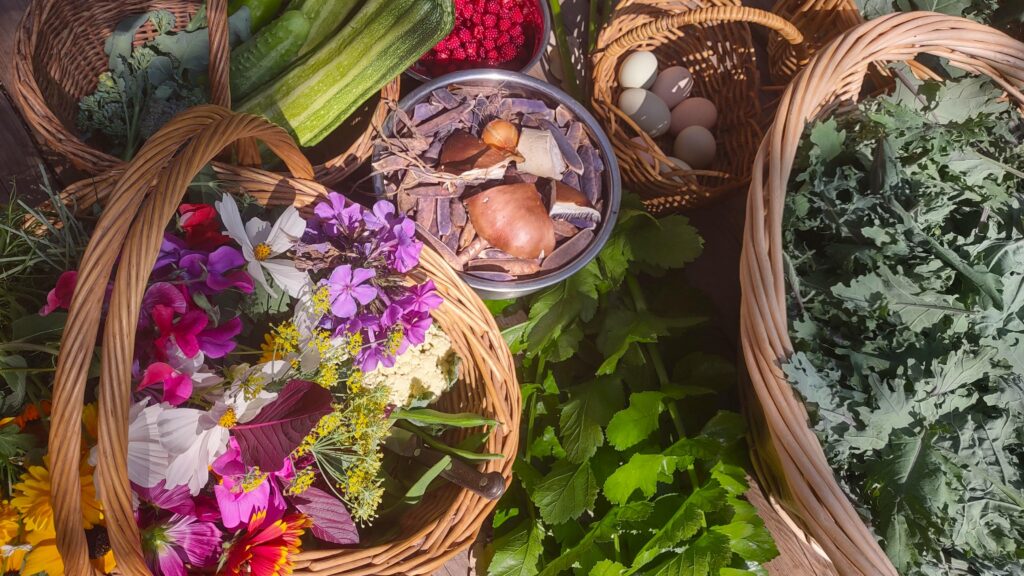
Grow food. Whatever we can do, whether it’s growing sprouts on our kitchen counters to save $10/week in veggies, or escaping the rat race to go whole-hog on a homestead — just do it. We can all (and yes I mean all) grow at least some of our food. This not only saves money (if we learn from someone else who’s doing it effectively and don’t fall for sales tactics for all the gadgets we don’t need), it also brings us closer to our food, giving us a deeper understanding of life, our bodies, our connection to the ecology we live in, and nutrition. It’s healthier for us (fresher food), and it’s also healthier for the environment, since everything we grow (sustainably) ourselves is something we don’t buy from the unsustainable agricultural industry.
Buy local. For all those foods and other things we can’t grow or make, ourselves, we can buy local! I guarantee you there is somebody out there trying to get rid of a bunch of homegrown zucchinis or apples right about now. What if we paid them instead of a big supermarket chain? What if we bought from local farmers, builders, and creators instead of from the capitalist industries that are the root of climate change? This is a shift we can make.
Don’t buy! Boycott capitalism. Buying local is one way of sidestepping the corporations who are doing the most damage, but buying less is an even better way. A big part of our problem is overpopulation, and then there’s overconsumption. We really don’t need all the stuff. We don’t need big houses. We don’t need big cars, we don’t need lots of clothing or school supplies or travel or household items. We don’t even need as much food as we currently consume, and we especially don’t need to be wasting as much food as we do through restaurant and supermarket refuse, and simple neglect at home. How many times do people go on a fabulous vacation and then declare they need a vacation from their vacation? What if we just took a local vacation in the first place — one that doesn’t displace people from rental accommodation, and that connects us with our homes in ways we hadn’t experienced, before? In the space that’s left without the things that we don’t *actually* need, we will learn to find convenience, fulfillment and joy. We will have space to keep building that resilience and resourcefulness I mentioned earlier.
Be happy with less. Along with resilience and resourcefulness comes happiness. It is just plain so rewarding to grow my own food! I go out every day now and tend my chickens, weed a bit of veggie garden, eat some food right off the plants, and just generally revel in a lifestyle that I once found daunting. I feel empowered by my mended clothing in a way I don’t feel empowered by something brand new. I now have some serious disabilities, and learning to be resilient and resourceful has made me happy, similarly to how my job working with kids used to make me feel.
Love our local ecology. Partly the joy I get is from being active in my local ecology (also similarly to when I worked with kids on wilderness exploration)! I have learned so much about how connected we are; am currently fascinated with the many types of wild bees and other insects that frequent my small yard, and with their life’s work and activities that all contribute to the diversity we depend on. How does this love save our world? By connecting us with it. If we love our ecology, we’ll know it better, and the more we know and love, the greater ability we’ll have to protect it. We need our ecology. If only for the simple reason that it feeds us and protects us from storms. That in its diversity it will recover when we finally do turn the trend of climate change around.
Love our neighbours. We’ve got a couple of new neighbours recently. We’re making an effort to connect with them. You know why? Because when the power goes out, when a tree falls across the road, when someone’s pipes freeze or someone needs any kind of help at all — or just a hug, we will be there for each other. When the storms come, we’ll need each other.
Love our children. Obviously. Because the hell that we’re going to experience pales deeply against the hell that our kids will know. If we love them, we need to save them.
Just love. And when it’s all too much, when we’re succumbing to doubt and fear and a feeling that nothing we do could possibly be enough, we can love. If I’m going to die, I want to do it in the arms of someone who loves me. And more importantly, I’m far less likely to die early if I share a deep love. Our future and neighbours and children and the whole global population is more likely to thrive if we live a life of love instead of material acquisition.
Love is actually a hard thing to do. So I’ll tumble out of my list now, just to write a little about love. Love is a challenge. It’s like a great wave piling up behind us, saying …RUN! And can we do it? Can we keep going even when the wave is catching our ankles? Can we slog through the wash around our waists, grasping at the ungraspable wind, to haul ourselves out when the wave peters out, and get up and run again before the next wave comes? That’s love. It’s work. Neverending, challenging, heartbreaking impossible work. But it’s also the only thing that’s worth working for. Love is, in many ways, survival. When love (of a person, planet, dream, or future) compels us, we can access the resilience, courage, creativity, and resourcefulness needed to meet all the challenges. Climate change included.
So whether or not you can join a climate march tomorrow, do something. Something that will make you feel empowered and resilient. Something that will save us, tomorrow. And tomorrow? Do something again!