Why Feeling Matters in Public Policy

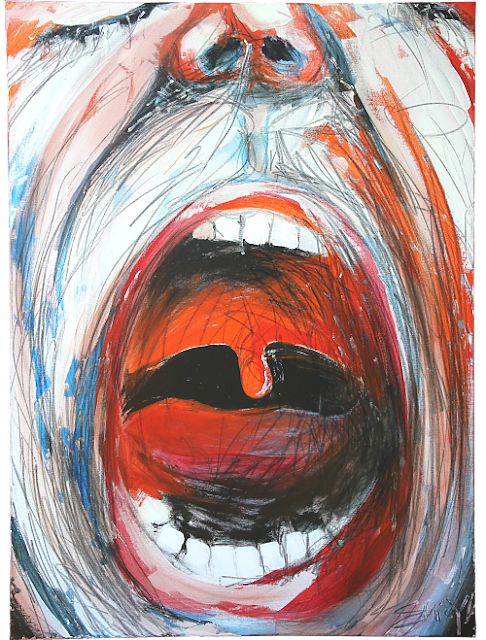
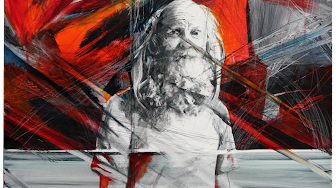
A painting, in oil, acrylic and graphite scribbles, of a close-up face, more-than-filling the frame, and screaming. The screaming mouth fills most of the frame. Predominant colours are white, orange, sky blue, and grey/black.

Last night I attended a devastating meeting in my community. On the surface it was pretty run-of-the-mill: A bunch of councillors and a few municipal staff members slowly picking their way through various presentations, decisions, and amendments. They came to the end of the meeting having checked a few boxes, put a few requests to bed or to progress, and made a few small changes to the contentious bylaw that much of the population feels will rip the heart out of our community.

As a member of this community for all of my life, I've been passionate about the things that tie us together. Some of those things are the big organized events, like our traditional summer festival and Remembrance Day celebration; the fishing derbies that used to happen when I was a kid, and the raft race. The events change over the years, but always hold us together, and are facilitated by a huge number of dedicated creative people, who look at their community and see the need for celebration. We're also held together by the little things, like stopping to chat with an oncoming driver in the road, or letting the community cat into the car for a ride. We're held together by actions like calling a neighbour for help clearing a dead deer or sitting down with Bob for an ephemeral but deeply interesting conversation. 

Sometimes the holding together is very intentional. So many of us contribute time, ideas, and great heart to this community. In my own work and volunteer roles, I've been bringing newcomers into engagement with our wilderness, so that they can love and value this place as I do. As an artist I've grown in this rich stew of community to see the value of social practice around inclusion and diversity. I consider my work (both public and gallery-focused) a method of bringing out the voices of my fellow citizens and reminding us all of our personal benefit to community. 

Most of the artists I know are somehow engaged in broad community visioning, and feelings are our language. When we sit around talking together, we talk about the big picture. We talk about the vibe of the public spaces in our community, and the vague drifting of public sentiment; of community values. We talk about the social-emotional gorgeousness we're trying to promote, and the social change that is or should be happening. We see the big web of emotional connection that makes a community whole; that tethers us to the place we live, and we work in our sometimes-mysterious ways to keep it alive. 

Yes, these feelings and ideas can be vague, but we are masters of vaguery. The term "vague", like its linguistic origin in the French for "wave", might seem unthreatening. But a wave, however gentle, rarely comes alone, and sometimes builds slowly, unseen. Sometimes a tidal wave is a wall of water. Often it's just a going out of the tide, and then a returning, and returning, and returning, until the one unappreciated wave has enveloped a whole community. "Vague" is the feeling of community sentiment, and it can be just as devastating.

What devastated me about the council meeting was our council's lack of vision for that social web; that vague sentiment. During the meeting, various councillors mentioned that the bylaw was needed in order to "control" people, and that "not all people are our friends". They spoke often about controlling the population, but never about listening to it. They received a long series of letters asking them to consider the social damage caused by a pending bylaw that will severely limit access and enjoyment to our most popular public spaces. Letter-writers spoke about the casual gathering that will no longer happen after this bylaw is passed, and the councillors chalked it up to a lack of understanding on the public's part. The one councillor who opposes this bylaw spoke up to explain–again–his fierce opposition, and the idea that they shouldn't be pushing through a bylaw that is so publicly reviled. They carried on without acknowledging his words. Finally, they picked away at some of the wording of the bylaw, ostensibly to help people understand, without seeing the big picture. They didn't let any feelings they had to get in the way of their bylaw. They deafly ignored their populace, and carried on as though nothing had happened.

Is this a crisis of imagination? Maybe. Maybe we as a society are becoming less and less able to imagine a future we want to live in; to envision it so that we can create it. We're less and less able to see a future that is inclusive if we can't imagine how to converse or get along with those who we deem "not our friends". We know, in the abstract, that we need public policy that is expressly inclusive, but we, like our councillors, have forgotten how to include our neighbours. We've forgotten how to listen to the great vague voice of public sentiment.

The big picture in public policy is public sentiment. The public doesn't like this bylaw. We don't like that we haven't been consulted. We don't like that our letters were not read aloud, nor discussed for the many serious points they bring up. We don't like the feeling that a series of long complex bylaws will govern our footsteps and enjoyment of community spaces. We feel oppressed by this bylaw, and our feelings are what this community is made of. 

As our community becomes more and more developed; more populated, more busy, more anonymous, we're losing sight of the importance of neighbourly compassion in our social exchanges. As our municipal government takes on more control, we have relinquished the desire to affect change, ourselves. We've given up. We are increasingly more likely to call the authorities to deal with dead deer or fallen trees instead of hauling them away, ourselves. We used to use them for meat or firewood; we're no longer permitted to do so. And as our social agency is taken away, we're growing more likely to call the authorities when a neighbour offends us than to bring over a drink and have a chat. Our crisis of imagination has led to a crisis of public agency.

And when I realized that the vision of that big picture–that public engagement–is missing from our leadership, I realized that we also have a crisis of feeling. We elected leaders to do a dry job of picking through legal documents and approving or rejecting requests, but we didn't empower them to feel. When they post on public forums they are expected to remain impartial. We expect that the work of governing should be done without emotion, but it concerns emotion a great deal. We need our councillors to have compassion for the woman living in a tent behind the library, to prevent them from passing bylaws that would outlaw her presence. We need them to notice the people feeling alarmed and horrified by proposed changes and ask themselves how those feelings will impact the big picture of our community. We need them to feel, so that they can take our feelings into account; so that we feel heard and empowered to engage in our community.

Originally published in July, 2021.

Creating Hope as an Exit from Existential Fear

This has been a hard, hard month in my province. We're reckoning with our responsibility regarding both climate change and colonialism (which are inextricably linked). Our province is beginning to locate the remains of thousands of murdered indigenous children, at the same time as our towns, farms, wildlife and even humans burn, in the climate-change-fueled fires we're now accustomed to. And all the while we're trying to save the last remaining stands of old-growth forest on this land… with very little success, so far. Colonialism, capitalism, consumerism and industrial terrorism are huge foes and how can we not feel small and weak? Terror and hopelessness abound. Two generations of kids are growing up without hope. And now they're looking at their parents and seeing no reassurance, because we adults are scared, too. We have no idea how we're going to pull out of this one. I think the only way out is through. 

Yes, to some degree, it's necessary to recognize the fire and just run like hell. It's necessary to make sure our neighbours know about the fire. It's necessary to point out that the torch and gas are in our own hands. But then… where do we run to? Through the fire and out the other side? Where's the other side? And why even bother? The concept of "through" requires us to see an exit on the other side, and we have to want that exit.

The exit we want is joy. Harmony. Peace. Love. Those are things worth running to. So we have to find joy, again–or create it. We have to create hope. We have to find reasons to stop fighting and instead start working for change, and, even more importantly, we have to make that change joyful. We have to know that the place we're headed is the place we want to be going.

You get back what you put into the world. Most of us know that, at some level. And yet many, including myself, are feeling and putting out a lot of fear. I think I put joy into the world wherever I can, but maybe I can do more! Maybe instead of dwelling in the anger that my friends' missing siblings might be among those buried children, or instead of raging against the industries and "isms" that are creating climate change, I can make an exit door.

I know it's hard. Sometimes I just want to hide–bury my face in the pillow, or in the tear-soaked sweater of my partner, and wallow in my hopelessness. Sometimes I want to spend money I don't have on something I don't need and just pretend the whole scary world doesn't exist. That's OK for a minute, but then I have to look up again from my sorrow or my distraction and be real. 

I guess for all of us, the ways we "look up" and get busy creating our exit doors will vary. For me, it's working with other parents and teachers to find positive ways of encouraging exploration and discovery in learning. In helping others overcome challenges and find hope, I feel more hopeful, myself. But it's also the small things.

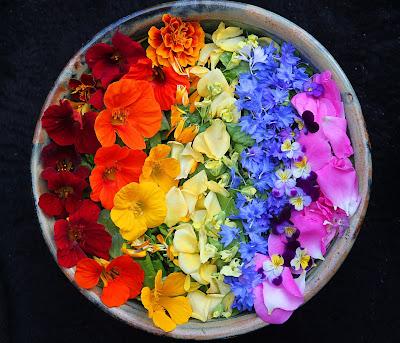
A photo of a bowl of flower-salad from above, on a black background (tabletop). So the image is a circle of ceramic (the edge of the bowl) with flowers arranged across the surface of the salad, within it, in a rainbow. Lines of blossoms from left to right are: deep red nasturtiums, orange nasturtiums, warm yellow nasturtiums, pale yellow rose petals, green parsley, blue bachelor's buttons, purple and yellow violets, and pink rose petals.

This is a picture of my salad. My family grew it in our garden, and picked it for dinner last night. We gobbled it up with a huge amount of joy. The diversity of colour, scents, flavours and ideas contained in this bowl looks to me like a visual story of hope for the people of our world. Despite all odds, and because of diversity, this abundance of life persists! And I eat it and am a part of my own ecosystem. And my wild and unkempt garden not only provides food for me, but shelter from the heat; shelter from the storm; shelter from the fear. My salad isn't enough to change the world. I know that. But in every small way that we cultivate hope in our own hearts, we bring more hope to all of our actions, and to the world. Maybe the small things we do at home give us courage or hope enough to make bigger changes in the world, like supporting those neighbours who suffer directly from colonialism, forest fires, and loss of hope. Having hope, too, is a great privilege, and once we've accessed it, we need to share it–by both small and large means. And when we all have hope, we can tackle the really big problems, like colonialism, capitalism, and consumerism. Or maybe those "isms", which thrive on a population devoid of hope, will just starve when we stop feeding them, and start feeding hope, instead.

So how do you create hope? What is your joyful exit door? What is your vision for a workable, hopeful future? How can we make positive change in our own lives and work towards change for our whole community; our whole world? How can we change our lives, our employment; our communications so that everything we do is working towards the future we want? And how can we be generous; how can we hold each other up, make joyful, hopeful futures for each other to run to? 

I want to be running toward something.

Originally published in July, 2021.

Reaching People; Alienating People; Being Unheard

This video by Rage Against the Machine x the Umma Chroma brings up something I struggle with a lot in my own work and in the work of people I really respect, like RATM. You try so hard to help people see their own strength in changemaking; their own worth and their own ability to make postive change, then you look out at the crowd of people supporting you, and you know a large percentage don't hear the message. They go home shouting about it, but they didn't hear it. Maybe that's because they didn't go there to be educated–I get that. But we keep telling ourselves, as artists, as educators, as community organizers, that even if just one person in that crowd goes home and makes some kind of positive change, we've been successful, but how is that really enough?

The most successful instagram post I've ever made was an in-progress shot of a dress that's about oppression of women; the objectification of the female body. In a very brief time it got thousands of views, and was worked into a German graffiti artist's work. The vast majority of the people sharing it were men. You know why? Because the breasts of the mannequin it sat on were visible. For the handful of women who felt seen, understood, and the smaller handful of men who understood the message, there were thousands who just consumed it like a piece of meat.

I love this video because they're not allowing us to just revel in the anger of the song and not question our lives, our heritage, our thoughts; our whiteness. Putting out something so blatant runs the risk of people choosing not to watch–of alienating any and all of the audience that didn't already understand or agree. Please watch this video if you think it looks stupid. Watch it if you think you already understand, or you don't need to know. Watch it if you think RATM is too white. Watch it if you think you're too white.

Anyway. These are my thoughts for the moment. This is something I struggle with in life and living and art.

Originally published in January 2021.

Art Towards Evolution

Art that is engaged in change-making is relevant to humanity’s evolution as a social species, by encouraging and supporting us in making the changes necessary for our survival. During this time of growing climate and social crises, we need work that challenges us to evolve for the better. Relationships – interaction between individuals, our histories and common future – are how we grow. It’s essential that we take time to listen and know each other; to learn from each other’s wisdom and stories. I hope that as artists we can give people space to be heard, to hear other people, and to change and make change.

Teens

"Children are the most disrespected group of people in the world."

She turned her small face and looked at me intensely, maybe to see how I would react; maybe to be sure I heard her. She was one of a group of three teens who had just come through an installation about children's rights and left her comments behind. I hoped she felt respected by me as she walked out of the gallery.

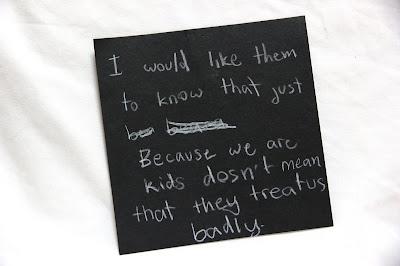
Text written by a teen in white pencil on a black square card, hanging from a thread in a gallery installation. The text says: "I would like them to know that just because we are kids doesn't mean that they treat us badly."

And then it hit me: "Group of people." That's how we see them. We see them as separate from us until we judge them to be old, wise, or experienced enough to earn our respect – as adults. We determine their clothing, their food, their education and other activities, their freedom to come or go and quite often we even determine their friends and hobbies. They tell us their fears and hopes and great big plans and we pat them on the shoulders and ignore them; carry on with our lives. When do we look them in the face and ask them to tell us more? When do we ask their advice? When do we heed it?

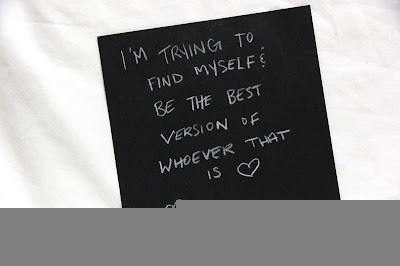
Text written by a teen in white pencil on a black square card, hanging from a thread in a gallery installation. The text says: "I'm trying to find myself and be the best version of whoever that is."

I grew up and eventually returned to raise my kids on a small island. For longer than I've been alive, the teens from this island have boarded a ferry five or more days per week to attend school on the mainland. Unchaperoned. As a teen I got up at six-thirty, washed my hair under the tap, dressed, put on my makeup and left to walk to the ferry at seven. In the winter I arrived at the dock with my hair frozen like brown sticks around my face. Unlike some of the other girls, I did not push into the crowded washroom to fix it in the two tiny mirrors. I sat at the end of my age-group of kids, watching the same kids get beat up day after day, watching the animated conversation of some girls I wasn't friends with, picking at the Naugahyde seats and avoiding the splash of the food fights. I moved further down when people started bringing compost to throw.

Twenty minutes each way. Morning and afternoon. The ferry commute was a drag, and a shared ritual, and also the rocking, floating bridge between the confines of childhood and the expected freedom of adulthood. In the 80's we skipped school by going en masse to the mall first thing, then arriving at school before lunch to report that we were all late because the ferry was late. We sometimes argued about the ethics of how to accomplish this feat. We shared time every day, but we were individuals. We had different stories, different values, and different lives.

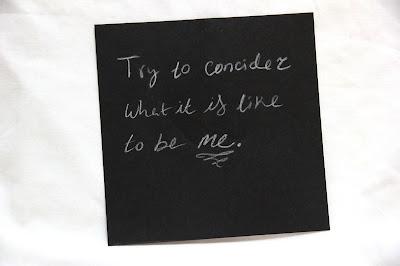
Text written by a teen in white pencil on a black square card, hanging from a thread in a gallery installation. The text says: "Try to consider what it is like to be me."

Our island also has a history of ferry exclusion. As a public-private entity, the ferry corporation has the right to ban people, and they have done so on various occasions that I remember. They banned a teenager in my grade for vandalism and mischief. He eventually took the ferry with a chaperone to attend school. They also banned our local petty criminal because the police thought it would do him good to get out of the community where he regularly slept in parked cars and picked drunken fights in public. It didn't help. Community members transported him back to the island in the trunks of their cars. My point is that these people, too, are individuals.

At various times we've had issues arise on the busiest ferry runs, like unidentified persons vandalizing the boat or flooding the toilets, and sometimes the first response is for the captain to make announcements to the teens. He tells them, as a group, to smarten up and behave themselves. He tells the adults on the next commuter run to rein in their children. Recently people in the community have been wondering aloud in public why teens (again, as a group) can't just behave themselves for twenty minutes at a time. Few, if any of us, know what the current transgression is, but we know it's been committed by teens. The captain has reportedly announced to our teens that if the unnamed incidents don't stop, the police will be involved and the surveillance footage will be reviewed. For me that crossed a line.

If criminal acts are being committed, it's perfectly reasonable to check surveillance footage and involve police. It's perfectly reasonable to expect people not to commit such acts, and to take steps to ensure that they stop. It is not, however, reasonable to reprimand, admonish, threaten and sometimes (as I have witnessed) deny service or civility to an entire group of people based on the premise that one or a few of them are suspected of having done something wrong.

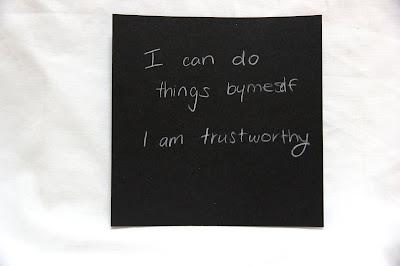
Text written by a teen in white pencil on a black square card, hanging from a thread in a gallery installation. The text says: "I can do things by myself. I am trustworthy."

When adults smoke on the ferry (which is wholly a no-smoking/no-vaping zone), they are asked to butt out. If they refuse, they are taken to the chief steward's office and spoken to, as individuals. I've seen this happen. I've stood at the chief steward's office while an adult smoker was being spoken to, and every effort was made to treat me with respect and provide me with service despite the fact that I, too, am an adult. The same can't be said for our teens' experience. Every teen is a suspect in some people's reasoning.

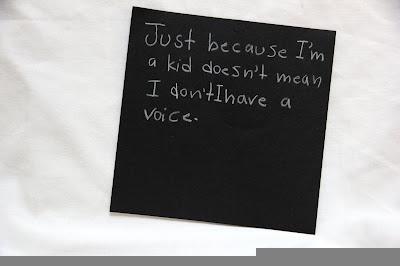
Text written by a teen in white pencil on a black square card, hanging from a thread in a gallery installation. The text says: "Just because I'm a kids doesn't mean I don't have a voice."

What do you think that does to a person? Imagine if every day you walked to work only to be eyed suspiciously at the door to the building, and every time a toilet overflowed, people called all the adults in the building together to reprimand them. How would you feel about using the toilet? Imagine if, when some person stole from the vending machine, they denied all adults access to the vending machines. Would you respect the people who judged you? Would you still care about upholding the values of your community if you weren't expected to uphold them anyway?

I'm responsible for denigrating teens as a group, too. When I was barely more than a teenager myself, a truck full of students from a nearby high school pulled up to my grandmother's lawn, dumped an assortment of fast food wrappers out the window, and drove off. A few years later, walking along our island road with my four-year-old son, we spied some litter in the ditch. He immediately shook his head and muttered grumpily, "ach… teenagers". I can't remember how I led him to that assumption, but I am certain I did. Now he's seventeen. He and his sister have somehow managed to get through a bunch of teenagehood without dumping their trash. Even more than navigating teen years myself, parenting teens has taught me to see them as individuals.

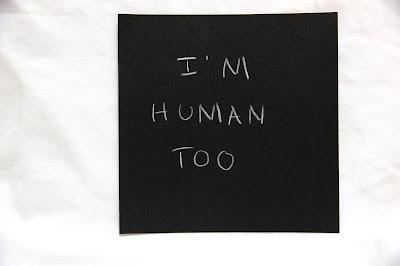
Text written by a teen in white pencil on a black square card, hanging from a thread in a gallery installation. The text says: "I'm human too."

Teens are worthy of our attention as individuals. They are humans learning to be adults, and counting on our respect and exemplary modeling to help them navigate their surprising, sometimes frightening individual journeys. If we want them to see adults as individuals rather than a homogeneous, brooding group, we need to model to them how to do that. We need to see them, and we need to show them how seeing people is done well.

Some teens are children. They have an innocent wisdom not yet drawn out of them by the pressures of growing up. Some teens are also adults. They know their own minds and they know when they haven't done wrong. Some teens see us when we're wrong, and they know when we aren't hearing their voices. Some teens know when not to bother speaking up, because we've lumped them all into one disrespected group and we can't hear their individual cries. In fact, when teens report crimes committed by adults, they are often ignored.

It's time we look into the faces of the children and teens we pass and see them as simply humans. It's time we see them as individuals with wisdom, needs, values, and human rights. It's time we respect them.

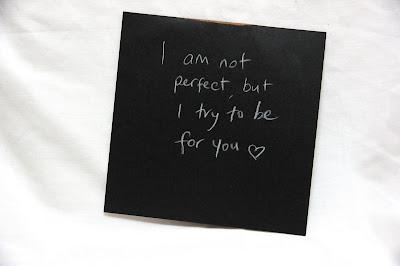
Text written by a teen in white pencil on a black square card, hanging from a thread in a gallery installation. The text says: "I'm not perfect, but I try to be, for you." There is a heart after the text.

*The handwritten statements accompanying this article were contributed by teens at a 2019 installation of a piece called "Building Blocks: What do you want the adults in your life to know and respect about you?"

Originally published in October, 2019.

Community as a Way of Life

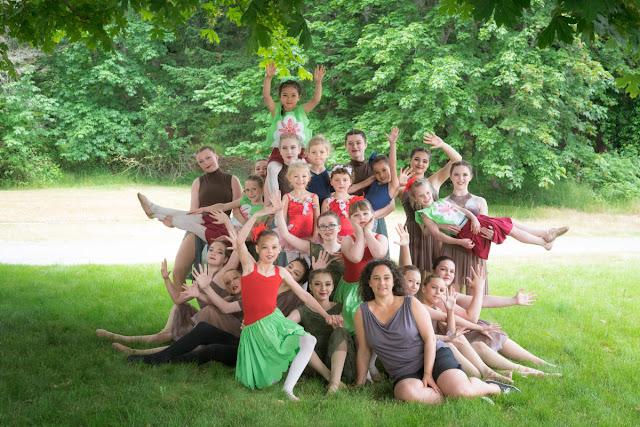
Outside on a lawn, with leafy green trees in the background, dancer, teacher, and community organizer Mara Brenner sits surrounded by a large group of her young dance students in brown, green, and orange leotards and flowy skirts. Most are gesturing with their arms, and three of the younger children are being held aloft by others.
Mara Brenner with students of Gabriola Dance, 2019. Photo by Inspired Spirits Photography.

When I was 26, bewildered and a bit in shock with the reality of new motherhood, I took my baby to our local Family Place, and sat around the edges of the activity, watching. Whining lines of Suzanne Vega ran through my head: "in the outskirts, and in the fringes, on the edge and off the avenue"… as my baby nursed his way through the stress of a new situation. Out of the fray of mothers and toddlers and snack foods and plastic dishes came the most welcoming smile. This woman actually held out her arm to me, beckoning me to join the group. And Mara became my friend.

Years later, as we sat around her trailer home together, watching our kids play and leap from the furniture, I complained about my back issues, and Mara deftly used the opportunity to attempt to convince me to take the adults' ballet class that she taught in the evenings. I told her 'no way'. I explained that ballet left me behind when I was nine and had a pot belly and knees that didn't straighten all the way. She convinced me anyway, and next term I cautiously and inelegantly stepped into her class. 

Mara doesn't just teach ballet. She's an accredited Pilates instructor, and a passionate life-long-learner of human anatomy and movement. She looked at me while I attempted the ballet moves and explained exactly what my muscles and bones were doing and how I could optimize for my personal development. When she didn't have an answer, she went away and researched or thought about it until she figured it out (yes – that's the definition of being a life-long-learner, and an expert!) She sees people not only as moving, learning bodies, but as humans with struggles and opportunities. I soon became one of Mara's 'Tequilarinas' – the group of adults who danced until 9pm and then went for a tequila at the pub, together. After a year, my back was healed. I started wearing superhero costumes to ballet.

Through her friendship, clear strong vision, and unflinching determination, Mara gave me more confidence and opportunity than any other teacher I've had.

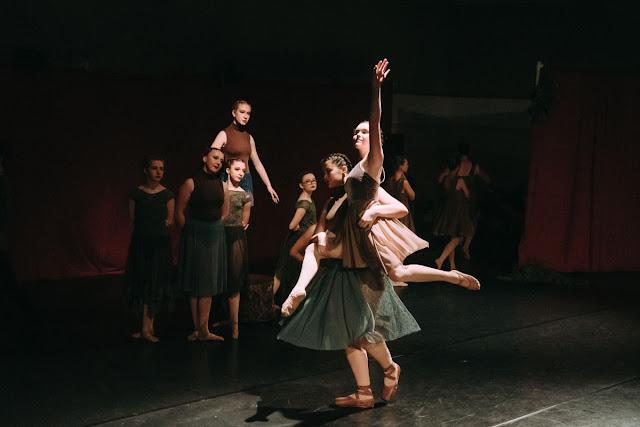
A group of dancers in brown and green leotards and flowy skirts stands around a tree stump, while two of them perform a lift, downstage. The dancer being lifted appears to be in a grand leap, with one arm reaching for the sky.
Gabriola Dance year end showcase, 2019: The Giving Tree. Photo by Inspired Spirits Photography.

Mara Brenner taught our island's children and adults ballet, and also used her company MaraGold Productions to bring world class artists to perform not only on our small island, but at various Canadian venues. She worked her dancing feet off one hundred percent of the time, not just giving to her community, but building it. She exemplified a kind of character strength and courage that's hard to maintain, but essential in a thriving community. Eventually her community turned its back on Mara and her family.

Our land use bylaw only allows trailer-living for a brief period of time while landowners are building a permanent dwelling. As you can imagine, building a home on the wages of a ballet teacher and a glazier, while also raising two young children, takes longer than it otherwise might. Mara and her partner, Stu, lived in a trailer on land they owned, while slowly building their permanent home. At the point they were forced to leave, they had only built the foundation. Theirs was almost an idealist story of dreamy island living, until our snooty bylaws pushed them out.

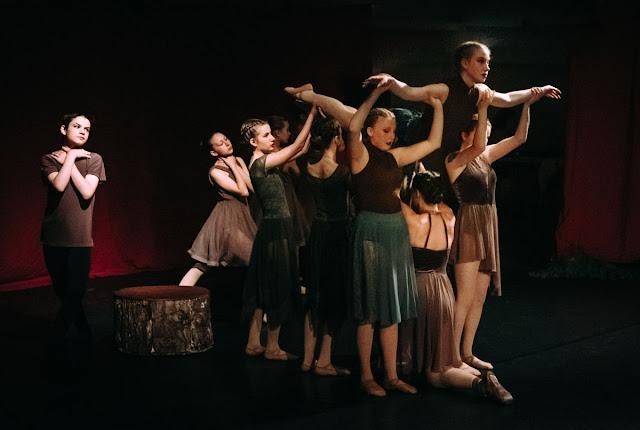
A group of dancers in brown and green leotards and flowy skirts lift the oldest dancer along, where she has fallen from the stump she initially stood on. They represent an apple tree, falling.
An older boy dancer in a brown shirt and black leggings stands off to the left, his hands crossed over his chest, looking solemnly in the direction of the tree.
Gabriola Dance year end showcase, 2019: The Giving Tree. Photo by Inspired Spirits Photography.

So they left! Mara and her family found their new home on Gabriola Island, and quickly turned the small outbuilding into a dance studio. Around the same time she was gifted her own ballet teacher's extensive collection of ballet school costumes, and she threw all her extensive skill and passion into Gabriola Dance. Last weekend I went to see her year-end showcase, and I was moved to write this article.

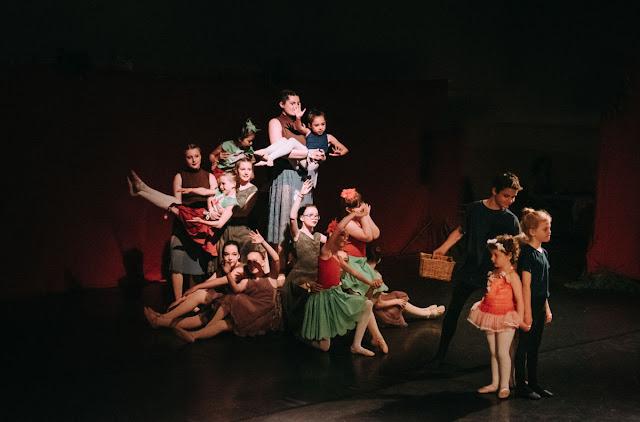
A collection of dancers in brown and green leotards and flowy skirts stands smiling and gesturing. They represent an apple tree. An older boy dressed in a black t-shirt and leggings holds a basket in one hand, and looks towards three younger dancers on the right side of the stage: A young oy also dressed in black, and two very young ballerinas, in pinkish-orange tutus.
Gabriola Dance year end showcase, 2019: The Giving Tree. Photo by Inspired Spirits Photography.

Finally with a permanent roof over her head on Gabriola, Mara pulled everything out of her heart and poured it into ten years of parenting and teaching in her new community. This 10th showcase felt to me like watching my friend stitch up all her passions and skills into one beautiful, powerful package. It was in many ways her gift to the world. 

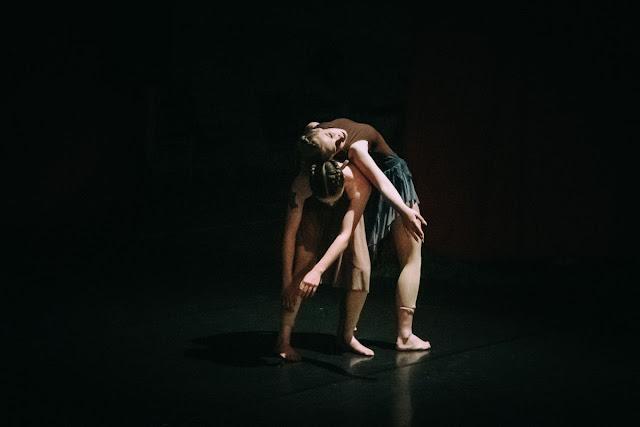
Two contemporary dancers in brown leotards and flowy green skirts stand centre-stage. One leans forward, while the other one leans over her, back-to-back, in an expression of sorrow and exhaustion.
Gabriola Dance year end showcase, 2019: The Giving Tree. Photo by Inspired Spirits Photography.

I think we all hope we can make a difference in the world – at least leave it a slightly better place than we found it. These days many of us are just hoping we save enough of the world that our children will grow old before it's gone. So Mara developed a dance performance of Shel Silverstein's 'The Giving Tree'. The piece brings together students of many diverse ages and training levels. It's profound and moving, but Mara didn't leave it at that. Working on this project brought up a great deal of conversation among students about climate change, and it became clear that she needed to deal with the prevalent angst and anxiety that today's children harbour around this topic. So she had all the conversations with them, and at the end of the dance showcase, she hosted a talk back with biologist Melanie Mamoser and registered clinical counsellor Caitlin Kopperson, to discuss the affects of climate change on childhood anxiety. One of the most urgent questions, of course, is 'what can we do?', and although there's no clear answer to that, there were some good ideas, and the conversation at least left me feeling hopeful that people were talking about it, and that children's voices are being heard in this discussion.

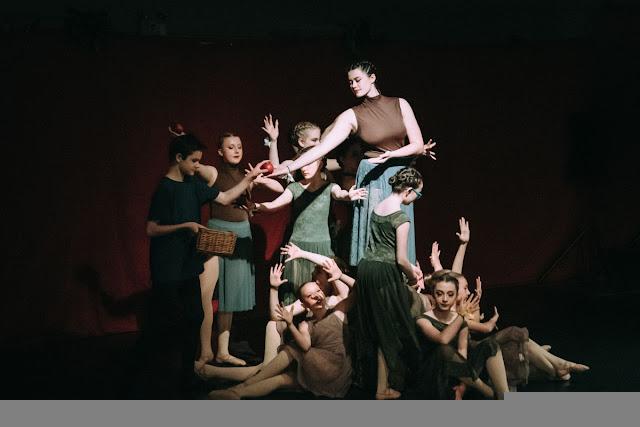
A tableau of dancers in brown and green leotards and skirts represent an apple tree. An adult dancer in a brown leotard and green skirt reaches out to hand a red apple to a boy in a a black t-shirt and leggings, who stands on the left side, ready to put the apple into a basket.
Gabriola Dance year end showcase, 2019: The Giving Tree. Photo by Inspired Spirits Photography.

With The Giving Tree, Mara does something I hope we all manage to do in our lives: She orchestrates her many gifts into one grand oeuvre, showcasing not only the work of her students and other community members, but pulling them all together in a kind of hopeful community invocation. May we all have the courage to live our hearts' dreams and create a better world in doing so, each in our own ways, and all within community.

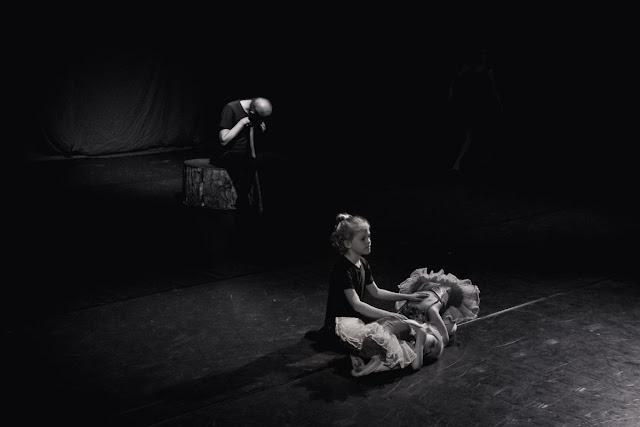
A black and white image of an old man sitting on a stump, leaning on a crutch. In front of him, a young dancer dressed in black kneels on the ground, his hands resting on the backs of two very young ballerinas in tutus, curled up on the floor, in front of him.
Gabriola Dance year end showcase, 2019: The Giving Tree. Photo by Inspired Spirits Photography.

Resources:
Gabriola Pilates and Dance: http://maragoldtheatreproductions.blogspot.com/p/dance.html

Inspired Spirits Photography: https://www.inspiredspiritsphotography.ca/

Originally published in June, 2019

Working Class Heroes: It's Up to Us to End Capitalism

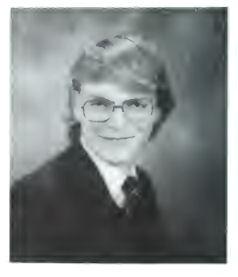
A very low-resolution black-and-white image of 18-year-old Markus, with a mop of blond hair, a wide smile, and square-rimmed glasses. He is wearing a white collared shirt with a dark tie and blazer. It's a classic yearbook photo.

First there was the Universe. Then there was Markus. From then on this planet (Earth) was one of the most important things in life (his life). Then he went to SMU. This in and of itself was not very important – but while going there, he noticed many things about life which he did not like. These were mainly small things, such as holes in the ozone layer of the atmosphere, acid rain and projected populations for Earth. Having decided to change all this, he found that he already had the solution; the only problem was that he would have to become a V.V.I.P. (very, very important person) in the scientific field to implement it – and to know just about everything there is to know about this world. He is planning to start by learning everything about engineering or computers, and continue from there.

That's an excerpt from my partner's grad write-up in his 1988 school yearbook. He tells me he must have just finished reading the Hitchhiker's Guide to the Galaxy, and adapted his writing-style, accordingly. He also tells me it sounds pompous. My partner is anything but pompous. He's just lost all the confidence he had in high school; he doesn't think he can save the world, anymore. 

The list of devastating global circumstances facing humanity has played out even faster than we 80's kids could have imagined, and we feel helpless. My partner did go on to study physics and engineering, eventually getting his degree in Computer Science. He now goes to work every day, finds, fixes and creates bugs in software that is used all over the world for resource management. Some of this 'resource management' is towards protecting the ecological welfare of the planet; a lot of it is simply management for destructive capitalist ventures. My partner does whatever he is told to do. Then he comes home exhausted, eats dinner, pets the dog, plays accordion, and goes to sleep, only to get up in the morning and start again. On weekends and vacations he sometimes makes adventures to soothe his tired soul; mostly he works at replacing our old house with less mouldy materials, hoping that at least his efforts will provide shelter for his family. Dreams of saving the world went away a long, long time ago. Shelter and survival in the capitalist world is his current goal.

Does it sound like drudgery? He would say no. Because he's living the dream we were all fed as children, and in fact he's doing better than that: He's raising free-thinking unschooled children in a park-like setting, hoping they'll have the guts and wherewithal to follow their own dreams in a way he never managed to do.

But wait – that's what his parents were doing too! They sent him to the best school they could find, where he learned to fly airplanes, wear a suit, and feel confident that he really could grow up to be a very, very important person in a scientific field and change the world. But he didn't. Why not? 

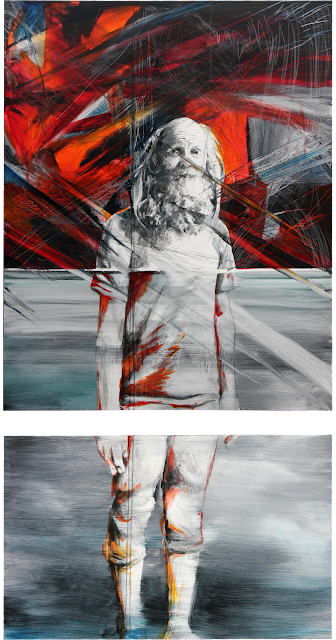
Large painting: "No Time Instead of it All" by Emily van Lidth de Jeude. A long-haired, bearded man in a white t-shirt stands in an abstract mess of red, orange, black and white slashes; an abstract representation of feelings of angst, fear, and oppression. The lower half of the painting is calmer, like he's standing in a dreadful grey lake, up to his chest. His hands hang limply at his sides, and his pants are rolled up to his shins, but clearly the water surpassed his ankles a long time ago. The painting is life-size, on two canvases, split with a four-inch-wide gap at the level of his crotch, so that his hands and legs are detached from his upper body. He's thus incapable of taking action or of running away.

Why do all of us hope that our children will grow up to change the world, and not change it ourselves? Somehow we seem to feel that we can trudge into the capitalist system that requires our compliance and still raise kids who will magically end up elsewhere. Why on earth would they? We ask our children to follow their hearts and at the same time we tell them to follow our culture's mandated path to adulthood. We expect them to be different and brave and to change the world and save us from the disaster that capitalism has caused (seriously – if you haven't already, go read that article and watch the video), but we're too afraid to get out of the system, ourselves. They will be, too.

John Lennon wrote in his song Working Class Hero (full lyrics and song video here), three full generations ago:

When they've tortured and scared you for twenty-odd years
Then they expect you to pick a career
When you can't really function you're so full of fear
A working class hero is something to be

Keep you doped with religion and sex and TV
And you think you're so clever and classless and free
But you're still fucking peasants as far as I can see
A working class hero is something to be

Our kids follow our lead. Unless we break this cycle, our children, like us, will reach adulthood and discover that the only feasible path is the one their parents took, and they will have children themselves, and they will hope that their children will save them. And with every generation the outlook is bleaker, and with every generation we hope the next will save us. 

Capitalism is killing us. Our school system is part of it. Our work ethic and career paths are part of it. Our diet and housing and everything that we consider to be essential is part of it. These things need to change, and WE need to change them–not our children or our children's children. There is no more time for us to live in fear. And there is no point hoping that the few brave souls who unschool their kids or drop out of the system or attend rallies will do the work for us. There will be no new reality until we all jump on board. We are killing ourselves with capitalism and we have to stop, now.

Originally published in February, 2019