Taking the Leap (away from fascism)

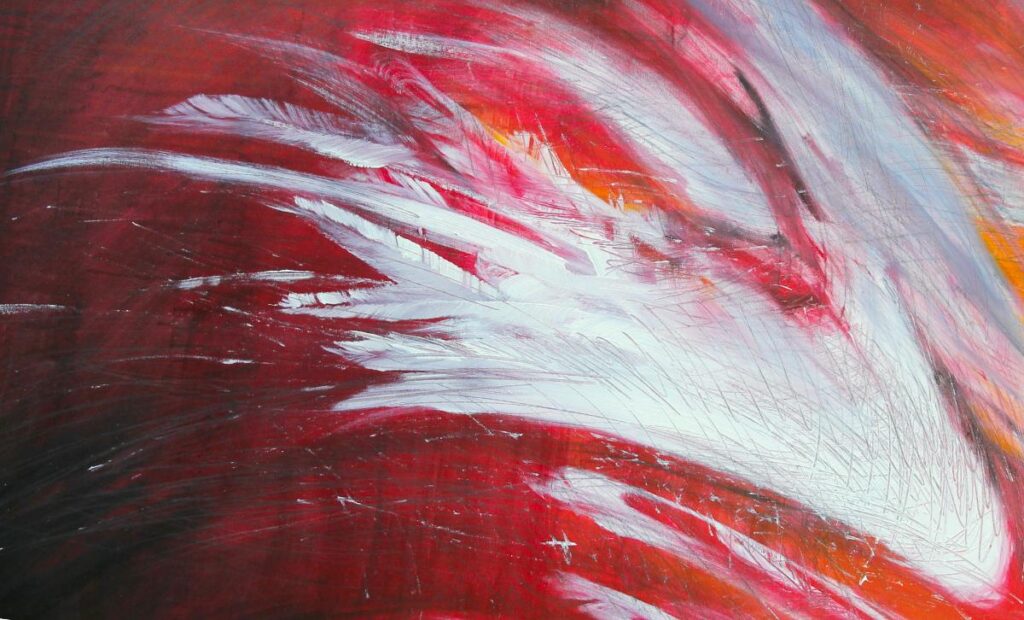
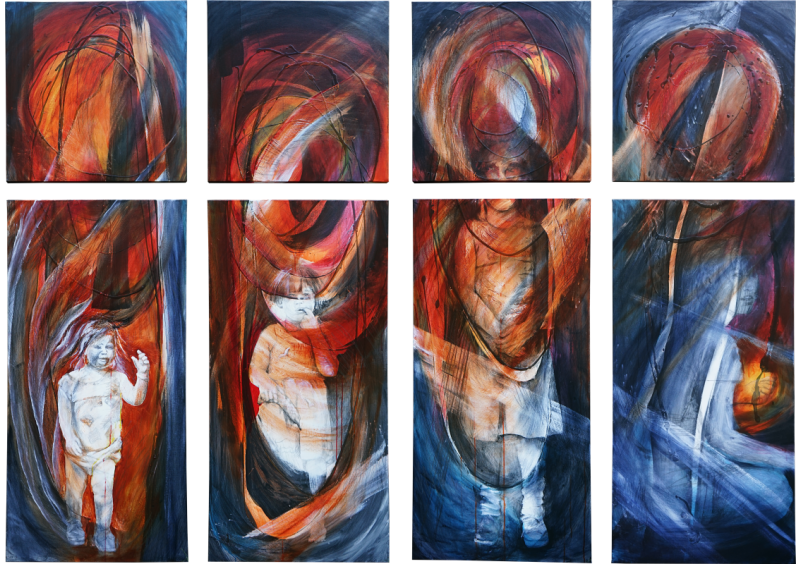
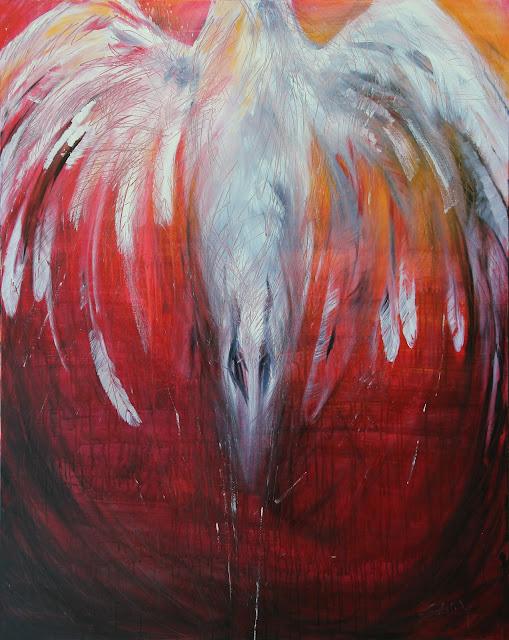
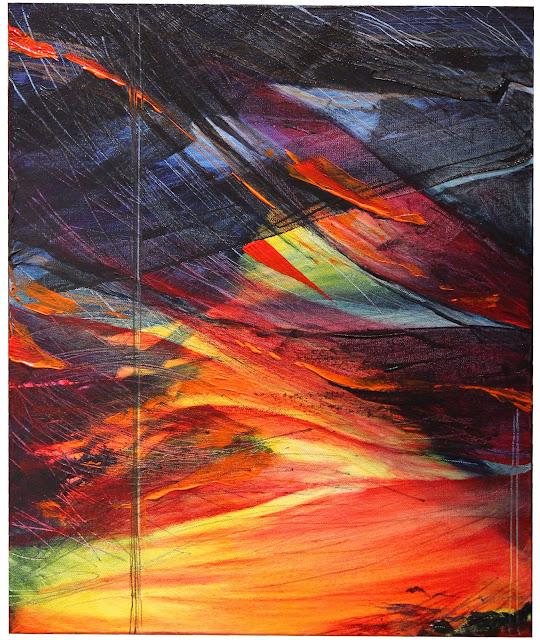
A red and orange and yellow background with a giant swoosh of white abstract paints and pencil lines and scratching that vaguely resemble a leaping bird wing.
"Escaping the Nest" (detail), by Emily van Lidth de Jeude

You can only get pushed and pushed and pushed to a certain point, and then it becomes easier to take a leap to somewhere else. That happened to us with our first child, as we tried to find his place in the landscape of school options, and nothing–just nothing–felt good to him. We had heard about some mysterious people who just didn't send their kids to school at all: unschoolers. Terrifying. But after some research, I timidly told our son's Kindergarten principal that we'd be joining the unschoolers. And to my shock, he agreed it was a good idea for our boy! I was scared, but we jumped. And suddenly we felt so free.

So the thing about jumping is that you do get this feeling of freedom, but then you have to land, and land running. I guess we've mastered that, now. We embraced the landing of our unschooling choice, and took step after stumbling step over the next ten or so years, until we discovered our kids (because our daughter chose to unschool as well) were fully capable teens running their own show. And now they're happy, independent adults, still running their own show. We made it! But it wasn't just lucky. It was planned.

You don't jump out of a plane with no preparation. Or at least I hope you don't. I jumped into the unschooling world after a bit of research and some deep heart-searching, because I needed to be sure I could give up my career for this. And I did. I bit the bullet and did it, and we're all OK!! The thing is about making big life-changes: you have to run with it. Don't go timidly. You go with intention, and determination to keep taking the next step, even as you're just starting the first one.

Same for getting married, for maintaining what has sometimes been a difficult marriage, for buying a new car, for taking a huge road-trip with the kids, for some of my biggest art projects, for growing our own food, for my kids when they decided to move out and support themselves, and now… for leaving fascist media in the dust, even though it feels like the whole world depends on it.

Yep. This week I spent every spare minute researching and planning for my leap away from Meta, Paypal, Amazon, and Windows. (I never used X to begin with.) Poof! In two weeks I'll be free of all of them. And yes that includes their hard-copy shops like Whole Foods. Done.

Is it scary? YES!! Especially because most of my friends and even my own kids are not following suit. I've only managed to find a few dozen of my community members on BlueSky, and even fewer on Mastodon. But I have faith that number will grow and, on the whole, I feel delighted. (Edited a year later to add: While there are indeed more locals on BlueSky, I have basically abandoned it now, because Mastodon is far better, and far more open-minded.)

I think I'm in the free-fall stage of taking a leap. I'm buoyed by that feeling of weightless joy that I feel at the top of a swing's arc. I made profiles on BlueSky and Mastodon, and spent two days messaging contacts on Meta and asking for their email addresses and phone numbers. My Contacts folders are now a thing of beauty. 

But the best part is that I've had a few really wonderful conversations (by text and email) with some friends I've not spoken to in years. It turns out I was seeing almost nothing of what my friends posted on Meta, and now I'm finally connecting with these people! Even my European cousins are jumping off WhatsApp and we've moved our cousins-chat to Signal. With a little faith, all this turns out to be easy. It's like a refreshment for my heart and mind! Remember when we used to just call each other for a visit? Or simply drop by? I hope that becomes normal, again.

So, I need a parachute, right? That list of friends' contacts is my parachute. I spent a good long time creating it, and I trust that it will hold me. I've been researching where to get goods locally to replace the things I shamefully relied on getting through Amazon. Additionally, I'll have to learn to use a Linux operating system. That's going to be my next big task. Thankfully I live with a man who has some experience with it, so I know I'll manage. And even one of the locals who's also migrating off of Meta has offered to coach me. We have a beautiful community.

I guess the thing about taking a big leap is to just do it. In all of these situations I got pushed so far I couldn't not jump. In this case, I just know that there is no possible way I can live with myself if I support or am even associated with fascist companies. Being confronted by the irrefutable fascism of these people has pushed me off their platforms. Period. Now I just have to hit the ground running, and I think I can manage that. See you on the other side!

*I'm aware that many people feel we have to stay on these media to transform them. But that's just not me. I like working from the ground up, and now I'm off to help with building something better. For more details on why I'm leaving fascist media, etc. please check out my previous post: My Grandmother's Cocoa and How We Overcome Fascism

My Grandmother's Cocoa and How We Overcome Fascism

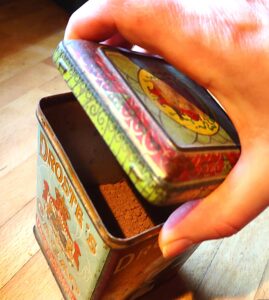
A hand lifts the lid of an antique Droste's Cocoa tin. There is red dutch-processed cocoa powder, inside.

On my shelf is this old can of cocoa. It says "Droste" and gives a weight "For Eng. and the Colonies". For me, this can of cocoa carries more than 1lb of memories and warnings.

When I was in my early teens I went to the kitchen of our double-wide trailer, stood at the upper extension of my tip-toes, and slid this red and blue metal can off our harvest-yellow fridge. It had been there as long as I could remember, and I'm not sure why this day, of all others, I finally made hot chocolate for myself, but I did. And since I'd looked in that can many times, I knew where to find my ingredients. 

Maybe fifteen minutes later I sat on the couch, fully proud and enjoying my first self-made hot-chocolate. I found something crunchy in my mouth and, already a fan of chocolate-covered coffee beans, I crunched away at the small bean and said, "aw, Mum! You got your coffee beans in the cocoa." 

"I can't imagine how," she said, disinterested. And I began to crunch another. But I thought better of it, and took it out of my mouth to see. It was a beetle! A small, black, coffee-bean-shaped beetle, desiccated and swirled with all its brethren into my hot chocolate.

"Gross!!" I yelled, and hurried to the kitchen to begin rinsing my mouth and spitting vigorously into the sink. 

Mum followed me. "Where did you get the cocoa?" She asked, with a wry smile.

"From the cocoa can! On the fridge!"

She began laughing. "Oh that's Grootmoeder's. From before the war!"

'Before the war.' Or, in Grootmoeder's words, 'in former days'—this was a topic we all heard about quite often, as storytelling was part of the way my grandmother dealt with her trauma from that time, along with keeping mementos. Our cocoa can was apparently one of those mementos. It was a reminder to her and to future generations of the terrifying shaking of planes overhead, of a deep gnawing in her empty stomach and a deeper fear that the baby in her arms would die of starvation. It was a reminder of the days she slipped under cover of night over rubble and into farmers' fields to steal tulip bulbs to stay alive, but never ever ever used the cocoa. Why? Because she needed a sign of hope that one day cocoa would not be just a relic of 'former days'. 

"Former days' were when Grootmoeder made chocolate treats for my grandfather, read the news and medical journals as compensation for giving up her dream of becoming a doctor in order to get married. When personal sorrows such as hers competed for space in her mind with the news telling of Hitler's determination to invade Poland, and other such worrisome things. I mean, it wasn't as though Hitler was actually new news. His rise to power began the year Grootmoeder was born, so to a young woman on the verge of starting a family, it wasn't exactly alarming. And besides, who wants to be alarmed? Who wants to set aside the demands of daily life to fight for something that may not be such a big deal, especially to a young, privileged, non-jewish Dutch woman? And what could she, a nineteen-year-old, possibly do to help the situation, anyway? She wanted to, of course, but her dream of becoming a doctor was in the process of being shoved under the carpet, and even if war should happen, she wouldn't be tending to injured soldiers.

Five years later she was nursing a baby from her own starving body, while trying to cook tulip bulbs on a dark, makeshift flame, while the buildings around her crumbled. And hidden away with other treasures was a can of cocoa that said "For Eng. and Colonies Net. 1lb." The fact that that cocoa came from a vast landscape of colonial murder and exploitation on the other side of the world, just to be processed and sold not only to my privileged grandmother but also back to the people still colonizing the out-of-sight-out-of-mind Americas was, truly, out-of-mind, to my grandmother, in former days. She had other things to worry about.

As Canadians, on the day after the new regime in America started Nazi-soluting their crowds, freeing violent fascist leaders from prison, and declaring their intentions of annexing various regions of the world, including Canada, we may feel similarly. Maybe it's more important to get our kids to school, today; to keep the peace in a community that's feeling the climatic and geo-political stresses and starting to fray at the edges. Maybe we're too stunned by the US government's sudden and bold conversion to what looks very much like a dictatorship (sweeping unilateral powers handed to the President, reworking of the official government website to remove the constitution and replace it with military imagery, declarations of intent to take over other territories, and commentary about there never being another election). Maybe we Canadians have our own pending elections and fascist contenders to worry about, and, like in the US, where about a third of potential voters didn't vote at all, the silent many could very well determine the outcome. And besides, our neighbours are all angry with us for not speaking up about their causes often enough.

Maybe it seems all hopeless and we just curl up with a hot cocoa for some Netflix hygge time. Maybe you don't want to hear me compare this Canadian moment to that time my grandmother was turning twelve and the Dutch National Socialist Movement was founded, in her country. Because did that really matter, compared to what was happening in Germany? And it was all just "news". What could she have done, anyway?

And here this can sits, on my shelf in Canada, with fresher cocoa in it, and I am self-medicating my very real personal traumas and fears about the future of my world with cocoa that, while supposedly ethically farmed and produced, hearkens back to pre-WWII and reminds me that we're all making choices in all our various moments that may be the difference between eating cocoa and eating tulip bulbs.

We have mundane obligations—yes. We do need to keep ourselves fed and our minds and communities peaceful. And we have opportunities in every action we take to courageously love through our fear. My teenaged grandmother watched the rise of fascism in her country and I'm watching it now, in mine. And all of us have, I feel, the responsibility to work to end short-sighted, morally blind, and greed-motivated thinking in our own communities. Because all fascist leaders began as children in communities, somewhere. All of us have influence on people who may one day oppress us or our loved ones. So that's where we need to do our work.

For me, the work looks like this:

  • Educating myself (with factually and ethically sound sources) on everything I can possibly learn, but especially the functioning of our current society, so that I might better understand the implications and consequences of my daily actions. 
  • Deleting my accounts (and thus no longer supporting or being exploited by) Amazon, Twitter, Paypal, Meta, Oracle, Microsoft, and anything else I soon may find to be associated with the group of mega-billionaires now running the fascist uprising.
  • Seeking to understand and have compassion for others, while still speaking out (gently) when others are causing harm—especially if they don't see it, themselves.
  • Building community: volunteering and supporting others who volunteer in my community. Being engaged in public processes and informed about past, current and future events.
  • Spreading factual information (hopefully non-combatively) in every way I can.
  • Voting at all levels of government. And encouraging others to vote, as well.

I posted recently on a home-canning group I'm a member of, and mentioned something about "hard times ahead". Instantly a bunch of other canners jumped on my comment with laughy-faces and remarks about the coming golden age of America, promised by their newly-elected leader. They were obviously canning the Kool-Aid. 

Let us not be fooled by a smiling face on a can of cocoa or a militarized website. I'm the granddaughter of a Dutch woman who nursed her baby from a starving body, and I'm married to the grandson of a Nazi soldier whose family was impoverished, shunned, and living in extreme fear, after the war. Both of our families carry immense trauma from that time. The last time fascism took hold like it is right now, everybody on every side of all the borders suffered, except the richest few. That's always the way. 

This coming 'golden age' is not for America, it's for the richest few. It's a return to feudalism, and we are the exploited masses. (Watch Yanis Varoufakis explain this, here: https://www.youtube.com/watch?v=X3FdIyNMaFY) If you're reading this, you're unlikely to be one of the richest few, so we're all serfs in this boat, together. It's not the 'other people' (however you want to define your personal xenophobic preferences) who are causing the problem. It's the people massaging our fears. And together with the diversity of all the other serfs, we're the majority. We can build the future we want to see. 

We are not powerless. We overcome the fascism by refusing to fight, vilify or other our fellow citizens. We overcome the oppression put upon us by creating local abundance and resilience in our own communities. We overcome the fear used to control us by opening our arms to embrace each other. That is how we win.


…….

Editing this post to add relevant links, for those wanting to understand more about the current regime:

What is wrong with Stargate: https://www.devx.com/experts/matt-wolfe-explains-project-stargate-and-their-500-billion-dollar-plan/

Why leave Meta (beyond their end of fact-checking, diversity employment, and their permissive stance on hate-speech against lgbtq and immigrants (yes–it's worse!)): https://www.youtube.com/watch?v=X3FdIyNMaFY

How AI can be used to support fascism and looking into how to resist that (podcast): https://researchpod.org/university-of-bristol/transforming-society/developing-anti-fascist-ai

Forbes' explanation of the new DEI rules: https://www.forbes.com/sites/saradorn/2025/01/23/trumps-diversity-orders-rattle-ceos-what-companies-should-know-about-new-dei-rules/

Health and Science devastation: https://www.science.org/content/article/trump-hits-nih-devastating-freezes-meetings-travel-communications-and-hiring

Something more hopeful: Elisabet Sahtouris (evolutionary biologist) on the evolutionary inevitability of cooperation. https://www.youtube.com/watch?v=qMAPIlUJwmQ

Songs of the Apocalypse

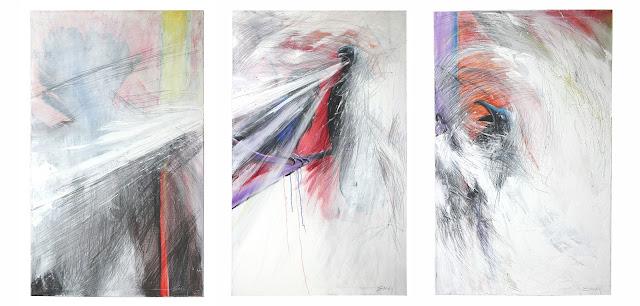
In a triptych called "Three Craws", four ravens are seen in a mess of expressive white paint. One, on the right, caws towards the middle. In the middle, one sits hunched while the other screams in his face, the white lines of his voice filling both the middle and left panel. On the left panel a fourth raven hangs, dead.
"Three Craws", oil and graphite on 3 stretched canvases. Emily van Lidth de Jeude

Songs of the Apocalypse is a series I’ve been working on since around the time my birth father died. He had lived a long time with Parkinson’s, but the circumstances of his death in hospital, while recovering from spinal surgery, are a complete mystery, and in that post-shock landscape of fear, confusion, and a resurgence of shallow-buried family traumas, his side of my family fell apart. So this series of paintings began as a way for me to deal with my emotions of that time. But of course those personal issues are deeply intertwined with the societal issues we all live with: helplessness in the face of climate change, capitalist, colonialist and patriarchal damage, global societal upheaval, and the fallout from those things. For example, many of my own childhood experiences are a direct result of my grandparents’ war traumas. Two of my grandparents come from families fleeing war and famine in Ukraine and Ireland. Others recently lived here through the great depression, and all of these unknowingly stored those experiences in the many generations to come. So those bigger-picture problems filtered down through the generations to effect even my own children’s health and genetic makeup, a hundred years later. Divorce, childhood trauma, and family strife are just microcosms of the bigger picture. So in dealing with individual portraits I’m also looking at our society as a whole. In looking at the wounds and the healing, I’m hoping to create psychological pathways for us all to heal from the greatest struggles we face.

My parents did everything they could to support me, given the understanding and tools of our time. They created a safe and nurtured life for me on a small island, and they continue to support me in my adulthood. But life cannot be perfect. Life is not about good and bad, but about all people constantly growing. And growing looks very messy.

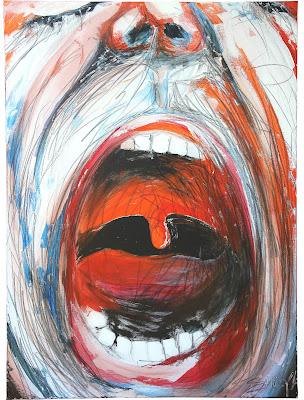
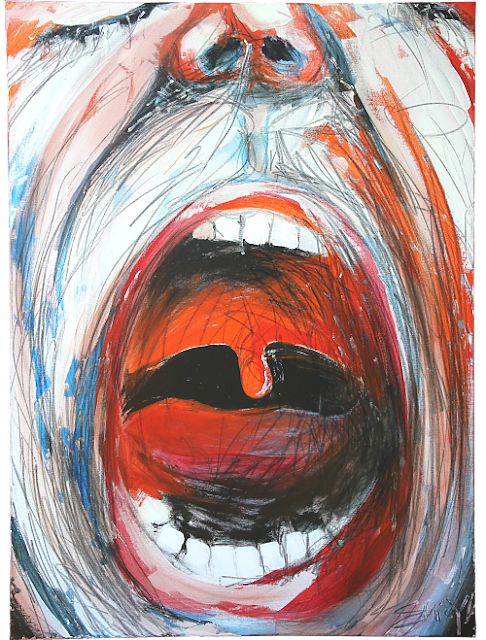
"(I open my mouth and) nothing comes out", oil and graphite on stretched canvas. Emily van Lidth de Jeude

The circumstances of my childhood were not what we consider to be ideal, but they’re also not at all uncommon. Like many of us, I live with intergenerational traumas from histories of war, colonialism, famine, and domestic abuse. These things are rarely spoken about, as our culture tends to look down upon expressing too much emotion or speaking about emotionally challenging topics. But the effects of my buried experiences are borne in my body as autoimmune diseases, and they’re in my paintings. The image above is one of the first I painted in the Songs of the Apocalypse series. It’s a depiction of my own face as it appears to me in dreams, screaming for all I’m worth to help the people I love (who are always suffering horrible fates in my dreams)… but no sound is coming out. And nobody hears me. As an artist I’m trying to break that helpless invisibility, not just for me but for all of us.

I am a woman in a world where one in three women has been the victim of physical or sexual violence, usually by a partner or close family member. So think of three women you know. Which one is it? Think of twelve women you know. How many of the four has told you their stories? I am a woman in a world where women are not only not expected to achieve, but are taught not to expect ourselves to achieve. A world where we’re expected to be happy to just survive.

"Will You Love My Heart", oil and graphite on 8 stretched canvases. Emily van Lidth de Jeude

I don’t call myself a survivor because I want to do more than survive. This is a portrait of me at one, four, eleven and sixteen. It’s called Will You Love my Heart, and is painted to Sinéad O’Connor’s song, Love is Ours. It’s on exhibit July 24-August 18 at the Silk Purse Gallery in West Vancouver. As a synaesthete, I usually paint music, but not just any music. The song that inspires a painting will have a very specific meaning associated with my own memory, so what I’m painting is my visual experience of that song combined with my own memory and emotion. Love is Ours is about holding onto the pieces of our broken hearts and keeping each other alive. In our boxes of personal experience we grow out into the rest of the world, and then will we be loved? Or shoved back down into our private little trauma boxes? I’ve spent my whole life since my teens trying to get out of that box, to find love and healing, and grow into the many links between my heart and yours (yes you—we’re all connected). 

I figure it’s a good idea to let my voice come out now, share my progress and hopefully inspire billions of others to do the same. That’s why I’m finally beginning to show the Songs of the Apocalypse series.

So think of those women again. Those 12 women, four of whom have been assaulted. Maybe you’re one of them. Maybe your child is, or your partner or your mother or your dearest friend. What can you do in this moment to raise her up out of the box built of her trauma? What can you do to break the walls of the box? How can you change even one thing about the space you give her; the voice you give her; the respect you give her, that could help her find her own way out of the box? And how does your love make her strong?

I’m a feminist artist with a loving, evolving male partner and a strong, courageous daughter, and an extremely emotionally-aware son. Being the strongest I can be strengthens the foundations for everyone, including all genders, ages and classes of people. It even will combat climate change, colonialism, the patriarchy, and capitalism, because as I become stronger I can lean less on the cultural norms that hold up those false shelters. Creating a world where I can come out of my box and thrive means creating a world where everyone can thrive. Equality doesn’t mean bringing anybody down. It means using the pathways created by love to hold each other up.

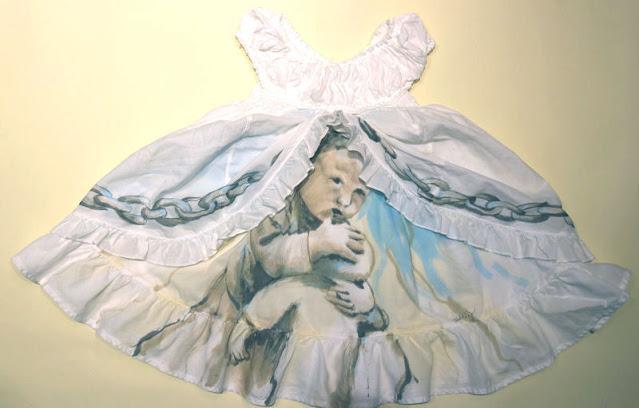
A tiny white child's Christening dress is laid out on a pale yellow background. The dress has ruffles with a chain painted onto them, and from underneath, a baby peeks out, holding a doll to its chest in a protective way.
"Chain Dress", acrylic and stains on an altered child's dress. Emily van Lidth de Jeude

Art for Change: When Connection and Conversation Are the Outcome

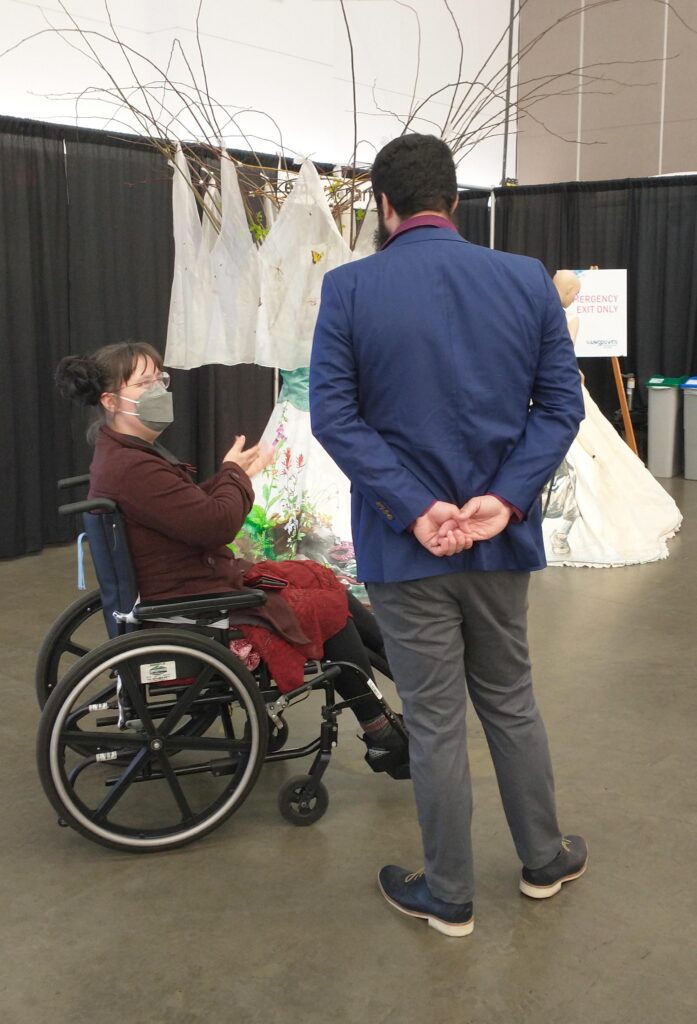
I could see him drifting across the polished concrete floor of the convention centre, blue-jacketed arms spread into a perfect reflection of the very wide smile that punctuated his neatly-trimmed ebony beard. He was studying the very sad-looking portrait of my recently-divorced brother that adorns the train of the gown I had on display. He circled the gown slowly, hands splayed as if to catch every bit of story it offered, taking it in with sparkling eyes and smiling, smiling, until he looked into mine, and said, "did you make this?"

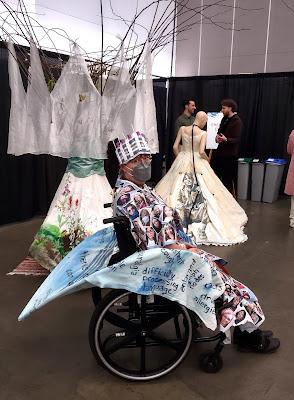
Artist Emily van Lidth de Jeude sits in her wheelchair, wearing black leggings, a short red dress, a burgundy jacket, and a grey face mask. She has two curly fake hair buns, and is gesturing with her hands as she speaks to a dark-bearded man in grey pants and a blue suit jacket. Some of Emily's wearable art pieces are visible in the background.

"Yes," I answered. "It's called '(dis)robe: Nursing Gown'. Tell me about your big smile!" And he told me he felt seen. We talked for a long while about how crippling our societal expectations can be for people of all genders. We talked about how trapped the painted man looked, even though he held the mannequin by a dog-collared lead. We talked about how the patriarchy crushes all but the wealthiest people–it was never about men versus women; it's just a few billion pawns fighting for survival under the shoe of someone much more powerful. And what if we were to work together, instead?

I just finished a four-day stint of exhibiting some of my wearable art pieces at the Art Vancouver fair. This gave me opportunity to reflect quite a bit on why I do what I do. My purpose as an artist hasn't changed, but it has deepened and I suppose I feel it more intensely, now. I'm here to connect people with each other, with their own authenticity, and with a more equitable, sustainable future. My art is a conversation-opener. Conversations like the one I had with this blue-jacketed man are the cornerstone of social change. They're the space where the change takes root in our hearts.

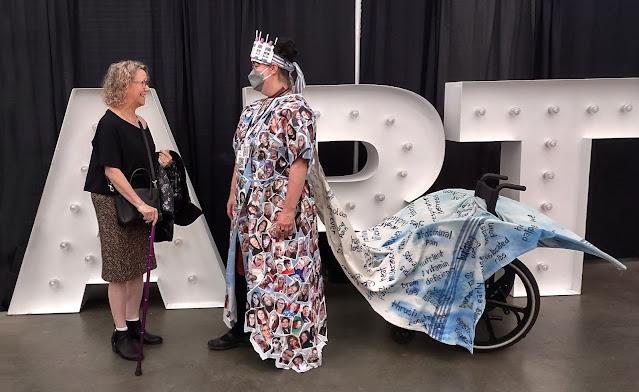
See those two people talking at the back of the image below? They're talking. Their hearts are making change. During this show I also spoke with many children who wondered what was "going on with the boobies" on that Nursing Gown, or whether they could touch the insects on the Gaia Gown, and I saw children pull their mothers around the skirt to identify the flowers they knew. People wondered where they might wear such unusual dresses, or why anybody would want to. "Definitely not to work!" One of them exclaimed.

The artist, Emily van Lidth de Jeude, sits in her wheelchair, wearing the Hospital Gown project she created. Hospital Gown is a wearable art piece covered with selfies of over 300 Long Covid patients, and a train (which she's sitting on) covered with many of the most common symptoms of Long Covid. In the distance, two more of Emily's wearable art pieces can be seen, on display.

The main piece of this winter's artistic journey for me was the Long Covid gown, '(dis)robe: Hospital Gown' (image at the top). It involved over 300 selfies contributed by Covid long-haulers from around the world, transferred to an altered donated hospital gown. From the back of the gown, trailing from a drawing of my son's hands (because when my Long Covid was at its worst, he used to help me walk by gently pushing my back), was a hospital-blanket train covered in some of the most common symptoms of Long Covid. These are the symptoms that millions of people worldwide live with every day, often confined to home or bed, invisibly. So the train is supported by a wheelchair that is also partially hidden. There's symbolism in everything I do, and this was my opportunity to give a voice to the millions of people who, like me, live mostly invisibly with Long Covid.
And when I got too exhausted (shaky, blurred vision, heart palpitations) from wearing the gown and talking to people, I could just step back and sit in that wheelchair. A purpose-built wearable art piece! This is what comes of making art that truly deals with my own personal experience.

I invited many people from the Long Covid community to attend, so it was no surprise that this was a conversation piece for long-haulers, nurses and other health professionals. Some people even came to delight in finding their own faces on the gown! But it was also a chance for us all to be visible to others–many of whom had never realized Long Covid was happening in the world. Education is change-making.

This weekend was, for me, an opportunity to see other people becoming; changing, evolving, and questioning themselves. It was an opportunity to hug so very many lovely souls, and to express gratitude for their thoughts and opinions. There were people just visiting from afar, people who came to support artist friends, and people who were also showing work at the fair, or working to organize. There were people who came just to buy a pretty painting, but ended up chatting about climate change, gender politics, and the healthcare system. My own display confronted people with sometimes-difficult topics, and yet they bravely engaged. This reminded me that while we sometimes want to hide from challenges, humans are mostly courageous, and generous with our intentions.

I was not the only artist there trying to change the world through art. Humanity is a great kaleidoscopic spectrum of beautiful people, reaching across so many circumstantial divides to connect and thrive. We're like all the network of roots, mycelium, compost and microorganisms in the forest floor: a vibrant bubbling potion of hope, and a foundation for continued life. In following our own paths with so many tentative, compassionate feelers, we're finding our way.

Playgrounds, Gaza, and a Forest: How Competition Impedes Prosperity

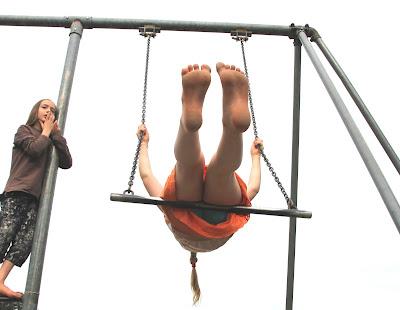
A long-haired boy in a long-sleeved brown shirt and black and white capri pants stands on a bar, half-way up a swing-set, looking wistfully off into the distance. His sister, in an orange skirt, turquoise shorts, and a shirt that is obscured by the angle of the photo, swings on a trapeze, beside him. Her feet stick out into the centre of the photo, in the foreground, and her long braid trails behind her.

One damp autumn day, I crossed the dirt and wood-chip playground to the swings, where I saw a girl a couple of years younger than I was, and also the bottom of her grade's social heap, swinging on the best swing. You know the best swing? It's the one that is for some reason not spun up out of reach by the older kids, and the most visible to the playground supervisor, so other kids don't bother trying to haul you out of it. During those years, I spent all recesses and lunch hours either hiding on the bluffs, up in a tree, or firmly glued to that swing and swinging fiercely back-and-forth, back-and-forth, daring people to come near me with a glare they never noticed. But this day, this younger girl's thick brown hair flew back-and-forth, back-and-forth over her raincoated shoulders. I stood at the pole of the swing-set and ground my boots into the dirt. When nobody was looking, I told her passing face that I was magic and would turn her into a rock if she didn't get off and give me the swing.

When I was a kid I was near the bottom of the social heap. The kids who hurt me the most were also hurt the most by their parents, or by other kids at the school. It's normalized, in our culture, to turn and dish out to someone else a cruelty that was served to us. School, career-building, politics, capitalism–they're all just games of getting ahead of others, and put us in a position where we feel that "getting ahead" is the same as "prosperity". It's an illusion, but our longstanding capitalist social structure leads us to believe in it at the cost of vision and community. 

Israel is flexing its playground seniority in Gaza. It feels heartless to compare genocide to playground bullying, but I want to point out that in accepting what we see as insignificant cruelty in our privileged day-to-day as a necessary cost of getting ahead, we also pave the way to accept greater and greater atrocities. I understand from my playground experience how easy it feels to commit some lesser act of cruelty against another person when I've been hurt. So by extrapolation, I get that maybe if your people has been persecuted for thousands of years, and even in living memory was the pointed victim of horrific acts of genocide, it might seem less than horrible for (some members) of that people to commit genocide against the next victim down the chain. I mean, aren't we all just making gains by stepping up upon the backs of those just below us in rank, privilege, or esteem?

Well no–not everybody is doing that. Some of us from every race, religion, and social ranking in the world are in fact trying very hard not to be that kind of monster. Some of those in my circles who are most vocally supporting freedom for Palestinians are my Jewish friends. Because fighting to get or stay on top of a social pyramid does not equal prosperity! Because some of us learned this important lesson in childhood.  

Back in my elementary school playground… I have never forgotten the look of horror on that girl's face, and my triumph at seeing her run away, so I could get to safety on that swing. My triumph was the worst. I remember the sick feeling in my stomach, after she left. I didn't know where she had run to, or who might be kicking her, feeding her dirt, or holding her down and whispering the most vile threats in her ears. I remember thinking we looked rather similar and maybe she could have been my friend if I hadn't been so desperate to get that swing. I felt that getting the swing gave me safety, but it also took away hers. I remember that my triumph came with a horrible cost to my feeling of righteousness, and that year I became one of those people who knows better than to pass the bullying on to the next rung down the ladder. Sometime after that I bravely spoke a few words to my bullied-mate in the classroom. We had a breath-holding competition. So for a couple of minutes we found common ground in an environment of terror and ladder-climbing, and I think in some small way we both learned to transcend the hierarchy of our class.

We can ALL learn from our mistakes. We can all look at our leaders and our cultural and personal privileges and refuse to make progress at the cost of others. Sure, we're trying to survive in what is, at its root, a culture of competition, and to some degree we have to participate in the status quo to survive. But we can also work to change it. Those of us with more privilege have more ability to effect change. We can change the ways we look at others; we can choose to befriend the people who make less money than we do, the people whose lashes lower when we speak to them; the people who seem least likely to improve our social status. We can look critically at our privilege and resources and belongings and ask ourselves what we actually need, and how we can change our lives and share the excess to achieve a social balance in our community. We can remind ourselves that a balanced community means prosperity for all. 

Does prosperity mean a lack of suffering? Of course not. We're all going to die. We're all going to hurt. We're all going to lose loved ones, and health, and hope. But a balanced community is exactly the only thing that will sustain us through these challenges. And we can look to the ecology just outside our city limits for inspiration in achieving prosperity through social balance. 

A tree in a forest. If a maple drops ten thousand seeds on the forest floor, all but a few hundred of those are likely to be eaten by insects, rodents and birds before they ever sprout, and of those that do sprout, most will be eaten as spring greens by the likes of deer, and others. And maybe five will grow to be saplings, and maybe zero will live to become trees, most years. Until one day the mother tree has crumbled under the weight of some winter snow and in the mess of her fallen limbs, one of last year's saplings will grow sheltered and become a tree, itself. But you know what? In all those years where not a single one of those seeds grew to maturity, that original tree fed the ecosystem around her, and reached her roots through the landscape to share nutrients with the neighbouring trees. All the other plants and animals' droppings and dead bodies fed the soil, and now that soil is rich with microbial life and nutrients, and that new maple tree will grow strong–not on the backs of all those it conquered, but in an ecology of giving and dying and growing. The maple tree has no fear of falling behind. She is a sanctuary for mosses, ferns and all kinds of insect, microbial and animal life–she is part of that life. She's just growing and giving and crumbling and feeding her ecology. And that is why she prospers. I want to learn some of that wisdom.

What if there was no fear of falling behind in human society? Would we carry, feed, and connect with each other; with our ecology? Would we relish those connections instead of conquering others? I feel like I've experienced this when I sing in community. When my own voice drowns away among the voices of others, but together we're a beautiful sound. I experience it when I play with children in the wilderness. We're each so insignificant in the big forest, but our play changes the landscape and we see the impact of our being there; we learn to play carefully. We learn that if we destroy the stream-bank, then the water downstream will be muddy, and then we'll have no clean water for drinking, anywhere. We learn that affecting anything (anybody) will have impacts on ourselves.

If my life depends on privilege gained through competition, and supported by people who aren't being supported by me, then when those people's lives falter, so do I. We can't build a pyramid to stand on, then rip out the stability of the base, and expect to keep standing on the top.

And from another perspective, when we've prospered exponentially at the cost of the ecosystem that supports us without honouring it, giving back to it, and living in harmony with it, the ecology we depend on is faltering underneath our ridiculous pyramid, and we're all beginning to discover what happens, then.

Our system of pyramid-climbing is not a strong one. A strong system is lateral. Like a forest, or a group of people singing. A strong system loses a limb and regrows to heal the wound. A strong system has no leaders, but many trusted and equal members, all giving instead of taking. Giving is not sacrifice, it's prosperity.

It's scary to think of not having enough (food, money, land, power, achievement, influence, etc.) In a hierarchical culture, "not enough" equals failure, threat; fear. For those near the bottom of the cultural pyramid in my community it means no shelter; no food. For those on the bottom in Gaza it means abject trauma every day. It means death. Is this an acceptable cost for my "getting ahead"? I don't want this kind of unstable throne. I don't want to support a global society that prospers on hierarchical oppression, because in that kind of culture, everybody is a potential pawn, or enemy. Everybody is unstable. 

I want to transcend capitalism and find joy in uplifting others instead of uplifting myself at a cost to others. I want to stop prospering as an individual, and when I fall, I want to fall down in community, knowing that others will grow into my wounds. I want to be worth more than what I own or who bends under my feet. In a lateral community I will be worth the whole of us. I want the mirage of hierarchy to disappear and I want us all to be free.

Free Palestine.

Disinformation and Meanness: What is going on?!

A giant white bird flies upward off the canvas, semi-abstracted, belly in full view, head cut off by the top of the canvas, and feathers disintegrating into the red background, which fades away to black, at the bottom, mirroring the bird's small black feet, pulled tight against its tail.
Escaping the Nest (middle of triptych), by Emily van Lidth de Jeude

It just hit me that maybe ten years ago I was worried about the rise of misinformation on social media. I saw it once in a while; people posting things from known biased sources, or just stating information they assumed was correct but wasn’t. Extensive fact-checking became more necessary than I had felt it was, before, since even trusted sources seemed infiltrated with presumption and error. Or maybe I was just becoming more aware. 

Recently, though, it feels like disinformation is the norm, and complicated with some serious cruelty. On the bigger social media groups I’m a part of (chicken-keeping, canning, foraging, mushrooms, birds, education, etc.) it’s just absolutely normal for somebody to post a question and receive 30–70% wrong answers. It seems people have just become accustomed to stating an uneducated guess as fact. (And seriously — for canning, foraging, mushrooms, chickens, and schooling, this can lead to disaster, for example when someone asks for ID on a poisonous mushroom, and half the responses say it’s edible, and most of the other half are phallus jokes.) And then there are the people berating each other, not just for being wrong, but for correcting the mistakes, as well. Or for totally unrelated things. Like when said phallus jokes become linked to anti-trans attacks. It gets awful out there.

THEN there’s the morality war. There is a propensity for people (mostly white men, I’m sorry to say), to stick their uneducated opinions into posts about LGBTQ2IA+, indigenous, children’s rights, women’s rights, and BIPOC issues… again, as facts. Many of these “facts” are colonial constructs held by our society because they keep white men in power (and because the rest of us think they ensure our continued prosperity). But many are now also just lies made up by conspiracy theorists (like all the supposed chemical, psychological and media conspiracies to make our kids gay or trans or supportive of minority rights…) Sure, there are many sides to every story, but some things are actually not happening. I’m not even getting into the massive quagmire of people in power (often leaders of large corporate enterprises, politicians and religious leaders) using minorities as stepping-stones to more power. Some of us use these crimes as security for our privilege, without ever questioning ourselves.

In my art life this takes shape as criticism and fear: Am I appropriating symbols that are proprietary to a marginalized group that I’m not a member of? Rainbow spectra and feathers were important in my work before I became aware of appropriation, and it’s been hard to sideline them, even though I know how important it is. Even harder was the bickering between artists and members of the LGBTQ2IA+ and BIPOC communities. Oh yeah, and the outright hate-filled rhetoric between some feminists of different stripes. These issues make communicating online really fraught, even without the added question of misinformation or disinformation.

What is going on?! Why is our culture disintegrating into this kind of nastiness and ignorance? As a long-time unschooling parent who notices the lack of this behaviour in the unschooling groups, it’s easy to feel like it might have some kind of relationship with our education system. Especially since unschooling mindset is one of curiosity, acceptance and learning, and unfortunately the compulsory, competitive nature of our school system can provoke a rebellion against curiosity and learning, as well as a propensity for bullying tactics. The rebellion against understanding and the bullying are apparent in a lot of the online attacks I’ve seen. But I think that, in the bigger picture, there’s a deeper reason. We’re experiencing a massive cultural shift. Our minds are opening. And that’s just messy.

We’re threatened from all angles as climate change changes every single foundation our cultures were built on (predictability of seasons, harvests, weather, migration, and therefore employment, finances, housing, healthcare, and even cultural norms). So in this state of growing societal panic, some people are trying to keep things as they were (ignoring the fact that the great majority of underprivileged people have already been suffering these unpredictabilities forever). Some are taking opportunities to fight for rights long-denied to them. Some, like me, are gleefully running headlong into the change, wanting to create a new and better world out of the chaos, and ALL of us are rather ungrounded in the process. There’s so much change, so much fear and threat, that we’re all just kind of scrabbling for understanding all the time. I guess it’s not surprising that a lot of people are confused about the facts, in this kind of chaos! I am too. Everything seems to take so much research now! And patience, tact, and caution! And in the rush of this change, and the feeling of urgency everywhere, it’s not surprising we don’t feel we have time to fact-check or to come to an understanding of the issues we’re talking about before making assumptions and proclamations. 

So it’s frustrating, and sometimes even extremely upsetting, when people resort to cruelty because they feel threatened or inadequate in the face of such big unfathomable change. But it’s necessary that we remain patient and kind, reminding ourselves that these actions are a part of our societal growth. And I’m choosing to see it as a great sign that big change is happening. As a woman with many friends and family in marginalized communities, I’m glad to see my own and other people’s rights have a chance to be respected. As a person living on earth, I’m glad we are making changes that might make our future survivable! Maybe we can all take deep breaths and remind ourselves that everybody is confused and frightened. And maybe saying lots of wrong things is part of our process. We’re learning to learn and communicate! Real learning with an open heart and mind is how we will adapt to our new civilization. It’s how we will all grow to meet the challenge of a world none of us have lived in, before.

10 Ways to Save Humanity Even if You Can't March on Sept 15th

As the death-toll from Libya’s storm floods surpasses eleven thousand, and various hurricanes march their ways across the oceans, people all over the world are gearing up to March to End Fossil Fuels, tomorrow. (Find your city’s event on this map.)

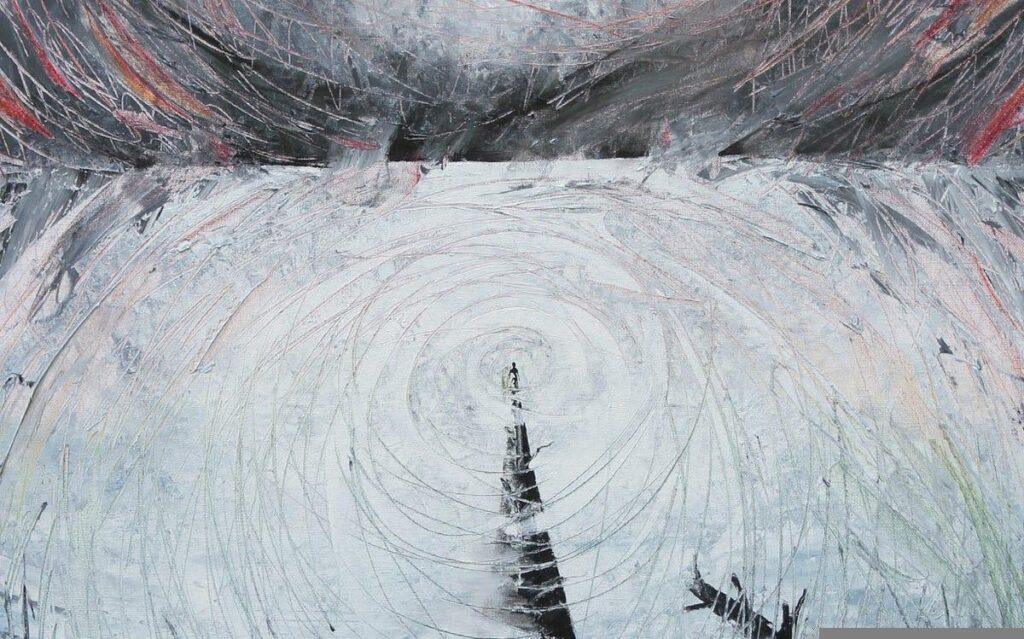
A painting by artist Emily van Lidth de Jeude. Mostly white and grey; a kind of abstract landscape, maybe, with fiery grey in the distance. A jetty or log stretches from the foreground into the distance of what might be a lake, a sea or a plane, and a very tiny distorted human figure stands at the end of it, encircled by nothingness.
Not a Thing Between Me and You (detail) … Recent painting by Emily van Lidth de Jeude, in response to Neil Young’s song, “Overhead”. This painting deals with our compulsion to just keep going into an unknown future, together, even when we don’t know we’re not alone. It’s about courage.

But what if we can’t march? And even if we can, how are we going to propel this impetus into action? How are we going to actually save our future on this planet? (Let’s face it, we’re not going to another planet, and instead of talking about “our children’s future” now, we’re talking about our own.) We’ve got months or a couple of years to turn this around, and even if we do, storms like this are now here to stay. So what can we do about it?

  1. Become resilient.
    We can stop following the status quo, and learn to live differently than our youths and the media told us to. Learn to cook our own food. Learn to pivot our careers and plans and housing situations as needed, and without being traumatized. Adaptable creatures survive.
  2. Make our kids resilient. 
    So you might know I usually write about unschooling. That was (and still is) my effort to raise resilient, independent, capable adults. And it worked! At 18 and 21, my kids are now living independently (together), paying their own way, and making changes for a better world. 
    Unschooling isn’t the only way to make our kids resilient. Any kind of freedom to explore and develop their own skills will help. As will encouraging schools to opt for explorative learning, wilderness education, and all the things that will help our kids be connected, creative, courageous, and resourceful. Those are the skills our kids will need to survive our new world.
  3. Grow food.
    Whatever we can do, whether it’s growing sprouts on our kitchen counters to save $10/week in veggies, or escaping the rat race to go whole-hog on a homestead — just do it. We can all (and yes I mean all) grow at least some of our food. This not only saves money (if we learn from someone else who’s doing it effectively and don’t fall for sales tactics for all the gadgets we don’t need), it also brings us closer to our food, giving us a deeper understanding of life, our bodies, our connection to the ecology we live in, and nutrition. It’s healthier for us (fresher food), and it’s also healthier for the environment, since everything we grow (sustainably) ourselves is something we don’t buy from the unsustainable agricultural industry.
  4. Buy local.
    For all those foods and other things we can’t grow or make, ourselves, we can buy local! I guarantee you there is somebody out there trying to get rid of a bunch of homegrown zucchinis or apples right about now. What if we paid them instead of a big supermarket chain? What if we bought from local farmers, builders, and creators instead of from the capitalist industries that are the root of climate change? This is a shift we can make.
  5. Don’t buy! Boycott capitalism.
    Buying local is one way of sidestepping the corporations who are doing the most damage, but buying less is an even better way. A big part of our problem is overpopulation, and then there’s overconsumption. We really don’t need all the stuff. We don’t need big houses. We don’t need big cars, we don’t need lots of clothing or school supplies or travel or household items. We don’t even need as much food as we currently consume, and we especially don’t need to be wasting as much food as we do through restaurant and supermarket refuse, and simple neglect at home. How many times do people go on a fabulous vacation and then declare they need a vacation from their vacation? What if we just took a local vacation in the first place — one that doesn’t displace people from rental accommodation, and that connects us with our homes in ways we hadn’t experienced, before? In the space that’s left without the things that we don’t *actually* need, we will learn to find convenience, fulfillment and joy. We will have space to keep building that resilience and resourcefulness I mentioned earlier.
  6. Be happy with less.
    Along with resilience and resourcefulness comes happiness. It is just plain so rewarding to grow my own food! I go out every day now and tend my chickens, weed a bit of veggie garden, eat some food right off the plants, and just generally revel in a lifestyle that I once found daunting. I feel empowered by my mended clothing in a way I don’t feel empowered by something brand new. I now have some serious disabilities, and learning to be resilient and resourceful has made me happy, similarly to how my job working with kids used to make me feel.
  7. Love our local ecology.
    Partly the joy I get is from being active in my local ecology (also similarly to when I worked with kids on wilderness exploration)! I have learned so much about how connected we are; am currently fascinated with the many types of wild bees and other insects that frequent my small yard, and with their life’s work and activities that all contribute to the diversity we depend on. How does this love save our world? By connecting us with it. If we love our ecology, we’ll know it better, and the more we know and love, the greater ability we’ll have to protect it. We need our ecology. If only for the simple reason that it feeds us and protects us from storms. That in its diversity it will recover when we finally do turn the trend of climate change around.
  8. Love our neighbours.
    We’ve got a couple of new neighbours recently. We’re making an effort to connect with them. You know why? Because when the power goes out, when a tree falls across the road, when someone’s pipes freeze or someone needs any kind of help at all — or just a hug, we will be there for each other. When the storms come, we’ll need each other.
  9. Love our children.
    Obviously. Because the hell that we’re going to experience pales deeply against the hell that our kids will know. If we love them, we need to save them.
  10. Just love.
    And when it’s all too much, when we’re succumbing to doubt and fear and a feeling that nothing we do could possibly be enough, we can love. If I’m going to die, I want to do it in the arms of someone who loves me. And more importantly, I’m far less likely to die early if I share a deep love. Our future and neighbours and children and the whole global population is more likely to thrive if we live a life of love instead of material acquisition. 

Love is actually a hard thing to do. So I’ll tumble out of my list now, just to write a little about love. Love is a challenge. It’s like a great wave piling up behind us, saying …RUN! And can we do it? Can we keep going even when the wave is catching our ankles? Can we slog through the wash around our waists, grasping at the ungraspable wind, to haul ourselves out when the wave peters out, and get up and run again before the next wave comes? That’s love. It’s work. Neverending, challenging, heartbreaking impossible work. But it’s also the only thing that’s worth working for. Love is, in many ways, survival. When love (of a person, planet, dream, or future) compels us, we can access the resilience, courage, creativity, and resourcefulness needed to meet all the challenges. Climate change included. 

So whether or not you can join a climate march tomorrow, do something. Something that will make you feel empowered and resilient. Something that will save us, tomorrow. And tomorrow? Do something again!

With love,
Emily

Smoke, Fire, Ashes, and Covering Everything With White

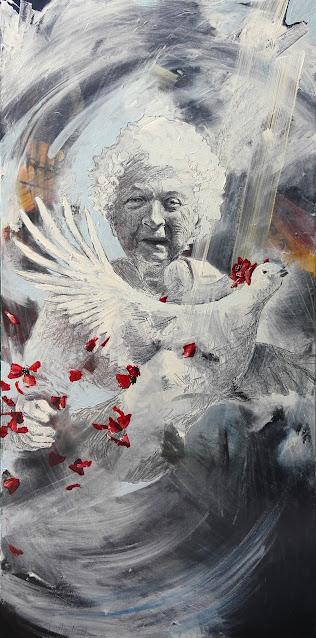
A mostly black and white painting. A portrait of an old woman with white curly hair, wrinkly skin and a big laughing smile. She's reaching her arms forward to the viewer, and a white ptarmigan is flying out of her arms, towards the right. A trail of red poppies and poppy petals tumbles off the ptarmigan as it goes.
Grandma Frees the Ptarmigan, 2023

I sometimes wonder why everything I paint recently, and somehow even the installations I do, gets a clouded overlay. It's oil paint, white fabric, soft white light; whatever. I keep washing everything away into a purposeful obscurity. (Except my portrait of my Ukrainian Grandma releasing her war trauma. For that I made the obscurity first, and she came out of it. That's a strange happening!) Recently I also found out I have cataracts, apparently caused by the various courses of prednisone I've been subjected to over these last 3.5 years of struggling with long COVID. Blah. Great. Not the news you want, as an artist! But even more recently I realized I might be replicating my own clouded cateract vision in my work. Huh.

I mean, part of me wants to embrace that (since the inflammatory effects of my long COVID also mean cataract surgery is not recommended), but part of me is still looking for a deeper meaning. And the white thing has been going on in my work for longer than I've had cataracts. I think I found my deeper meaning, during this current fire-season. It's self-silencing. 

We live in a world full of fear, watching homes and towns and futures burn and flood and life just get harder and harder. And the best comfort we can give ourselves is to wrap up in the status quo. Get a latte from a huge corporate entity and watch some non-reality on Netflix. We Canadians aren't even allowed to share the news anymore (Meta: Working to silence the world!) 

A big rough abstract painting and drawing of a screaming mouth, which basically fills the whole canvas, though a bit of nostrils are visible at the top. It's very rough and scribbly. Some people say upsetting but I don't think so because it's my own mouth!! It's called (I open my mouth and) Nothing Comes Out. It's a picture of a dream I've had most all of my life, where someone's being horribly hurt and I'm screaming for help, but... guess what?! Nothing comes out!! (How did you guess...?) 
Predominant colours in this horrible scribbly drawing/painting are white, graphite grey, orange and pthalo blue. And red.
There's an uvula in the middle of the canvas but clearly... it's not doing anything. Maybe I got carried away with this description.
(I open my mouth and) Nothing Comes Out, 2016

I've been passionately determined to change the status quo since I was a kid, but people get defensive if I talk about change. People write off my personal status-quo-breaking experiments (unschooling, regenerative farming, rejecting many popular conveniences in an effort to live sustainably) as impossible for most, or, even worse, "crazy". I feel so frustrated; so unheard, and so afraid of losing community support (and friends!) because my voice has been too loud; too radical. So I'm trying to shout my meaning while simultaneously silencing myself (!) Yeah. That's weird.

Is it necessary? Do I risk being written off like Sinéad O'Connor and everybody else who just couldn't keep silent? Who tried to change us? Or am I getting desperate enough not to care?

Drink Before the War, 2019

I was so saddened by Sinéad's death that I got even quieter. Now I'm so infuriated with watching my province burn (the homes of family friends gone, family evacuated and praying they don't lose everything, and my own veggies wilting and dropping in the smoke) while so many continue their world travels, unnecessary purchases, and general adherence to the status quo. I feel like I've been shouting for change my whole life, and my voice is hoarse but still somehow no sound comes out. So today I'm going back to the studio and just see what comes out of my brushes, because I just can't not scream about it all right now.

I don't think I'll stop using white. It's also evocative for me these days of the smoke and ash that's now a part of our every summer. And the blindness with which we're going into the future. My blindness. But I'm going to try to stop silencing myself.

Stay-At-Home-Feminist-Mom: Why I Traded my Early Art Career for the Privilege of Parenting My Children

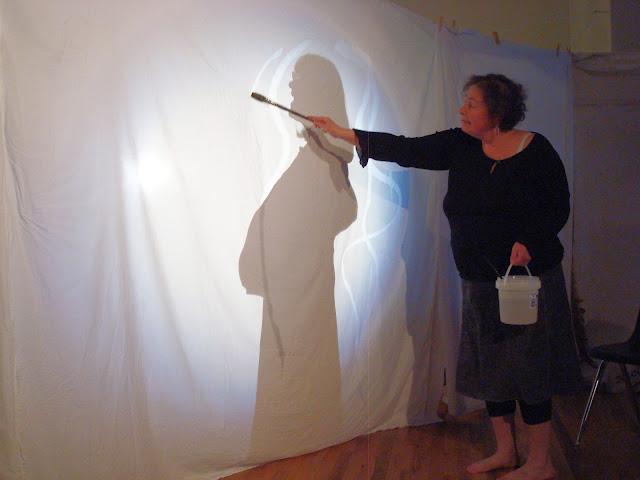
A white sheet is hung across the room with wooden clothespins, and it's lit from behind, where the shadow of a singing pregnant woman is cast against it. In front of the white sheet, a woman in a black dress stands painting with water around the shadow of the pregnant woman. The painted lines make the sheet more transparent, accentuating and ornamenting the view of the pregnant woman singing.
Visual and film artist Lidia Patriasz paints the silhouette of my mother, Lyn van Lidth de Jeude, during a performance of my work, SuperMAMA, 2010. All the women who participated in this production were mothers; most were also visual artists or musicians, and these two were also preschool teachers. Photo by Adrian van Lidth de Jeude.

As a teen, I never really thought about becoming a mother. Finding the elusive “true love” — yes! But not kids. I was going to find a man who was supportive of my political views (and would understand there is nothing actually “political” about equal rights), and spend my life busting up the patriarchy with gusto! Through the amazing art career I had planned, I was going to save us from climate change AND our degrading societal norms, by showing the world what absolute tools for the patriarchy we’ve been, and getting us out from under the shoe of the Man. Yeah.

So… that didn’t go quite as planned. My man was not unsupportive, he was just mild-mannered and uninterested in the big angry mission I was on. But he loved me. And also: hormones. Somehow my hormones side-swiped my passionate goals, so that suddenly, and for a few years, there was nothing more important to me than having babies. (My teenaged self gets whiplash here: HUH?!) So I had my baby, and determined when he was nearly two that it was time to go back to my career… or have another baby. I chose that latter. The timing of this choice coincided with our first child’s registration for preschool.

Preschool is such a wonderful thing! These devoted people take our kids so we can go back to the work of tearing down the patriarchy! My mother in law tells of the glorious day she left both children at preschool, and walked away with her body upright for the first time in years! It’s the place you go to drop off your beloveds for a beautiful day of mind-building play and learning, and you — the newly freed mother — go back to your world-changing career!! YES!! (I was SO naive.)

In my case, the first two years of preschool were spent back and forth between nursing my youngest and tending to the eldest while he very slowly acclimated to a system that never worked for him: school. I said he acclimated. He never thrived. By the time my youngest entered preschool (where she absolutely did thrive), my job became accompanying my eldest to his Kindergarten, where he continued not to thrive.

It wasn’t a heartfelt thinking-through that led me to leave my career behind. It was just circumstance. I could never have left my son in that world that wasn’t serving him, and homeschool (unschooling, in our case), seemed like the best option. Nobody picks the second best option for their kids if they can help it. My husband and I rarely even talked about our life as a choice, and when we did, it was only that I apologized for not making any money, and that he reassured me my work with the children was equally important. I had found the equality I’d been fighting for: not in equal pay, but in being equally valued — at least by my partner.

Financially, staying home with my kids was certainly a sacrifice. On one income for the foreseeable future, we abandoned our dreams of owning our own home. We are incredibly lucky in being able to rent from my parents, which has meant we have a kind of home security unavailable to most renters, today. But it was a mouldy and rotten home, and has necessitated over a decade of my husband’s free weekends and vacation time spent rebuilding (he’s still not finished, actually). So we sacrificed free family time, as well. Of course all this meant that unlike many of our kids’ friends’ families, we rarely had money for vacations, new clothes, or sports and arts programs.

What we do have is an amazing attachment. That alone, and the benefits I knew it would have for my children’s lives, was enough to keep me home. It was enough to make every sacrifice of money, freedom, and career worthwhile. And I was so passionate about my work as a mother that it really became my life. I volunteered at various family-related organizations, served on and chaired various boards in my community, and founded and ran a few programs, all geared towards supporting healthy families in our community. I somehow never even saw the irony of becoming a stay-at-home-mom, after my passionately feminist youth, until people began pointing it out to me, as my kids grew older, and I continued staying home. It seems it’s reasonable for a feminist to have kids and attachment parent them, but then apparently one should put them in school and get back to work on smashing the patriarchy.

Well hold on! What if my work as a mother IS smashing the patriarchy?! Is feminism now relegated to single, childless women, or those who leave their kids in the care of others? What does that say about our respect for other women? Day-care workers and teachers are some of the forgotten sacrifices in this equation, disrespected in wages, benefits AND the mainstream feminist viewpoint. Like stay-at-home-mothers, they’re the people feminism blindly relies on to raise the next generation of feminists, while feminists are out doing “more important” things.

In the process of changing the world, there is NOTHING more powerful than raising children.

The way we raise our children determines how successful each generation of women will be at improving our lot. When caregivers aren’t valued as much as our economy values shareholders and industry-builders, we all lose. That goes for daycare staff, teachers, AND stay-at-home-mothers and homeschooling parents. Many stay-at-home-mothers are the volunteers in our communities who make the programs that support women and children. 

And all that is not to ignore the unbelievable power of setting an example. As parents, we are the greatest teachers our children will ever have. When they’re sixty they’ll find themselves blindly doing what they saw us doing. There is no such thing as “do what I say, not what I do”… our children will always do what we do. So when they see us living powerful lives, when they see our partners respect us; when they see us respect ourselves, they will follow suit. And if we take in other children to care for, we’re influencing those children, too, and their children’s children. In everything from the choices we make in life, to the ways we speak to our children to the ways we glance at ourselves in the mirror, in passing, caregivers are POWERFUL. We’re the grease in the wheels of feminism. I argue, actually, that women who put down other women for choosing to stay home with children are just part of the blind patriarchy. 

Without regular vacations, without owning a home, without being socially acceptable, I am privileged. I’m privileged to have watched my kids grow up; to have shared my own life with them, and to have grown alongside them. I’m privileged to have had opportunity to make a difference in my community, and to model that for my children, so that, as young adults, they’re now busy doing the same. I’m privileged to have developed a very close relationship with my kids.

The experience I’ve had in staying home with my kids and unschooling them is not available to all women: especially not to single mothers, or those with partners who are not supportive of the idea. Even as I now struggle to develop a career as a middle-aged woman with disability and not much documented work experience, I know how lucky I am to have lived the life I chose. My career has shifted from some-kind-of-subversive-artist to an artist that is deeply rooted in my own experience as a stay-at-home-feminist-mom. The first big installation I created was about giving voice to other mothers. Being a parent has given me a perspective on humanity that was deeply needed for my art-making, but not available to me until I’d had the experiences I have.

I didn’t trade my values and career for having children; I traded my early career for the extremely powerful, feminist privilege of parenting my children, full-on. Or, to shift the focus a little, I am using my chosen experience as a stay-at-home-feminist-mom to build a stronger foundation for my career, and thus hopefully to smash the patriarchy, even harder.

Originally published in January, 2022.

How to Prepare for Scarcity and the Great Inflation

A view of Earth, lit only from above, on a black background. Some of Europe and Asia can be seen under a thin, sparse layer of clouds. This is a rendering of a 3D model by Taliesin River.
Illustration by Taliesin River

"You’d better prepare for the greatest inflationary wave in human history." That's the line that stuck out to me, near the end of umair haque's REALLY good article, "Why Everything is Suddenly Getting More Expensive — And Why It Won't Stop". If you haven't read this article yet, or aren't already familiar with the idea of the Great Inflation, and how we're now paying for the affordability of past generations, I recommend reading that article before reading this one. 

umair's article was very helpful to my understanding of why our groceries are getting so expensive or why, for example, I looked into second hand electric cars a few years ago and could find plentiful good options under 9K, and now there are none. So we know the Great Inflation is happening. My question is, how are we preparing?

Emergency kits and Go-bags are not going to cut it. Home preparedness is totally underway at my house. After this year's excruciatingly horrible wildfire season, we made plans to back up our family photos and prepared a little waterproof box for our phones, wallets and hard-drive, for when we'll inevitably have to jump in the ocean and swim. After this year's heat-wave, we bought an air conditioner that doubles as a dehumidifier for the now annual warm-and-foggy (read: in-house-moldy) season. After the deep freeze we insulated our chicken-coop. After the current flood-caused highway (and whole-town) washouts, we put emergency supplies in our car. After gas prices jumped and the flood-caused supply chain disruptions made gas rationing necessary, we looked into electric cars. I already told you how that went. 

But what's next?? We all know that none of this is enough. We can hardly predict the next climate-change-related disaster. Who knows how we should prepare? The one thing we all have to do is learn to live differently. And the change needed is so drastic we can hardly fathom it. Personally, I need lists to help me fathom. So I'm making one. In my mind it breaks down to three broad sections: things we need "much less", "none" and "more". My list is not complete or well-organised, but it helps me sort out my mind, so here goes:

We need much less of this:
Most things in this first section should actually be on the "none" list, but at the moment our culture is such that we're going to need a transitional phase. I guess that's what this is. This gives us time to learn and share some skills we've abandoned and get prepared for the time when, whether we like it or not, all these things move to the "none" section.

Travel: As fuel and steel prices rise, it's going to become impossible for most people to travel, anyway, and the many industries that depend on travel tourism will die, regardless. But on top of that, it's already becoming impossible to commute for work, to send our children to non-local schools or programs; to visit our parents. We're going to have to use our great ingenuity, as we have already proven capable of during the pandemic, to work around this.

Dependence on government: I'm not sure what makes us think that the government will just keep creating resources to fix and replace those destroyed by climate change, but I'm going to go out on a limb and suggest that right now our government and military are pretty taxed just dealing with the constant march of disasters. At some point that's going to break. There won't always be soldiers available to build dikes and put out fires. We might as well get used to that, and expect to do the work, ourselves. Yes we can.

Clothing: I have such a clothing addiction! I think I buy very few things–just a garment or four a year for each person in my household. And recently I try to buy sustainably. But I also still own, alter and wear many clothes from my teens, and every decade between then and now. I probably have about ten times as many clothes as I actually need, and it's not like giving them away would be any more sustainable. Some parts of the world are drowning in our "donations" (take time to watch that if you, like me, still thought donating clothes was helpful). The only actual solution to this is to stop buying, entirely. I know I have enough clothing to last the rest of my life, if I do more mending. And I could clothe the rest of my family, too.

Non-local food and industrial agriculture: We know that industrial agriculture, along with fossil-fuel driven production and transportation, is a disaster for our future. Thousands of chickens and cows just drowned in my province when the artificially-drained land they lived on flooded, because of climate change. Our flimsy, human-made systems are going to crash so hard they can't recover. We might as well accept that now, and start something new so we're ready when they're gone. There are many viable solutions for this problem, and they begin with all of us eating more simply. 

Imported food: We can do this now. My family is Dutch, and we LOVE our imported cheese. My family is also Mexican, and we–wait! We already figured out how to make our own tortillas from local corn! This isn't going to be as hard as I thought. This isn't as big a deal, perhaps, as how our food is produced, but it's one way we can make a difference to our impact, and become more engaged in local food production.

Fossil fuels. Resource Extraction. ALL. THE. WASTE: We're already making some progress with this. As we limit our needless use of office buildings for computer terminal work than can be done online, we will need less concrete and steel. As we commute and travel less, we'll need fewer highways and less fuel. As we drive less, fewer cars. And on it goes. The stuff that supported our wasteful consumerist existence will no longer be needed, and we can stop pillaging and burning our earth's resources.

We need none of this:
We already know these things are destroying us, and we can eliminate them, now. Yes, there will be devastating job losses, and huge shifts needed in our culture and thought patterns. We'll have to get very creative. But you know how when a close family member dies we're devastated and we don't know how we'll ever recover? But then we do, and we grow. And we end up somewhere new we never could have imagined before the loss. This will be the same.

Tourism: Yep. That's probably the end of the travel industry. Airlines. Cruising. Little plastic souvenirs and the trusted income source of so many communities, including mine. We'll find other ways to enjoy our world, along with other ways of supporting our communities.

Careers that depend on global travel: So much of our current air-travel is related to needless work-travel. It's the end of my career as an artist who exhibits in Amsterdam. A few years ago I might have said, "at least I got to do it once…" Now I'm kind of embarrassed I didn't make this realization before that. Lucky for us, technology has brought the world to our handheld devices. We can make the most of this.

Needless consumption, supporting mega corporations, escapism: I, like most of us, grew up in an age where Christmas was actually about presents; about light shows in shopping districts and buying stuff to feel happy. I learned to satisfy my soul by shopping, by travelling; by escaping my real-world life into screens, food, shopping, and travel. Now that that world is falling apart, it's no longer satisfying to fulfill those consumption needs. For Christmas I want to be released from the "age of stuff", as my friend recently called it on Facebook. Oh yeah. Facebook. That has to go too. I'm going to have to actually go to out and talk to my community members in person. I hope I find some walking around without their phones.

So now what? Now that we've dispensed of most of the biggest industries in the world, most of the jobs, and everything we actually loved about life… how on earth are we going to survive? Well, maybe not on earth. The billionaires are already playing with spaceflight. Let them move to Mars. The rest of us will dig deeply into that "More" category, and thrive. 

We need more of this:
This is the beauty section. This is where we take all the grief and fear from the previous two sections of my list, turn it on its head, and marvel at all the joy we've found.

Local food (and other resources): The more of us go find sustainable, local producers to satisfy our needs, the more such producers there will be. It's not cheap to do this, so a huge part of it is valuing the food for what it's really worth. My partner and I decided to eat very little meat, a few years ago, and what we do eat should be sustainably produced. So in order to afford this (both ecologically and financially) we went from eating meat three or four times per week to a maximum of once a week. And we eat cheese about twice a month. I'm still looking for a really good local cheesemaker. When I find one, that cheese is going to be as expensive as it should be, but deeply, deeply appreciated. When you don't get something very often, it becomes so much more valuable. It's the scarcity principle, but this time it's working for us.

Sharing: My family has chickens, now. Sometimes we don't have enough eggs even to bake bread. Sometimes, we have enough to bake, make quiches, and share with our family. Those are happy times, when we feel rewarded by our ability to contribute. Like when my neighbour grew so many apples she asked us to come pick some. We ate so many apples that year. Sharing isn't always about food, or even objects. We make a point of learning and sharing knowledge with our neighbours, as well. Sharing isn't just necessary for the equitable use of community resources–it's necessary for our survival.

Finding sustainable ways to contribute locally: This is the joyful counterpart to the misery of losing jobs and entire industries; economical collapse that will be a natural fallout from rampant inflation. This is where we find ourselves working instead of for money, for survival. And I can tell you from my experiences supporting unschooling parents, teaching and writing for free, and raising plants and animals for food, it's the most rewarding work I've ever done.

Connecting with community and local ecology: We protect what we know and love. Those who know and love us are our resources, and will protect us. This is the foundation of a wholistic society, but it's also the root of love and joy, so… what more can I say?

Pointedly appreciating what we do have: This comes back to the scarcity principle. My family has been regularly cutting back our consumption for a few years, now. We're eating mostly rice, corn, beans and lentils, along with what we grow, ourselves, and locally-grown veggies in the winter. We really enjoy our mushrooms, now that we only get them when they decide to pop up in the garden, or when we find them growing in the wild. It's the same for our homegrown chicken, eggs and veggies. It's the same for clothes we've mended or repurposed. Now that we rarely get to see our family (because: travel), we appreciate phone calls so much more. I make a big deal in my heart of what we took for granted, before. And that leaves me feeling deep joy.

~~~

Maybe it's weird to be talking about deep joy in relation to climate change disasters and our current basic needs becoming unaffordable. But maybe we're just not seeing straight. The cost (as opposed the price) of our lifestyle has been astronomical since our parents and grandparents were children. Now we're finally paying for it, in climate change disasters and rampant inflation. That's going to hurt a lot, no matter how we slice it. But maybe some mental preparation can make the hurt more tolerable. 

Maybe, instead of dreading the fires or floods or the housing crisis, we can prepare by living more simply, by forming strong communities of people who support each other; by building and living within our means. Maybe instead of rushing to the stores to stock up when we hear there's a shortage of microchips, maple syrup, or gas, we can embrace scarcity. Those last few spoonfuls of maple syrup are extra special now; I can feel resilient by making do with older devices, and I can walk instead of driving. I can even stay home. I can change careers, if I need to. And most of us will. Maybe, instead of working ourselves to death and spending more than we earn on big homes; spending time and money we don't have on travel and products that cost us our future, we can work less, spend less, love more, and look at everything we do have as if it is a gift. Because it really is. And we're finally learning to cherish it. That cherishing–that appreciation and finding of deep joy–is how we prepare our minds for the inevitable.

Originally published in December, 2021.