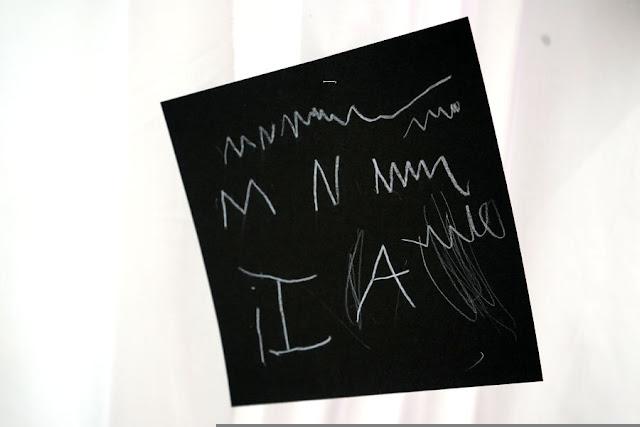
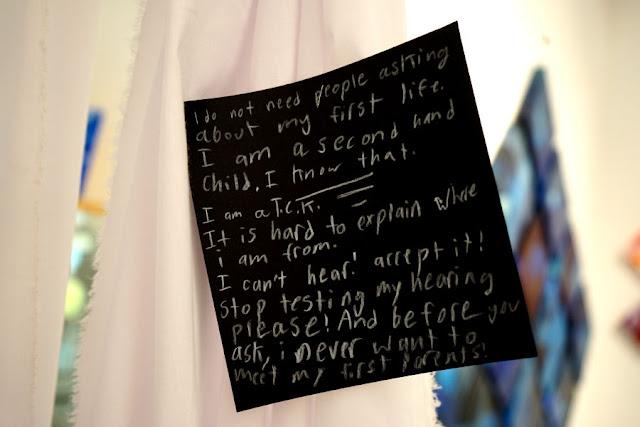
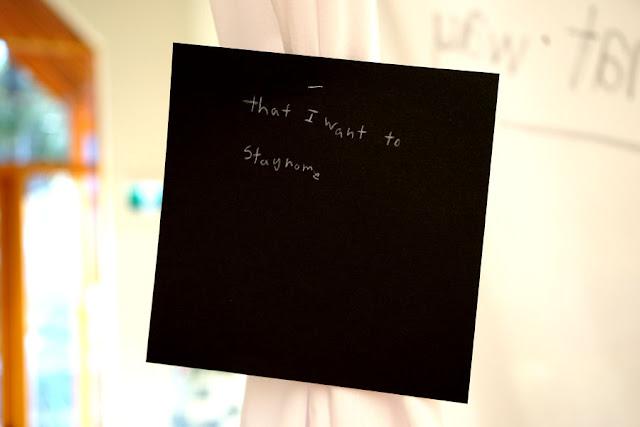
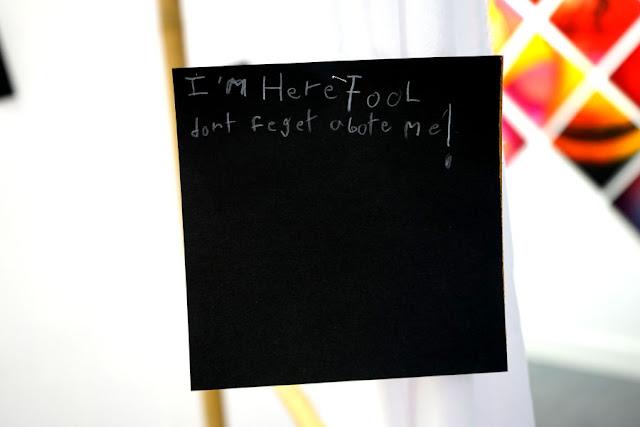
Mid 1980's. Behind the loose rehearsal set for our play, I was stuffing my winter socks into my mother's bra, transforming from my role as the sandwich-board-wearing, singing pig to the obnoxiously-vain queen. I was nervous about my fellow actors watching me put this giant bra on over my t-shirt, and remembered Julie's words from when we'd been swimming at the beach just last summer. She'd been changing into her swimsuit, under the veil of her shirt, and said, "I don't know why I'm shy; I have nothing to hide!"
Julie was my best friend's mother, the cooker of tofu dinners and the owner of fluttery, gentle hands that tucked me into bed on the hundreds of nights I slept in her home. She was the giver of twenty-five cents' allowance to any child who happened to wake up in her home on a Sunday morning, and the offerer of hugs, should any of us need them. When she offered me the role of the pig and the queen in her and Jack's new theatre program, Tir-na-nOg, I accepted because I loved her. I accepted because I knew I'd be safe with her. And I was.
And in the refrain of the play we performed, (yes, of course it's normal for a play to have a refrain!) we sang,
My leaves, they fall, like yellow tears My leaves, they fall, like yellow tears My bones, they are bared, to the bite of the wind I am fading away; I am fading away
…because, collectively, we young performers were a tree, and the wind, and whatever else we needed to be for the beautiful, heart-full, obscurely profound story we were telling to the handful of parents who came to watch us.
Close your eyes, follow me, come and see Close your eyes, follow me, come and see
The words of this song still permeate my dreams, now that I'm fifty. Now I'm fifty, Jack and Julie's little theatre school has nurtured two generations into adulthood, including my own children. They worked with a local developer to build a space for their dream, and have been operating out of this little space for decades, now. On the east side of the building is a wide open room full of props and costumes, some chairs, and the spirit of so many imaginative group adventures that have echoed off its walls, over the years. It's the space where Jack gathers children's ideas around a story and helps knit them all into an adventuresome script. It's where Julie flits through the developing story, reflecting and celebrating each child's contributions with a kind of joy that infuses the whole room with glittery delight. On the west side of the building, Jack has built a spectacular theatre. It's small, but supremely functional, and his beautiful curved walls, trap doors and secret passageways have inspired much creativity for the children who use them. The set is empowering to children, because it gives them a way to work with their resources and surprise people with ingenuity. Julie paints the set; the backdrops. Julie brings the ephemeral magic to the space. This building, and the nurturing of our children's dreams within it, are a foundation of our community, you might say.
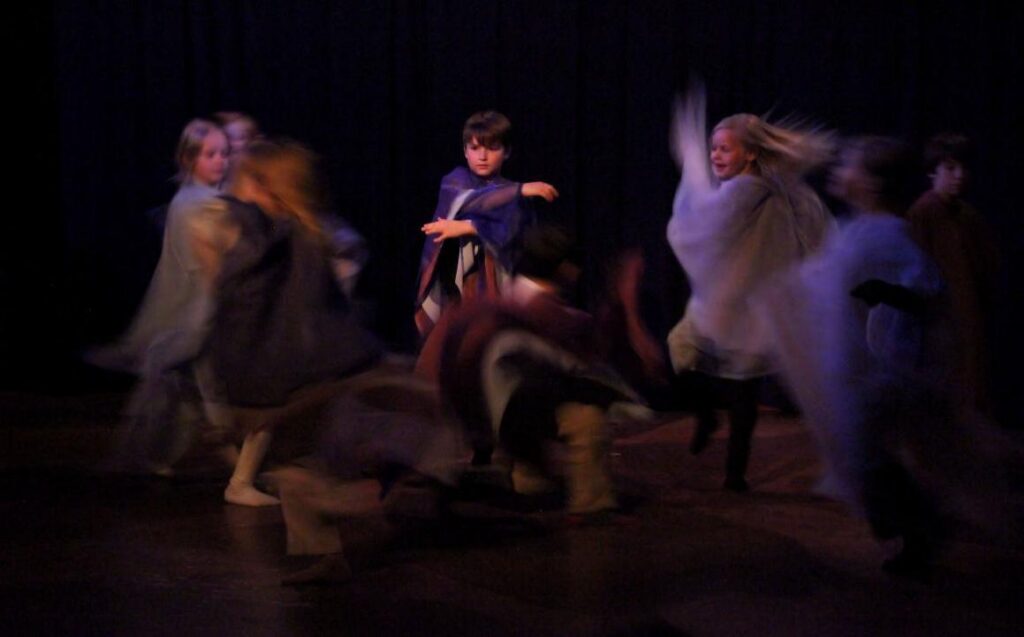
Tir-na-nOg production of the NeverEnding Story, 2013.
Tir-na-nOg isn't just the Land of Perpetual Youth. It's the place where youth is a key to growth. A place where imagination, delight and authenticity play with each other in the spaces between children's faces. And adults'. Because now many children stay with Jack and Julie into adulthood. Some have gone on to very successful careers in the performing arts, but no matter where their life-paths have gone, all have had their lives enriched, their confidence bolstered, and their prospects widened by the lessons they learned at Tir-na-nOg.
My own first child was one of these. Taliesin knew Jack and Julie personally; had played with their grandson in their small apartment above the theatre school, and had gone to see their school's plays multiple times, as well. He wanted SO much to be a part of this magical world. But he was also one of the shyest children I'd ever known, so actually going in to the first day of theatre class proved to be impossible for him. We tried again every week, even taking homeopathic stagefright remedy, arriving before the other children, and more acclimatization visits… to no avail. After six weeks, Jack worried that Taliesin was missing too much of the year's program, and suggested maybe we should wait until the following year. But Tali was determined, and somehow just the sound of Jack's soft gentle voice gave him the confidence he needed, and… he just went in!
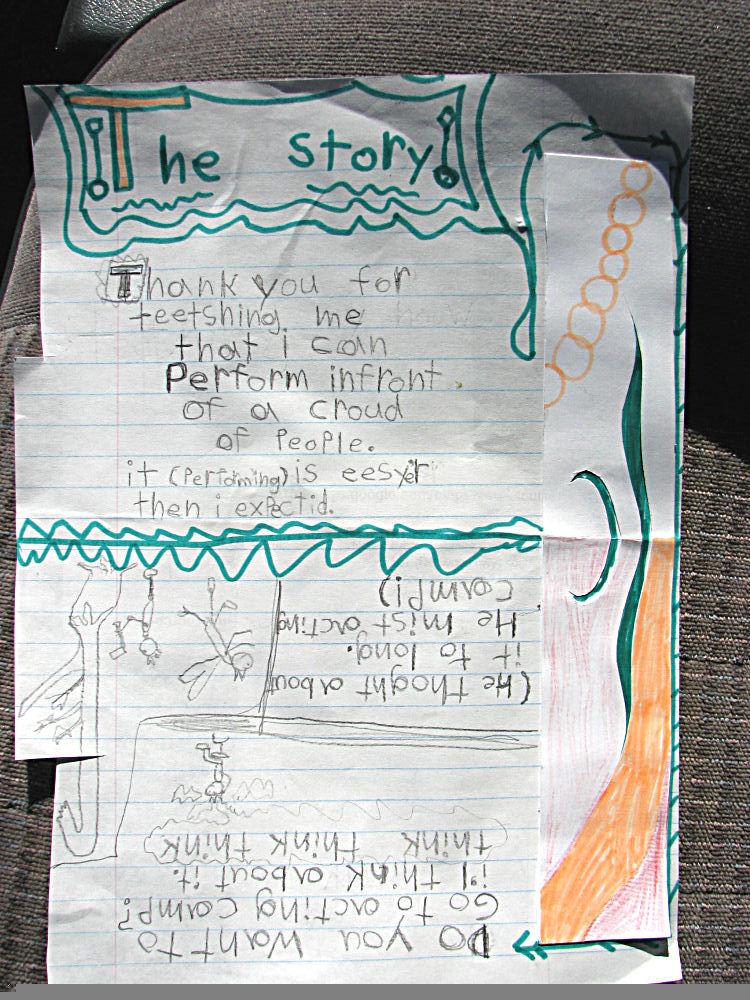
Taliesin's thank-you letter to Jack and Julie, after his first year at Tir-na-nOg.
That year Taliesin created a non-speaking role for himself, but then started taking on speaking parts, and eventually leading roles with many many lines, that he diligently practised, while also making himself costumes, often with friends who were also in the program. Taliesin went on to create YouTube videos about science topics he was interested in, as well as animations and comedy. He acted in various school plays, but his dream career is not theatre. That doesn't mean the gifts he got from Tir-na-nOg aren't still serving him.
In adulthood, Taliesin became a digital artist, building upon the creativity and confidence nurtured at Tir-na-nOg. And he also ended up working part-time for the H.R. MacMillan Space Centre, while he lived in Vancouver. He became that quintessential inspired science-show-guy, excitedly demonstrating rocket propulsion and other seeming miracles to a crowd of parents and kids! When I went to watch his show, I cried with joy. In the audience that day were a few children, and as he looked out into their eager and shy faces, I saw the same look in his eyes that I know from Jack. He saw them. I mean he really connected with those kids; took their questions at face value and, gently but enthusiastically, made his science show theirs. When he brought up a kid to help him demonstrate, that kid knew he was safe up there on the stage, which is a gift Tali got from Jack and Julie, and now passes on to younger children, as well.
So many of Tir-na-nOg's alumni are spreading Jack and Julie's gifts to the world. Some even still live on the island and are more directly still associated with the school.
Jack and Julie's gift may be spreading into the world, but the fate of the theatre school itself is now in jeopardy. Jack is undergoing treatment for aggressive prostate cancer, and Julie has been diagnosed with Alzheimer's. The fact that they managed to keep the school operating so long with their current troubles is a miracle, indeed, but now they need our help. Our community is fundraising to pay off their building loan, so that the dream of Tir-na-nOg can continue, without their constant personal involvement. Donations can be made at https://www.gofundme.com/f/support-jack-julie
And in our future, may we continue to see our children grow into their confidence. May we continue to see their dreams blossom, and Jack and Julie's gifts spill out into the bigger world. Maybe we continue to hum, as we walk along,
Close your eyes, follow me, come and see Close your eyes, follow me, come and see
Tripping a little over an unexpectedly-high tuft of moss on the log I was stepping over, I heard shouts from the children, up ahead, and looked up to walk smack into the dangling tips of a soft wet cedar bough. I brushed the water off my face as the shouts were joined by gasps of horror or awe, and then guttural, powerful noises, and a loud “YEAH!!” As a small arm jutted up above the ferns that still stood between me and the kids, holding a rather long piece of deer-spine, that then fell apart in mid air, dropping a piece of itself unceremoniously back to the forest floor. The kid holding it up looked a little disappointed, but continued smiling, as they and their classmates experienced what was, for some, the first sight of a nearly-complete deer skeleton.
Some of the kids gathered as many bones as they could carry; some fought for their perceived rights to the skull; the spine; those amazing paddle-like shoulder-blades that always seem to become useful tools in the hands of ten-year-olds accessing their powerful, primal nature. Some stood back looking alarmed, and one kid was wearing the pelvis as a hat. A wide-eyed girl ran up to me with a piece of the bottom jaw, pulling a tooth back and forth in its socket. “It comes out! Emily, the tooth comes out!” She exclaimed. “It comes out and it fits back in!” Was she amazed by the perfection of the way bones fit together, or by the access to an understanding of her own teeth; those things that had come out of her mouth with some celebration, and then grown there again, anew? Maybe she was just amazed at the tactile delight of it all.
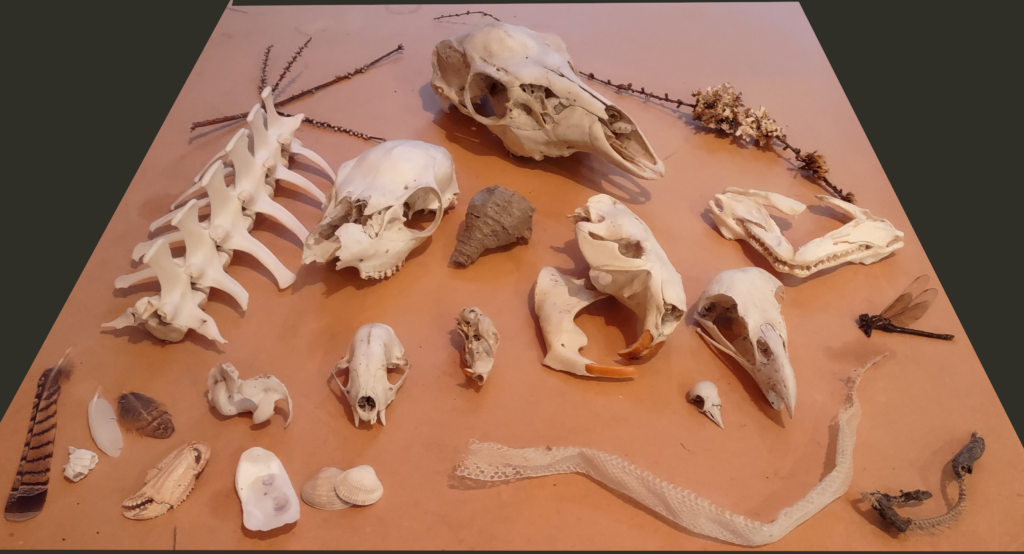
Tidying up today for this weekend's open studio, I dusted around my bone collection, as usual. There were a few dead flies on them, as well as a few spiderwebs, and thankfully not too much dust, because dusting feathers—and especially that desiccated dragonfly—is a pain! Every time I pick up the rat skull, one of its massively long curled incisors tumbles out and I have to slide it back into that channel that grew to fit it perfectly, when the rat was alive.
Most visitors to the studio just come to buy a painting and don’t even seem to notice the bones, but I want them to look clean, anyway, because there’s something kind of yucky about dusty bones that’s improved by being cleaned. And anyway, sometimes people do notice them, and ask about them. I'm always a little nervous to divulge that I actually almost never draw or paint from these. Some people assume I do, and I guess I might think the same of another artist; imagining her like Georgia O'Keeffe, describing all the beauty of these things in charcoal and paint. But no. They mean so much more to me than just a subject to make a picture of.
When I clean the bones, I’m reminded of their differences and similarities. I have a rat skull from the compost (caught by our cats and delivered there to decompose, by me) and a beaver skull that my brother found down by the creek. Both have those amazingly long, curled incisors. You can imagine how, as the rat chews away at the wood of the chicken coop, or the beaver gnaws the trees down by the creek, they’d wear them away and need that long reserve to keep growing in. It also reminds me why it’s so important to give pet rodents something to chew. Compare that to the teeth in my deer skulls that look more like barnacles; not meant for cutting through wood at all, but just gnawing on their tough fodder of grasses and my roses, if the gate is left open. If they fall out they take a while to regrow. Unlike shark teeth. The little baby hammerhead jaw my daughter’s friend brought from Mexico is a reminder that a shark can’t go long without its teeth, so it keeps an entire collection of them behind each pointy front tooth, just waiting to move up into place, when space is made. I’ve known some children who had what we called “shark teeth”—baby teeth that never fell out but just stayed there in front of their growing adult teeth. They feel to me a bit like backup-teeth. Not like the canines on that otter skull. They have no backups, waiting. I imagine if otters break a canine they’d suffer for a while. Maybe that’s why they’re so vicious. They can’t afford to lose a fight. The teeth of these skulls have such stories to tell, as much in the ways they’re similar to each other and to me, as in how different they are. Different lives; different needs; different priorities. But still with the same basic bodily needs.
You’d think there’d be few similarities between all these toothed animals and the bird skulls I have, or the barnacles and bivalves. But I see the similarities there, too. The beak of the eagle is in many ways a bit like its talons; you know how easily it would puncture and tear the body of that little flat-beaked songbird, holding one half under a talon and hooking the other half with its beak. The songbird’s skull is so light I can blow it off my hand by accident while trying to get the dust off. It’s made to fly. And that’s how it escapes the eagle.
The barnacle, of course, looks like a molar. Of course we know barnacles are filter-feeders, reaching out their elegant and feathery feeding legs to catch floating foods under the waves, but then why are they shaped like teeth? If you’ve ever stepped on one in bare feet you’ll know why. It’s protection. Same with a shark, or an otter. One of the ways human children defend themselves is by biting. That’s what teeth are for, too! And the bivalves. Nothing about them can be considered tooth-like, it seems, until you remember that there are razor clams. You don’t want to step on those, either! And sometimes, on shells, I find the little curved bits at the edge and remember that that’s where the clam’s mouth comes out to feed, or sometimes its foot. Because clams walk through sand. And fast, too, as you know if you’ve ever tried to dig for one.
I look at all these bones and other body parts, and I feel connected to the world. I feel joyful that in our great diversity, we’re still all related; that our bodies have evolved to succeed in diversity and community. In this collection I also have lichens that remind me of our strength in living collectively with other species; I have conifer "berries" (not actually berries; I don't know what they are) that usually grow unnoticed in the tops of enormous trees, but which I collected off the ground. They remind me that there are beautiful processes we hardly notice for their being out of our usual sight, until a storm comes and knocks us all sideways, and we see things differently. I remember that all change is growth; even death. I remember that there is joy in just the smooth feeling of these bones; their lightness and their heaviness, the things I understand about them and the things that are mysterious to me. I remember the delight that I or others had in finding them, and I feel the sorrow that these lives ended, and the comfort of knowing our commonalities; the aliveness of just knowing we exist. I think of these things and I remember that everything is beautiful.
Dear Little Emily is a series of letters to my childhood self, exploring loss, love, and personal growth.
~*~
Dear little Emily, Do you remember Mum’s friend Katie? I mean, of course not, because we weren’t born yet. But I know Mum told you, with a sparkle in her eyes. When Mum was a girl, and lived in Mill Valley, Katie’s mother used to take her temperature every morning before school, in the little cookie-cutter house that was just like Mum’s, and sometimes Katie would bite the thermometer in half, and pour out the silver-heavy drop of mercury into her hand, and carry it out to play with. Mum and Katie delighted at the way the mercury rolled over their hands; wondered at the pure and clandestine droplet of magic. Funny to think that it was poison, when everything about it was so curative—the thermometer, the naughtiness, and the friendship.
I was thinking of this while taking my temperature, today; looking for the fine line of silver on the old thermometer that has survived for decades while countless surely-better digital thermometers died and went to plastic heaven. Like Mum. Is there a heaven for children who grew up to have their own children, and worked their lives away, and then retired and died of brain tumours, cut just under their white and beautiful hair, just as we expected them to finally start living? Is there a heaven for children who treasured and understood the joy of play so well that they grew up to teach and care for children all their lives; to learn and practise and master the art of growing through play? Children who played with mercury? Like Mum?
Little Mum sat in her classroom after she’d moved north from Mill Valley, and stared out the window at the first snowflakes she’d ever seen. Her teacher rapped the back of her hand with a ruler, to punish her for not paying attention. Mum grew up to have her children in Canada, where she delighted in the snow falling, and rolling and jumping and sledding in it, and in skating on the frozen lakes. She took you and little Adrian out to play not only in the snow, but the waves and the forests and the fields of most beautiful grasses and flowers and insects. She married a man who brought you gifts of found animals—almost-pets that you could never keep but who opened your hearts to a sense of wonder. You and Adrian will both become teachers. You and Adrian will never stop playing, even though the constraints of our worker-hungry world will try to make you.
Right now, little me, you’re ten; maybe eleven. You think Mum’s harsh because she says you really do have to learn the long division, even though it’s obviously stupid. Like a game of numbers that has no purpose but to prove your insufficiency. Like the barely-visible stripe on the thermometer: Always insufficient. Always too low to mean staying home from school. There is no such thing as a proficient thermometer.
Mum says babies are born proficient. They can breathe, and pee and poop, and they take only a day or so to learn how to nurse; no time at all to learn to cry, to tell us they need us. They need our love. And in that warm circle of our love, they grow. By the time they’re a month old, they’re proficient at so many things, from telling us when they need a diaper change, to when they’ve had enough milk, to using their ears and eyes and fingers and tongues to explore their growing world. And as soon as we notice these proficiencies, we try to control them.
By the time they’re a few months old, babies have learned to navigate our systems and controls; to cry only enough to get what they need, even if love is not available; to make do in a world that is ever-more restrictive. They’ve learned to grow despite the challenges we present. And by the time they’re half-grown, like you are, now, my little old self, they’ve learned to hide their true selves away: to master the art of appearing-to-be-doing-something, while growing in secret; breaking the thermometer to go do science at the back fence on the way to school. By the time they’re twenty, they’ve come to recognize the restrictions were for their safety, and by the time they’re thirty-five, like Mum is now, in your world, little Emily, they’ve learned to tell their children to finish their long division homework. Even if they wish they didn’t have to.
I’m almost fifty, now, little Em. I took my temperature, today, because I have Long Covid, and I get a fever from over-exerting myself, like I did today, by visiting with my Aunties. I wanted to break the thermometer, but I guess I was never as brave as Katie from Mill Valley in Mum’s childhood. I’d be so angry if my own children behaved so recklessly. What have we done? What have we done to ourselves, and our children, and our future?
Not wanting to be the parent our mother was, but inspired by her knowledge about child development, and by my own teaching experience, I ended up unschooling our children; Mum’s grandchildren. Much to her initial concern, but I did it anyway. I explained that it was like taking the premise of her child-centred preschool and expanding it to the whole life of the child: To present and encourage opportunities for growth, and to always support the children in their endeavours, while being a bit of a safety-net, on the other side.
One day, before Mum’s dead, you will show your children the game of long division. You’ll sit them at the dining-room table, your eyes full of excitement, and show them how the numbers fall into place like satisfying blocks tumbling into their designated holes in the block-sorting-box. Your daughter will expand the game into a mind-bending board-game, and your son will revolt, but then go on to take a calculus course at a local college, in his teens. For fun. We can’t always know how a child will experience wonder, but we can make space for it.
The unschooling “worked”, you might say. Your one-day kids are grown, now, and living independently; supporting themselves with varying degrees of financial security. And they’re happy. They live their lives in the world I failed to change, but somehow they are the change. I never gave them a mercury thermometer in their lives, because I was afraid they’d break it for fun, and maybe poison themselves.
Little Emily, I’m sorry you have to do your long division. I’m sorry you also never were left with a fun little stick of mercury to break out and roll around in your palm. But you had salamanders and frog’s eggs. You had trees to climb at lunch hour. You had a mother who took snow days very seriously, as she did “town days”, which meant getting out of school and going for adventures in town. And she won’t flinch much, when you tell her her grandchildren are leaving her preschool not to go to school, at all. She’ll cringe and fight it just a little before she, like all humans do, grows from the experience. She’ll sometimes take them for town days, too. And give them silly putty to play with, even when they’re ten or eleven, and listening to music that horrifies her. She knows what matters to them, as it does to all people growing. Even to aging preschool teachers who are about to die of brain cancer, and just don’t know it yet.
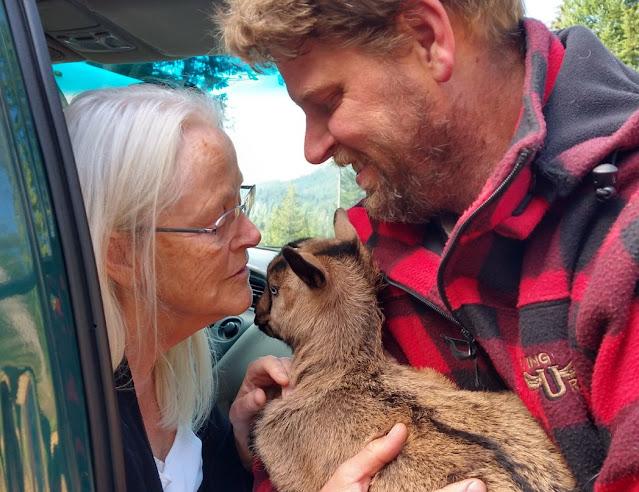
What matters is nurturing growth. Play. Discovery. Mum never lost the ability to wonder; to make space in her own life for joy. Just before she died, last year, her movements and language oppressed by the tumour’s growth in her left parietal lobe, her heart broken by the grief of saying goodbye, Mum went to visit Adrian’s new baby goats. The last trip she made outside of her house in this life was to look lovingly into the eyes of these babies as she did thousands of times in her life, with baby humans. She couldn’t speak anymore, but her eyes tell me she saw those babies’ potential. She saw their little growing selves and all the dreams they didn’t yet know they were going to dream.
Wonder. Mum didn’t look at them to see their sense of wonder, but I know that seeing the wonder in those babies’ eyes connected her to her own. The wonder we allow children to experience is what can sustain them through a lifetime of having to make do in a world that is never ideal. Wonder gives them a space to discover, learn, and grow. And in the end, when their lives are coming to an end, it gives them joy.
After Mum died, I dreamed I was holding her on my hip, and turning around in our yard, as she pointed wordlessly to the sparkling needles on the trees, the flock of singing birds flying by, and then the bulbs coming out of the snow and blooming. We turned further and she pointed at the veggie seedlings on the black earth, and the worms and beetles and pupae in the ground, bustling about their lives. We looked up, and she pointed at the sky, which had become a prismatic dome of light, shining above us, in a perfect white that somehow let its rainbow self show at all the edges. A matrix of wonder.
Little Emily, our mother was a conduit of wonder. She knew what children and all people need for growth, and she did her best to give you that gift.
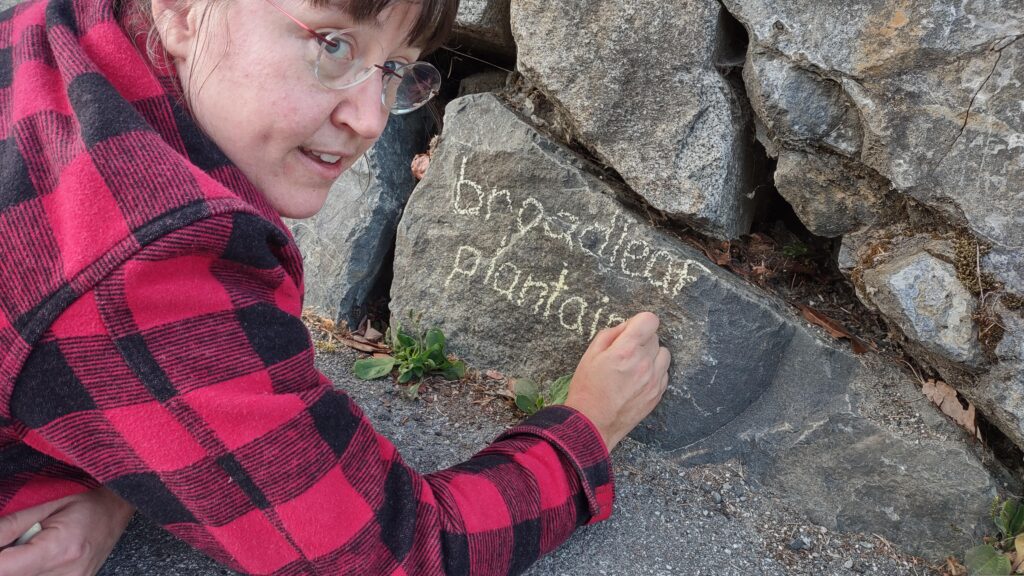
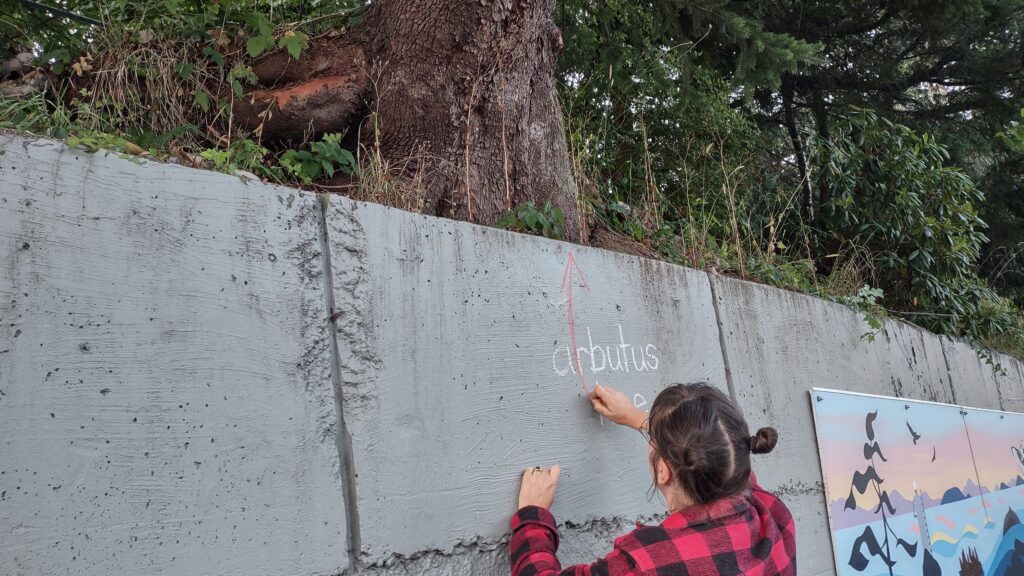
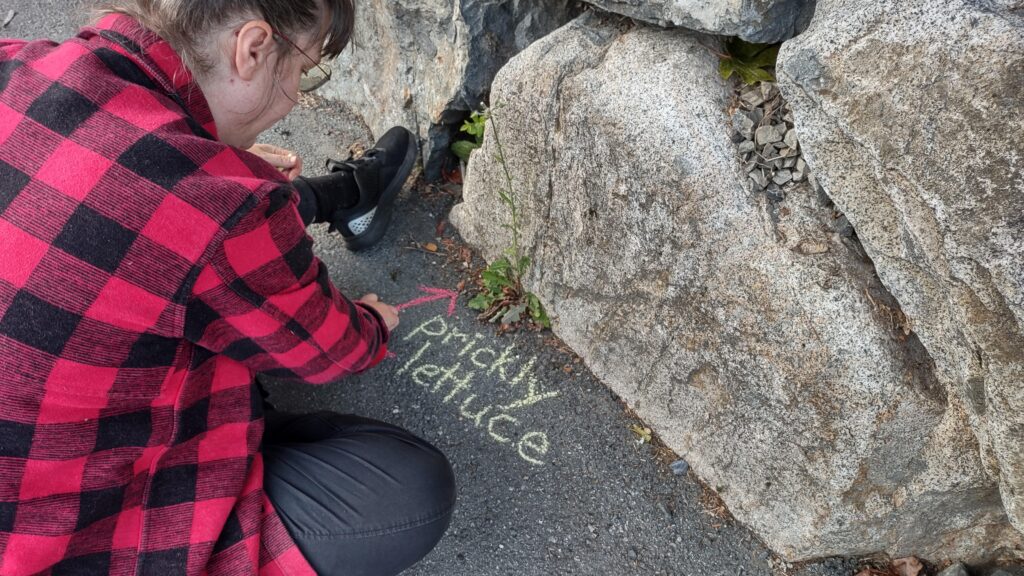
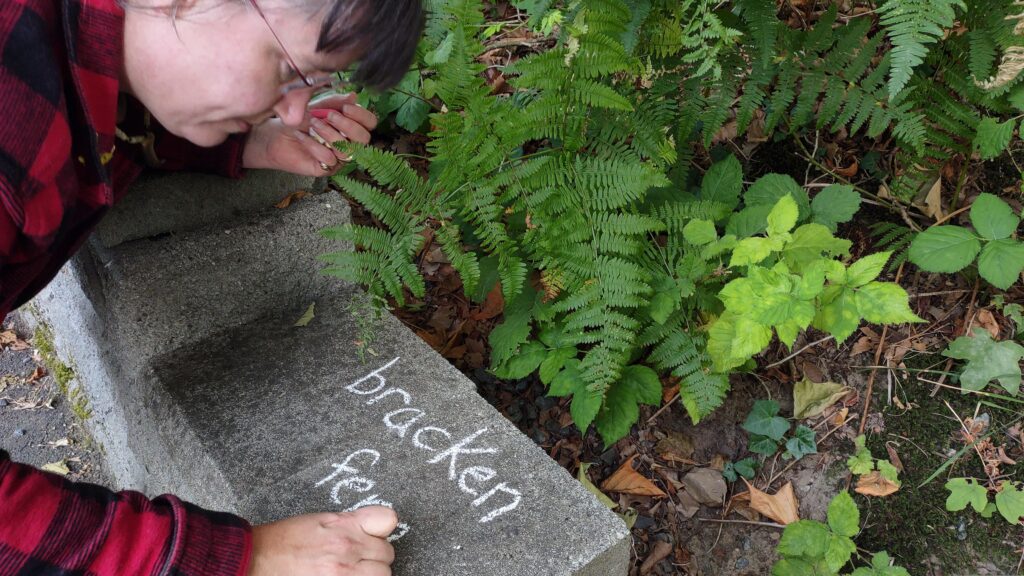
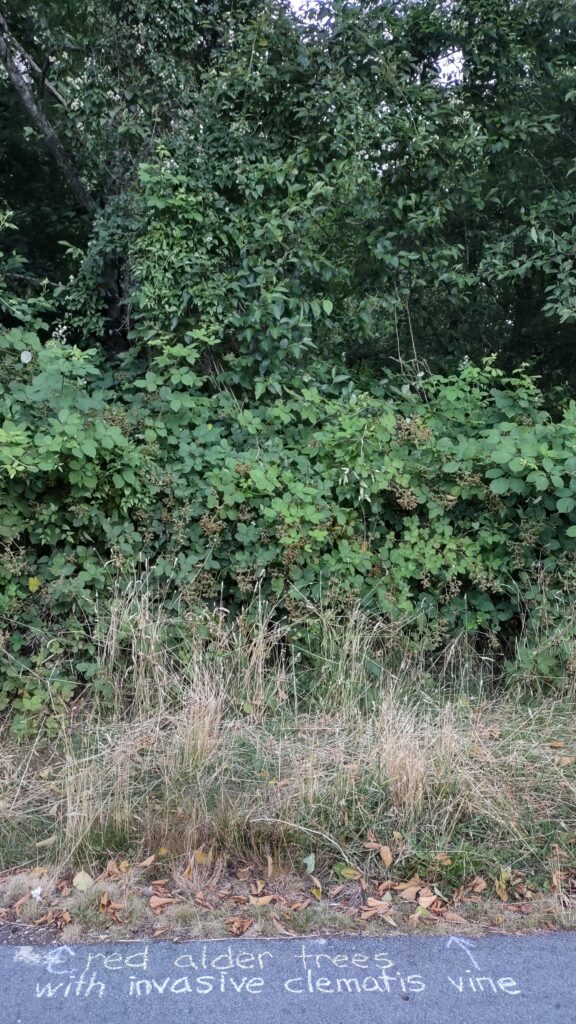
This has become one of my favourite things to do. Every year I go out and label the weeds and trees in the place with the highest foot-traffic on our island.
I hope people see these and begin to notice a bit of the world around them in ways they may not have, before. I hope people also go home and find the same weeds, there. Sure, it's the simplest kind of art.
I'm just chalking rocks, walls, and sidewalks with plant names! But I really feel it might be one of the most impactful works I've done.
And yes, if you're wondering, I do have municipal permission to do this! So the credit for this also goes to open-minded officials and other citizens who can appreciate the benefits of art and education in our communities. 🙂
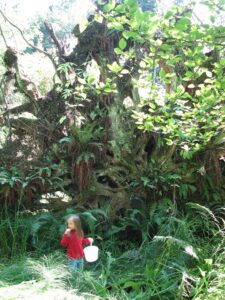
Taliesin picking berries in front of a root tower.
Once I lost my son in the forest. We were heading home through ferns taller than his three-year-old self, he carrying a harvest of licorice ferns and I carrying his baby sister and some oyster mushrooms. He followed along behind me, and when I turned around, he was gone. I called repeatedly. I retraced my steps. I gripped by baby girl to my chest and started running, panicking, and– there he was, nestled into a sword fern, chewing on a piece of licorice fern root. He looked up blandly at my stricken face and said "I'm just havin' some licorice root." His trance-like state may have been induced by the well-known calming medicine of licorice fern, or it may have been just his joyful state of mind after a couple of hours spent wandering the forest with his mother and sister.
My kids and I spent part of most days of their childhood out in the forest, exploring. That's what I did as a mother because it's what I knew to do from my own childhood, spent here in this same little west coast paradise. When my head hurts, I go outside. Maybe I chew an alder leaf like the wild aspirin that it is; maybe I just lift my face to the fresh air, sun or rain. When my heart hurts, I lie in the moss and let it soak up my tears. Licorice fern soothes me; so does the feeling of bark, or the creek water between my toes. When I'm hungry, I eat beans off the vine on my porch, or berries and other treats from the woods; when I'm hungry for adventure I go exploring in my medicine forest. I made up that word. Medicine Forest. It's like a permaculture food forest, but with emphasis on its healing power. My parents didn't purposely give me a medicine forest, but they did give it to me, and I'm passing it on to my children. Let me explain.
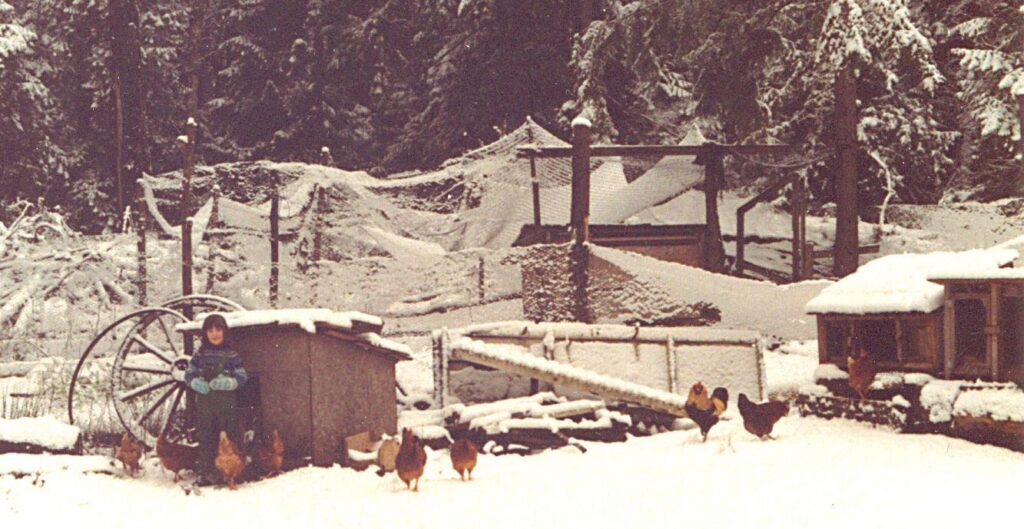
That's me with our chickens in the early 1980's, rabbit hutches on the right, and winter-covered veggie garden, behind.
I grew up in a pretty typical single family house – a modified double-wide mobile home, actually – on a five-acre piece of land that my parents purchased in 1980. This land was forest when they bought it. We used to come up here and have a picnic on the slope they hoped would one day be their building site. They let my brother and me free-range all over this place, climbing trees, damming creeks, digging great big holes and picking and using whatever plants we felt like, as they slowly cleared the land and built up what is now a developed property. We raised chickens, meat rabbits, and pigs (but only once because the experience was too heartbreaking for all of us to repeat). My parents grew food crops and allowed us to plant our own experimental gardens, while also insisting that we should help with the family food operations. My brother and I were never forced to kill or butcher animals, but because our parents nurtured our curiosity, we both knew how to clean a rabbit or chicken by the time we were twelve, and by the time we were fifteen we could cook a good family meal from the foods we'd grown or wildcrafted. We didn't even know the word wildcraft, though. We were just "picking nettles", or "finding a mushroom."
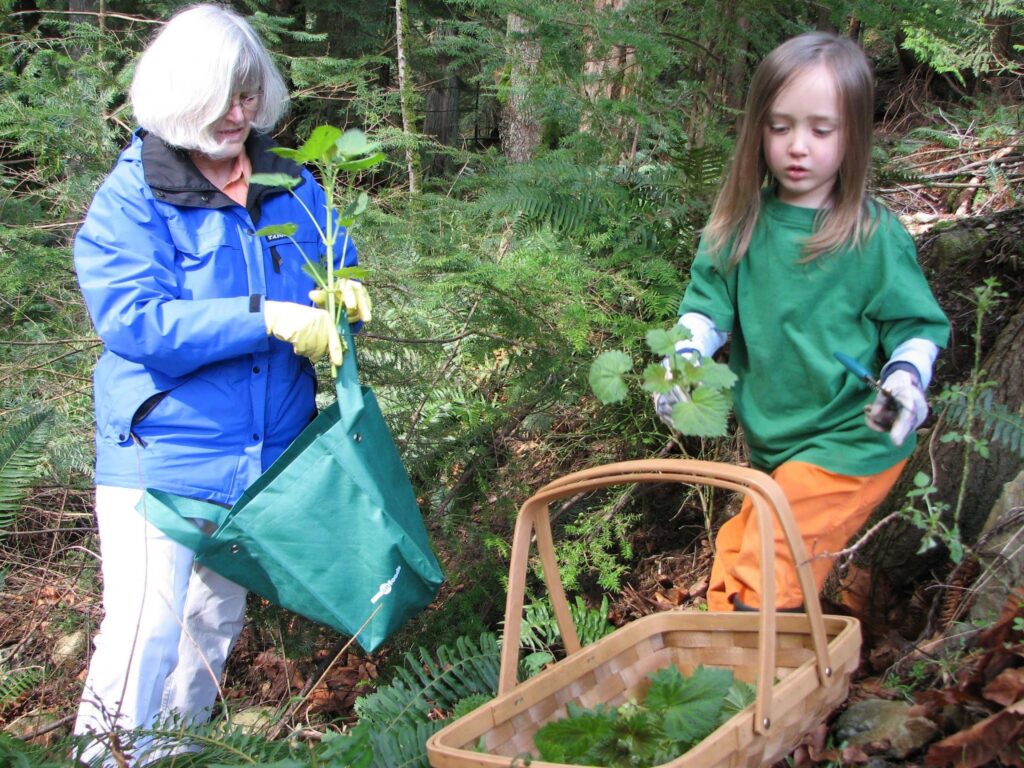
My son helping my mother pick nettles in the late 2000's.
Living in and with the forest our parents were busy turning into a home was just "life". We could pick indigenous trailing blackberries from the hillside, invasive Himalayan blackberries from the place Pappa was trying to get them out of the creek, or cultivated boysenberries from Mum's garden. Same difference. They all make good pie, if you don't eat them all before getting them home. And whether they make it home or not, your belly is full with the food, your heart is full of the joy, and your mind is full of knowing every detail of your home. That's a medicine forest. It's a place where everything is living and growing together — humans included. It's a place you've grown so connected to that just living there heals you from the inside out.
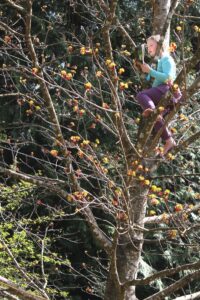
My daughter reading in a tree she knows every inch of.
Somehow through my own teaching and parenting over the years I have come to recognize that, just like the best learning happens when we're inspired by connections to our own experience, the best living happens when we're connected to everything around us. Think of it this way: you care much more about your own backyard than someone else's. You have a lot more interest in your own little potted plant than in the weed at the edge of the pavement, or some tree in a forest far away. So somebody teaching you about a baobab tree might have a bit of a tough job keeping your interest. But what if that tree was yours? My friend went to Africa and really got to know baobab trees – and they became hers. When we connect personally with things, they matter, and mattering strengthens our neural pathways. That's great for learning, but how does this have to do with my medicine forest? Well, this place matters to me. It matters so much that I've spent about thirty years of my life exploring here, both as a child and now with my own now-grown children. I know exactly which part of which slope of which creek has the best clay for sculpting, and which part will still have a pool of water and some desperately-hungry trout in August. I know where the elusive white slugs live. I know how berries' flavours change with the weather and with the time of day. This deep understanding of my little wilderness is my connection, and it's why this place is my medicine.
On top of being important to my own health, my experience of exploring this place has made me resourceful and resilient. We all learn more from observing the people around us than from being taught conventionally, and I learned from watching my parents develop this land; their need to be resourceful when we had no electricity, no toilet, or no income. I learned from watching them not just survive here, but keep working even in the face of failure to find joy and wellness in whatever this land and life had to offer. The moss is not my weeping pillow because I'm an idyllic child from a book about fairies; it's my pillow because sometimes I was just plain too sad, as a child, and the moss was what I found to comfort me. My kids didn't harvest nettles for brownie points or allowance; they donned gloves and harvested them just because that's what we do for Easter. They got stung and they complained to me, but they also delighted in testing their brawn by picking them bare-fingered or by eating them raw. They were building resilience, just like I once did. This year they both came home for Easter and actually wanted to go nettle picking. They want to reconnect to and eat food from their own ecology. We're in this ecosystem for better and worse and every day that falls in between. Like the plants, we'll thrive or die as part of this, so we're doing our best to thrive.
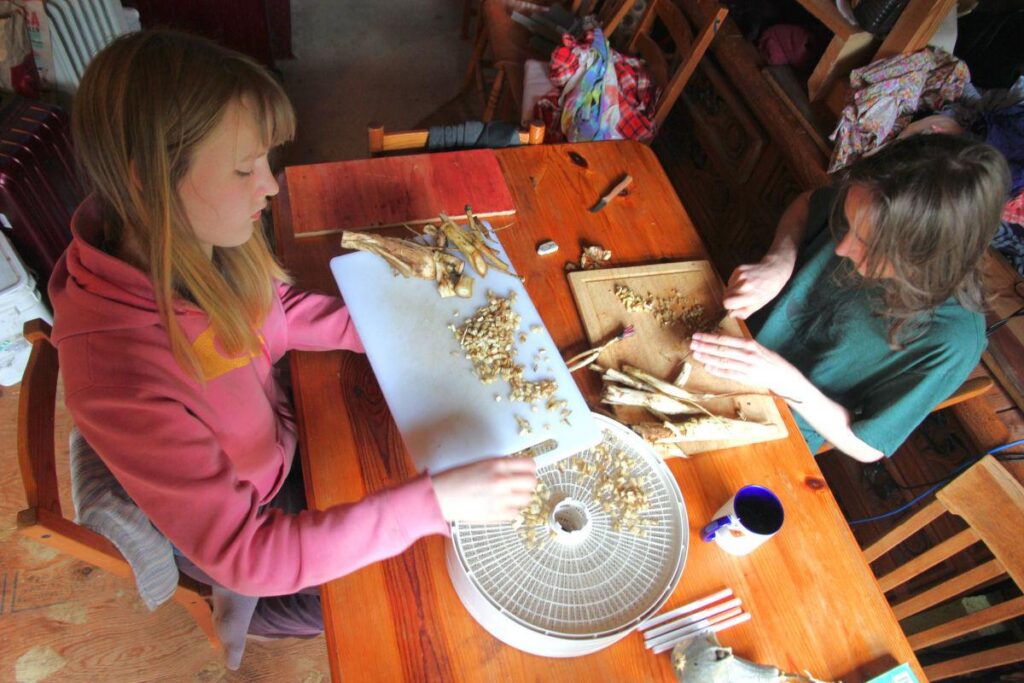
My kids at fifteen and eighteen processing wild burdock root for tea.
The business of gardening and developing the physical ecosystem is nowhere near as idyllic as I imagine it sounds. There are brutal realities in nature that hurt like hell. Our crops fail, our chickens get sick and I have to put them down; sometimes we fight and resent each other's impact in the ecosystem. Sometimes money is short, time runs out, and family or world tragedy makes us doubt we can succeed. But experiencing these things, feeling them and accepting them is part of the whole picture. My medicine forest is the ecological basket that holds our family, and the love and knowledge we cultivate here, among the weeds and the crops and the chickens, the weather and the water and our own bodies living. When I leave this place, my medicine forest is carried in the knowledge of my body and mind, to nourish and grow with other ecosystems. It's a conscious choice I make to see my surroundings and live in health with them, as a part of them.
In a monoculture garden, one invasion of a particularly voracious insect can wipe out a whole crop, with nothing remaining to re-seed. The earth itself becomes a barren place, unable to nurture new-fallen seeds without significant help from humans. In a food forest, insects may devour a plant here or there, but the diversity of the community will discourage any one plant or insect from taking over, and thus ensure that enough remains to keep the community thriving. The dead plants along with the dead insects and the droppings of all those who foraged in the forest will feed the earth, ensuring that all the fallen seeds have at least a chance to grow. In fact, the richness of the soil even means the earth will hold more water, making everything thrive more easily.
My parents have asked me how I came to know all these things, and I said "from you", because it was their willingness to let me explore that gave me the gift of knowing my ecosystem. It was their willingness to let me grow my own experimental gardens, and now to rent us a piece of their land and still let me grow my own experimental gardens that gave me the gift of my medicine forest. Sometimes they don't like the look of my unkempt yard, my son's experimental tree fort project, or the weed piles I leave laying around. But they let me and their grandchildren keep living and exploring here, because they're watching the growth of our medicine forest. And sometimes – just once in a long while – we discover things we can teach them, too. Explorative parenting is like that. It's looking at the whole family as a forest instead of one plant seeding another. Our family is like a forest of possibility, where everybody lives in community, exploring and discovering and balancing and sharing, as we all put our roots further and further down, and our branches further and further to the sky.
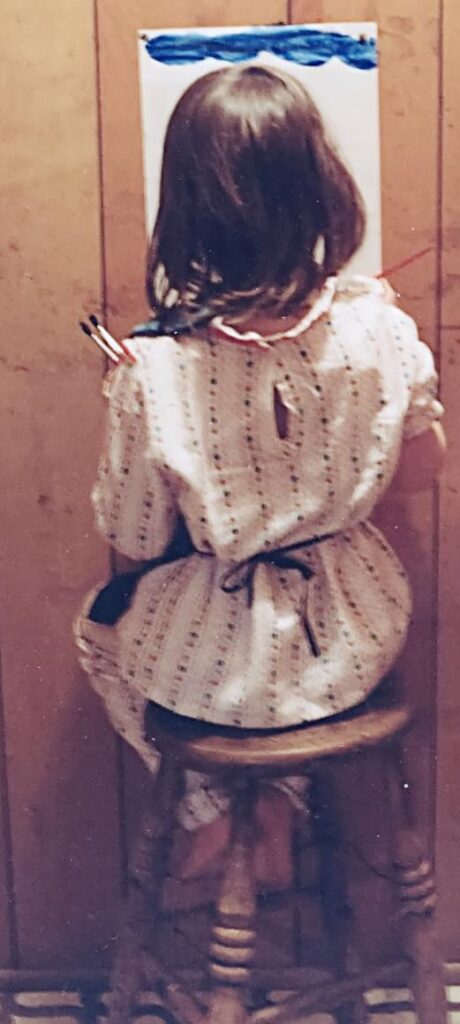
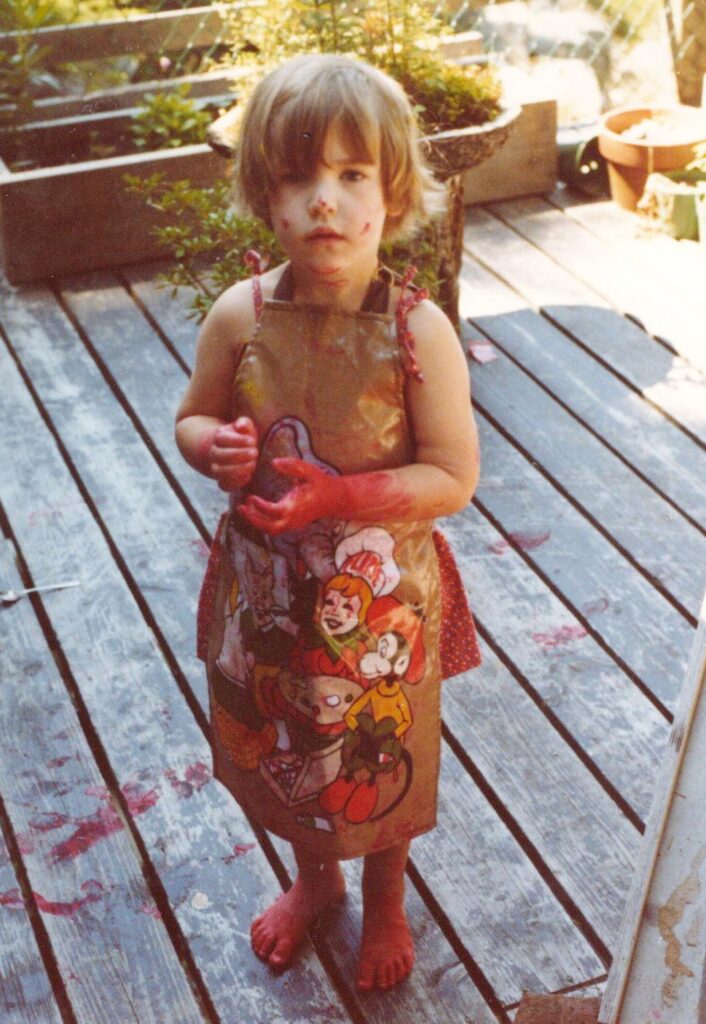
When I was a kid, I wanted to be an artist. Or a botanist, or a hair-dresser. My parents and grandparents gave me wonderful art supplies, and my father even made me a palette with a hole in it for my thumb, and positioned the kitchen stool in front of the wall of our trailer for me to use as a painting stool. That’s me in the photo, in the early nineteen-eighties, feeling wonderful and accomplished, but with absolutely no idea of what it meant to “be an artist”.
So What, Exactly, Is an Artist?
I'm an artist, now. Twenty-five years and two kids after I got my degree in visual arts, my career is built on helping people reach beyond societal expectations to un-silence themselves, and connect genuinely with the world we inhabit. I do paint, and I do have gallery exhibitions, but I also tromp in the forests, use materials I never imagined would one day be called “materials”, and make art I never imagined would be called “art.” The focus of my work is to connect people with our own deeply-held stories; as an explorative learning consultant I also encourage parents and teachers to do the same with their children. It turns out art was just a vehicle for something more important to me. And I’m still an artist.
The stereotype of the famous artist making masterpieces in his (he's almost always male, white and powerful) studio has almost nothing to do with a successful art career. I wish somebody had explained this to me when I was a kid. Picasso was an abusive, deceitful creep, and we don't have to appreciate his work to be artists. There’s SO much more wonderfulness in being an artist than I had imagined! So much more diversity!
Artists are responsible for not only the beauty we see in our human-made world, but also for the connection we make with neighbours, for the realizations we make about our own lives and feelings when we watch movies, listen to music, or read books. Artists determine how easy it is to use the devices we buy. Through media, artists determine which devices and foods and colours will be more popular. They understand the influence of shapes, colours, sound, movement and texture on our emotions, and… like it or not, our emotions govern much of what we do. Artists are powerful. A “career in the arts” is a massively open-ended term, but also, having a grounding in artistic practice and theory means a deeper foundation or influence in any career we choose. Moreover, having the ability to express ourselves is an important foundation of meaningful connection.
I like to imagine a world full of people who were encouraged in this way. How happy, satisfied, and valuable could we all be? How would our chosen paths be enhanced by a facility with self-expression and material, sound, or movement exploration? Do you really want your kid to be an artist? And if so, how can you support them?
What NOT to do: Unsolicited "Help"
It's incredibly easy to break kids' confidence in art (or anything) and less easy to build it. As with so much in life, the first thing we can do to "help" our kids succeed is to get out of their way. It's not easy, especially when we're watching them struggle with something we know there's an easy solution for. But we zip our mouths, find something else to occupy our attention, and trust that they'll get where they need to go. And never, ever critique.
Criticism is more likely to break our confidence than to teach us something, and a shattered confidence is a massive barrier to success. My daughter is a writer, and was recently working on her second novel. I edited her first novel for her, judiciously reporting back on only glaring typos and missing punctuation. It was an amazing realistic fiction coming-of-age story, written from the bold heart of a young girl whose grandfather had recently died. I love it so much I heartily recommend it to readers of all ages. Her next novel, though, was a departure from the world she knew and understood so well, and required a steep learning curve. It was an epic fantasy, full of people from different cultures and a massively complex magical world… all of which she dutifully researched and developed before writing. But then she was challenged by trying to fit this enormous complexity into a single story. And when it came time for me to edit her book, I didn't hold back with the criticisms and suggestions. Some chapters were confusing, some events seemed out of place, and mostly I was confused by the timeline. Sure, she was only fourteen, but I just knew she was capable, so I critiqued! Despite my attempts at being gentle with my criticism, it all seemed insurmountable to her, and after a few attempts at editing, she abandoned the book. To her credit, she's keeping an open mind about the possibility of writing it in the future, but unfortunately I feel I threw a hammer at a beautiful glass sculpture she was creating, that actually she just needed more time with, alone. Without my critiquing.
So that's how not to build confidence. Just think of all the ways we're doing that, in every part of our kids' lives, and even our own. So many of us have an overachieving inner critic. And a culturally-supported fear that that critic is what's keeping us on the straight-and-narrow. But you know what? It's not. What would happen if we just didn't correct our kids? Well I have some experience with that, now, both in teaching and parenting. It's ridiculously hard to shut up my inner critic sometimes, but when I do, the kids thrive.
My daughter is truly an excellent writer–so much so, that in her frantic enthusiasm she charges ahead, forgetting to put periods at the ends of sentences, capitals on names, or sometimes misspelling words. She edits herself, and (as we all are prone to doing) sees right through her mistakes to read what she intended to write. What if she asks me to edit and I just ignore those mistakes? I've experimented with that. Sometimes she looks over her work later and discovers her mistakes. Sometimes she puts it aside for a few months, grows and learns, and comes back to it to realize she would now write it differently. Sometimes, even, she submits or publishes something with mistakes. And you know what? That's just fine! I frequently go back to my own work from years earlier, and see how much I've learned and grown since my thirties–and yet my work was appreciated then, as well. Have you any idea how many typos I still find in my writing? Tons. I'm especially accomplished at missing words and totally redundant examples. Sometimes I don't even bother to correct them. Because they're part of my humanity. Our kids deserve that space to be human, too.
Honouring Growth
As a visual artist, I love to look back and see all my mistakes. I look at portraits I painted years ago, and wonder why I did them the way I did; sometimes I also notice things I thought were problems at the time, that now inform new directions in my work. Growth is where it's at, people! Otherwise what are we living for? In some deep place, children know this, as from the moment they're born they challenge themselves to grow by exploring different tastes, movements, and expressions.
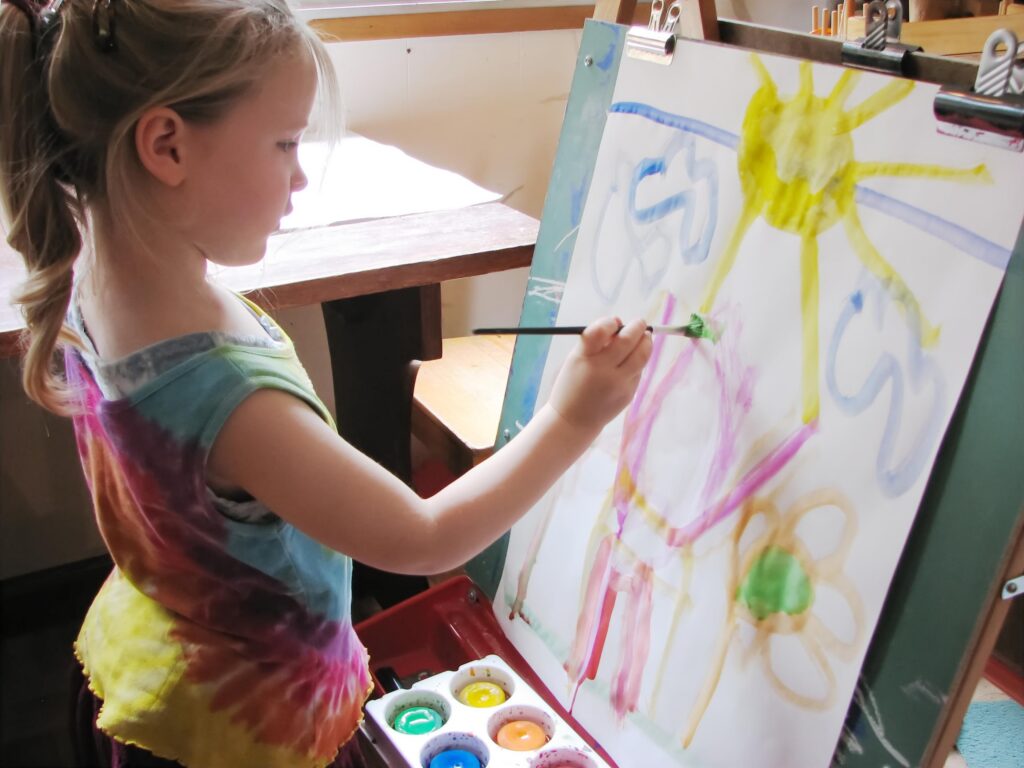
Rhiannon, age 5, experimenting with paints.
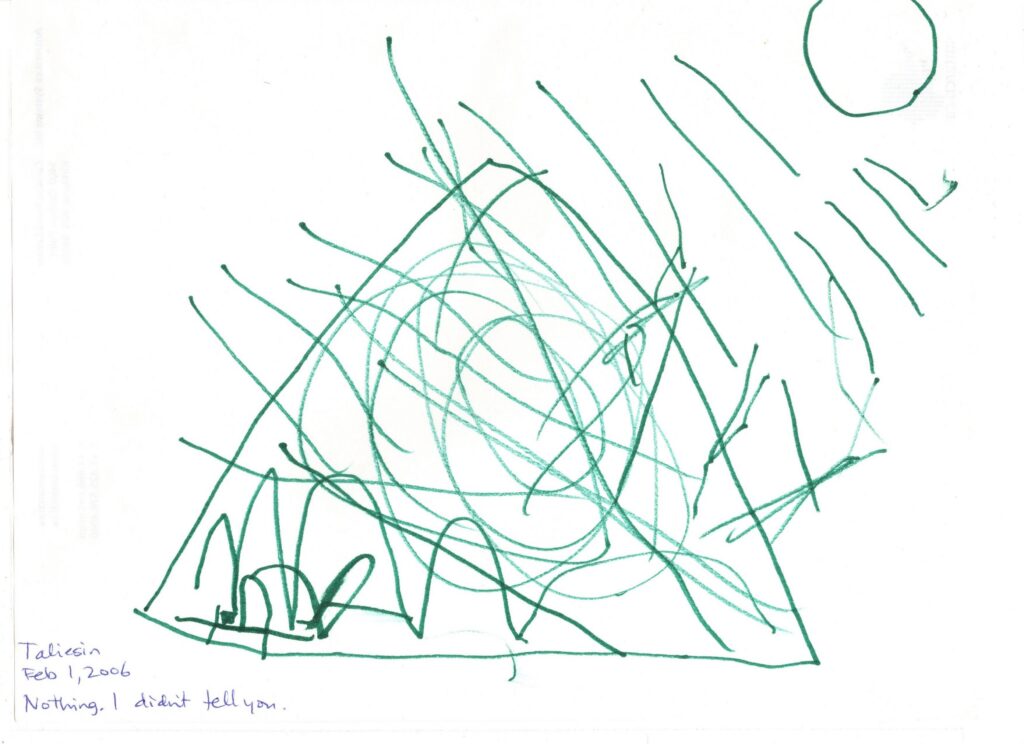
Children, like my daughter in the photo, above, want to represent their world. But it isn't always as we might expect! As parents, we have a choice about whether to show our children how to draw things the way we think it should be done, or to allow them to discover their own ways, through experimentation. My son was once drawing a whole page full of lines, and I asked him what he was drawing (something I've since learned not to do), and he told me it was a drum. I was totally perplexed, and asked him where the parts of the drum were. This was a boy who had no problem drawing a circle–why would he choose to represent a drum with a whole lot of unconnected lines? "It's the sound of the drum." He said. Boom.
He didn't need my assumptions. He needed my appreciation, and the freedom to keep exploring. As long as we respond to our kids' experiments with curiosity and loving encouragement, they'll continue to know that where they are on their journey of growth is perfect. And that will be the impetus they need to keep growing with enthusiasm. I have no idea how my son's drawings of sound influenced his life, but considering he now is employed as a visual artist and makes music to accompany his personal visual projects, I'm relieved I didn't get in the way of that particular growth pattern by showing him "how to draw a drum."
Asking Helpful Questions
I realized during my children's earliest years that questions like "what are you drawing?" are extremely limiting. In that question I have determined that my child must be trying to represent a specific thing, and the assumption is usually that it's a visual representation of something we know. But what if it's not? What if it's our children's experimentation with colours, shapes or lines? Or sound, as in the drum example? That kind of experimentation–without intent to satisfy outside demands–is essential for learning to use materials. Professional artists actually bill for material experimentation; it's called "research". We even sometimes mount gallery exhibitions composed entirely of experimental output–often to great acclaim. So why would I limit the possibilities of my own child's artistic output?
But we want to ask questions! We know it's important to engage and encourage! So how can we ask questions that promote growth-dialogue about art (or anything), without limiting our children's growth or expression?
Think about the words in the question "What are you drawing?" The word 'what' carries the assumption they're trying to represent an object. The word 'drawing' means we assume they're focused on the output of the material in their hands, as opposed to the feeling, taste, smell, or movement of it. How are these assumptions limiting the range of acceptable answers?
Drawing by Taliesin, age 3.
Maybe we have a kid who is happy to contradict us, and says, "I'm not drawing anything. I'm dancing the pen," or, as in my son’s drawing, above, “Nothing. I didn’t tell you.” (I learned a lot about parenting from that bold rejection.) But more likely, our kid wants to please us; to learn from our example, and will find a suitable answer, like, "some lines," or as my daughter used to do, look at a bunch of lines she was experimenting with and come up with a wild explanation like, "it's a dog on a house with the family having dinner." It's tragically very common that kids learn to minimize themselves to match what they perceive coming from adults. I've seen plenty of kids who were making successful attempts at depicting what might have been people or animals declare that they were “just scribbling.” Why? Because maybe they feared hearing our criticisms, or maybe we've previously defined their drawings of animals as 'scribbling', or maybe, because their own inner critic is already developed enough to silence their voice.
Adults are notoriously bad at asking kids questions, and kids generally have rote answers ready to respond to each of them: How old are you? How is school? What are you making? What is your favourite colour/subject/sport/etc.? How are we so uninspired?! These questions aren't about engaging with kids or developing rapport; they're expected. What if, instead of asking what they're drawing, we invite them to tell about what they're doing? This is an open invitation to consider what they're doing and talk about it. It's up to us to be open to hearing their response, no matter how long, unexpected, or confusing it may be. Not all questions will be helpful for all kids in all situations, but through practice we can become better at asking good questions. Here's a list of interesting open-ended questions to use in engaging kids to talk about their art:
Interesting! Can you tell me about this?
Does this have a story or feeling?
How do you feel about what you're doing?
Show me how you like to use [material]…
What do you think about the materials you're using?
Are there any other materials you'd like to use?
Materials
Ah how I love shopping for materials!! And hoarding them!! Don't we all?! How much of our parenting waste is comprised of once-used adorable kits that were soon replaced by something newer and more exciting? I won't go on at length about this, because I've previously written a whole article about Supplies and Practice of Open-Ended Art Exploration. But suffice it to say that well-chosen art materials are the foundation of good artistic experience. And I don't mean the expensive stuff. I mean well-chosen. Materials can be anything from kitchen supplies to mud and sticks outside, to a mish-mash of mark-making, gluing, cutting and melting tools. The important feature of all of these things is that they do not come with instructions or intended uses. How we present and use materials is much more important than what they are.
Modelling
From the moment they were born, and possibly earlier, our kids have looked to us to lead them. The important thing to remember about modelling to our children is that it's happening all the time; not just when we do it intentionally. Our kids see our hesitation and fear with art as much as they see our enthusiasm. They see us avoid trying new things, and they see us when we courageously do them, and when we have small successes and failures. They emulate not only our actions but also the way we emotionally deal with these things.
With this in mind, the absolute best thing we can do for our children is to use any and all materials available to us to explore creatively, for our own happiness. That last bit is important. Kids can smell a fraud from a mile away, so we have to be creative in the way that we want to be. Otherwise we're just teaching our kids to put on a show for someone else's benefit, and that's nothing about authenticity.
And we should stretch ourselves. If we're accustomed to buying craft kits and following the instructions, we should absolutely try to break that habit (more on why in the materials article, above) and try experimenting with new materials. We can also stretch our definition of art-making. Try experimental baking! Try sewing or crocheting! Try putting on your favourite music, getting dressed up in fancy dress or costumes and dancing your heart out! Try painting your whole self and rolling around on an old sheet, outside. In the rain! It doesn't matter what or how you engage in art, just as long as you do it. And if your output isn't what you expect? Even better. Keep experimenting. You're modelling growth to your children.
Living a life full of joyful exploration and learning, ourselves, is the best way we can teach our children.
Nurturing Important Skills
Me, age 4, being an artist.
We’re culturally trained to associate specific skills and attributes with art: dancers should be thin and flexible, visual artists should be able to draw realistic depictions with technical skills like shading, perspective, and colour theory; musicians should first learn to read music and do scales. Unless we’re born talented, of course.
Oh hell, I hate the word ‘talent’! It's such a harmful concept. I wasn't born talented; I developed some skills in accurate rendering of my observations by having a keen interest in observing how things are put together; how the light plays on them, and being given room to experiment with materials throughout my life. It was easy for me because I loved it, just like my daughter loves telling stories, so writing is easy for her to learn. We develop the skills we need when we realize we need them, and as long as we're not discouraged from exploring them.
As parents and teachers, we need to help build foundational skills for life, and trust that those material skills will come when needed. As an artist, I owe a huge amount of my career satisfaction to some less-concrete skills and passions:
seeing the big picture in life, art, etc.
a keen interest in social phenomena
a passion for exploration and discovery
We really can't know what skills will be foundational for each of the unique kids we work with. Neither can we know the cultural landscape our kids will grow into, nor what careers will be common, when they’re grown. Who knew, when I was in art school twenty-five years ago that people would be making virtual and even invisible art to sell online, one day? Who knew I’d raise a son who gets paid to make thousands of geographically plausible planet renderings by using procedural generation techniques? His art process looks like a bunch of visual programming. I could never have predicted this, never mind taught him these skills. So when trying to support kids I parent and teach, I try to encourage growth of all sorts of skills. Life is not divided by subject. Careers are not determined by skill-acquisition. It's all interconnected. The more we learn, the more we can learn.
So Do You? Really?
Yes. I guess I really do want my kids to be artists–however that looks for them, and however it looks in the future we can only dream of. I want them to explore all the materials and develop all the skills I can’t even fathom right now. I want them to change the definition of the word “artist” to mean new and wonderful things, and I want them to keep on growing as the world grows, around them.
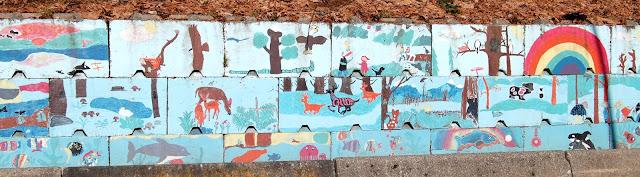
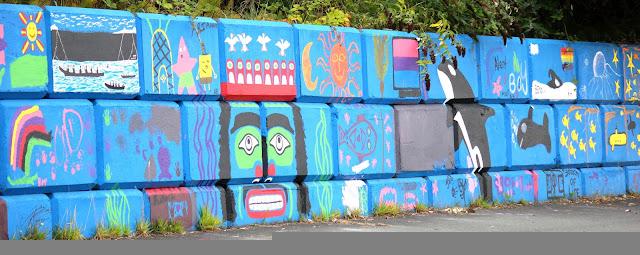
There's a rambling little debate going on in my community right now about what kind of mural should go up on the lock-block retaining wall that acts as the de facto welcome sign to our island. This wall faces the ferry dock, and forms the north side of the pedestrian walkway from the dock to the rest of the island. This is the plain concrete wall that, for generations now, has welcomed commuting adults and teens, newcomers and old-timers as well as untold numbers of tourists to our small island. Sometimes it sports blackberries trailing down to catch our shoulders as we pass by, sometimes obscene or public-shaming graffiti, and almost always an assortment of hardy edible weeds that pop out from its crevices. But most noticeably, it's a boring grey wall of concrete lock-blocks.
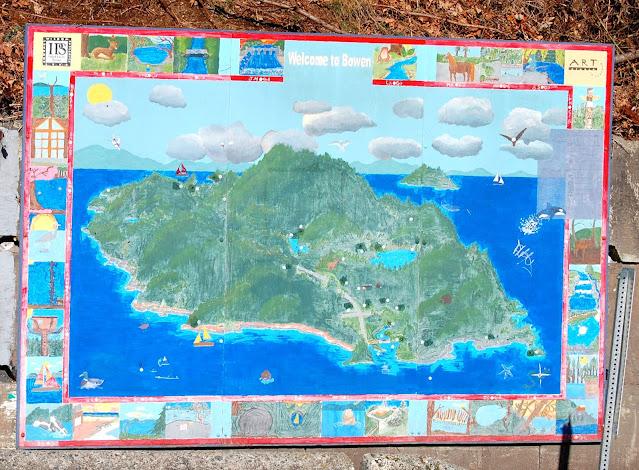
Once this wall had a vast mural painted by kids from the local school–each block was painted with scenes of local wilderness or animals. Another time there was a big plywood mural of the island and local information, painted with students from our middle school. Yet another time, the wall was the stage for a temporary piece of public art made by one of our local artists, which peeled and disappeared over time. For a few years now, it's been just a boring grey wall of concrete lock-blocks.
The Nex̱wlélex̱m/Bowen Island lock-block wall, as it was once painted by local kids. Photo by Singne Palmquist
So now there's a call out for proposals from artists who would like to paint it, and an ongoing debate about whether it should have been offered to the island's children. I'm an artist; I'd love to have my work up in my own community and in fact have been talking with other artists about a collaborative work depicting local wildflowers for this wall. I love the idea of something that pleases and educates at the same time. But now I'm going to champion kids' art, for this wall. Because I think the many benefits of a mural painted by local kids far outweigh those of a more polished, "adult" mural.
Belonging
One of the best ways we can build sustainable community is to encourage engagement and concern for home and community. We need people to care that this is their home and feel that it deserves looking after. We care about things we feel ownership of. Kids feel ownership of their artwork–especially artwork that was designed and developed by them and displayed publicly in their home.
Why not just put their artwork up on the fridge? Well we can, of course, but not "just". It's not the same as being given the respect of one's community by being welcomed to paint right on our most visible wall. Being welcomed by one's community is, of course, the nature of the meaning of "home", and we want our kids to feel at home. We want them to grow up with the idea that this is their home, that their home matters, and that how they engage with it matters. We want them to feel seen; to feel responsible; to feel that what they do makes an impact on their home and future. So we have to give them that responsibility.
Imagine how it feels to children who painted the wall, say, in grade five, to then be walking past it twice every weekday on their way to and from school in grade eight. Some will tease each other about it; some will feel embarrassed, some will ignore it, and some will feel a quiet or even loud sense of pride. Almost all of them will feel connection. They'll feel a sense of belonging. Maybe they'll walk down to the dock to meet visiting relatives, and escort them past the mural they painted. Maybe they'll take selfies with their contributions. Maybe they'll move away and come back to find their marks still here, a few years later.
Not every child will have an opportunity to paint this wall. Maybe just one or two grades, and maybe it will be repainted every five years. But the kids who didn't paint it may have siblings who painted it. They may just have witnessed it being done and feel the tendrils of connection reaching out. They'll know that this mural was done by and in honour of the children of our community, and they'll feel valued.
Nex̱wlélex̱m/Bowen Island plywood info-mural painted with local youth. Photo by Singne Palmquist.
Learning
As a parent and educator I'm quite horrified by the many ways children are silenced in our culture; their ideas and skills unvalued, as they're seen as "still developing" in the system that is meant to develop them. Have we forgotten the meaning of development? It means growth. Children are not vessels into which we dump our own ideas for eighteen years and then trust to follow along like good little citizens. Children are growing people with their own ideas and skills and values, and they learn from experience.
Everybody learns from experience. You can read as many manuals as you like about how to fix your appliance, but the first time you actually open the appliance up is when you really start learning. So what do kids learn by painting a mural in their community? So much.
They'll learn simply from experience about materials: what type of paint is needed for this project? What chemical properties make it suitable and why won't classroom acrylics do the job? What types of scenes are acceptable, and why? Why has the council requested local flora and fauna, and what exactly are our local flora and fauna? What is the political and social work that goes into a project like this? And all the various applied maths, sciences, communication and language skills that come as a matter of course in the creation of this mural.
Why can't they just learn those things in school? Why can't they paint the school walls? Why does this painting have to be making a visual chaos of our lovely manicured community?
Chaos = Development
Because growth, development, and learning need chaos to thrive. It was the chaotic and random assortment of elements that evolved to become life as we know it, today. It was and is a chaotic assortment of peoples, places, climates and experiences that make humanity as we are, today. It was the chaotic rambling experiments of toddler-hood that gave our children the chance to develop skills they now depend on, like language, social skills, gross motor skills and dexterity. They learned all of those things from observing and experimenting, free-range, under our benevolent supervision. They didn't learn them in a school, from textbooks. They learned them because they felt at home in their homes, and made big messes and had big accidents. Our homes were chaotic. Now our kids are older, and it's time for them to be out in their wider community.
Our children are part of our community, and they are our community's future. Instead of being tucked away, seen and not heard, they need to feel they are part of it, so they can grow and thrive here.
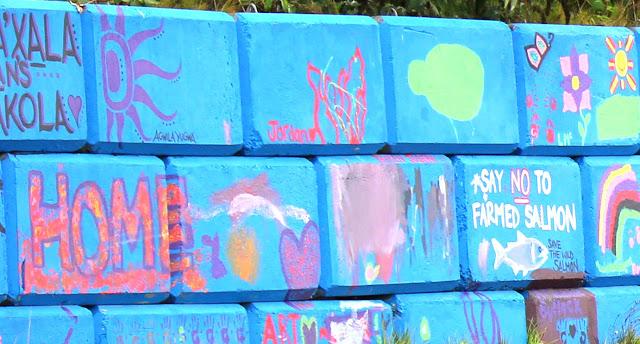
Kids' mural on lock-block wall at the Alert Bay ferry marshaling area. Photo by Emily van Lidth de Jeude
Responsibility
We look after what matters to us. If we want our children to grow up to look after their home and community, we need to allow it to matter to them.
We used to have an old cherry tree near the lock-block wall in the cove. Kids would climb it and hang out there, waiting for their commuting parents to walk off the boat. But eventually someone injured himself falling out of the tree, and then the tree was deemed too old, so was surrounded by fencing, off-limits to our kids. Now the area has been beautified as part of an effort to create a more visually-pleasing entrance to our community. There are all sorts of gorgeous plants there. I love them. But do the kids? Do they care about a tidy garden that they were expressly excluded from, and forbidden to play in? I asked my kids. My daughter says, "It's just another place you can't go." And how long before that garden is a dumping place for their litter and midnight beer cans, because it was never something they cared about in the first place? We look after what matters to us.
So how about a playground? What if we put in a playground at the ferry terminal, and the kids can play in blissful harmony with the commuters and traffic and beautiful gardens. Sure, but what kind of playground? Is it creative, dangerous, messy; fun? Because those are the things that make a playground worthwhile. Imagine an area full of tools, wood, climbing-trees and ropes; dirt and shovels and paint. That would be an amazing place for feeling belonging, learning new skills, and developing a sense of responsibility. But these playgrounds tend not to be condoned, these days, because of the chaotic look of them in our otherwise manicured landscapes, and because parents are afraid of danger. But danger–risk-taking–is essential for learning and for developing a sense of responsibility.
Another section of the Alert Bay mural. Photo by Emily van Lidth de Jeude.
Risk-Taking
If we never take risks, we can't learn to manage or mitigate them. Learning is all about taking risks, and risky play is a big part of progressive education all over the world. Just like babies learn to walk by taking risks and falling, teens learn to navigate social situations by taking risks and making mistakes; suffering heartbreak and social exclusion. We take risks as adults when we choose partners, careers, or make big purchases. We learn from all of those risks, and that's how we grow as individuals and how we evolve as a species.
Our kids are part of our communities; our species. They need to take risks like painting a public wall or climbing public trees so they can learn how their community works. You know what the boy who fell out of the tree learned? In addition to some of his physical limits, he may have learned that he was valued in his community, when he was seen, held, and tended to by an adult who was not his parent.
Kids who paint walls take many risks, in choosing what and how to paint, in consulting with their peers, their supervisors, and their community, and they take social risks in walking past the mural they painted every day for a few years and navigating the conversations that arise. They take personal emotional risk in putting their artwork in a public space and facing the opinions of their community. And that social risk helps them to grow into their community–to become a part of it, deeply and permanently because they grew and thrived there.
A community that sits in stagnant contemplation of its perfectly manicured surroundings is not growing, thriving, or evolving. And who wants that?
It's not only kids taking risks in this scenario. It's us, too. It's the adults who give the kids our most prominent walls to paint and just trust them. That's a huge risk, especially for those of us who are quite afraid of the chaos of childish experimentation. But it's a risk we have to take if we want to grow as individual adults or as a community. Is it like giving our living room wall to a bunch of monkeys with paintbrushes and walking away? Maybe. But I'd rather have something unexpected that I can learn from than live in a stagnant community. It's a risk we have to take if we want to grow.
As a community we are growing. Our kids quite literally are our future, and if we want them to grow into responsible adults who care about their home, then we need to make them a part of it, now.
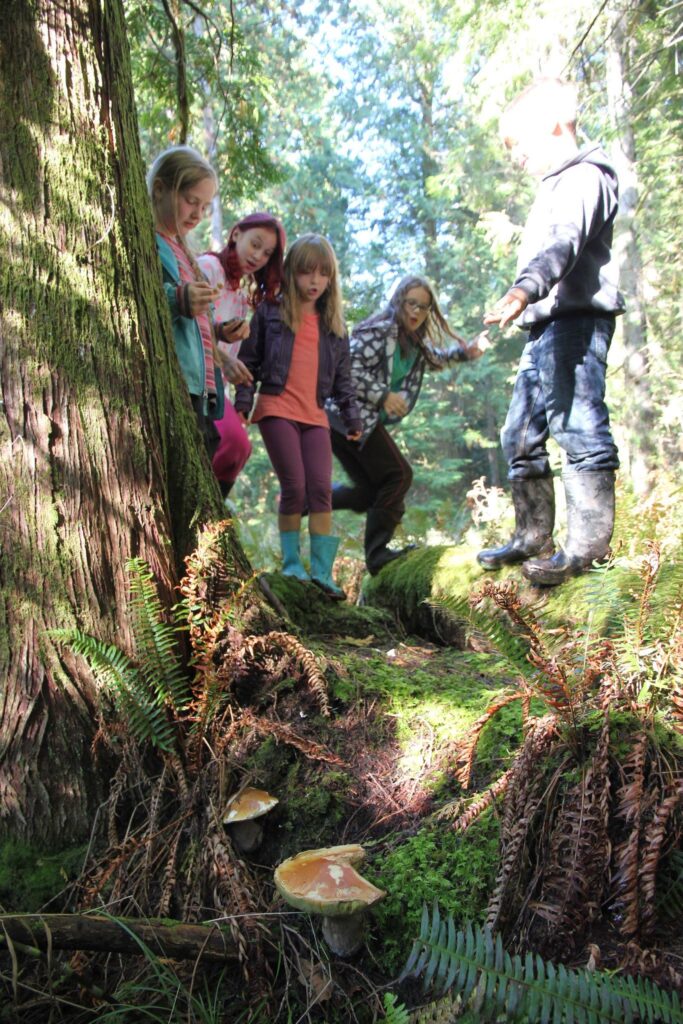
Discovering a gigantic (and partially slug-eaten) mushroom here in Canada.
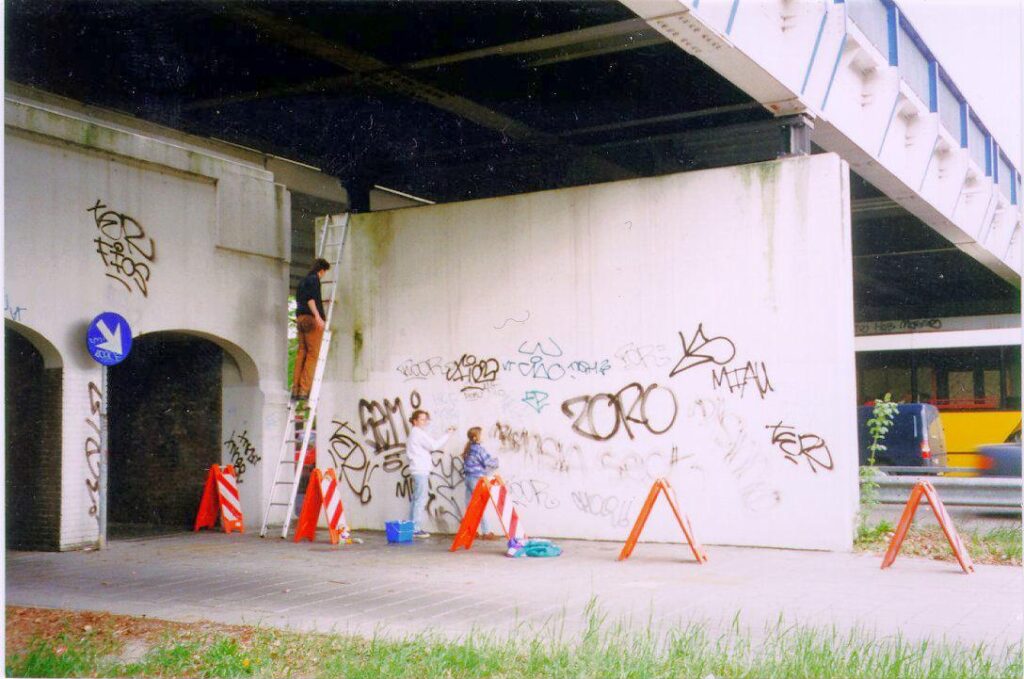
My first outdoor art class was rather an accident. I was working with a group of kids from the American School in Wassenaar, the Netherlands, and decided we'd make a mural to revitalize the wall of a local underpass that at the time was covered with white supremacist graffiti. Taking the kids outside to paint the mural they'd designed was just the obvious next step in the process, and it required the city to drop off a ladder and high-vis barricades to keep us safe from passing cyclists. The city obliged, and we cloistered ourselves up against the wall and painted that mural.
Preparing the Wassenaar wall for mural-painting.
But really we had to stand back quite frequently to look at the job we were doing, which meant stepping out of the barricaded area, across the busy bike-path, and onto the unkempt grassy area beside the overpass. That's where we took breaks, where we sat in the long grass and weeds and chatted, ate our snacks, pondered the mural, and generally did the work of assimilating all the learning that comes with designing and then painting a large mural in a public location–and confronting racism as a group of culturally displaced children. There, in the grass, we found little beetles climbing up the blades; we dropped breadcrumbs by accident and wondered about the safety of picking them up to eat them. We watched all the cyclists zooming by between us and the mural, and we soaked up the sunshine on our faces. We talked about neo-nazis, flowers, bicycles, the various countries we came from, different species of flies, the American School, flies stuck in paint, and languages of racist graffiti. I was nineteen, and really had no idea what I was doing with these kids, as a teacher, but the act of teaching taught me.
It took me quite a few years, more art classes taught for practical reasons outside, and parenting my own two kids into an unschooling paradigm before I realized the importance of that time spent sitting on grass in Wassenaar. I didn't originally take my classes outside because I knew it was the best place to learn. I took them because it was a place to let off steam; a place to find interesting textures for rubbings, collages, and still-life arrangements, or just the place we had to be to make the big art. Back in those early days I didn’t realize we were doing so much more than art. I took my own kids out just to escape the monotony of our living room, and the boring routine of meals, diapers, nursing, and play time. We did meals, diapers, nursing and play time in the forest, and let me tell you—that was not boring! And it wasn't long before I realized that we didn't actually need anything other than a snack and a spare diaper to go into the woods—that what we were doing there was so much more than just home in the forest: it was everything. Very soon, books, toys, and the stroller were irrelevant, and sticks, mud, water and plants became my kids' playthings. And playthings are learning tools. It wasn’t long after this that I started taking all my art classes outside for at least half our time together, and realized what I’d been missing, all along: connection.
The ecosystem that surrounds our curated homes is vast and complex and interconnected. It’s the seeming chaos that we tried to tame with our cities, boxes, and rules, but in actuality it’s the perfectly-tuned balance of millions of organisms, ideas and functions that we have not yet nearly achieved with our human-made system. Every concept humans dream up has roots in our basic understanding of the world and its natural systems.
Human-Designed Environment vs. Wilderness
The confines of a classroom or home are the curated attempt at a kind of intellectual ecosystem by a species that has become accustomed to putting things in boxes: to looking so hard at one object that we forgot to see the context it exists in. We put everything in boxes. We hang alphabet posters on the wall, keep fish or hamsters in a tank on a shelf for observation, and keep a stack of books, papers, or laptops for recording our observations. In this, we teach ourselves to exclude. We teach ourselves not to consider the wider context of whatever we’re seeing, because we’re afraid it’s too much for our small minds to fathom.
But our minds want to fathom! Our minds need to expand; to take time to sit and observe and wonder; to take subconscious note of all the millions of things that happen in the wilderness, from the slope of a leaning tree to the plants growing on top of it, to the smell of the soil, the mechanics of wings, jaws and elytra to the taste of sap. Our minds draw the connections between these millions of things long before we could ever articulate them.
One of the greatest tragedies of the current education system is our need for documentation and evaluation of learning. Students and teachers spend so much time documenting, testing, and evaluating that there’s no time left for sitting out in the wilderness, just assimilating. I can understand that, given the centralized nature of our system, the people at the top want to be sure every child is receiving the same instruction and meeting the same standards. But this is old. We’re progressing beyond the industrial society this system was designed for, where humans are needed to follow directions and work in factories. We’re on the edge of a new enlightenment, where the work we do with our minds is valued as much or more than our ability to assemble products. We don’t need the over-simplified, over documented fact-sheets of the industrial age, that break reality into such small pieces that it’s meaningless in the big picture. Our minds need a rich environment full of wonder, intrigue, and uncertainty to grow. The wilderness offers that.
Boxes vs. the Big Picture
As unschoolers at home, my kids were welcome to play and explore whatever interested them, free from the school system. But the fear I developed growing up in that school system led me to buy them a series of workbooks designed for their grade-levels. At some point my son was working on the science section (the only section he was willing to look at), and became furious. “This is a stupid book!” he declared. “They don’t know anything!” He was talking about the page that claimed killer whales eat other whales. He knew they ate salmon—at least those whales inhabiting our area at the time. And he knew that other killer whales ate seals and sea lions, but he didn’t care because they weren’t anywhere near us. I tried to explain that transient killer whales might, in fact, eat smaller whales, so maybe the book wasn’t wholly wrong. But both of us were dismayed at the description of something we knew to be a very complex system, as something so simplified as to be incorrect.
Humans are forever trying to make things simpler to understand them. It’s definitely simpler and less risky to put something in a box for observation than it is to go get to know it in its natural environment. If you put a killer whale in a big box with a smaller whale, I bet it would eventually eat it. But then you wouldn’t know anything about either species at all.
Boxes are more predictable, and we like predictable. The trouble is that the world and everything in it is not that simple. So in boxing everything; in teaching our kids “the simple facts” of, say, anatomy, combustion engines, or long division, we ignore the greater context of not only how these things fit into the vast ecology that we’re a part of, but why they matter. That’s why it’s OK to forget them when the test is finished and we move on to the next subject. They were never important in the big picture because we never saw the big picture: The ecosystem of everything.
The thing is, though, that that ecosystem is the context of our lives. We didn’t come from nature thousands of years ago and then progress beyond it with industry and technology, we are nature. We are the ecosystem, and our minds, unbeknownst to us, are naturally evolved to live in, observe, and understand it. Everything we are is the same basic particles that comprise a killer whale, a turtle; a beetle, or a piece of sandwich fallen into the weeds and digested by microbes, on the side of the bike path in Wassenaar. Everything we have built came from nature. Not just the raw materials, harvested unseen behind a slim screen of trees by the highway, but also our ingenuity. It comes from nature. It comes from people walking through the wilderness getting to know it; people living for thousands of years in their own ecosystem, learning and understanding the ecology of that place until they know how to heal themselves with specific plants, actions, and technologies. Humans learned medicine from the wilderness, and then learned to make it into pills. I learned about my own body’s anatomy by butchering rabbits with my family, as a child. Humans learned engineering from stacking, digging, and weaving pieces of wilderness to make homes and all other manner of ingenuity—like birds build nests and bears prepare dens for winter. Children build forts and mats; crowns and shoes and gardens in the wilderness. And this play is where they learn the core skills they need to become engineers, physicians, caregivers, fashion designers, mathematicians, and politicians.
That’s a lot of things to become! And you know it’s just my random little list. It looks like hyperbole but it’s really a gross understatement. I can’t think of a single career that wouldn’t be ideally begun in the wilderness. Why? Because our minds are capable of more than we know, and more than we can articulate. In sitting, playing, or living in the wilderness we give our minds space to learn. That’s why we learn better, there.
Natural play in the forest.
The Whole Picture: Interconnection
Getting to know our own ecosystems isn’t quantifiable. It’s not really so much about seeing or learning more as it is about seeing the interconnection of all things. What was missing from that infamous killer whale page in my son’s workbook was indeed just a lot of information, but more importantly it was the connection between all that information. Salmon is to killer whales what smaller fish are to salmon. And our local residents prefer chinook salmon. But where do they find them? And how do they interact or share territory with the transient (now Biggs) killer whales, who eat pinnipeds, dolphins and minke whales? What do minke whales eat? Who eats their poop? Oh yeah—whale poop is the fertilizer of the seas. Like rabbit, horse, and chicken manure on my garden. Like deer poop in the forest, and the leaves and berries that went into it, feed the ferns, trees, and the grasses that later were picked for the robin’s nest; the corvid that later stole the robin’s scrawny babies to eat; the blue eggshells that fell to the ground to be gnawed by insects and harvested for calcium. The picture goes on and on forever. It’s not just big; it’s whole. Try to put that on a spreadsheet and send it to the ministry for documentation of learning.
Really. I’ve tried. As an unschooling parent still enrolling my kids in a DL program in order to access community resources and group activities, I had to quantify my kids’ learning on paper once every term. I learned very fast that what my children were learning was absolutely unquantifiable; that an “education” in our province constitutes a list of checked boxes, but that what my children understood of the world was much more important. School-going kids also understand far more than is noted on their reports; more than they are seen knowing, by a system inclined to look at them mostly for the purpose of checking boxes. They understand the social connectivity of their class and school, of their families and the landscape of the places they are given to explore. If we want our children to know more about the world, we simply have to give them more places to explore. And if we want them to really become comfortable and fluent in complexity, we have to give them plenty of time exploring in the wilderness.
Exploring: Curated Experience vs. Free Play
Exploring doesn’t mean hiking along a trail. I mean, it might, if that’s where interest led you. But it might mean going off-trail, crawling into the underbrush, or sitting down to dissect a pile of bear poop. It might mean sitting smelling the wind, and maybe it’s autumn, and the wind carries a musky smell that turns out to be a very large rutting deer watching you from afar. He saw you first because he’s accustomed to this wilderness and used to noticing the changes. You’re the change in his wilderness, and now you’re a part of it. And you discovered something you didn’t expect when you sat down to smell the wind.
When kids play in the wild without direction they probably learn more than they would if the play was curated. Most times school kids are taken outside to play, the play is directed by a teacher. Maybe we play capture the flag; maybe we sit and read our books or go on a scavenger hunt. These aren’t harmful activities, but in the expectation of specific activity, they don’t leave much room for exploration. We learn to see outdoor spaces as locations for performing human-designed activities, as opposed to ecosystems to be a part of. But it doesn’t have to be that way.
Take a group of kids into the woods with no expectations, supplies or instruction, and leave them to play. They will use their previous experiences, their broad complex understanding of the world, and their inquisitive minds to take stock of the situation and adapt. They’ll explore their surroundings. They’ll use whatever objects they find around (clothing, sticks, leaves, water) to act out and explore their ideas. It’s a lot like documentation, but freed from the constraints of ministry check-boxes and expected reporting methods, it will look like play. It is play. And it’s essential for learning. Just like in playing, a crow learns where the robins are nesting and where he might find his next meal. He learns how to slide in snow and dig for grubs. Play is essential for learning. In playing with kids in the forest, I learned the best things I know about teaching.
The wilderness provides the best playground for our imaginations, because it’s complex enough to house all our ideas. It provides the best place for learning, because, when we give ourselves time to just be there, we can discover and come to understand—intrinsically—the roots of everything. Without constraints on space, complexity, or imagination, we really can be wholly educated. We can become everything we want to be.
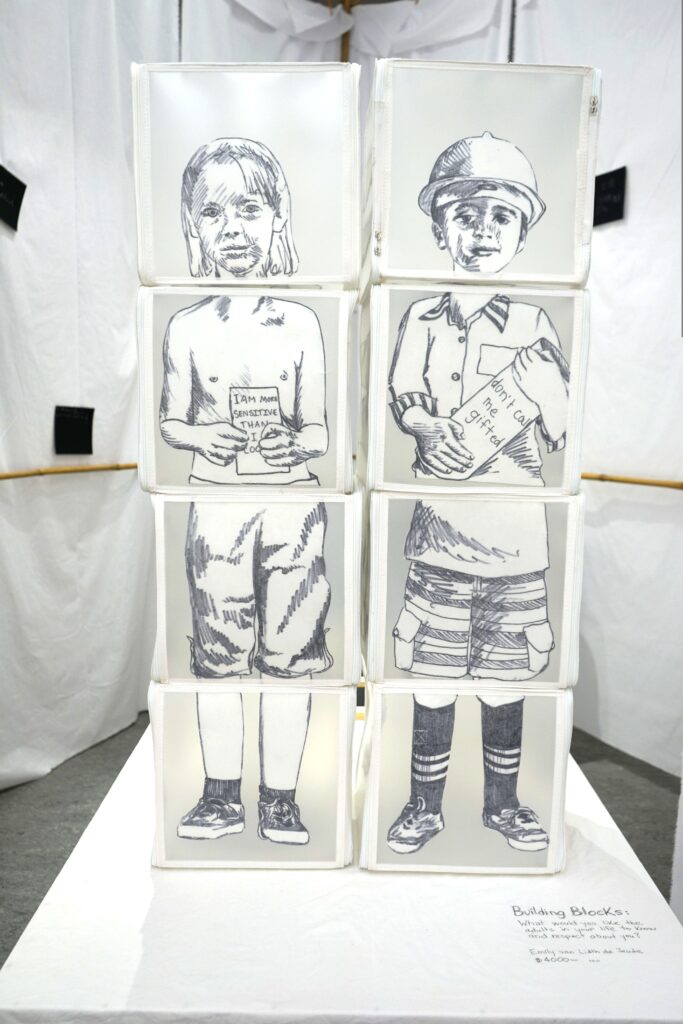
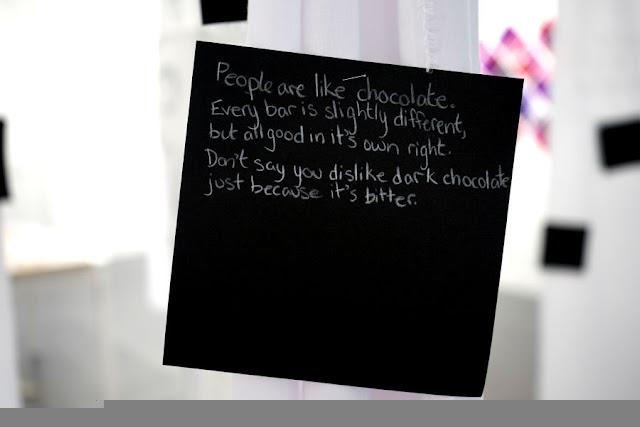
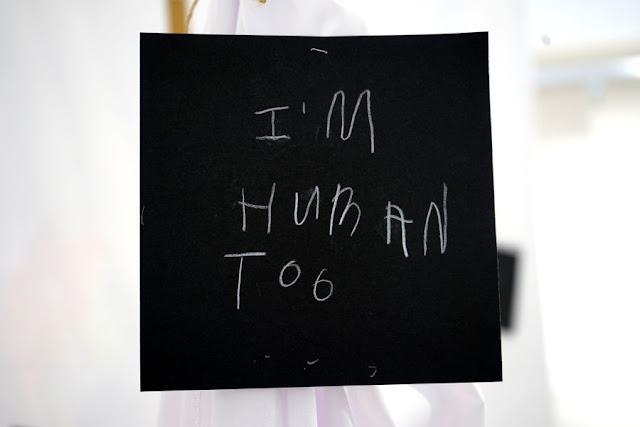
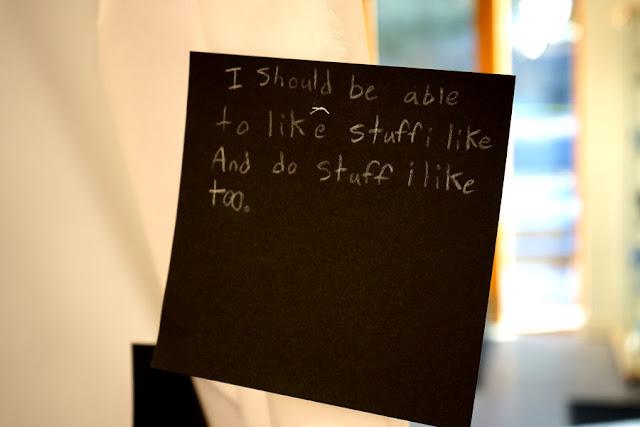
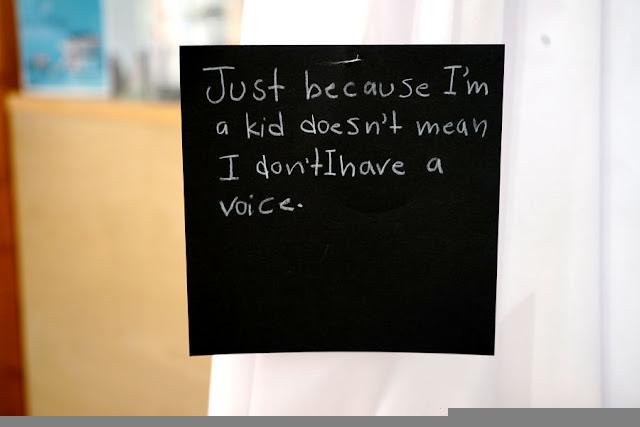
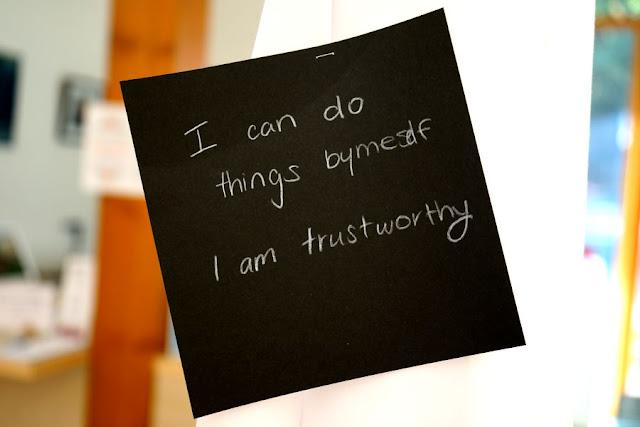
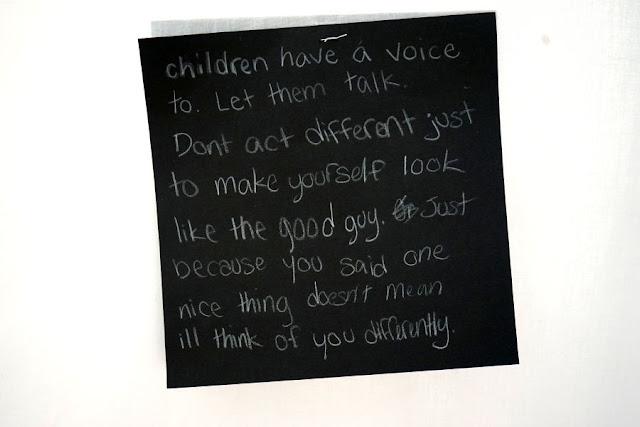
"Children are the most disrespected group of people in the world."
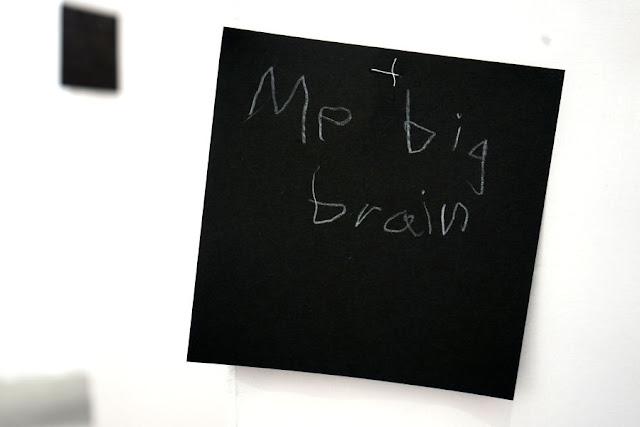
She turned her small face and looked at me intensely, maybe to see how I would react; maybe to be sure I heard her. She was one of a group of three teens who had just come through an installation about children's rights and left her comments behind. I hoped she felt respected by me as she walked out of the gallery.
And then it hit me: "Group of people." That's how we see them. We see them as separate from us until we judge them to be old, wise, or experienced enough to earn our respect – as adults. We determine their clothing, their food, their education and other activities, their freedom to come or go and quite often we even determine their friends and hobbies. They tell us their fears and hopes and great big plans and we pat them on the shoulders and ignore them; carry on with our lives. When do we look them in the face and ask them to tell us more? When do we ask their advice? When do we heed it?
I grew up and eventually returned to raise my kids on a small island. For longer than I've been alive, the teens from this island have boarded a ferry five or more days per week to attend school on the mainland. Unchaperoned. As a teen I got up at six-thirty, washed my hair under the tap, dressed, put on my makeup and left to walk to the ferry at seven. In the winter I arrived at the dock with my hair frozen like brown sticks around my face. Unlike some of the other girls, I did not push into the crowded washroom to fix it in the two tiny mirrors. I sat at the end of my age-group of kids, watching the same kids get beat up day after day, watching the animated conversation of some girls I wasn't friends with, picking at the Naugahyde seats and avoiding the splash of the food fights. I moved further down when people started bringing compost to throw.
Twenty minutes each way. Morning and afternoon. The ferry commute was a drag, and a shared ritual, and also the rocking, floating bridge between the confines of childhood and the expected freedom of adulthood. In the 80's we skipped school by going en masse to the mall first thing, then arriving at school before lunch to report that we were all late because the ferry was late. We sometimes argued about the ethics of how to accomplish this feat. We shared time every day, but we were individuals. We had different stories, different values, and different lives.
Our island also has a history of ferry exclusion. As a public-private entity, the ferry corporation has the right to ban people, and they have done so on various occasions that I remember. They banned a teenager in my grade for vandalism and mischief. He eventually took the ferry with a chaperone to attend school. They also banned our local petty criminal because the police thought it would do him good to get out of the community where he regularly slept in parked cars and picked drunken fights in public. It didn't help. Community members transported him back to the island in the trunks of their cars. My point is that these people, too, are individuals.
At various times we've had issues arise on the busiest ferry runs, like unidentified persons vandalizing the boat or flooding the toilets, and sometimes the first response is for the captain to make announcements to the teens. He tells them, as a group, to smarten up and behave themselves. He tells the adults on the next commuter run to rein in their children. Recently people in the community have been wondering aloud in public why teens (again, as a group) can't just behave themselves for twenty minutes at a time. Few, if any of us, know what the current transgression is, but we know it's been committed by teens. The captain has reportedly announced to our teens that if the unnamed incidents don't stop, the police will be involved and the surveillance footage will be reviewed. For me that crossed a line.
If criminal acts are being committed, it's perfectly reasonable to check surveillance footage and involve police. It's perfectly reasonable to expect people not to commit such acts, and to take steps to ensure that they stop. It is not, however, reasonable to reprimand, admonish, threaten and sometimes (as I have witnessed) deny service or civility to an entire group of people based on the premise that one or a few of them are suspected of having done something wrong.
When adults smoke on the ferry (which is wholly a no-smoking/no-vaping zone), they are asked to butt out. If they refuse, they are taken to the chief steward's office and spoken to, as individuals. I've seen this happen. I've stood at the chief steward's office while an adult smoker was being spoken to, and every effort was made to treat me with respect and provide me with service despite the fact that I, too, am an adult. The same can't be said for our teens' experience. Every teen is a suspect in some people's reasoning.
What do you think that does to a person? Imagine if every day you walked to work only to be eyed suspiciously at the door to the building, and every time a toilet overflowed, people called all the adults in the building together to reprimand them. How would you feel about using the toilet? Imagine if, when some person stole from the vending machine, they denied all adults access to the vending machines. Would you respect the people who judged you? Would you still care about upholding the values of your community if you weren't expected to uphold them anyway?
I'm responsible for denigrating teens as a group, too. When I was barely more than a teenager myself, a truck full of students from a nearby high school pulled up to my grandmother's lawn, dumped an assortment of fast food wrappers out the window, and drove off. A few years later, walking along our island road with my four-year-old son, we spied some litter in the ditch. He immediately shook his head and muttered grumpily, "ach… teenagers". I can't remember how I led him to that assumption, but I am certain I did. Now he's seventeen. He and his sister have somehow managed to get through a bunch of teenagehood without dumping their trash. Even more than navigating teen years myself, parenting teens has taught me to see them as individuals.
Teens are worthy of our attention as individuals. They are humans learning to be adults, and counting on our respect and exemplary modeling to help them navigate their surprising, sometimes frightening individual journeys. If we want them to see adults as individuals rather than a homogeneous, brooding group, we need to model to them how to do that. We need to see them, and we need to show them how seeing people is done well.
Some teens are children. They have an innocent wisdom not yet drawn out of them by the pressures of growing up. Some teens are also adults. They know their own minds and they know when they haven't done wrong. Some teens see us when we're wrong, and they know when we aren't hearing their voices. Some teens know when not to bother speaking up, because we've lumped them all into one disrespected group and we can't hear their individual cries. In fact, when teens report crimes committed by adults, they are often ignored.
It's time we look into the faces of the children and teens we pass and see them as simply humans. It's time we see them as individuals with wisdom, needs, values, and human rights. It's time we respect them.
*The handwritten statements accompanying this article were contributed by teens at a 2019 installation of a piece called "Building Blocks: What do you want the adults in your life to know and respect about you?"
My 2019 exhibit included, as its central installation, this piece about children's rights. It's made of plastic clothing storage boxes, which I covered in portraits of children, holding signs that state their various answers to the question, What would you like the adults in your life to know and respect about you?
The children who contributed the answers for this sculpture range in age from 5 to 17, and the sculpture is interactive. Visitors to the installation were encouraged to put on white gloves and play with the cubes, rearranging again and again to make a vast assortment of different children.
The installation included a small tray of black paper, where young visitors could write their own answers to the question. I hung these answers around the installation as they appeared.
These are the voices of our children – mostly anonymous children, and therefore everychild. These are the things that all children need us to know. They need us to shed our busy-ness, our righteousness and our preoccupations and hear their voices. And their voices keep coming. Let's be good listeners.