On Shame and Invisible Disability

Once, while downtown with my young children, I noticed a man walking by with a pin that said “invisible disability”.

“Gad, how awkward”, I thought. He’s obviously not that disabled, as he’s walking around, downtown. And as we carried on our way, I continued to wonder what on earth his supposed invisible disability was, and why he felt the need to declare it on his jacket. Could he have partial blindness, and the pin is supposed to warn people he may bump into them? Could he be deaf, and we should help him in case of audio-only emergencies like an air-raid siren? Maybe he just has cognitive decline or a mental health problem. Likely that. Yeah. A mental health problem that causes attention-seeking and makes him feel sorry for himself because he just can’t deal.

I found a clean-looking bench and sat my kids down to consume our sandwiches. Gluten-free bread in those days was a novelty, but necessary for my son, so our sandwiches were rather hard and crumbly. I’d made up for the tasteless bread with super-tasty salami and tomatoes. No mayonnaise because my son was also allergic to eggs. Maybe the pin-guy just had food allergies and felt sorry for himself, but why would he advertise it?

I was a young mother at the time, still flailing to just understand my own kid’s food allergies, and pretty entitled. I worked my butt off with parenting, teaching, and running community programs. I prided myself on working hard, and I couldn’t imagine anybody more tired than me; more in-pain from lifting children; more deserving of accommodations or understanding. I certainly couldn’t imagine that one day I’d have an invisible disability.

Now that my kids are grown and I live with a serious invisible disability, I still don’t want to advertise it. Because shame. That pin-wearing guy was much more courageous than I am. I mean to challenge my shame with this photo:

Author Emily van Lidth de Jeude is reclining in bed with a small handmade cup of tea, a laptop on her knees, and a black plastic clip pinching the top of her nose, between her eyes. On her left, on the blanket, is a phone and an empty plate. On her right is a nightstand covered with a teapot, various books, an N95 mask, and nine bottles of medication and supplements.

Here I am in my usual morning location, writing this article. This photo was taken by my partner and caregiver, Markus, because I asked him to. The weird black thing on my face is an acupressure clip for migraines. I tidied the nightstand for the photo. Now I’m out of breath from doing so.

In early 2020 I was a parent, a visual artist, a self-determined learning consultant, and a leader of art and wilderness programs. I also grew many of our family’s veggies, in a garden I loved. I spent a lot of time hiking, crawling and climbing around in the wilderness with kids. Then I, my daughter and most of her class that I’d been teaching, came down with a sickness that nobody could identify, because although our symptoms matched those of the then-new Covid-19, there wasn’t yet any test available to confirm it. After a week of fever, some blacking-out and a visit to urgent care, then a few weeks of ongoing respiratory symptoms, we recovered and went back to work and school.

By March, I was exhausted. My body hurt everywhere, and I developed a new, ongoing respiratory issue; I felt like I couldn’t get enough air, and was given asthma inhalers of two different types, that made the symptoms much worse. I had a headache all day every day, but I told myself I can handle pain, and kept working. After a day of work I’d be wheezing and shaking in the evening; sometimes also with a fever. I cut back my work days to only two per week. Then one. Then one every two weeks. And by summer I was flat-out in bed, most of every day. I eventually learned that the name for one of my major symptoms is postural orthostatic tachycardia syndrome, or POTS. It’s basically a circulation and autonomic nervous system issue, and means that if I’m upright for too long, I get blurred vision, dizziness, nausea, and will eventually pass out. I spent the latter half of 2020 and all of 2021 mainly in bed.

I had Long Covid. I still do, but those first two years were the worst. I couldn’t get out of bed for more than about five or ten minutes at a time, maybe three times a day, without suffering intense shooting pain, wheezing, dizziness, blurred vision, and fever. My partner helped me to dress and undress. He washed me, and administered the many trial-medications and supplements I was offered. He worked gratefully from home and took frequent breaks to bring me food or tea, to keep up with errands, and sometimes to feed me or help me to the toilet. On the occasions I did leave the house, my son would walk behind me and push gently up on my back to help me walk. My daughter, also suffering from Long Covid, but less severely, would curl up beside me in bed, where we spent endless hours just keeping each other company. My kids took over most of the cooking, garden and chicken duties. I find it difficult to talk about the extent of my physical disability in those years, partly because my symptoms were dismissed and mocked by so many physicians, at the time, but also probably because I carried around a huge ableist attitude. And because my disability was invisible.

The most obvious invisibility was that I was in bed. No longer able to attend community functions or even just go to the store and bump into neighbours, I was no longer part of my community. This experience forced me to realize something I’d never believed, before: Most people don’t really miss you, when you’re gone.

But as the years went by, and more and more was learned about Long Covid, my health did improve. I benefited greatly from the BC Women’s Hospital’s Complex Chronic Diseases Program, and a series of interventions that slowly brought me to the point where I am, today: I can spend hours of every day out of bed, mainly in the afternoon, and therefore can go out in public once in a while. Despite POTS, arthritis and other inflammatory pain, I can do at least a couple of “big activities” each month, such as watching a show, attending a family gathering, or grocery shopping. Sometimes one per week, if I rest thoroughly for the week in-between, to recover from the resulting fever, viral flare-ups, nerve, organ and joint inflammation. If I don’t rest, or if I am unfortunate enough to pick up “a slight cold”, as it’s known to others, I can end up with months of shaking, untreatable fever, passing out from lack of oxygen and/or pain, pneumonia, bronchial, sinus, and urinary infections, or pleurisy. I’m now allergic to at least one antibiotic, because of this, and have cataracts from prednisone. So I’m very, very careful about masking in public, sticking to my treatment regimens, and how much I go out. I’m not as careful as I should be around staying home, because it’s lonely, here!

This, too, is a kind of invisibility. When I’m out in public, people see me and tell me I look so healthy! I say “yes! I’m doing really well!” and then return to my house, where I curl up on the couch, my partner wraps me in a blanket, and I wait for the fever to subside.

Once in a while I mention my reality to people. In a sentence or so I try to describe my symptoms—an effort, I guess, to break the invisibility shield; create some kind of connection. And while some people are curious; compassionate, even, many sort of drift away, or roll their eyes. Sometimes, out of love or concern, they offer advice: I’m suffering because I got vaccinated, or otherwise because I am an anti-vaxxer. I should try going paleo, or vegan, or eating only meat, or mainly blueberries. More reasonably, I should see a therapist, or a doctor, or maybe get some exercise. I get it. I really do. I have the same propensity for offering unsolicited advice, myself, and know it comes from a good place. All they can see of me is that I’ve put on weight and am not out working in the community. They care about me, but my experience is largely invisible. They don’t know that I’ve already seen over a dozen specialists, tried even more interventions, and that as much as it physically pains me to put on weight from lack of exercise, exercise itself makes me put on weight by causing inflammation and more hours lying in bed.

I am SO aware that this sounds like a pity party. If you’re still reading, I commend your patience and tolerance. I’m still here because, as I healed, I discovered there are in fact millions of (by one estimate 400 million) people living with Long Covid, and fighting for others’ visibility is worth confronting my own shame. In 2024 I created a wearable art piece and performance called (dis)robe: Hospital Gown, that included the faces and common symptoms of over three hundred Long Covid patients. The intent was to advocate and create visibility for this massive group of people, but I also learned a lot, in the process.

I learned that most of us are women. I learned that while some had pre-existing health issues, many were very active, healthy people. Long Covid doesn’t seem to discriminate, and may not, in fact, be a result of laziness or incompetence. The list of symptoms is very long, but many are common to most of us. All of us have been discriminated against, either for mask-wearing, sitting down to rest, using mobility aids, or for being anti-vaxxers (most of us aren’t). I’ve learned that very few have actually been helped. The number of people who were or are still dismissed by medical professionals is alarming. The number of medical professionals who still treat us with disdain is sickening.

A few days after my second Covid vaccine in 2021, my partner brought me in to the ER, as I was wheezing, blacking out from either lack of oxygen or the excruciating pain in my chest, shaking, squirming uncontrollably, and running a moderate fever. My partner pulled our car up to the doors of the ER, but I couldn’t get myself out. He ran inside and luckily found friends who were there with their elderly father, and they helped me in to the waiting room. The place was packed; there were no beds, and everyone was stressed. Because I couldn’t see, was wheezing loudly, and was in too much pain to speak clearly or state pertinent facts, my partner tried to describe the situation to the intake coordinator. She barked at him that I could speak for myself, and told me to stop hyperventilating and get my act together. My partner tried to steady me in the chairs as we waited beside an unused stretcher, until he couldn’t manage it anymore, and just put me on the stretcher, without anybody’s permission. The ER doctor came by every few hours, offering me opiates for the pain, which I’m allergic to, and every time I declined she rolled her eyes and left in exasperation. Eventually she told me to get a thermometer and go home. Nobody even looked at my lungs, and thankfully, I did eventually recover.

In 2025 I lost a friend to pneumonia. She was a mother, like me, to a teenaged child. She wasn’t formally diagnosed with Long Covid, because our system hasn’t yet managed to find, diagnose, or treat all those who are suffering. She thought she had Long Covid, and as someone who knew her well, and saw the similarities in our symptoms and the way she was dismissed by medical professionals, I don’t doubt she did. Her official cause of death was pneumonia, though. It will not be recorded as Long Covid, and nobody cares, even so. Well… I do. Juanita is one of the people for whom I’m writing this. She was extremely courageous. Lots of people, including me, were put off by how forward she was; how open and honest about her life’s challenges. People like to ask you how you’re doing, and hear back “great, thanks! How about you?” They don’t actually want to know. My father told me this when I was a teenager and I thought he was just obnoxious. Now I know he was right.

My father had Parkinson’s. It was, eventually, a very visible disability. Although unfortunately, before he used a walker, people sometimes just saw his wobbliness and assumed he was a drunk. When people asked him how he was doing, he often said, “better than I could be!” It was a way of seeing the positive in what was actually an extremely challenging, progressive disease. He also liked to say his cup was so full it was overflowing.

I guess I’m following my Dad’s lead on this. When people ask me how I’m doing, I might answer that my chicks are growing adorably, or I’m sure loving this weather, or maybe that I’m so happy my kids are living well in the city. Sometimes I take my Dad’s lead and say something that hopefully points at the ongoing challenge of my disability while sounding positive about it.

Disability.

That’s still hard to write. Even though I have a disability parking tag in my car. My car that mainly my partner drives, because driving taxes my system too much. I lie there with the passenger seat reclined and my feet up, heating my body with the seat heater, trying to conserve energy and circulation for whatever we’re driving to. I haven’t applied for all the disability benefits I am supposedly entitled to because the process is too much work, and (mainly) because I’m ashamed. Internalized ableism. Gad, how awkward.

I long for the life I once loved: leading adventures through the bush, running art programs and tromping out as an installation and performance artist, making change in the world, for the better. But I hold my adorable chicks; I make an excursion from my bed to the sunshine. And I remind myself that I have an invisible disability, and I’m better than I could be.

Dear Little Emily: Psychosomatic

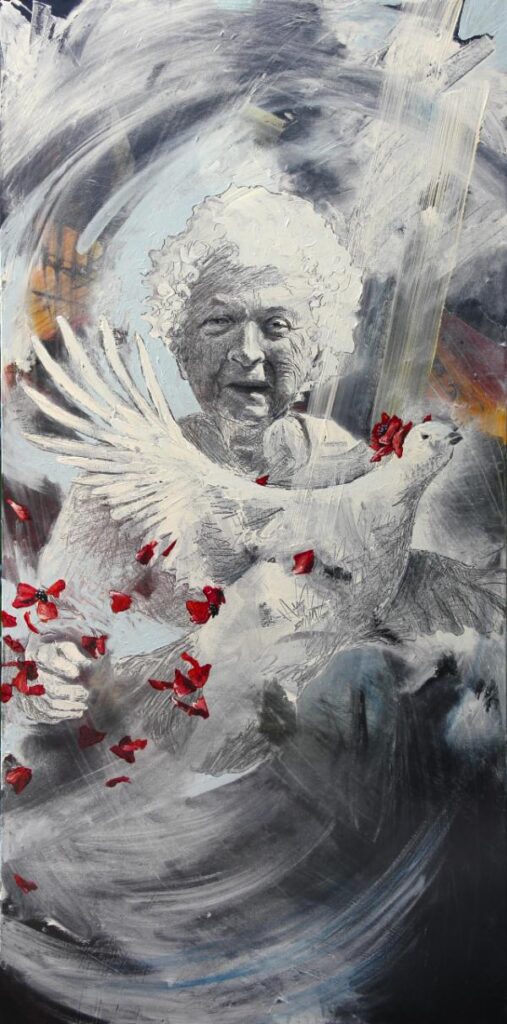
An oil painting, mainly in grey tones and white, of an elderly woman, laughing in a swoosh of white. She's holding her hands toward the viewer, and a white ptarmigan is flying out of them, towards her left, leaving a flutter of red poppy petals behind.
Grandma Frees the Ptarmigan, oil and graphite by Emily van Lidth de Jeude

The audio version of this story is available on my MakerTube.

Dear Little Emily,

You’re sitting on the floor of Mum and Pappa’s house, by the big brown bookshelf and the wide darker-brown row of Encyclopedia Britannicas. You have one open on your lap—number twenty-two—its huge brown covers rested against your bare knees, and you’re running your finger down the one of the many shiny, thin-paper pages of the PSYCHOLOGY section. Jeez there are a lot of things to say about psychology. But nowhere, not anywhere at all, do you see the word ‘psychosomatic’ popping up. Finally, after picking through hundreds of words you can’t bother to try out, you land upon this: PSYCHOPHYSICS, "a department of psychology which deals with the physiological aspects of mental phenomena." Mental. Grandma is a mental case, that’s for sure.

And amazingly, like the heavy book is calling her right out of crazy-land, the next listing in the book is PTARMIGAN. "A gallinaceous bird akin to the grouse." Whatever that means. It says it’s Gaelic, which is impossible, because you know ptarmigans are Canadian or Ukrainian. Grandpa is Irish and he never mentioned a ptarmigan. Grandma says ptarmigans live in Ukraine and in the Rockies, so. There they are.

But what the hell. Psychosomatic. It’s not even in the encyclopedia, right? Like even the definition of Grandma’s craziness is not in the book, that’s how imaginary it is. And the encyclopedia, now you’re nearly twelve, and it’s nineteen-eighty-seven, is the biggest, most trustworthy source of information in existence. As far as you know, little me, and you know more than some eleven-year-olds, but not nearly as much as you think you do.

You’re thinking about the last time you visited Grandma. Daddy dropped you off there for a sleepover, which seemed like a wonderful escape from the terrifying basement corner that you have to sleep in, at his house. But soon you realized there are other kinds of bad.

You sat in the wooden nook while Grandma smoothed her long, pearlescent nails. They’re three times as thick as your nails, because she’s old (though not as old as most Grandmothers, Mum says), and her nails are all covered with ridges, which she fills with layer upon layer of nail polish. You heard the plastic scrape of her nails; the rattle of her bracelets, and you shifted your gaze to the pink and turquoise squares of the kitchen floor. She was still talking, and you were getting tired. “The Devil lives in her,” she went on. “He lives in her mind and when she dies he’ll take her away to his lands.”

This wasn’t the first time Grandma professed to understand the Devil’s behaviour, and it usually somehow involved Mum. Mum says it doesn’t matter because we don’t believe in the Devil, so you sat quietly just waiting for Grandma to finish. “People who leave their husbands are evil,” she continued. “Your mother has the Devil in her heart, and you were born from that woman’s evilness. You have to pray to God to take it out of you.”

“I don’t believe in God,” you said, then, looking bravely up into Grandma’s wrinkly face; her nose kind of lumpy, in a way that made you think that must be the Ukrainian coming through. The angry concern in her sinister eyes leaked out the wrinkles of her face and into the perfect curls of her permanent-set hair. She looked like she might bite you, but you were too tired to care. It would be hours before Daddy would be there to pick you up, and by this point you thought you might fall asleep right there on the table, next to Grandma’s hands, her plastic bracelets rattling beside your head.

“Your mother taught you to say that. She put the Devil in you.”

“I’m so tired, Grandma,” you pleaded.

She looked up then, again, from her nails, and appeared surprised. “Oh, yes, dear. Would you like some Sprite?”

“Can I lie down on your bed for a minute?”

“Of course, doll-babe,” she replied. “I have to go call in the sun.” 

You walked down the short hallway to Grandma’s bedroom as she slowly descended the brass-rattle staircase to the basement door, where the sun had begun to peek through, from the cedar trees, outside. “Come on, Sun!” She exclaimed. And, “oh hello, how’s your morning?” She asked of some random bird flying through her yard. And you lay there on her perfectly pink bed thinking about the mystery of fibromyalgia that caused Grandma to stand in the doorway and soak up the sun, every time it shone; that caused her, also, to keep her house a few degrees above normal, because supposedly it helped her pain. Grandma says she has fibromyalgia. Mum, Daddy, and everybody else say she has psychosomatic illness. It’s all in her head. And the Encyclopedia Britannica, for all its wisdom, has declined to comment. 

You woke up with Daddy’s hand on your back. Somehow in your thoughts you’d slept two whole hours away, and it was time to go home. 

Home is a place of reason; a big tree-speckled yard full of food plants and flowering plants, some ponds, rabbits, chickens, a dog and a safe house to live in. No gods or devils, no ‘fairytales’, as Pappa calls them. You eat what you grow and you see how the actual world works. Everyone is upfront, or so they say. And illnesses are real—the kinds of things you can check with a thermometer and heal with cough syrup, chicken broth, and Earl Grey tea. Nobody has psychosomatic illness in this home. Nobody also calls in the sun, nor talks to birds.

Mum says it’s not really Grandma’s fault she’s crazy. She was born to parents who fled when Russia invaded, and that kind of family trauma can make people a little strange. Grandma says she remembers her own mother hiding up in the trees as her entire village was murdered. Grandma says this as if she herself was in those trees. Which is impossible, of course, since Grandma wasn’t born, yet. But she remembers. Daddy says Grandma is just wasting Grandpa’s money by keeping the house so warm. Pappa says it’s none of our business what she does with Grandpa’s money. You just wonder why Grandma doesn’t have her own money. 

Times are going to change, little Emily. Here I am, writing you from twenty-twenty-five—a date you likely find it difficult to imagine. I found it difficult to imagine the year two-thousand only months before it arrived! But here we are. You’re grown. Me. We even had kids who’ve grown up, by now. Russia is beating the shit out of Ukraine, again, and Grandma didn’t die of war or fibromyalgia; she died of strokes, kind of, in the end. Mum died of a brain tumour, and so far as I can tell, the Devil didn’t take her, because I still hear her voice in my head, sometimes reassuring me, sometimes giving her opinions, and sometimes shrieking in alarm. Maybe it’s the Devil after all. Who knows. And I have fibromyalgia. 

Yeah. You. You, when you’re grown up, little me, are going to have fibromyalgia, just like Grandma. And no family member is going to dare tell you it’s all in your head, because they’ll all watch you experience the pain and struggle that this stupid illness involves. In fact, one of the doctors who diagnoses you will mysteriously test a bunch of seemingly-random spots on your limbs for pain, and when they all hurt like bruises, she’ll explain that those pain spots are specific to fibromyalgia. She’ll then suggest self-treatment by using saunas, keeping your house warm, and perhaps also trying infrared therapy. Infrared light is contained in sunlight, little Em. The doctor will one day tell you to call in the sun. Well… metaphorically-speaking. 

You’re not exactly going to start calling in the sun. But I do try to soak it in as much as my fair skin and hot flashes will allow. I sit out there on the porch, watching the yard of this place you grew up in and that I eventually raised our own children in. I see the garden where I still grow most of our food, and I watch Eamon, the raven who’s been living around here for a few years now, fly low over the sunflowers, and land under the walnut. “Good morning, Eamon!” I call. He doesn’t answer, but sometimes when I’m in the garden he calls, and I do answer. We play a game where I copy his calls, and he changes them. Or at least I think we play this game. Maybe it’s all in my head. Who cares.

Love, Emily