Labelling Weeds: Art for Public Engagement

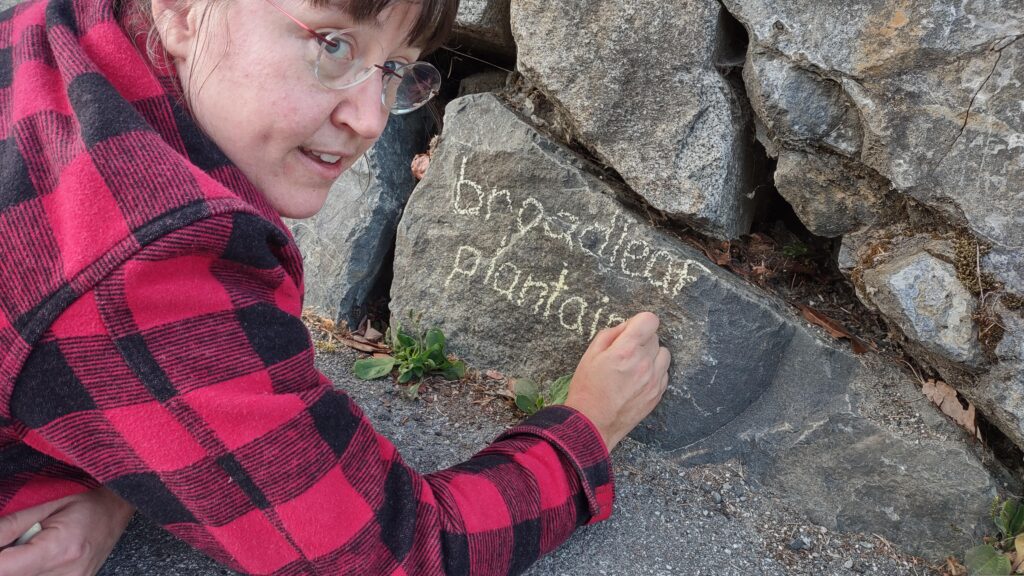
Close-up photo of artist Emily van Lidth de Jeude, with brown hair in buns and a red and black lumber jacket, printing the words "broadleaf plantain" on a rock with chalk. There are small plantain plants growing out from under the rock.

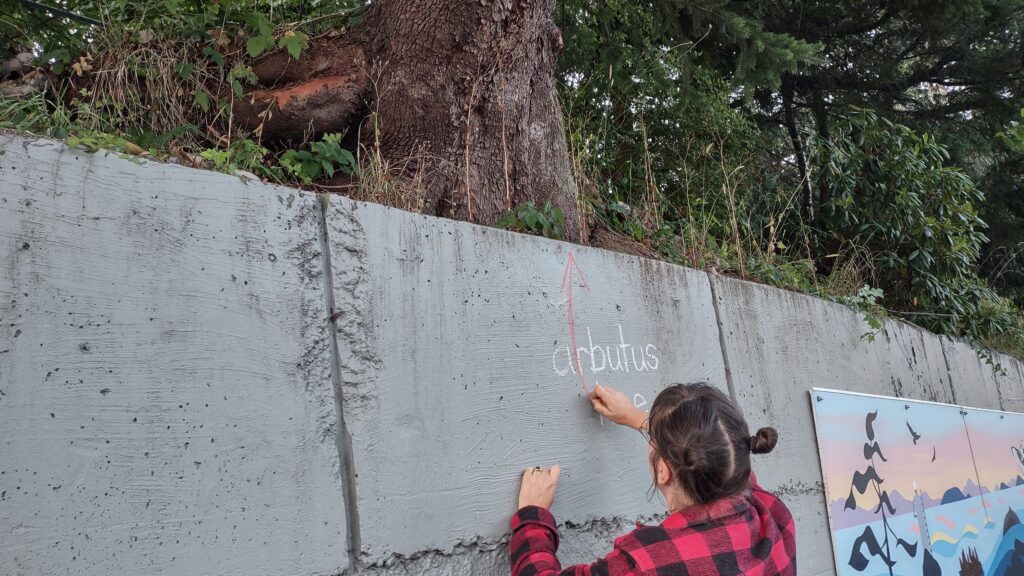
This has become one of my favourite things to do. Every year I go out and label the weeds and trees in the place with the highest foot-traffic on our island.

Photo of the back of artist Emily van Lidth de Jeude, with brown hair in buns and a red and black lumber jacket, printing the words "arbutus tree" on a concrete block wall, and a red arrow pointing up to the base of a large arbutus tree that is growing ontop of the wall.

I hope people see these and begin to notice a bit of the world around them in ways they may not have, before. I hope people also go home and find the same weeds, there. Sure, it's the simplest kind of art.

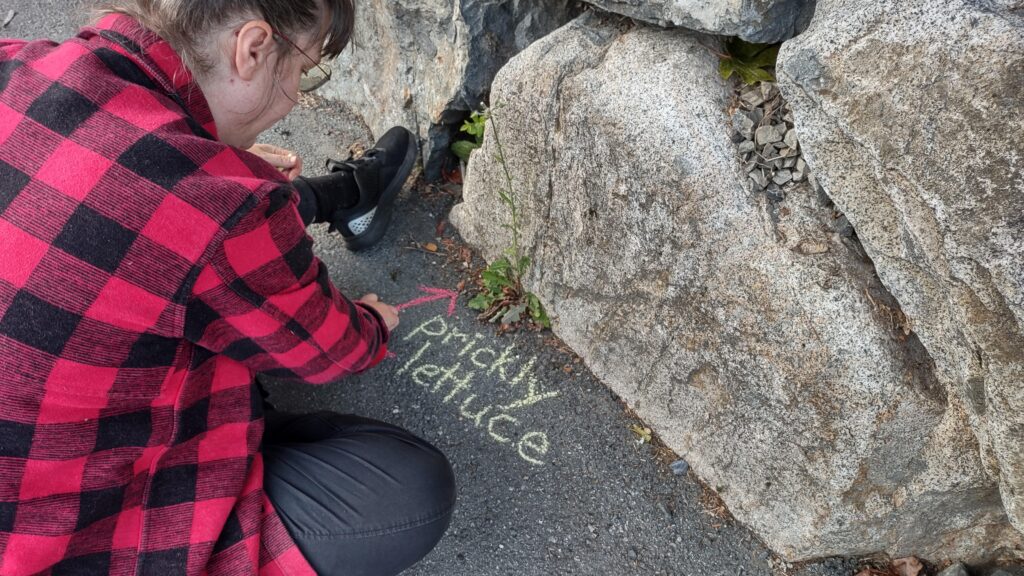
Close-up photo of artist Emily van Lidth de Jeude, with brown hair in buns and a red and black lumber jacket, sitting on the pavement next to a rock wall with a small plant growing out at the bottom. She he printing the words "prickly lettuce" in chalk, on the pavement.

I'm just chalking rocks, walls, and sidewalks with plant names! But I really feel it might be one of the most impactful works I've done.

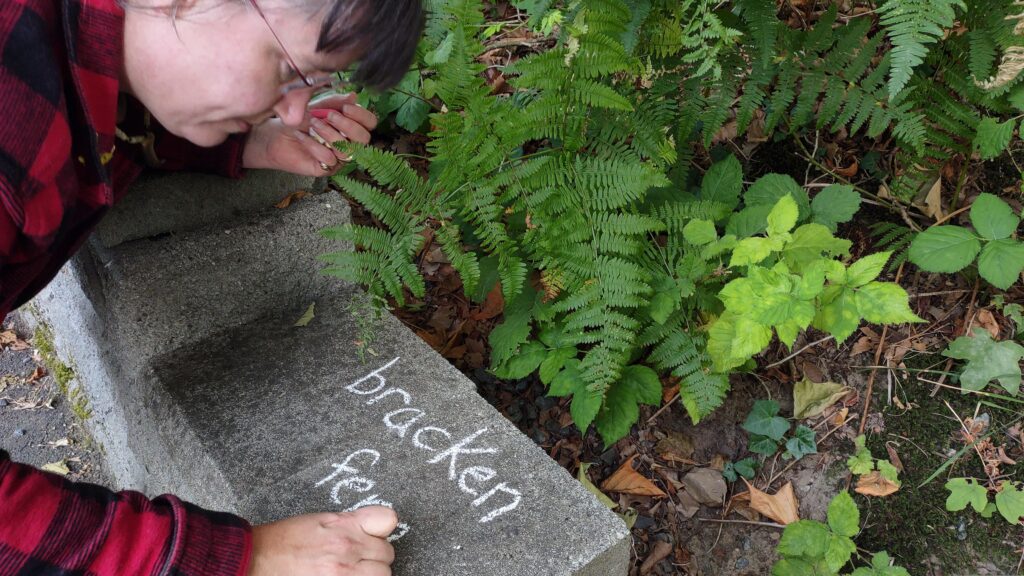
Close-up photo of artist Emily van Lidth de Jeude, with brown hair in buns and a red and black lumber jacket, printing the words "bracken fern" ontop of a small concrete block wall. There are bracken ferns growing on the other side of the wall from where Emily is standing.

And yes, if you're wondering, I do have municipal permission to do this! So the credit for this also goes to open-minded officials and other citizens who can appreciate the benefits of art and education in our communities. 🙂

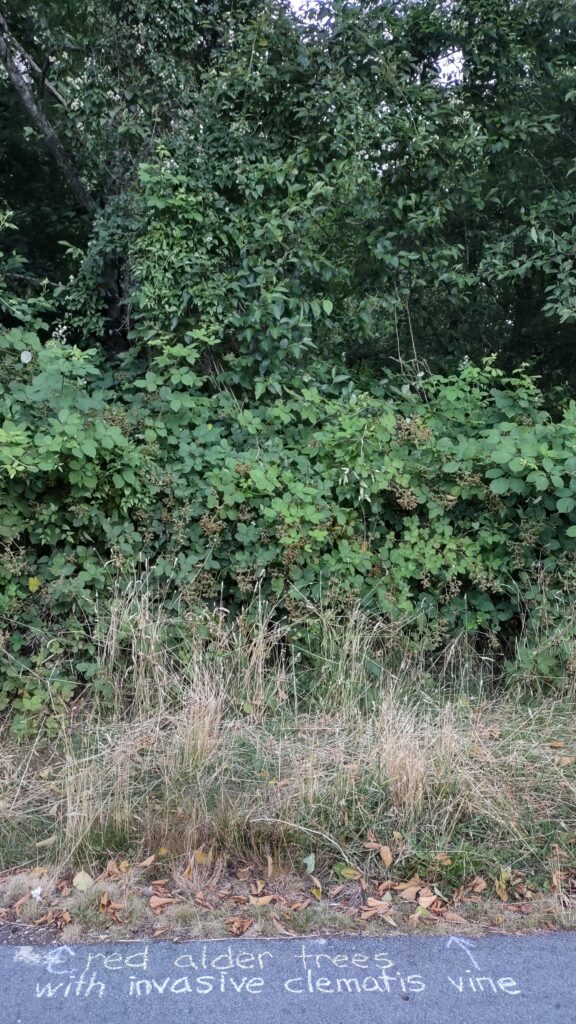
A photo of a sidewalk with the words "red alder tree with invasive clematis vine", written in chalk on the pavement. Beside the pavement is dry grass, then blackberry bushes, then above those red alder trees filled with invasive clematis vines, flowering white.

The Medicine Forest my Parents Gave Me: how exploring and knowing our place in the ecosystem builds resilience

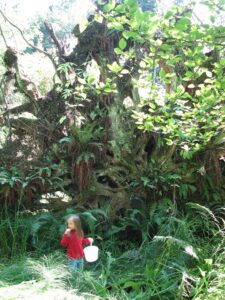
A young long-haired boy in a red turtleneck and jeans stands with a bucket and a handfull of greens held to his mouth, in a grassy forest. He's in front of a huge wall of roots -- an upturned tree -- that is six times taller than he is.
Taliesin picking berries in front of a root tower.

Once I lost my son in the forest. We were heading home through ferns taller than his three-year-old self, he carrying a harvest of licorice ferns and I carrying his baby sister and some oyster mushrooms. He followed along behind me, and when I turned around, he was gone. I called repeatedly. I retraced my steps. I gripped by baby girl to my chest and started running, panicking, and– there he was, nestled into a sword fern, chewing on a piece of licorice fern root. He looked up blandly at my stricken face and said "I'm just havin' some licorice root." His trance-like state may have been induced by the well-known calming medicine of licorice fern, or it may have been just his joyful state of mind after a couple of hours spent wandering the forest with his mother and sister.  

My kids and I spent part of most days of their childhood out in the forest, exploring. That's what I did as a mother because it's what I knew to do from my own childhood, spent here in this same little west coast paradise. When my head hurts, I go outside. Maybe I chew an alder leaf like the wild aspirin that it is; maybe I just lift my face to the fresh air, sun or rain. When my heart hurts, I lie in the moss and let it soak up my tears. Licorice fern soothes me; so does the feeling of bark, or the creek water between my toes. When I'm hungry, I eat beans off the vine on my porch, or berries and other treats from the woods; when I'm hungry for adventure I go exploring in my medicine forest. I made up that word. Medicine Forest. It's like a permaculture food forest, but with emphasis on its healing power. My parents didn't purposely give me a medicine forest, but they did give it to me, and I'm passing it on to my children. Let me explain.

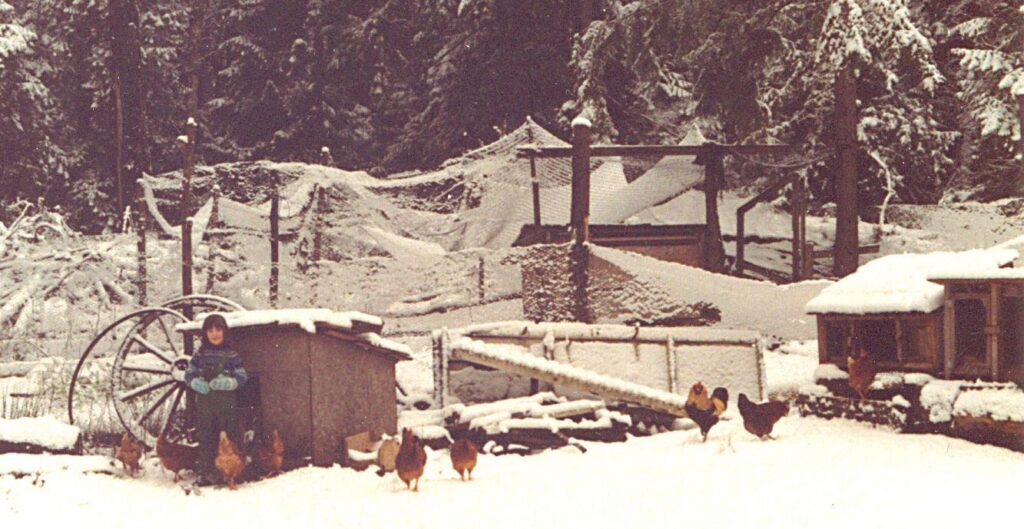
A young girl in a blue sweater and mittens stands in the snow among a whole bunch of chickens, some standing wooden wagon wheels, and various small coops and garden fences.
That's me with our chickens in the early 1980's, rabbit hutches on the right, and winter-covered veggie garden, behind.

I grew up in a pretty typical single family house – a modified double-wide mobile home, actually – on a five-acre piece of land that my parents purchased in 1980. This land was forest when they bought it. We used to come up here and have a picnic on the slope they hoped would one day be their building site. They let my brother and me free-range all over this place, climbing trees, damming creeks, digging great big holes and picking and using whatever plants we felt like, as they slowly cleared the land and built up what is now a developed property. We raised chickens, meat rabbits, and pigs (but only once because the experience was too heartbreaking for all of us to repeat). My parents grew food crops and allowed us to plant our own experimental gardens, while also insisting that we should help with the family food operations. My brother and I were never forced to kill or butcher animals, but because our parents nurtured our curiosity, we both knew how to clean a rabbit or chicken by the time we were twelve, and by the time we were fifteen we could cook a good family meal from the foods we'd grown or wildcrafted. We didn't even know the word wildcraft, though. We were just "picking nettles", or "finding a mushroom."

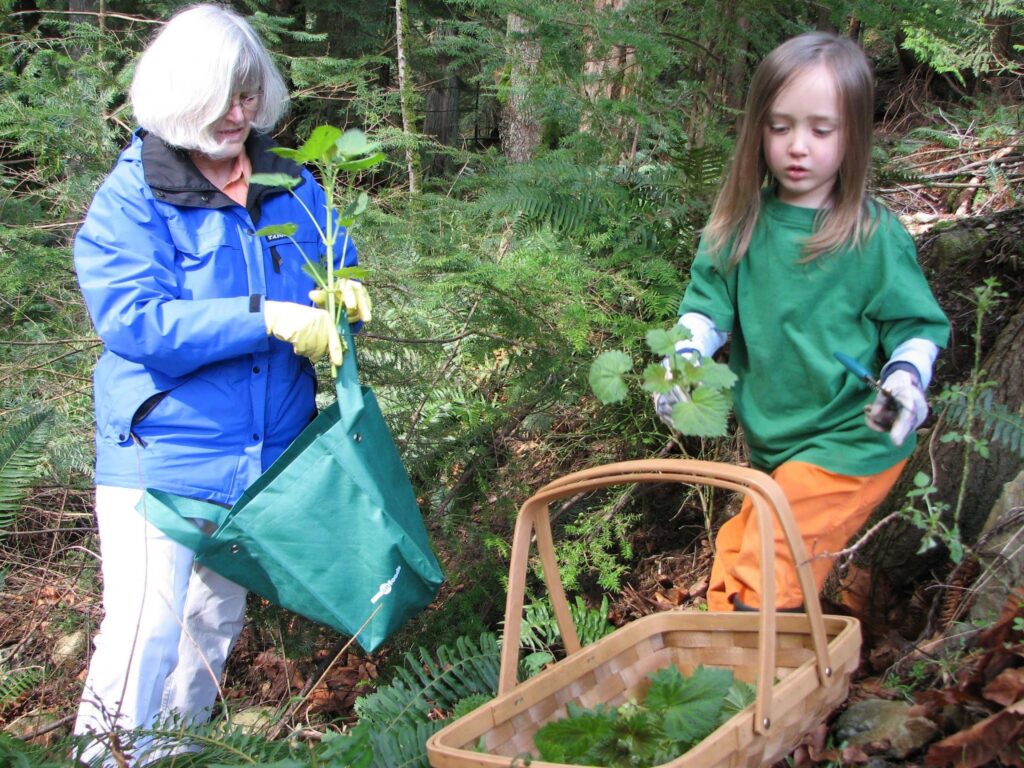
A white-haired woman and a young long-haired boy stand among ferns and nettles and wild berry plants, picking nettles and putting them into a shopping bag and a wicker basket.
My son helping my mother pick nettles in the late 2000's.

Living in and with the forest our parents were busy turning into a home was just "life". We could pick indigenous trailing blackberries from the hillside, invasive Himalayan blackberries from the place Pappa was trying to get them out of the creek, or cultivated boysenberries from Mum's garden. Same difference. They all make good pie, if you don't eat them all before getting them home. And whether they make it home or not, your belly is full with the food, your heart is full of the joy, and your mind is full of knowing every detail of your home. That's a medicine forest. It's a place where everything is living and growing together — humans included. It's a place you've grown so connected to that just living there heals you from the inside out.

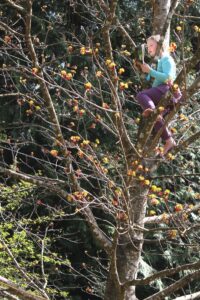
A young girl with long hair, shirt, pants, and bare feet, sits among the upper branches of a maple tree, her arms woven through the branches, holding a book she is reading.
My daughter reading in a tree she knows every inch of.

Somehow through my own teaching and parenting over the years I have come to recognize that, just like the best learning happens when we're inspired by connections to our own experience, the best living happens when we're connected to everything around us. Think of it this way: you care much more about your own backyard than someone else's. You have a lot more interest in your own little potted plant than in the weed at the edge of the pavement, or some tree in a forest far away. So somebody teaching you about a baobab tree might have a bit of a tough job keeping your interest. But what if that tree was yours? My friend went to Africa and really got to know baobab trees – and they became hers. When we connect personally with things, they matter, and mattering strengthens our neural pathways. That's great for learning, but how does this have to do with my medicine forest? Well, this place matters to me. It matters so much that I've spent about thirty years of my life exploring here, both as a child and now with my own now-grown children. I know exactly which part of which slope of which creek has the best clay for sculpting, and which part will still have a pool of water and some desperately-hungry trout in August. I know where the elusive white slugs live. I know how berries' flavours change with the weather and with the time of day. This deep understanding of my little wilderness is my connection, and it's why this place is my medicine.

On top of being important to my own health, my experience of exploring this place has made me resourceful and resilient. We all learn more from observing the people around us than from being taught conventionally, and I learned from watching my parents develop this land; their need to be resourceful when we had no electricity, no toilet, or no income. I learned from watching them not just survive here, but keep working even in the face of failure to find joy and wellness in whatever this land and life had to offer. The moss is not my weeping pillow because I'm an idyllic child from a book about fairies; it's my pillow because sometimes I was just plain too sad, as a child, and the moss was what I found to comfort me. My kids didn't harvest nettles for brownie points or allowance; they donned gloves and harvested them just because that's what we do for Easter. They got stung and they complained to me, but they also delighted in testing their brawn by picking them bare-fingered or by eating them raw. They were building resilience, just like I once did. This year they both came home for Easter and actually wanted to go nettle picking. They want to reconnect to and eat food from their own ecology. We're in this ecosystem for better and worse and every day that falls in between. Like the plants, we'll thrive or die as part of this, so we're doing our best to thrive.

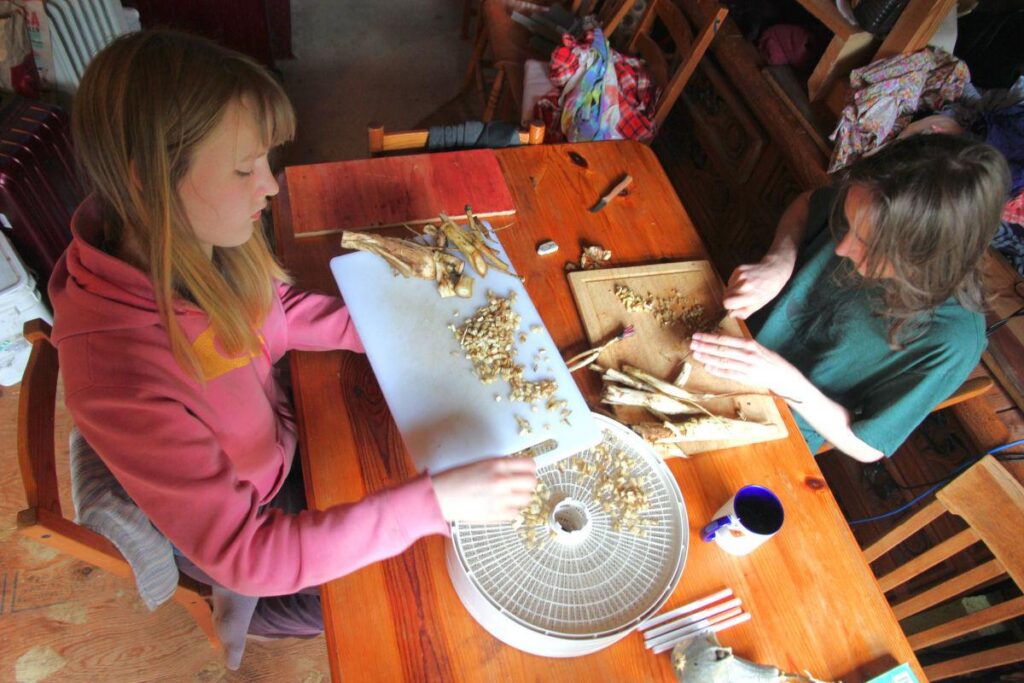
Two teenagers sit at a table, cutting burdock root into small pieces and laying them on dehydrator trays, for drying.
My kids at fifteen and eighteen processing wild burdock root for tea.

The business of gardening and developing the physical ecosystem is nowhere near as idyllic as I imagine it sounds. There are brutal realities in nature that hurt like hell. Our crops fail, our chickens get sick and I have to put them down; sometimes we fight and resent each other's impact in the ecosystem. Sometimes money is short, time runs out, and family or world tragedy makes us doubt we can succeed. But experiencing these things, feeling them and accepting them is part of the whole picture. My medicine forest is the ecological basket that holds our family, and the love and knowledge we cultivate here, among the weeds and the crops and the chickens, the weather and the water and our own bodies living. When I leave this place, my medicine forest is carried in the knowledge of my body and mind, to nourish and grow with other ecosystems. It's a conscious choice I make to see my surroundings and live in health with them, as a part of them. 

In a monoculture garden, one invasion of a particularly voracious insect can wipe out a whole crop, with nothing remaining to re-seed. The earth itself becomes a barren place, unable to nurture new-fallen seeds without significant help from humans. In a food forest, insects may devour a plant here or there, but the diversity of the community will discourage any one plant or insect from taking over, and thus ensure that enough remains to keep the community thriving. The dead plants along with the dead insects and the droppings of all those who foraged in the forest will feed the earth, ensuring that all the fallen seeds have at least a chance to grow. In fact, the richness of the soil even means the earth will hold more water, making everything thrive more easily.

My parents have asked me how I came to know all these things, and I said "from you", because it was their willingness to let me explore that gave me the gift of knowing my ecosystem. It was their willingness to let me grow my own experimental gardens, and now to rent us a piece of their land and still let me grow my own experimental gardens that gave me the gift of my medicine forest. Sometimes they don't like the look of my unkempt yard, my son's experimental tree fort project, or the weed piles I leave laying around. But they let me and their grandchildren keep living and exploring here, because they're watching the growth of our medicine forest. And sometimes – just once in a long while – we discover things we can teach them, too. Explorative parenting is like that. It's looking at the whole family as a forest instead of one plant seeding another. Our family is like a forest of possibility, where everybody lives in community, exploring and discovering and balancing and sharing, as we all put our roots further and further down, and our branches further and further to the sky.

See my Outdoor Explorations video on this topic, here: https://www.youtube.com/watch?v=ytWMYS6qTOE

Growing Food Without Land, Money or Time

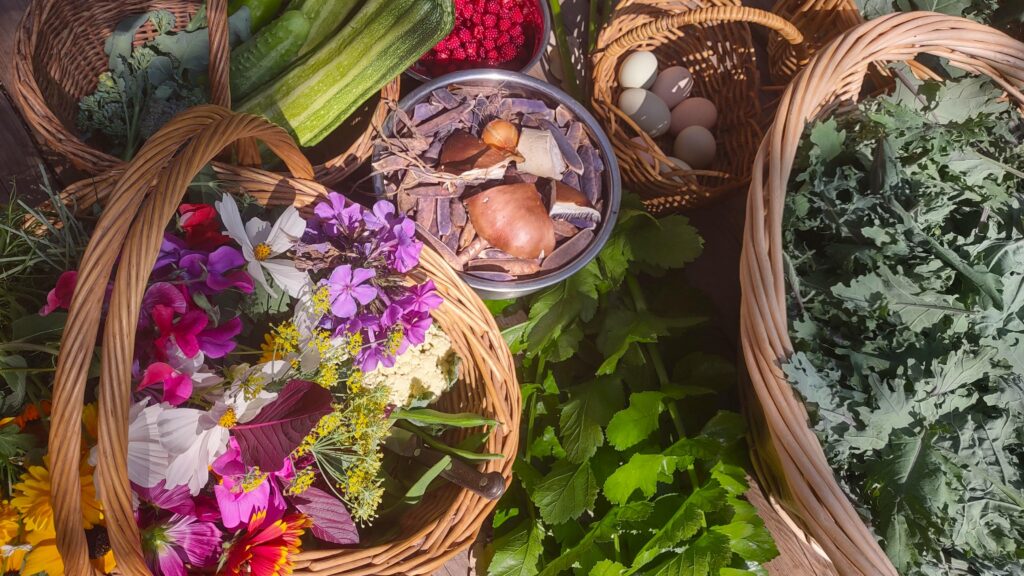
Baskets of freshly-harvested broccoli, cucumbers, zucchini, wineberries, purple peas, winecap mushrooms, multicoloured chicken eggs, kale, celery, cauliflower, and a diverse selection of flowers.

The idea of homesteading or growing food is enjoying some increased popularity at the moment, supposedly because it’s rewarding, both from a human-connection standpoint as well as ethically/morally, with regards to climate change and ecological preservation. Also, of course, once you’ve become accustomed to the deliciousness of homegrown fresh foods, it can be hard to return to the comparatively dull stuff from grocery stores that has sat waiting for ages, and usually was farmed extractively. That stuff is empty of nutrients and joy! And with the rise of fascism (and fascist destruction of trade, farming, research and prosperity), I think we’ll soon have many more reasons to grow and preserve our own foods.

I grew up in a homesteading family, so it wasn't difficult for me to tumble back into this rewarding life, as an adult with children. But, especially for people who are new to it, I know homesteading (or even just growing a little food) can seem really, really daunting. I keep seeing videos of homesteaders and food farmers “giving up”–either because they faced too many disappointments, or because other adventures called to them. If you’re one of those people who wants to grow food but has been put off by all the discouraging news out there, I’m writing this for you! I want to help you avoid some of the most common pitfalls, and find some serious hope and joy from growing food. The thing is, many of those homestead failures didn’t have to be failures. These people lacked a few of the basic ingredients for homesteading. I’ll talk about those ingredients in a minute. But first… the biggest deterrent to people growing food is lack of land, time or money. So let’s deal with those first.

I have no land!
OK. So you’re like most people. That’s OK! You can still grow food. The most obvious solution is to grow plants on a balcony or window. You can totally buy some expensive little gadgets like grow lights to help you with this, but it’s not even necessary. Just choose plants that don’t need a lot of light or space. The simplest is sprouts. Given two square feet of counter space, you can grow a huge variety of incredibly nutritious sprouts.

Easiest: Bean Sprouts
Buy the cheapest beans you want (whatever type you like but mung beans grow fast, so are great starters!). Soak a cup (or two if you have a big family) in at least twice as much water, overnight. Then strain them, rinse them, and spread them onto a baking tray lined with a woven cotton dish cloth (or whatever piece of fabric). Rinse them once or twice a day.

When you see them start to split, or little tiny points appear, they’re ready to eat! You can let them go a bit longer if you want to have a bit of a crunchy sprout. They’ll be delicious cooked like regular beans (and much more easily digestible), but can also be marinated for bean salad, or eaten fresh.

Almost as Easy: Pea or Sunflower Shoots
Buy whole peas or sunflower seeds (for planting; not packaged for eating!) Soak them overnight in a bowl of water, and then lay them on a planting tray full of soil. They barely need any soil, and can literally be dumped in a heap, or in dense rows. Put the tray on a windowsill, as they do need some light when they green up.

When it’s mild weather, they can also be planted outside, in this way. Simply wait for them to shoot up about 4-6 inches, and then snip them off with scissors. The peas will actually continue to grow and can be harvested a few more times.

When they’re spent, throw the remaining roots and stubs into your compost. The peas especially are amazing nitrogen fixers, and can even just be dug into the soil to feed whatever you grow there, next.

Alfalfa Sprouts (or clover, fenugreek, mustard, etc.)
This takes a tiny bit more time every day than the other two, but they’re SO delicious. I do recommend buying seeds intended for sprouting, here.

Prepare a wide-mouth canning jar (at least a pint or a litre or so), by cutting a piece of sturdy mesh that can be placed over the top and held in place by a canning ring. You can buy sprouting-screens for such jars, but it’s totally unnecessary.

Put 1 to 2 tbsp of seeds in the bottom of the jar, add some water, then the mesh and ring on top, and allow to soak for at least a few hours, or overnight. Then strain the water out through the mesh. Fill with fresh water, swirl around, and strain again. Leave the jar sitting open side down in a shallow bowl or on a (clean) dish rack. The seeds should be sitting against the mesh in the bottom corner of the jar, but not fully covering it. Repeat this rinse-swirl-strain process three times a day until your sprouts are starting to green up (tiny leaves will be developing at the end of the long stems). Then rinse and enjoy them!

Other than Sprouts: Small and Borrowed Spaces
So, obviously, sprouts are not the only thing you can grow on a counter. Buy or make planters out of whatever containers you like, and experiment away! Lots of people grow herbs inside, but veggies are possible too!

And if you have a balcony, even more is possible. I used to grow all kinds of veggies on my 3x8ft balcony in Vancouver, Canada. I had a screen of beans on one side (for shade as well as harvesting), squash growing along the railing (I had to hang little hammocks to hold the fruits as they got heavy), all kinds of herbs and heat-loving veggies, as well as a couple of tomatoes, and a 1x1m mini-lawn for my cats to roll on. We were very happy.

Of course, if you don’t have a balcony or windowsill at all, or just would like to grow much more than that, you may be able to work somebody else’s land. This relates to community-building, which I’ll talk about in a bit, for obvious reasons. But an increasing number of people are willing to allow others to grow food in their otherwise-unused yards, especially if they also get to enjoy the produce. Community gardens are another such non-homeowner option.

🌱


I have no time!
This is such an unfortunate reality for the majority, these days. Especially for those with kids or low-paying multi-jobs. Obviously, there are some things you can do (like sprouts, above) that can still be do-able, given enough forethought (and maybe a reminder to rinse and eat them!) But if you want to grow more than just sprouts, a mind-shift might be necessary.

For us, the pandemic gave us a reason to let go of kids’ activities and start a proper garden (after a few years of development, our kids have now moved out, and we grow most of our own food on less than 1/4 acre). A garden (or balcony planters) can take as little as a handful of hours per week, in the busiest growing season. And obviously, the more you grow, the more land you utilize, and the more variety you grow, the more time you’ll need. But I do have a few time-saving ideas:

No-Till Regenerative Gardening
I won’t go into detail, here, but I’d highly recommend watching a few YouTube/etc. videos about it. This is what we’ve been doing. At it’s core, it’s about feeding the soil and working with the ecology you have, instead of stripping it. This involves allowing some weeds to grow where they want, allowing the soil layers to remain in-tact by not ploughing, tilling, or weeding too aggressively, and watching which plants grow best where, to allow the garden to evolve in the way that works best for the plants you’re trying to grow. A lot of “allowing.” But… the more we “allow” things to grow as they need to, the less work we have to do in fighting them.

Grow Fruit Trees!
Fruit trees do need to be pruned at least once a year (twice can be better for some), and they’d benefit from some thoughtful planting and maintenance of the ground around them, but on the whole they can produce a lot of food for very little effort. The same is true of many perennial plants, including berry shrubs, asparagus, Jerusalem artichoke, and many others.

Be a Lazy Gardener
Some things really do need to be done, in the garden: adding compost in early spring, seeding (maybe even starting seeds indoors if you’re in a changeable climate place like I am), and pulling out weeds and veggies that outcompete others. But a pristine and orderly garden is not even a happy garden! Plants LOVE to be mixed up. Most also love to be left alone to grow! Gardening may not even take as much time as you think it will.

Call in the Insects
Insects are generous garden helpers. They pollinate, of course, but when we ensure a great diversity of insects (and insect species), they balance their own populations, keeping invading hordes of veggie-demolishing insects to a minimum. The greater diversity of insects we have, the fewer issues we’ll have from destructive insects. And they work for free! Well… almost. You have to pay them with flowers. Add a bunch of different types of flowers to attract insects. Clumps of marigolds, asters, violets, sweet peas—even perennials like rhododendrons and other flowering shrubs if that suits your fancy! Whatever is easy to grow, and makes you happy. Clovers are not only excellent insect-attractors, but also, being related to peas and beans, put much-needed nitrogen into the soil. They do take a bit of pulling-back, though, as they can easily grow into a bed and take over. I grow low-growing clovers between raised beds, and mulch the extras into my compost, as well.

Plant a No-Mow Lawn
Mowing lawns is not only a scourge on our air quality, but it's also a massive waste of time! We replaced our lawn with a low-growing no-mow lawn of sedges, small daisies and other flowers, and low-growing pink clovers. I never mow, anymore, and my lawn stays lush and green all summer!

Plant Thoughtfully
Check out useful companion plants for the veggies you choose, so that everything you grow can thrive. Always research, to understand the needs of your plants and the kind of plant community they enjoy. This will also help you diversify and create a garden that sustains itself, with little management needed from you.

Share Your Yard
If you have a yard, and a desire to eat homegrown food, but no time to grow it, consider allowing someone else to garden in your yard! Set some ground-rules, especially with regard to bylaws, invasive plants, and access, but then give as much freedom as possible to the person or people using your land. Trust them to make good decisions, and put your effort into building a relationship with them. You’re building a community. 💚

🌱


I Have No Money!
So… this is an increasing majority of people. And probably the hardest obstacle to overcome. I’ve been passionate about growing at least a little of my own food since I left home at 18, so I have learned a few basic cost-saving tricks along the way.

Save seeds
A LOT of veggies are just plain easy to save seeds from. The biggest issue you’ll have is cross-pollination, so plant just one type of each thing every year (like one type of bean, one type of pea, one type of lettuce, etc. etc.) That will save you accidentally creating useless hybrids. In most climates, the most commonly-grown veggies (and tomatoes and cucumbers and squashes) are easy to save seeds from. YouTube, again, will help you out with the specifics.

Don’t waste money!
There’s a massive industry out there making money off new gardeners who don’t know there are cheaper options. From grow-towers to veggie-starts to chemical fertilizers, there is an infinite list of things you don’t need. What you really do need is this:

  • Good Soil: You can buy it bagged if you’re growing indoors or on a balcony, but if you have land to grow on, get it delivered in bulk, or better yet, amend the soil you already have.
  • Compost: Buy a little, the first year, and start making your own (unless you’re composting inside, a good old compost heap, caged to keep out rodents, is your best bet—feed it constantly!)
  • Mulch to Keep Down Weeds: newspapers for small spaces, or arborists’ chips for larger plots. See https://getchipdrop.com/
  • Seeds: share with your community! Look for seed libraries, and talk to your neighbours. You don’t need to buy from seed growers, but if you do, just a few is enough.
  • Gloves: (Only if you’re dealing with weeds like blackberries.)
  • A Shovel: A small trowel is fine unless you have a large plot; then you’ll also want a spade.
  • Pots: Whether big pots for balcony growing or smaller pots and trays for windowsill growing or seed-starting, these should be free. There are SO many people throwing away their used nursery pots every year. Ask your gardening neighbours, or check your local recycling depot.


Garden in Community
The more people share the costs and the labour, the easier and cheaper gardening becomes. Not to mention more enjoyable, more fruitful, and with bigger harvests, since everyone learns from each other.

🌱

Ingredients for Success
OK, so I mentioned the basic ingredients for happy homesteading. I meant that in the same way the main ingredient in Mama’s cornbread is love. It really is—it was for my Mama, and now I’m the Mama I know what that means!! And it’s the same with gardening. The ingredients are love, commitment, and patience. Just like raising children! And baking. 🙂

I’m truly not just being poetic. Here’s what I mean:

Love
You have to LOVE this. Deeply. If you’re growing food because you think you should, or because someone else told you to, it’s going to be a slog. But if you have good reasons for doing it, it veers into the realm of love, and then you’ll weather all the storms. Some good reasons I and other successful gardeners have are because it brings us enormous joy, because it gives us wonderful food, and because it makes us feel we’re doing something to improve our world. What is your reason to love growing food? Maybe you don’t have one yet. You can start with just purpose, and given commitment and patience, love will grow.

Commitment
It’s not going to be a breeze. Growing food is a constant learning curve. Especially if you’re going the regenerative route, but shopping at stores that constantly try to sell you harmful industrial-farming products. You’ll use them and they’ll damage your soil or set back your progress and you’ll lose faith. And even if you really commit to regenerative farming, you’re going to have failures, because that’s simply how ecology works. It’s a balance that’s eked from an infinite complex diversity and many failures. But we commit to that—the complex diversity—and we weather the storms, and find solutions, and really… we grow into it.

Look at the word commit. It begins with bring together (co). Like community, coworker, etc. Commitment is about coming together not only with other people, but also with the task at hand. And in this case, that’s creating and nurturing a harmonious ecology that will produce food for us to eat. In other words, it’s about making ourselves co-participants in our ecology. That realization, alone, will make gardening easier and more successful. It’s not a project you’re overseeing; it’s a community of plants, insects, minerals, and weather that you’re a part of.

Oh… and quitting? You can’t quit. You’re not co- anything, if you quit. So grow a pair of potatoes and keep at it.

Patience
It will take years to have any kind of garden feeling whole. That’s because it has to go through many cycles (a year is a cycle) just for the soil nutrients to find an equilibrium, and from that basis, the diverse ecology of the plants, insects and animals. And it also just takes a few seasons for you to get to know all your co-ecosystem-inhabitants.

I’ve seen multiple homesteading “influencers” give up after a year or two. That’s like putting your toes into the opening of a shoe and declaring it doesn’t fit. No. You have to put it on, lace it up, and then walk around in it. And even then, you probably have to wear it for a few weeks or months before it really feels great. It’s the same with gardening. So… find a reason to love it, commit to it, and then be patient. And when you struggle, go find regenerative solutions for the ecosystem you’re growing into.

Happy spring!

How to Overcome Fascism by Eating Delicious Local Food in Season

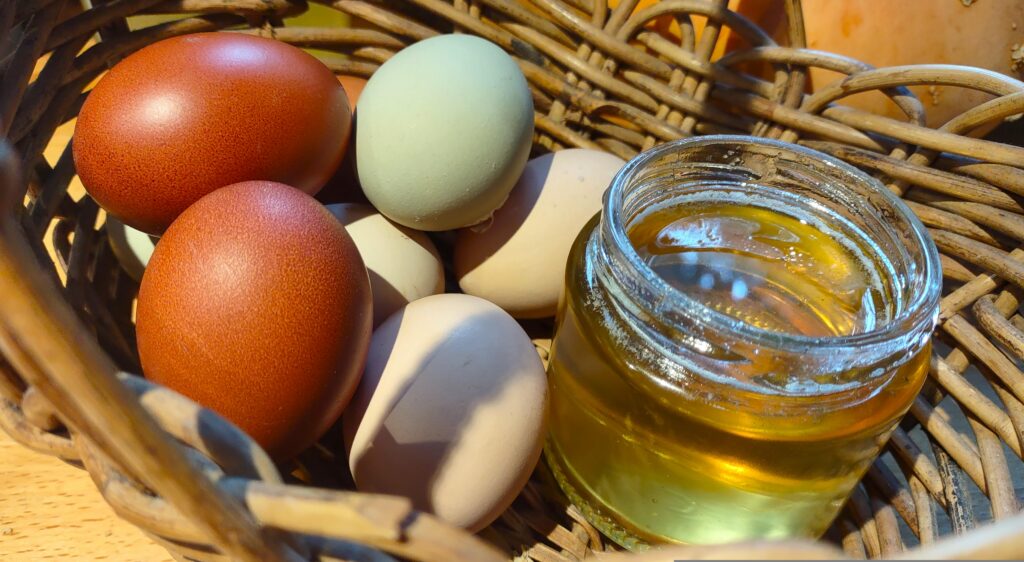
A wicker basket containing nine eggs of different colours (dark reddish-brown, pale brown, green, and pale green) along with a small open jar of local honey.

We had a beautiful moment, yesterday, when two young women who grew up next door to us brought us a jar of honey in trade for our chickens' eggs. They're just visiting their parents' house, as they both moved out years ago, now, and it was lovely to catch up a bit, and chat about what flowers the bees were drinking from.

Here's how it works: Both my and these young women's parents bought land, when it was affordable, here. Our parents grow and tend to a plethora of flowers, fruit trees and vegetables. Their parents keep bees that drink from the flowers in both of our yards (and pollinate the veggies and fruits we grow, as well!) and we keep chickens, who not only fertilize our veggie garden, but provide eggs and meat that we can trade for this gorgeous honey… made partially from the nectar of our own flowers. The neighbours on the other side of us grow corn that for some reason we can't grow just a couple hundred feet to the west, so we delight in fresh corn, in August, in addition to all the crops we grow ourselves, and buy from others in the neighbourhood. All of us have to give away zucchini and other too-plentiful crops to the broader community, as well. And we teach people how to do what we do, because the more people do this, the richer we'll all be.

It seems really too idyllic to be true, but this is the dream my parents had in the seventies, and through three generations we've now managed to carry it on, to some extent. And it's the foundation of what it truly means to buy local.

Now here we are clenching our teeth, watching a bunch of fascists try to take over a rather large chunk of the world, munching through Hitler's playbook one vile action at a time. Whether you're here or there, or whether you're repulsed or scared by their actions, eating local is a good idea. In fact, eating local has always been a good idea, because it's sustainable. And now maybe the trade war or the scarcity caused by fascists kicking a large percentage of farm workers out of their countries will push more people to eat local, too. I hate to think there might be a silver-lining to all of this, but also I'd rather build that silver lining than only wither away amongst the negatives. I think maybe that silver lining is bigger than food, too. I think now we can we use our frantic flee from fascism as a leg-up on the way to save humanity from pernicious greed.

And it doesn't matter what country we live in, either. All of us are going to be affected by the trade-war, and all are going to be affected by food and labour shortages. But we don't have to suffer. Yesterday I saw someone asking where to get fresh local produce in winter. Well… we live up north, so we probably can't, unless it's from a greenhouse. So the question is not so much how to simply buy locally, but how to change our diets and expectations in order to buy locally.

Me? I only eat fresh corn in the summer. That's when it's abundant, here. And frankly, it tastes a lot better than whatever well-travelled corn is available in the stores in other seasons. Maybe I freeze some of my neighbour's corn in the summer, and can add it to a nice Spanish rice or pot of chili, right now. Because it's winter. I'm eating a lot of veggies, legumes, fruits and meats that I dried or froze last summer, along with some fresh greens that I'm growing on my windowsill and under a grow-light (pea-shoots, alfalfa sprouts, and a few lettuces). In fact, even if you don't store food yourself, the best-tasting food in the grocery store during a northern winter was flash-frozen fresh from local farms, last summer. A bag of frozen broccoli is much more delicious than those slightly grey imported broccolis in the fresh produce section.

It definitely takes a little more planning to eat what's locally grown and seasonally available, instead of just going for fresh avocados, tomatoes and apples, year-round. But I like a small challenge, and to be honest, it's not much of a challenge after you've done it for a year or two, and mostly… it's so enjoyable! That fresh corn that I only eat in summer? It's not only more delicious because it's fresh and comes from my smiling neighbours' hands; it's also more delicious because we only eat it during one month of the year! It's like Christmas treats: by the time we get back around to Christmas, we're craving that stuff! Scarcity makes things delicious.

But what about expense; affordability? Have you seen the prices at the local farmers' market?! This kind of seasonal local eating is only for the privileged, right? Well yes, to some degree I can see that line of thinking. I have a huge privilege in being able to farm on the land I rent, but my family is also on the lower end of the middle class, and we've managed to make these choices by prioritizing where we spend our money. Instead of taking vacations, we built a garden; instead of owning a home, we rent. We cut expenses wherever we can, and spend a little more on the things we feel matter most: a healthy home and meaningful time with our children. We spend more than most people on ethical, partly-foraged meat, because raising our own chickens, buying neighbours' lambs, local, sustainably-caught seafood, and local grass-fed beef and dairy is very expensive! So we minimize our consumption of it, and we supplement with legumes and pulses. I buy some dried and grow/dry some myself, and then I just soak them overnight, move them to a tray for sprouting, and cook them in a day or two, whenever I feel like it. We pay pennies per cup of food, this way. Unless we add expensive cheese, which… I confess happens more than it should!

But boxed cereals, cookies, prepared foods; even canned foods–these I consider a waste of money. Our culture spends a lot on processed foods that don't nourish us, and deplete not only our finances but also our land and cultural heritage. Learning to cook from scratch is a huge benefit not only to our health, but also to our pocketbooks. It's true that it takes more time, but for our family this became quality time. By the time my kids moved out they were fully capable of growing food and cooking from scratch. I can't imagine a more important skill, but it's also a point of bonding for us, as we still get together to make and share meals.

How about a useful list. I'm in the Pacific Northwest, and can only talk about my own experience, really. So here it is, a list of common locally-produced foods from my region. I'd be happy to hear yours!

Fruits:

  • Spring: blossoms! (OK it's not a fruit but you can see my reasoning…)
  • Summer: all kinds of berries, grapes, and stone-fruits
  • Late summer: figs, kiwis, more berries, tomatoes
  • Autumn: apples, pears, quinces, tomatoes
  • Early winter: persimmons,
  • Winter: stored apples (still fresh), jams, canned fruits, frozen fruits, and dried fruits

Greens:

  • Spring: Pea shoots, edible-pod peas, spinach, lettuces, overwintered kale and broccoli, wild greens
  • Summer: Lettuce, Chard, kale, cabbages, broccoli, green beans, shelled green peas, celery
  • Autumn: same as summer, plus spinach
  • Winter: some fresh kale, stored cabbages, frozen or dried greens, and fresh sprouts/shoots

Other vegetables:

  • Spring: seaweeds, overwintered cauliflower, baby carrots, asparagus
  • Summer: turnips, celeriac, carrots, beets, cauliflower, new potatoes, peppers, eggplants, artichokes, sunchokes, zucchini and other summer squashes
  • Autumn: same as summer, plus potatoes, winter squashes 
  • Winter: seaweeds, stored potatoes, carrots, sunchokes and squashes, canned or frozen other things, dried seaweeds, peas, beans and lentils

Grains:

  • Autumn: most of our local grains are harvested in late summer or autumn, and of course they store on our shelves all year, after that. We have quite a few available in our area, despite not being the prairie: oats, barley, wheat, rye, corn, buckwheat and sorghum are what I'm aware of.

Nuts and seeds:

  • Autumn: mainly hazelnuts (indigenous, here!), but also some walnuts, hemp seeds, pine nuts, beechnuts, and chestnuts.

Animal products: (not by season because some can vary, and most can also be stored frozen)

  • meat: fish, invertebrates, poultry, larger birds, rodents, lamb, pig, and beef. I believe it's more sustainable to only eat locally and ethically-grown meat, and to eat it only rarely, supplementing with eggs, legumes and pulses, as well.
  • eggs: although many non-industrially-farmed chickens produce fewer eggs in the winter, it does depend on the breed and the conditions, so it's absolutely possible to have fresh eggs all year round.
  • dairy: we have lots of local sustainable small dairies here, producing cow, goat, and sheep products!

Sweeteners: (mostly made in autumn; stored all year)

  • maple syrup, barley syrup, honey, corn syrup, and beet sugar.
  • apples, grapes, figs 

Salt, spices, etc.:

  • we do actually have sea salt produced on the west coast!
  • many herbs, peppers, seeds, spices, etc. are grown here and preserved before winter.
  • seaweeds, kelps

What to cook! This is just some of my favourites:

  • Spring: all the flowery salads, dairy, eggs, and bright fresh greens! Also legume/pea salads, wild-green and egg sandwiches.
  • Summer: (Do I have to say this, even?) ABUNDANCE of fresh and grilled foods!!! We even make our own ice cream by putting frozen fruit, honey and local cream into the food processor!
  • Autumn: pies (fruit and savoury), hearty soups, hot potato and grain dishes.
  • Winter: chili, stews, & casseroles made with dried and frozen produce, baked desserts of grains and dried fruits, 

I'm getting hungry writing this list. Yum. Every region of this earth has its own delicious range of available nutritious foods in every season. We can not only survive but absolutely thrive by embracing the goodness of the places we call home. Tomorrow, I'm going to make a fruit-filled bread with my eggs, honey, local butter, home-dried apples, and some locally-grown oats I can grind into flour using my handy little mill. đź’›

10 Ways to Save Humanity Even if You Can't March on Sept 15th

As the death-toll from Libya’s storm floods surpasses eleven thousand, and various hurricanes march their ways across the oceans, people all over the world are gearing up to March to End Fossil Fuels, tomorrow. (Find your city’s event on this map.)

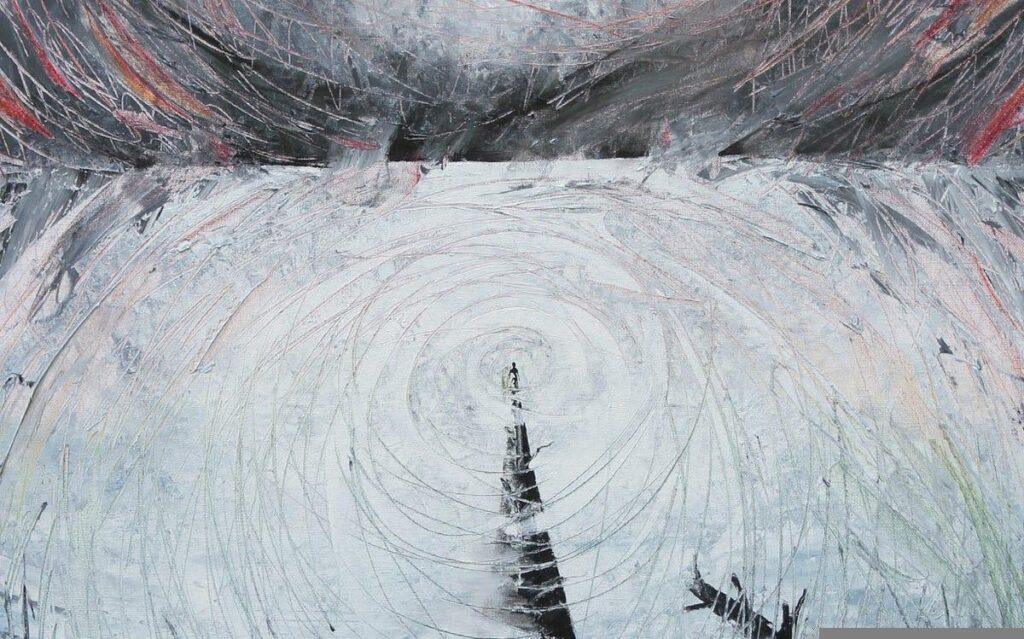
A painting by artist Emily van Lidth de Jeude. Mostly white and grey; a kind of abstract landscape, maybe, with fiery grey in the distance. A jetty or log stretches from the foreground into the distance of what might be a lake, a sea or a plane, and a very tiny distorted human figure stands at the end of it, encircled by nothingness.
Not a Thing Between Me and You (detail) … Recent painting by Emily van Lidth de Jeude, in response to Neil Young’s song, “Overhead”. This painting deals with our compulsion to just keep going into an unknown future, together, even when we don’t know we’re not alone. It’s about courage.

But what if we can’t march? And even if we can, how are we going to propel this impetus into action? How are we going to actually save our future on this planet? (Let’s face it, we’re not going to another planet, and instead of talking about “our children’s future” now, we’re talking about our own.) We’ve got months or a couple of years to turn this around, and even if we do, storms like this are now here to stay. So what can we do about it?

  1. Become resilient.
    We can stop following the status quo, and learn to live differently than our youths and the media told us to. Learn to cook our own food. Learn to pivot our careers and plans and housing situations as needed, and without being traumatized. Adaptable creatures survive.
  2. Make our kids resilient. 
    So you might know I usually write about unschooling. That was (and still is) my effort to raise resilient, independent, capable adults. And it worked! At 18 and 21, my kids are now living independently (together), paying their own way, and making changes for a better world. 
    Unschooling isn’t the only way to make our kids resilient. Any kind of freedom to explore and develop their own skills will help. As will encouraging schools to opt for explorative learning, wilderness education, and all the things that will help our kids be connected, creative, courageous, and resourceful. Those are the skills our kids will need to survive our new world.
  3. Grow food.
    Whatever we can do, whether it’s growing sprouts on our kitchen counters to save $10/week in veggies, or escaping the rat race to go whole-hog on a homestead — just do it. We can all (and yes I mean all) grow at least some of our food. This not only saves money (if we learn from someone else who’s doing it effectively and don’t fall for sales tactics for all the gadgets we don’t need), it also brings us closer to our food, giving us a deeper understanding of life, our bodies, our connection to the ecology we live in, and nutrition. It’s healthier for us (fresher food), and it’s also healthier for the environment, since everything we grow (sustainably) ourselves is something we don’t buy from the unsustainable agricultural industry.
  4. Buy local.
    For all those foods and other things we can’t grow or make, ourselves, we can buy local! I guarantee you there is somebody out there trying to get rid of a bunch of homegrown zucchinis or apples right about now. What if we paid them instead of a big supermarket chain? What if we bought from local farmers, builders, and creators instead of from the capitalist industries that are the root of climate change? This is a shift we can make.
  5. Don’t buy! Boycott capitalism.
    Buying local is one way of sidestepping the corporations who are doing the most damage, but buying less is an even better way. A big part of our problem is overpopulation, and then there’s overconsumption. We really don’t need all the stuff. We don’t need big houses. We don’t need big cars, we don’t need lots of clothing or school supplies or travel or household items. We don’t even need as much food as we currently consume, and we especially don’t need to be wasting as much food as we do through restaurant and supermarket refuse, and simple neglect at home. How many times do people go on a fabulous vacation and then declare they need a vacation from their vacation? What if we just took a local vacation in the first place — one that doesn’t displace people from rental accommodation, and that connects us with our homes in ways we hadn’t experienced, before? In the space that’s left without the things that we don’t *actually* need, we will learn to find convenience, fulfillment and joy. We will have space to keep building that resilience and resourcefulness I mentioned earlier.
  6. Be happy with less.
    Along with resilience and resourcefulness comes happiness. It is just plain so rewarding to grow my own food! I go out every day now and tend my chickens, weed a bit of veggie garden, eat some food right off the plants, and just generally revel in a lifestyle that I once found daunting. I feel empowered by my mended clothing in a way I don’t feel empowered by something brand new. I now have some serious disabilities, and learning to be resilient and resourceful has made me happy, similarly to how my job working with kids used to make me feel.
  7. Love our local ecology.
    Partly the joy I get is from being active in my local ecology (also similarly to when I worked with kids on wilderness exploration)! I have learned so much about how connected we are; am currently fascinated with the many types of wild bees and other insects that frequent my small yard, and with their life’s work and activities that all contribute to the diversity we depend on. How does this love save our world? By connecting us with it. If we love our ecology, we’ll know it better, and the more we know and love, the greater ability we’ll have to protect it. We need our ecology. If only for the simple reason that it feeds us and protects us from storms. That in its diversity it will recover when we finally do turn the trend of climate change around.
  8. Love our neighbours.
    We’ve got a couple of new neighbours recently. We’re making an effort to connect with them. You know why? Because when the power goes out, when a tree falls across the road, when someone’s pipes freeze or someone needs any kind of help at all — or just a hug, we will be there for each other. When the storms come, we’ll need each other.
  9. Love our children.
    Obviously. Because the hell that we’re going to experience pales deeply against the hell that our kids will know. If we love them, we need to save them.
  10. Just love.
    And when it’s all too much, when we’re succumbing to doubt and fear and a feeling that nothing we do could possibly be enough, we can love. If I’m going to die, I want to do it in the arms of someone who loves me. And more importantly, I’m far less likely to die early if I share a deep love. Our future and neighbours and children and the whole global population is more likely to thrive if we live a life of love instead of material acquisition. 

Love is actually a hard thing to do. So I’ll tumble out of my list now, just to write a little about love. Love is a challenge. It’s like a great wave piling up behind us, saying â€¦RUN! And can we do it? Can we keep going even when the wave is catching our ankles? Can we slog through the wash around our waists, grasping at the ungraspable wind, to haul ourselves out when the wave peters out, and get up and run again before the next wave comes? That’s love. It’s work. Neverending, challenging, heartbreaking impossible work. But it’s also the only thing that’s worth working for. Love is, in many ways, survival. When love (of a person, planet, dream, or future) compels us, we can access the resilience, courage, creativity, and resourcefulness needed to meet all the challenges. Climate change included. 

So whether or not you can join a climate march tomorrow, do something. Something that will make you feel empowered and resilient. Something that will save us, tomorrow. And tomorrow? Do something again!

With love,
Emily

the struggle between change-making and capitalism

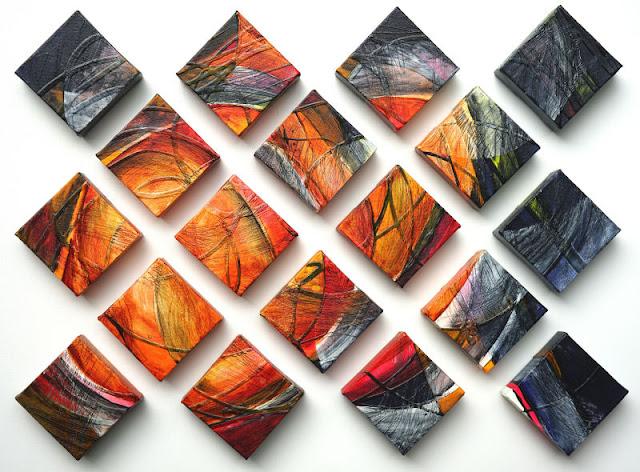
A Universe Inside Me, a change/able painting by Emily van Lidth de Jeude
To view this piece in action, see my MakerTube video.

All my life I've been interested in change-making. Other than loving my family, there's nothing in the world more important to me. But that's the issue–change-making costs money, and time that means I can't make money. My partner and I are constantly making choices to deny our kids some of the things their friends consider essential (travel, city-living, new devices, new shoes, a better car, and so many extra-curricular programs), in exchange for working on projects that we hope will better the world or just our own future. And yet, here we are with young adults on the verge of fleeing the nest, walking straight into the same capitalist trap they were raised in. And we're thinking of how to support their new city life while the world falls down around them. 

Cognitive dissidence is the least of it. I'm sitting here in the bizarrely unsurprising October heat and drought, the other side of our yard obscured by smoke, and really just wondering what comes next. 

In my work-life, I'm producing installations intended to bring people into connection with the ecosystems they live in, and with each other. I do commissioned portraits on the side, just to add a little tiny cash-flow to our family, but I've chosen a career that costs more money than it makes. I'm proud of this choice, but the balance is that my partner makes the family-sustaining income by creating software that, among other things, is used by companies logging old-growth forests around us, destroying the ecosystems I'm trying to save. 

At home, we're trying to grow our own food, which has turned out to be a very good thing, now that inflation is hitting us so hard. But we're buying plastic bags to store chickens in, and the climate is so unpredictable we're constantly re-planting, or nurturing struggling plants for months that ultimately fail to produce crops. No learning-curve can keep up with the speed of climate change. So we keep ending up in the stores with everyone else, trying to meet our nutritional needs as cheaply as possible, while wasting endless dollars buying chips and treats made by corporate behemoths that we feel will keep our kids happy. So we can send them smiling into the future.

In our community we're traipsing around making improvements while our friends drop like flies around us. We're afraid to ask for help when we need it because we know everyone else is already beat up by their own struggles, so we isolate and feed our lonely pain with all the subscriptions and addictions we can. And we contemplate the struggle: How can we make enough money to feed our kids without destroying their future? How can we raise them happy in a world where nothing matters more than the capitalist quest, but safeguard them against a capitalist apocalypse? How can we output joy when there's only fear coming in?

I wish this was a post where I have all the answers. Sometimes I try to write posts like that, and at those times it feels like there's a possibility we can plan and manage our way out of this mess. Right now I just sink into a futile wish that we'd all just stay home and forget the dreams we were sold as children, as impossible as that seems. I wish we'd stop selling the same dreams to our own kids at the cost of even the meagrest subsistence in their future. I wish we would all just grow food in peace, love each other and what remains of the world outside our doors.

How to Prepare for Scarcity and the Great Inflation

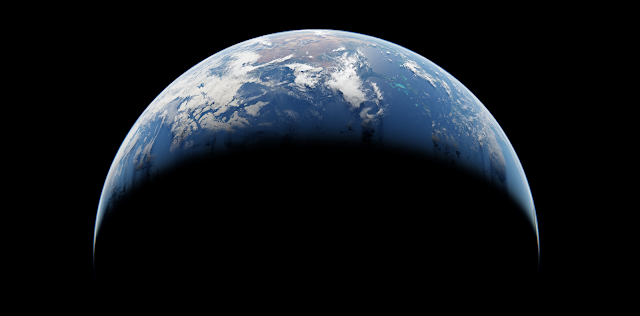
A view of Earth, lit only from above, on a black background. Some of Europe and Asia can be seen under a thin, sparse layer of clouds. This is a rendering of a 3D model by Taliesin River.
Illustration by Taliesin River

"You’d better prepare for the greatest inflationary wave in human history." That's the line that stuck out to me, near the end of umair haque's REALLY good article, "Why Everything is Suddenly Getting More Expensive — And Why It Won't Stop". If you haven't read this article yet, or aren't already familiar with the idea of the Great Inflation, and how we're now paying for the affordability of past generations, I recommend reading that article before reading this one. 

umair's article was very helpful to my understanding of why our groceries are getting so expensive or why, for example, I looked into second hand electric cars a few years ago and could find plentiful good options under 9K, and now there are none. So we know the Great Inflation is happening. My question is, how are we preparing?

Emergency kits and Go-bags are not going to cut it. Home preparedness is totally underway at my house. After this year's excruciatingly horrible wildfire season, we made plans to back up our family photos and prepared a little waterproof box for our phones, wallets and hard-drive, for when we'll inevitably have to jump in the ocean and swim. After this year's heat-wave, we bought an air conditioner that doubles as a dehumidifier for the now annual warm-and-foggy (read: in-house-moldy) season. After the deep freeze we insulated our chicken-coop. After the current flood-caused highway (and whole-town) washouts, we put emergency supplies in our car. After gas prices jumped and the flood-caused supply chain disruptions made gas rationing necessary, we looked into electric cars. I already told you how that went. 

But what's next?? We all know that none of this is enough. We can hardly predict the next climate-change-related disaster. Who knows how we should prepare? The one thing we all have to do is learn to live differently. And the change needed is so drastic we can hardly fathom it. Personally, I need lists to help me fathom. So I'm making one. In my mind it breaks down to three broad sections: things we need "much less", "none" and "more". My list is not complete or well-organised, but it helps me sort out my mind, so here goes:

We need much less of this:
Most things in this first section should actually be on the "none" list, but at the moment our culture is such that we're going to need a transitional phase. I guess that's what this is. This gives us time to learn and share some skills we've abandoned and get prepared for the time when, whether we like it or not, all these things move to the "none" section.

Travel: As fuel and steel prices rise, it's going to become impossible for most people to travel, anyway, and the many industries that depend on travel tourism will die, regardless. But on top of that, it's already becoming impossible to commute for work, to send our children to non-local schools or programs; to visit our parents. We're going to have to use our great ingenuity, as we have already proven capable of during the pandemic, to work around this.

Dependence on government: I'm not sure what makes us think that the government will just keep creating resources to fix and replace those destroyed by climate change, but I'm going to go out on a limb and suggest that right now our government and military are pretty taxed just dealing with the constant march of disasters. At some point that's going to break. There won't always be soldiers available to build dikes and put out fires. We might as well get used to that, and expect to do the work, ourselves. Yes we can.

Clothing: I have such a clothing addiction! I think I buy very few things–just a garment or four a year for each person in my household. And recently I try to buy sustainably. But I also still own, alter and wear many clothes from my teens, and every decade between then and now. I probably have about ten times as many clothes as I actually need, and it's not like giving them away would be any more sustainable. Some parts of the world are drowning in our "donations" (take time to watch that if you, like me, still thought donating clothes was helpful). The only actual solution to this is to stop buying, entirely. I know I have enough clothing to last the rest of my life, if I do more mending. And I could clothe the rest of my family, too.

Non-local food and industrial agriculture: We know that industrial agriculture, along with fossil-fuel driven production and transportation, is a disaster for our future. Thousands of chickens and cows just drowned in my province when the artificially-drained land they lived on flooded, because of climate change. Our flimsy, human-made systems are going to crash so hard they can't recover. We might as well accept that now, and start something new so we're ready when they're gone. There are many viable solutions for this problem, and they begin with all of us eating more simply. 

Imported food: We can do this now. My family is Dutch, and we LOVE our imported cheese. My family is also Mexican, and we–wait! We already figured out how to make our own tortillas from local corn! This isn't going to be as hard as I thought. This isn't as big a deal, perhaps, as how our food is produced, but it's one way we can make a difference to our impact, and become more engaged in local food production.

Fossil fuels. Resource Extraction. ALL. THE. WASTE: We're already making some progress with this. As we limit our needless use of office buildings for computer terminal work than can be done online, we will need less concrete and steel. As we commute and travel less, we'll need fewer highways and less fuel. As we drive less, fewer cars. And on it goes. The stuff that supported our wasteful consumerist existence will no longer be needed, and we can stop pillaging and burning our earth's resources.

We need none of this:
We already know these things are destroying us, and we can eliminate them, now. Yes, there will be devastating job losses, and huge shifts needed in our culture and thought patterns. We'll have to get very creative. But you know how when a close family member dies we're devastated and we don't know how we'll ever recover? But then we do, and we grow. And we end up somewhere new we never could have imagined before the loss. This will be the same.

Tourism: Yep. That's probably the end of the travel industry. Airlines. Cruising. Little plastic souvenirs and the trusted income source of so many communities, including mine. We'll find other ways to enjoy our world, along with other ways of supporting our communities.

Careers that depend on global travel: So much of our current air-travel is related to needless work-travel. It's the end of my career as an artist who exhibits in Amsterdam. A few years ago I might have said, "at least I got to do it once…" Now I'm kind of embarrassed I didn't make this realization before that. Lucky for us, technology has brought the world to our handheld devices. We can make the most of this.

Needless consumption, supporting mega corporations, escapism: I, like most of us, grew up in an age where Christmas was actually about presents; about light shows in shopping districts and buying stuff to feel happy. I learned to satisfy my soul by shopping, by travelling; by escaping my real-world life into screens, food, shopping, and travel. Now that that world is falling apart, it's no longer satisfying to fulfill those consumption needs. For Christmas I want to be released from the "age of stuff", as my friend recently called it on Facebook. Oh yeah. Facebook. That has to go too. I'm going to have to actually go to out and talk to my community members in person. I hope I find some walking around without their phones.

So now what? Now that we've dispensed of most of the biggest industries in the world, most of the jobs, and everything we actually loved about life… how on earth are we going to survive? Well, maybe not on earth. The billionaires are already playing with spaceflight. Let them move to Mars. The rest of us will dig deeply into that "More" category, and thrive. 

We need more of this:
This is the beauty section. This is where we take all the grief and fear from the previous two sections of my list, turn it on its head, and marvel at all the joy we've found.

Local food (and other resources): The more of us go find sustainable, local producers to satisfy our needs, the more such producers there will be. It's not cheap to do this, so a huge part of it is valuing the food for what it's really worth. My partner and I decided to eat very little meat, a few years ago, and what we do eat should be sustainably produced. So in order to afford this (both ecologically and financially) we went from eating meat three or four times per week to a maximum of once a week. And we eat cheese about twice a month. I'm still looking for a really good local cheesemaker. When I find one, that cheese is going to be as expensive as it should be, but deeply, deeply appreciated. When you don't get something very often, it becomes so much more valuable. It's the scarcity principle, but this time it's working for us.

Sharing: My family has chickens, now. Sometimes we don't have enough eggs even to bake bread. Sometimes, we have enough to bake, make quiches, and share with our family. Those are happy times, when we feel rewarded by our ability to contribute. Like when my neighbour grew so many apples she asked us to come pick some. We ate so many apples that year. Sharing isn't always about food, or even objects. We make a point of learning and sharing knowledge with our neighbours, as well. Sharing isn't just necessary for the equitable use of community resources–it's necessary for our survival.

Finding sustainable ways to contribute locally: This is the joyful counterpart to the misery of losing jobs and entire industries; economical collapse that will be a natural fallout from rampant inflation. This is where we find ourselves working instead of for money, for survival. And I can tell you from my experiences supporting unschooling parents, teaching and writing for free, and raising plants and animals for food, it's the most rewarding work I've ever done.

Connecting with community and local ecology: We protect what we know and love. Those who know and love us are our resources, and will protect us. This is the foundation of a wholistic society, but it's also the root of love and joy, so… what more can I say?

Pointedly appreciating what we do have: This comes back to the scarcity principle. My family has been regularly cutting back our consumption for a few years, now. We're eating mostly rice, corn, beans and lentils, along with what we grow, ourselves, and locally-grown veggies in the winter. We really enjoy our mushrooms, now that we only get them when they decide to pop up in the garden, or when we find them growing in the wild. It's the same for our homegrown chicken, eggs and veggies. It's the same for clothes we've mended or repurposed. Now that we rarely get to see our family (because: travel), we appreciate phone calls so much more. I make a big deal in my heart of what we took for granted, before. And that leaves me feeling deep joy.

~~~

Maybe it's weird to be talking about deep joy in relation to climate change disasters and our current basic needs becoming unaffordable. But maybe we're just not seeing straight. The cost (as opposed the price) of our lifestyle has been astronomical since our parents and grandparents were children. Now we're finally paying for it, in climate change disasters and rampant inflation. That's going to hurt a lot, no matter how we slice it. But maybe some mental preparation can make the hurt more tolerable. 

Maybe, instead of dreading the fires or floods or the housing crisis, we can prepare by living more simply, by forming strong communities of people who support each other; by building and living within our means. Maybe instead of rushing to the stores to stock up when we hear there's a shortage of microchips, maple syrup, or gas, we can embrace scarcity. Those last few spoonfuls of maple syrup are extra special now; I can feel resilient by making do with older devices, and I can walk instead of driving. I can even stay home. I can change careers, if I need to. And most of us will. Maybe, instead of working ourselves to death and spending more than we earn on big homes; spending time and money we don't have on travel and products that cost us our future, we can work less, spend less, love more, and look at everything we do have as if it is a gift. Because it really is. And we're finally learning to cherish it. That cherishing–that appreciation and finding of deep joy–is how we prepare our minds for the inevitable.

Originally published in December, 2021.
Creating Hope as an Exit from Existential Fear

This has been a hard, hard month in my province. We're reckoning with our responsibility regarding both climate change and colonialism (which are inextricably linked). Our province is beginning to locate the remains of thousands of murdered indigenous children, at the same time as our towns, farms, wildlife and even humans burn, in the climate-change-fueled fires we're now accustomed to. And all the while we're trying to save the last remaining stands of old-growth forest on this land… with very little success, so far. Colonialism, capitalism, consumerism and industrial terrorism are huge foes and how can we not feel small and weak? Terror and hopelessness abound. Two generations of kids are growing up without hope. And now they're looking at their parents and seeing no reassurance, because we adults are scared, too. We have no idea how we're going to pull out of this one. I think the only way out is through. 

Yes, to some degree, it's necessary to recognize the fire and just run like hell. It's necessary to make sure our neighbours know about the fire. It's necessary to point out that the torch and gas are in our own hands. But then… where do we run to? Through the fire and out the other side? Where's the other side? And why even bother? The concept of "through" requires us to see an exit on the other side, and we have to want that exit.

The exit we want is joy. Harmony. Peace. Love. Those are things worth running to. So we have to find joy, again–or create it. We have to create hope. We have to find reasons to stop fighting and instead start working for change, and, even more importantly, we have to make that change joyful. We have to know that the place we're headed is the place we want to be going.

You get back what you put into the world. Most of us know that, at some level. And yet many, including myself, are feeling and putting out a lot of fear. I think I put joy into the world wherever I can, but maybe I can do more! Maybe instead of dwelling in the anger that my friends' missing siblings might be among those buried children, or instead of raging against the industries and "isms" that are creating climate change, I can make an exit door.

I know it's hard. Sometimes I just want to hide–bury my face in the pillow, or in the tear-soaked sweater of my partner, and wallow in my hopelessness. Sometimes I want to spend money I don't have on something I don't need and just pretend the whole scary world doesn't exist. That's OK for a minute, but then I have to look up again from my sorrow or my distraction and be real. 

I guess for all of us, the ways we "look up" and get busy creating our exit doors will vary. For me, it's working with other parents and teachers to find positive ways of encouraging exploration and discovery in learning. In helping others overcome challenges and find hope, I feel more hopeful, myself. But it's also the small things.

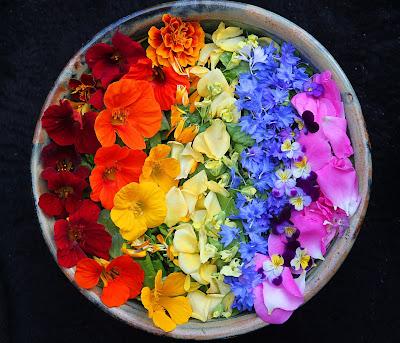
A photo of a bowl of flower-salad from above, on a black background (tabletop). So the image is a circle of ceramic (the edge of the bowl) with flowers arranged across the surface of the salad, within it, in a rainbow. Lines of blossoms from left to right are: deep red nasturtiums, orange nasturtiums, warm yellow nasturtiums, pale yellow rose petals, green parsley, blue bachelor's buttons, purple and yellow violets, and pink rose petals.

This is a picture of my salad. My family grew it in our garden, and picked it for dinner last night. We gobbled it up with a huge amount of joy. The diversity of colour, scents, flavours and ideas contained in this bowl looks to me like a visual story of hope for the people of our world. Despite all odds, and because of diversity, this abundance of life persists! And I eat it and am a part of my own ecosystem. And my wild and unkempt garden not only provides food for me, but shelter from the heat; shelter from the storm; shelter from the fear. My salad isn't enough to change the world. I know that. But in every small way that we cultivate hope in our own hearts, we bring more hope to all of our actions, and to the world. Maybe the small things we do at home give us courage or hope enough to make bigger changes in the world, like supporting those neighbours who suffer directly from colonialism, forest fires, and loss of hope. Having hope, too, is a great privilege, and once we've accessed it, we need to share it–by both small and large means. And when we all have hope, we can tackle the really big problems, like colonialism, capitalism, and consumerism. Or maybe those "isms", which thrive on a population devoid of hope, will just starve when we stop feeding them, and start feeding hope, instead.

So how do you create hope? What is your joyful exit door? What is your vision for a workable, hopeful future? How can we make positive change in our own lives and work towards change for our whole community; our whole world? How can we change our lives, our employment; our communications so that everything we do is working towards the future we want? And how can we be generous; how can we hold each other up, make joyful, hopeful futures for each other to run to? 

I want to be running toward something.

Originally published in July, 2021.