This has been a hard, hard month in my province. We're reckoning with our responsibility regarding both climate change and colonialism (which are inextricably linked). Our province is beginning to locate the remains of thousands of murdered indigenous children, at the same time as our towns, farms, wildlife and even humans burn, in the climate-change-fueled fires we're now accustomed to. And all the while we're trying to save the last remaining stands of old-growth forest on this land… with very little success, so far. Colonialism, capitalism, consumerism and industrial terrorism are huge foes and how can we not feel small and weak? Terror and hopelessness abound. Two generations of kids are growing up without hope. And now they're looking at their parents and seeing no reassurance, because we adults are scared, too. We have no idea how we're going to pull out of this one. I think the only way out is through.
Yes, to some degree, it's necessary to recognize the fire and just run like hell. It's necessary to make sure our neighbours know about the fire. It's necessary to point out that the torch and gas are in our own hands. But then… where do we run to? Through the fire and out the other side? Where's the other side? And why even bother? The concept of "through" requires us to see an exit on the other side, and we have to want that exit.
The exit we want is joy. Harmony. Peace. Love. Those are things worth running to. So we have to find joy, again–or create it. We have to create hope. We have to find reasons to stop fighting and instead start working for change, and, even more importantly, we have to make that change joyful. We have to know that the place we're headed is the place we want to be going.
You get back what you put into the world. Most of us know that, at some level. And yet many, including myself, are feeling and putting out a lot of fear. I think I put joy into the world wherever I can, but maybe I can do more! Maybe instead of dwelling in the anger that my friends' missing siblings might be among those buried children, or instead of raging against the industries and "isms" that are creating climate change, I can make an exit door.
I know it's hard. Sometimes I just want to hide–bury my face in the pillow, or in the tear-soaked sweater of my partner, and wallow in my hopelessness. Sometimes I want to spend money I don't have on something I don't need and just pretend the whole scary world doesn't exist. That's OK for a minute, but then I have to look up again from my sorrow or my distraction and be real.
I guess for all of us, the ways we "look up" and get busy creating our exit doors will vary. For me, it's working with other parents and teachers to find positive ways of encouraging exploration and discovery in learning. In helping others overcome challenges and find hope, I feel more hopeful, myself. But it's also the small things.
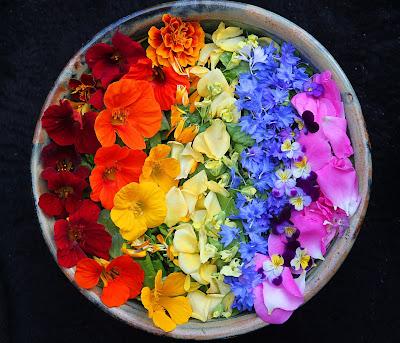
This is a picture of my salad. My family grew it in our garden, and picked it for dinner last night. We gobbled it up with a huge amount of joy. The diversity of colour, scents, flavours and ideas contained in this bowl looks to me like a visual story of hope for the people of our world. Despite all odds, and because of diversity, this abundance of life persists! And I eat it and am a part of my own ecosystem. And my wild and unkempt garden not only provides food for me, but shelter from the heat; shelter from the storm; shelter from the fear. My salad isn't enough to change the world. I know that. But in every small way that we cultivate hope in our own hearts, we bring more hope to all of our actions, and to the world. Maybe the small things we do at home give us courage or hope enough to make bigger changes in the world, like supporting those neighbours who suffer directly from colonialism, forest fires, and loss of hope. Having hope, too, is a great privilege, and once we've accessed it, we need to share it–by both small and large means. And when we all have hope, we can tackle the really big problems, like colonialism, capitalism, and consumerism. Or maybe those "isms", which thrive on a population devoid of hope, will just starve when we stop feeding them, and start feeding hope, instead.
So how do you create hope? What is your joyful exit door? What is your vision for a workable, hopeful future? How can we make positive change in our own lives and work towards change for our whole community; our whole world? How can we change our lives, our employment; our communications so that everything we do is working towards the future we want? And how can we be generous; how can we hold each other up, make joyful, hopeful futures for each other to run to?
There's a rambling little debate going on in my community right now about what kind of mural should go up on the lock-block retaining wall that acts as the de facto welcome sign to our island. This wall faces the ferry dock, and forms the north side of the pedestrian walkway from the dock to the rest of the island. This is the plain concrete wall that, for generations now, has welcomed commuting adults and teens, newcomers and old-timers as well as untold numbers of tourists to our small island. Sometimes it sports blackberries trailing down to catch our shoulders as we pass by, sometimes obscene or public-shaming graffiti, and almost always an assortment of hardy edible weeds that pop out from its crevices. But most noticeably, it's a boring grey wall of concrete lock-blocks.
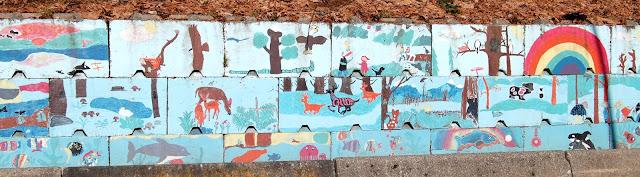
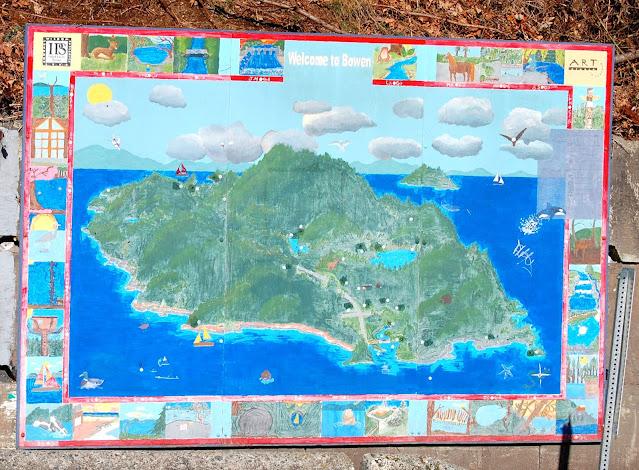
Once this wall had a vast mural painted by kids from the local school–each block was painted with scenes of local wilderness or animals. Another time there was a big plywood mural of the island and local information, painted with students from our middle school. Yet another time, the wall was the stage for a temporary piece of public art made by one of our local artists, which peeled and disappeared over time. For a few years now, it's been just a boring grey wall of concrete lock-blocks.
The Nex̱wlélex̱m/Bowen Island lock-block wall, as it was once painted by local kids. Photo by Singne Palmquist
So now there's a call out for proposals from artists who would like to paint it, and an ongoing debate about whether it should have been offered to the island's children. I'm an artist; I'd love to have my work up in my own community and in fact have been talking with other artists about a collaborative work depicting local wildflowers for this wall. I love the idea of something that pleases and educates at the same time. But now I'm going to champion kids' art, for this wall. Because I think the many benefits of a mural painted by local kids far outweigh those of a more polished, "adult" mural.
Belonging
One of the best ways we can build sustainable community is to encourage engagement and concern for home and community. We need people to care that this is their home and feel that it deserves looking after. We care about things we feel ownership of. Kids feel ownership of their artwork–especially artwork that was designed and developed by them and displayed publicly in their home.
Why not just put their artwork up on the fridge? Well we can, of course, but not "just". It's not the same as being given the respect of one's community by being welcomed to paint right on our most visible wall. Being welcomed by one's community is, of course, the nature of the meaning of "home", and we want our kids to feel at home. We want them to grow up with the idea that this is their home, that their home matters, and that how they engage with it matters. We want them to feel seen; to feel responsible; to feel that what they do makes an impact on their home and future. So we have to give them that responsibility.
Imagine how it feels to children who painted the wall, say, in grade five, to then be walking past it twice every weekday on their way to and from school in grade eight. Some will tease each other about it; some will feel embarrassed, some will ignore it, and some will feel a quiet or even loud sense of pride. Almost all of them will feel connection. They'll feel a sense of belonging. Maybe they'll walk down to the dock to meet visiting relatives, and escort them past the mural they painted. Maybe they'll take selfies with their contributions. Maybe they'll move away and come back to find their marks still here, a few years later.
Not every child will have an opportunity to paint this wall. Maybe just one or two grades, and maybe it will be repainted every five years. But the kids who didn't paint it may have siblings who painted it. They may just have witnessed it being done and feel the tendrils of connection reaching out. They'll know that this mural was done by and in honour of the children of our community, and they'll feel valued.
Nex̱wlélex̱m/Bowen Island plywood info-mural painted with local youth. Photo by Singne Palmquist.
Learning
As a parent and educator I'm quite horrified by the many ways children are silenced in our culture; their ideas and skills unvalued, as they're seen as "still developing" in the system that is meant to develop them. Have we forgotten the meaning of development? It means growth. Children are not vessels into which we dump our own ideas for eighteen years and then trust to follow along like good little citizens. Children are growing people with their own ideas and skills and values, and they learn from experience.
Everybody learns from experience. You can read as many manuals as you like about how to fix your appliance, but the first time you actually open the appliance up is when you really start learning. So what do kids learn by painting a mural in their community? So much.
They'll learn simply from experience about materials: what type of paint is needed for this project? What chemical properties make it suitable and why won't classroom acrylics do the job? What types of scenes are acceptable, and why? Why has the council requested local flora and fauna, and what exactly are our local flora and fauna? What is the political and social work that goes into a project like this? And all the various applied maths, sciences, communication and language skills that come as a matter of course in the creation of this mural.
Why can't they just learn those things in school? Why can't they paint the school walls? Why does this painting have to be making a visual chaos of our lovely manicured community?
Chaos = Development
Because growth, development, and learning need chaos to thrive. It was the chaotic and random assortment of elements that evolved to become life as we know it, today. It was and is a chaotic assortment of peoples, places, climates and experiences that make humanity as we are, today. It was the chaotic rambling experiments of toddler-hood that gave our children the chance to develop skills they now depend on, like language, social skills, gross motor skills and dexterity. They learned all of those things from observing and experimenting, free-range, under our benevolent supervision. They didn't learn them in a school, from textbooks. They learned them because they felt at home in their homes, and made big messes and had big accidents. Our homes were chaotic. Now our kids are older, and it's time for them to be out in their wider community.
Our children are part of our community, and they are our community's future. Instead of being tucked away, seen and not heard, they need to feel they are part of it, so they can grow and thrive here.
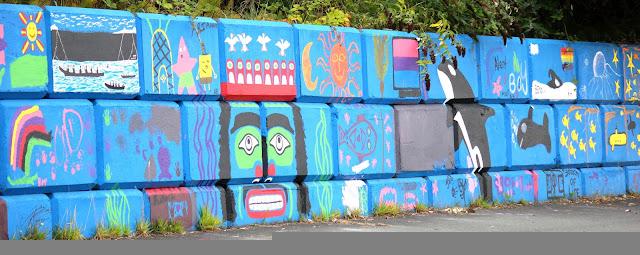
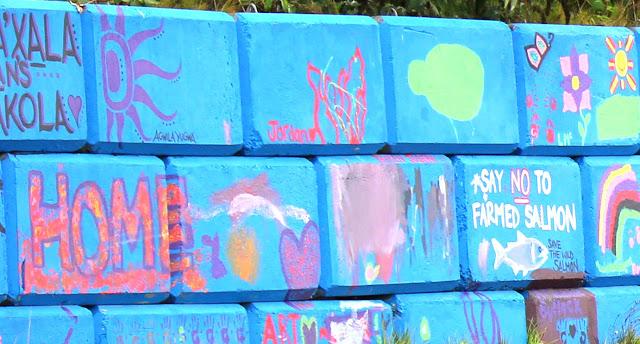
Kids' mural on lock-block wall at the Alert Bay ferry marshaling area. Photo by Emily van Lidth de Jeude
Responsibility
We look after what matters to us. If we want our children to grow up to look after their home and community, we need to allow it to matter to them.
We used to have an old cherry tree near the lock-block wall in the cove. Kids would climb it and hang out there, waiting for their commuting parents to walk off the boat. But eventually someone injured himself falling out of the tree, and then the tree was deemed too old, so was surrounded by fencing, off-limits to our kids. Now the area has been beautified as part of an effort to create a more visually-pleasing entrance to our community. There are all sorts of gorgeous plants there. I love them. But do the kids? Do they care about a tidy garden that they were expressly excluded from, and forbidden to play in? I asked my kids. My daughter says, "It's just another place you can't go." And how long before that garden is a dumping place for their litter and midnight beer cans, because it was never something they cared about in the first place? We look after what matters to us.
So how about a playground? What if we put in a playground at the ferry terminal, and the kids can play in blissful harmony with the commuters and traffic and beautiful gardens. Sure, but what kind of playground? Is it creative, dangerous, messy; fun? Because those are the things that make a playground worthwhile. Imagine an area full of tools, wood, climbing-trees and ropes; dirt and shovels and paint. That would be an amazing place for feeling belonging, learning new skills, and developing a sense of responsibility. But these playgrounds tend not to be condoned, these days, because of the chaotic look of them in our otherwise manicured landscapes, and because parents are afraid of danger. But danger–risk-taking–is essential for learning and for developing a sense of responsibility.
Another section of the Alert Bay mural. Photo by Emily van Lidth de Jeude.
Risk-Taking
If we never take risks, we can't learn to manage or mitigate them. Learning is all about taking risks, and risky play is a big part of progressive education all over the world. Just like babies learn to walk by taking risks and falling, teens learn to navigate social situations by taking risks and making mistakes; suffering heartbreak and social exclusion. We take risks as adults when we choose partners, careers, or make big purchases. We learn from all of those risks, and that's how we grow as individuals and how we evolve as a species.
Our kids are part of our communities; our species. They need to take risks like painting a public wall or climbing public trees so they can learn how their community works. You know what the boy who fell out of the tree learned? In addition to some of his physical limits, he may have learned that he was valued in his community, when he was seen, held, and tended to by an adult who was not his parent.
Kids who paint walls take many risks, in choosing what and how to paint, in consulting with their peers, their supervisors, and their community, and they take social risks in walking past the mural they painted every day for a few years and navigating the conversations that arise. They take personal emotional risk in putting their artwork in a public space and facing the opinions of their community. And that social risk helps them to grow into their community–to become a part of it, deeply and permanently because they grew and thrived there.
A community that sits in stagnant contemplation of its perfectly manicured surroundings is not growing, thriving, or evolving. And who wants that?
It's not only kids taking risks in this scenario. It's us, too. It's the adults who give the kids our most prominent walls to paint and just trust them. That's a huge risk, especially for those of us who are quite afraid of the chaos of childish experimentation. But it's a risk we have to take if we want to grow as individual adults or as a community. Is it like giving our living room wall to a bunch of monkeys with paintbrushes and walking away? Maybe. But I'd rather have something unexpected that I can learn from than live in a stagnant community. It's a risk we have to take if we want to grow.
As a community we are growing. Our kids quite literally are our future, and if we want them to grow into responsible adults who care about their home, then we need to make them a part of it, now.
This video by Rage Against the Machine x the Umma Chroma brings up something I struggle with a lot in my own work and in the work of people I really respect, like RATM. You try so hard to help people see their own strength in changemaking; their own worth and their own ability to make postive change, then you look out at the crowd of people supporting you, and you know a large percentage don't hear the message. They go home shouting about it, but they didn't hear it. Maybe that's because they didn't go there to be educated–I get that. But we keep telling ourselves, as artists, as educators, as community organizers, that even if just one person in that crowd goes home and makes some kind of positive change, we've been successful, but how is that really enough?
The most successful instagram post I've ever made was an in-progress shot of a dress that's about oppression of women; the objectification of the female body. In a very brief time it got thousands of views, and was worked into a German graffiti artist's work. The vast majority of the people sharing it were men. You know why? Because the breasts of the mannequin it sat on were visible. For the handful of women who felt seen, understood, and the smaller handful of men who understood the message, there were thousands who just consumed it like a piece of meat.
I love this video because they're not allowing us to just revel in the anger of the song and not question our lives, our heritage, our thoughts; our whiteness. Putting out something so blatant runs the risk of people choosing not to watch–of alienating any and all of the audience that didn't already understand or agree. Please watch this video if you think it looks stupid. Watch it if you think you already understand, or you don't need to know. Watch it if you think RATM is too white. Watch it if you think you're too white.
Anyway. These are my thoughts for the moment. This is something I struggle with in life and living and art.
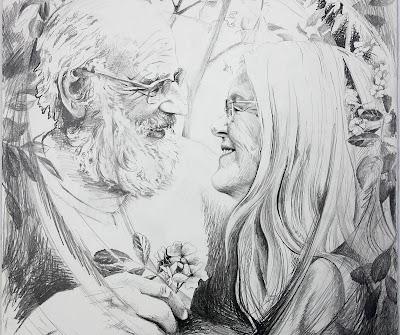
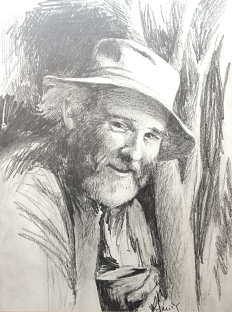
The process I use for making portraits is designed to connect me with my subjects. If possible, I begin by doing a photo-session with the subject(s), then I download some songs recommended by the subjects, and put them on repeat in my studio. I choose a good photo from the session, and lay out the portrait using my handy projector, before setting up my laptop beside my painting wall and getting going with the real drawing work. I use graphite, I scribble, I cross-hatch, and if desired by the person who commissioned the work, I use gesso. There's not a step of this process that is dispensable to me, and I thought I'd explain why.
The reason for doing a photo-shoot is probably obvious. I need to connect with the subject. I've been commissioned a few times to make portraits as surprise gifts for the subjects, and while it's possible, it's incredibly difficult to know if I've captured the essence of somebody I've never met, just working from a photo I didn't take. The most beautiful portraits, to me, capture the essence of a person or relationship. They capture a moment in time. You want to look at that portrait and have a happy memory. So either I work from a photo that was taken at a very happy moment, or I make that happy moment. When we do a photo-shoot we talk endlessly throughout the session about what makes life (or the relationship if there are multiple subjects) special. I get into the nitty-gritty of what matters to the person I'm photographing, and by the end of the session, I'm in love. Yep. I love really easily, so if I've ever interviewed or photographed you, there is a piece of my heart dedicated to you. I'm going to make your portrait with all that love I have for you, and my memory of the time we spent taking your portrait.
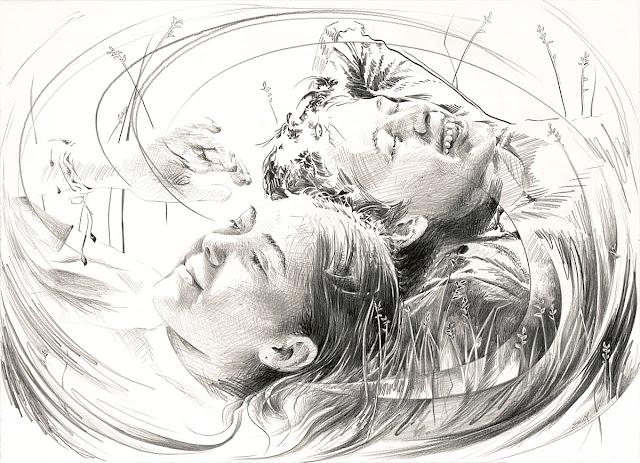
That love is what the song-requests are about, too. It's a way of filling my studio with your personality. I've been given songs by artists in genres I didn't care to listen to, before, but by the time I'd drawn the portrait, and listened to the songs a hundred times over (no that's not an exaggeration), I hum the songs in my sleep and love them too. I've discovered some great artists this way, but more than that the spirit of the songs informs the work. I usually title my portraits, as I do most of my recent works on canvas, after a line from one of the songs I'm working with. If you've hired me to make a portrait, you probably already know I'm a synaesthete: I see sound. So when I make the portrait with the recommended songs playing on repeat, I'm drawing my own visual interpretation of the subject, the moment, the feeling, and the music… all mixed up on a flat surface, with graphite.
So why use a projector? I know a lot of people think projectors are a terrible intrusion into visual art, taking away the artist's eye; the artist's interpretation; the art. I used to think that too, until I was painting portraits with watered down acrylic on used bed sheets (the MAMA Project) and couldn't afford to make a single mistake (because you can't remove or even lighten up a misplaced stroke of paint). I re-did a few of those first bed sheet portraits, and ended up throwing my precious donated sheets away, before resorting to the projector. Then I realized that the projector doesn't have to take away the soul of the art–I just had to learn to use it properly. It's a wonderful tool for laying out the structure of a person's face or body, to avoid making mistakes that would have to be fixed or reworked, later. The trick is to stop using the projector early in the process. I lay out the structure, and then I turn it off, turn up the music, and go back to the way I love to draw: scribbling and painting layer after layer, from my heart. But without mistakes of bone-structure or eye-placement.
The scribbling. To me this is truly indispensable. It's just how I draw, like others use watercolour, fine chalk shading, or bold brush strokes. I scribble. Call it cross-hatching, if you like; it originally came out of cross-hatching, and there's still a good amount of cross-hatching in my work. But straight-up cross-hatching doesn't have the energy and vivacity of scribbling. Scribbling is unscripted. It's emotional. It's how I let loose and let art happen. It's how my intuition deals with putting feeling onto a flat surface. It's the reason my hand-drawn portrait is more than the photo I took to begin with. When I work with gesso (and I prefer this, although many clients request only graphite), I get to layer the scribbling with a depth that graphite alone can't really muster. Then it becomes scribbling with texture and colour (because gesso turns graphite blue in certain light), and allows for so much more depth of feeling and movement in the portrait.
Recently I was asked to make a portrait without the scribbling, or cross-hatching. I did it, but although the client was happy with the result, I wasn't. I felt it didn't have the depth or feeling of my other portraits. My style isn't for everybody, and that's OK. It's who I am though, and a hand-drawn portrait is a big messy soup of the subject, the moment, and the artist. Just like it's essential for me to capture the nature of the portrait's subject, it's essential for me to let my own heart be present in the work. After all, I've put my whole heart into connecting with the subject, and that's where the feeling is. My heart is messy. That's the nature of my work.
I'd just like to thank Emily Carr University Alumni Association for interviewing me for their Get to Know series. I was honoured and delighted (also for the opportunity to give thanks for my education, and specifically to mention Celia King). Link to interview: https://www.ecuaa.ca/get-to-know-series/get-to-know-emily-van-lidth-de-jeude/
As we round the corner on a new decade, I find myself contemplative about the evolution of our species. What have we changed? Where are we going? What changes are to come? And, as so many ask these days, how can we save ourselves? How can we "be the change"?
“We but mirror the world. All the tendencies present in the outer world are to be found in the world of our body. If we could change ourselves, the tendencies in the world would also change. As a man changes his own nature, so does the attitude of the world change towards him. This is the divine mystery supreme. A wonderful thing it is and the source of our happiness. We need not wait to see what others do.” – Mahatma Gandhi
This morning I read that two firefighters have died fighting Australia's massive bush fires. That's 10 people dead so far this year in a fire season that's only half over, according to Victoria emergency services minister Lisa Neville. Over 1000 homes have burned so far, but it's not a shock, anymore. It's the news we're accustomed to hearing. I was, however, surprised to read that the prime minister apologized for having been on vacation at the time. His compassion is news; in our current human state of trauma and overwhelming feelings of helplessness, many of us have become dispirited, numbed by the constant reports of tragedy. We are accustomed to looking away. My children know that in every season people around the world die of heat, floods, storms, wildfires and other climate-related disasters. Sometimes we watch the smoke on the news; sometimes we're battling to keep it out of our own lungs. It's the end of the decade, the end of my children's childhood, and the beginning of a new epoch for humanity. And what can we do to save ourselves?
In her book, Braiding Sweetgrass, Robin Wall Kimmerer talks about her university students' inability to imagine a healthy relationship between humans and nature:
"As the land becomes impoverished, so too does the scope of their vision. I realized that they could not even imagine what beneficial relations between their species and others might look like. How can we begin to move toward ecological and cultural sustainability if we cannot even imagine what the path feels like? If we can't imagine the generosity of geese? These students were not raised on the story of Skywoman."
I would like to suggest that connection is how we will save ourselves.
The other day I drove my kids past the recreation centre in Burnaby where I first kindled my desire to connect children with nature. Around two decades ago, before I had children of my own, I took my eight-to-ten-year-old art group out to the small planting of conifers and rhododendrons beside the parking lot at that rec centre. It was the only forest-like area between the mall, the skytrain and the office buildings. Beside the smooth concrete pathway, I and this group of kids dug our fingers into the grass and needles and found worms coming skyward after recent rainfall. We saved one from a puddle. We gathered cones and twigs, and the children discovered that cones actually contain seeds of the trees they fell from. Although I tried valiantly to connect our indoor art adventures to this one outing, it was plainly evident to me that the greatest learning we'd had by far was the short fifteen minutes we spent out poking fingers into the earth. This was the moment of connection – of discovering a sense of home and belonging in nature. I have spent the last two decades bringing people into the wilderness, welcoming them to these spaces where nature still displays its fabulous and curious habits, and beckoning them to feel at home. Because this is our home.
In the last decade forest schools have become increasingly popular; as have explorative and self-directed learning. These things, I think, are beacons of hope for our civilization. As we reintegrate with nature in a curious and explorative way, we become, as a species, attuned to our own existence, and better able to understand our own nature. As we discover the amazing interactions between other species in the wild, we discover our own interactions with them, as well. We discover our mutual needs and gifts. We discover our sameness.
But how will this help us survive the climate emergency? In very practical terms, explorative wilderness play helps people of all ages become more resilient and resourceful; both qualities needed to survive any time, but especially in the unpredictable time we're entering now. A few years ago, during the worst smoke season we've had yet on Canada's west coast, I bought an air purifier that barely managed to keep the smoke out of one room of my home. But I took my Wild Art groups into the forest nearby, to discover the clear green-filtered air and relatively smoke-free play areas. During the hot smoky season we found respite under the shelter of cedars and hemlocks, leaning our bodies against the cool logs and reaching fingers into the mud that remained from the previous winter's flood. The children learned resourcefulness as they wrote, developed and performed a play about consumerism (their own idea, but not surprising given the climate of fear in the forest fire season). They connected with our local recycling centre and second-hand store for props, and created other props and a set from objects found in the forest.
In addition to resilience and resourcefulness, the deeply-felt connection that nature exploration develops between humans, and between humans and other species, helps us to see the bigger picture. We discover the trees' need for moss, holding water like a sponge, as we discover our own need for the damp cool that that moss provides, and the shelter of the trees' leaves. Symbiotic relationships are everywhere, and the more of them we discover, the greater our perception grows; the bigger our picture becomes. Climate change is a very big picture. If we want to solve it, we need to understand the interconnectedness of all things. We need to know that we matter.
And mostly, in this world where happiness is sold on in-game-advertising and the price-tags on our brand-name merchandise, we can discover happiness in nature. The pursuit of happiness continues to be a ubiquitous aim of the human spirit, and we're not going to save our home and future by denying ourselves joy. Our salvation will not come from starvation and asceticism. It will come from abundance. We just need to start seeing abundance – happiness – in the things we need to save, and then we'll find ourselves ever more willing to save them. Saving the trees is much easier when the trees are our children's playthings; when we know their scent and the feeling of their cool skin on ours in the summer; when we have experienced their canopy protecting us from the heat and the smoke. Saving frogs and beetles and worms and slugs is much more delightful when we're not envisioning some far-away ecosystem we've never walked in, but noticing the appearance of worms after rain in our own neighbourhood puddles.
Wilderness isn't far away. Wilderness is happening in the city puddle under our feet, or, as we once discovered with the help of our trusty microscope, in the surface of an old moldy piece of cat food! Wilderness is, yes, in the Australian bush, burning up with its koalas heading ever closer to extinction. And it is also in the weeds along the edge of a forgotten urban alley. It is in the heart of the little girl playing there, digging her fingers in past plastic wrappers and grasshoppers to find the treasure she buried there last winter: A fir cone full of now-sprouting seeds, which she carefully pulls out, and plants again.
In the last decade we have become, as a species, accustomed to watching our home burn from the other side of the street, then turning our back on it and looking towards our cell phones for a quick emotional fix. We've become accustomed to blinding ourselves to our own feelings of despair and helplessness; using capitalist promises and lies to soothe our broken hearts. Now it's time to get back over there and put out the flames. I think about Robin Wall Kimmerer's despair at her students' lack of connection with wilderness and I think to myself that if we allow our children to find joy in the discovery of small things, the next generation will be the first to return to nature. When they reach university, the scope of their vision will be greater, because they have seen and known the wilderness beneath their feet. They will integrate the great technological systems of their day with the great system of the wilderness and those of us who follow them will, finally, be the change we already know ourselves to be.
Happy new decade. May we connect with each other and with our wilderness.
Art that is engaged in change-making is relevant to humanity’s evolution as a social species, by encouraging and supporting us in making the changes necessary for our survival. During this time of growing climate and social crises, we need work that challenges us to evolve for the better. Relationships – interaction between individuals, our histories and common future – are how we grow. It’s essential that we take time to listen and know each other; to learn from each other’s wisdom and stories. I hope that as artists we can give people space to be heard, to hear other people, and to change and make change.
"Children are the most disrespected group of people in the world."
She turned her small face and looked at me intensely, maybe to see how I would react; maybe to be sure I heard her. She was one of a group of three teens who had just come through an installation about children's rights and left her comments behind. I hoped she felt respected by me as she walked out of the gallery.
And then it hit me: "Group of people." That's how we see them. We see them as separate from us until we judge them to be old, wise, or experienced enough to earn our respect – as adults. We determine their clothing, their food, their education and other activities, their freedom to come or go and quite often we even determine their friends and hobbies. They tell us their fears and hopes and great big plans and we pat them on the shoulders and ignore them; carry on with our lives. When do we look them in the face and ask them to tell us more? When do we ask their advice? When do we heed it?
I grew up and eventually returned to raise my kids on a small island. For longer than I've been alive, the teens from this island have boarded a ferry five or more days per week to attend school on the mainland. Unchaperoned. As a teen I got up at six-thirty, washed my hair under the tap, dressed, put on my makeup and left to walk to the ferry at seven. In the winter I arrived at the dock with my hair frozen like brown sticks around my face. Unlike some of the other girls, I did not push into the crowded washroom to fix it in the two tiny mirrors. I sat at the end of my age-group of kids, watching the same kids get beat up day after day, watching the animated conversation of some girls I wasn't friends with, picking at the Naugahyde seats and avoiding the splash of the food fights. I moved further down when people started bringing compost to throw.
Twenty minutes each way. Morning and afternoon. The ferry commute was a drag, and a shared ritual, and also the rocking, floating bridge between the confines of childhood and the expected freedom of adulthood. In the 80's we skipped school by going en masse to the mall first thing, then arriving at school before lunch to report that we were all late because the ferry was late. We sometimes argued about the ethics of how to accomplish this feat. We shared time every day, but we were individuals. We had different stories, different values, and different lives.
Our island also has a history of ferry exclusion. As a public-private entity, the ferry corporation has the right to ban people, and they have done so on various occasions that I remember. They banned a teenager in my grade for vandalism and mischief. He eventually took the ferry with a chaperone to attend school. They also banned our local petty criminal because the police thought it would do him good to get out of the community where he regularly slept in parked cars and picked drunken fights in public. It didn't help. Community members transported him back to the island in the trunks of their cars. My point is that these people, too, are individuals.
At various times we've had issues arise on the busiest ferry runs, like unidentified persons vandalizing the boat or flooding the toilets, and sometimes the first response is for the captain to make announcements to the teens. He tells them, as a group, to smarten up and behave themselves. He tells the adults on the next commuter run to rein in their children. Recently people in the community have been wondering aloud in public why teens (again, as a group) can't just behave themselves for twenty minutes at a time. Few, if any of us, know what the current transgression is, but we know it's been committed by teens. The captain has reportedly announced to our teens that if the unnamed incidents don't stop, the police will be involved and the surveillance footage will be reviewed. For me that crossed a line.
If criminal acts are being committed, it's perfectly reasonable to check surveillance footage and involve police. It's perfectly reasonable to expect people not to commit such acts, and to take steps to ensure that they stop. It is not, however, reasonable to reprimand, admonish, threaten and sometimes (as I have witnessed) deny service or civility to an entire group of people based on the premise that one or a few of them are suspected of having done something wrong.
When adults smoke on the ferry (which is wholly a no-smoking/no-vaping zone), they are asked to butt out. If they refuse, they are taken to the chief steward's office and spoken to, as individuals. I've seen this happen. I've stood at the chief steward's office while an adult smoker was being spoken to, and every effort was made to treat me with respect and provide me with service despite the fact that I, too, am an adult. The same can't be said for our teens' experience. Every teen is a suspect in some people's reasoning.
What do you think that does to a person? Imagine if every day you walked to work only to be eyed suspiciously at the door to the building, and every time a toilet overflowed, people called all the adults in the building together to reprimand them. How would you feel about using the toilet? Imagine if, when some person stole from the vending machine, they denied all adults access to the vending machines. Would you respect the people who judged you? Would you still care about upholding the values of your community if you weren't expected to uphold them anyway?
I'm responsible for denigrating teens as a group, too. When I was barely more than a teenager myself, a truck full of students from a nearby high school pulled up to my grandmother's lawn, dumped an assortment of fast food wrappers out the window, and drove off. A few years later, walking along our island road with my four-year-old son, we spied some litter in the ditch. He immediately shook his head and muttered grumpily, "ach… teenagers". I can't remember how I led him to that assumption, but I am certain I did. Now he's seventeen. He and his sister have somehow managed to get through a bunch of teenagehood without dumping their trash. Even more than navigating teen years myself, parenting teens has taught me to see them as individuals.
Teens are worthy of our attention as individuals. They are humans learning to be adults, and counting on our respect and exemplary modeling to help them navigate their surprising, sometimes frightening individual journeys. If we want them to see adults as individuals rather than a homogeneous, brooding group, we need to model to them how to do that. We need to see them, and we need to show them how seeing people is done well.
Some teens are children. They have an innocent wisdom not yet drawn out of them by the pressures of growing up. Some teens are also adults. They know their own minds and they know when they haven't done wrong. Some teens see us when we're wrong, and they know when we aren't hearing their voices. Some teens know when not to bother speaking up, because we've lumped them all into one disrespected group and we can't hear their individual cries. In fact, when teens report crimes committed by adults, they are often ignored.
It's time we look into the faces of the children and teens we pass and see them as simply humans. It's time we see them as individuals with wisdom, needs, values, and human rights. It's time we respect them.
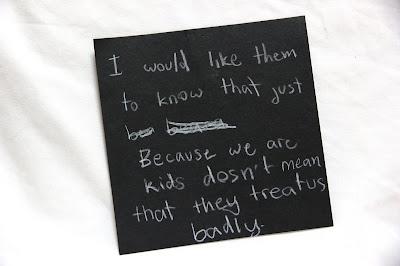
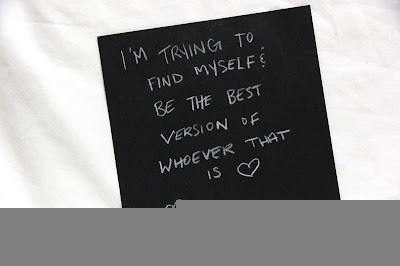
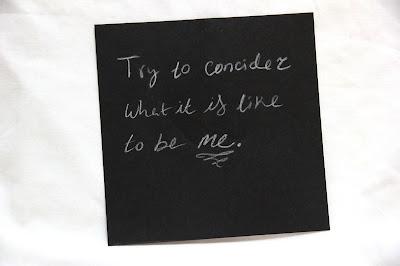
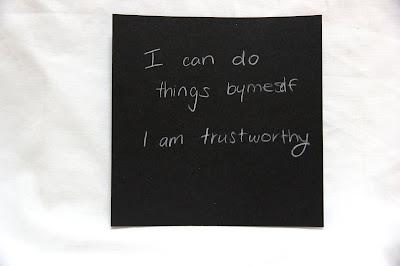
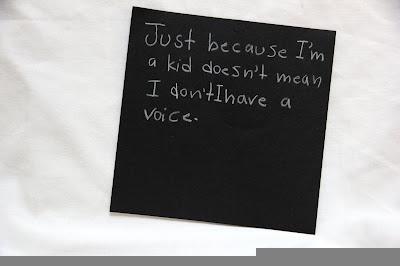
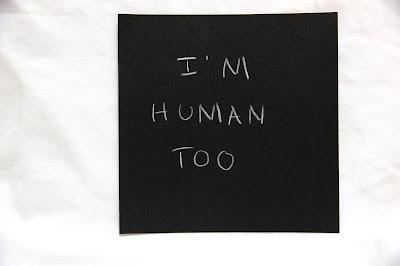
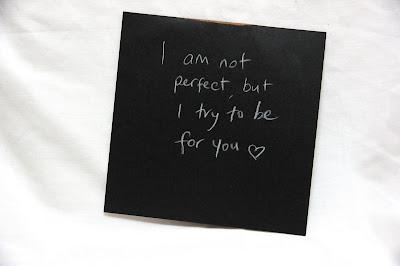
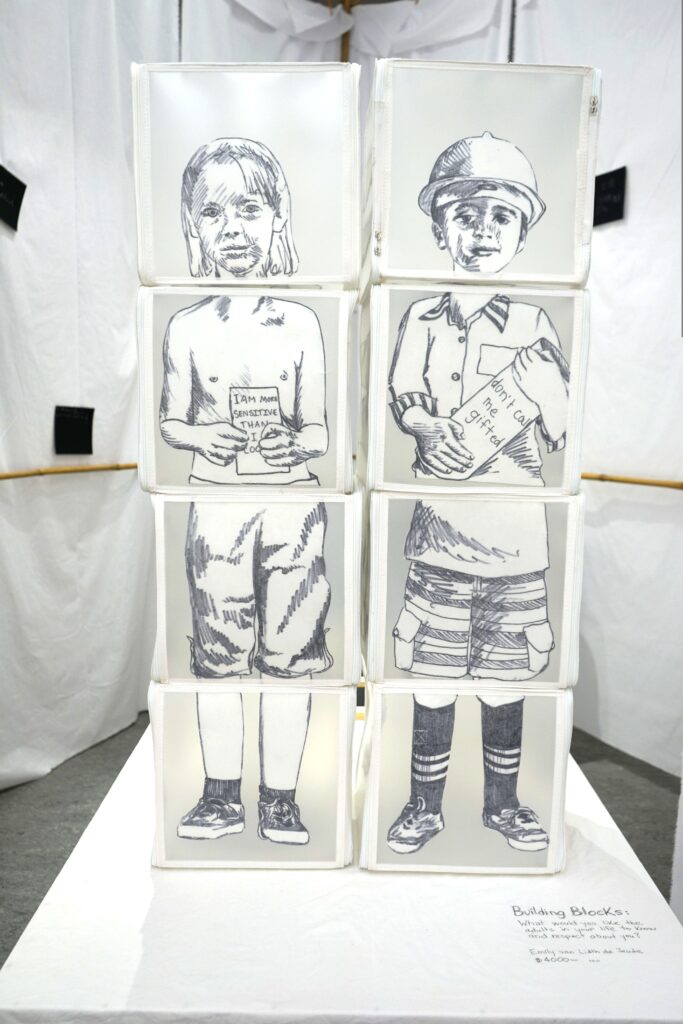
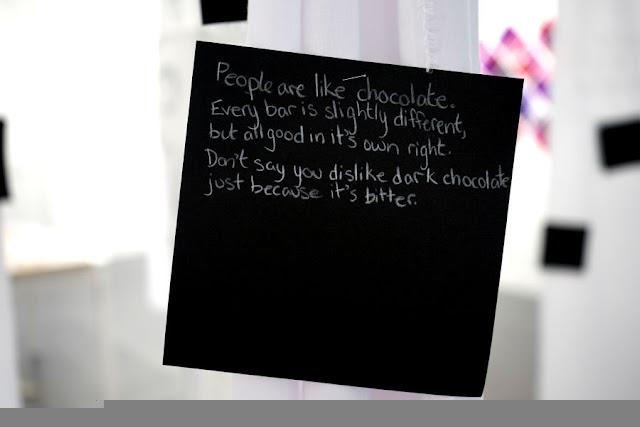
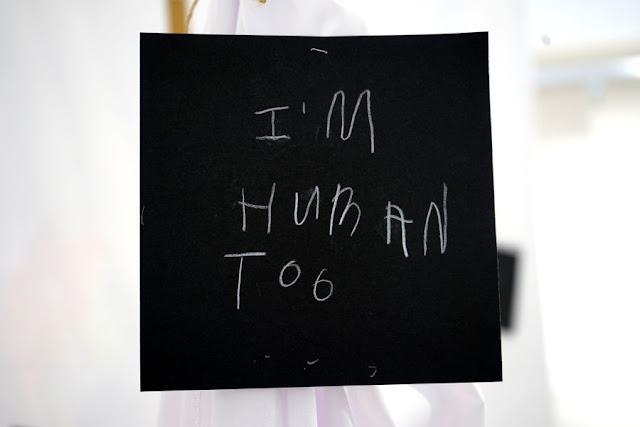
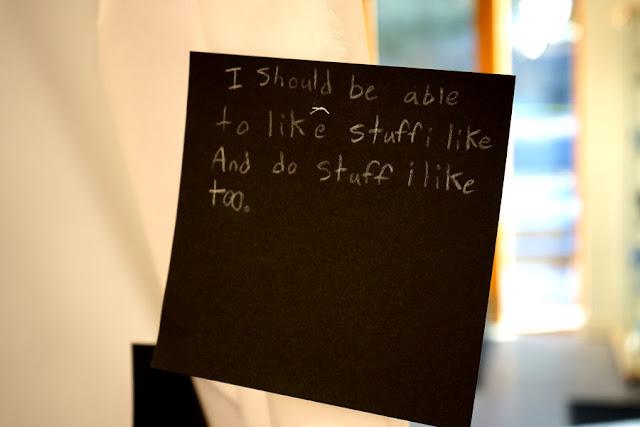
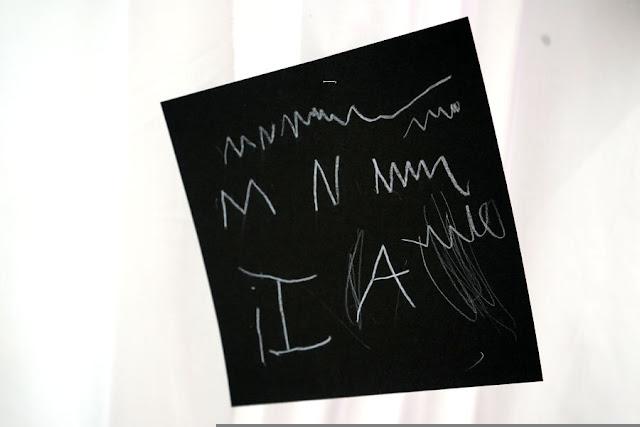
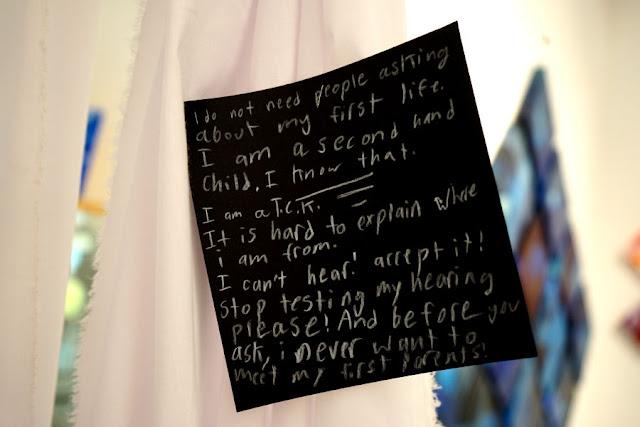
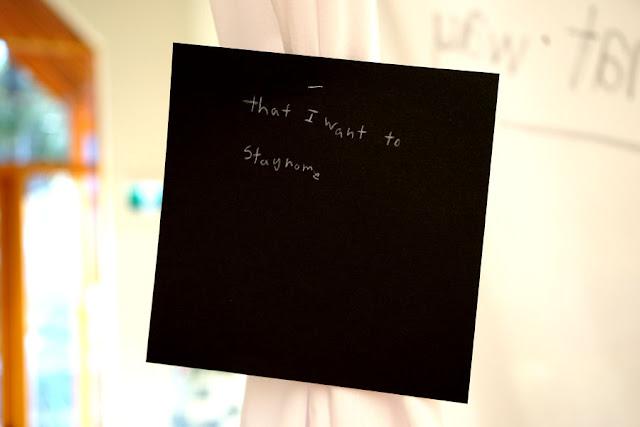
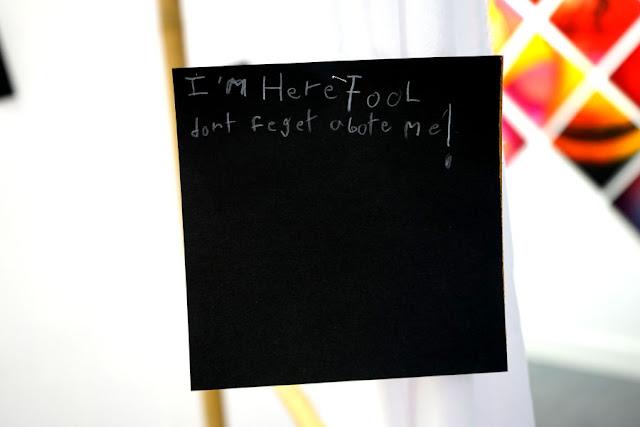
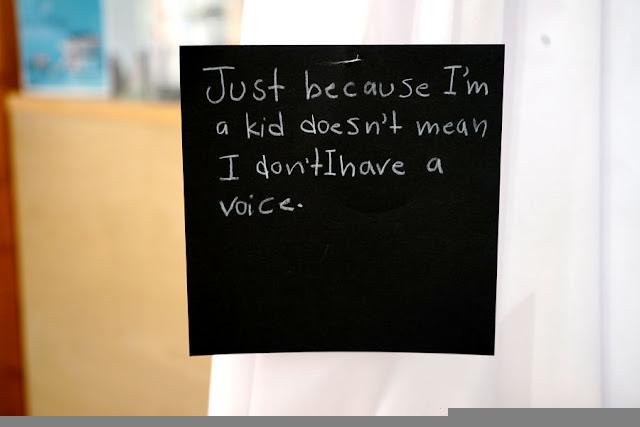
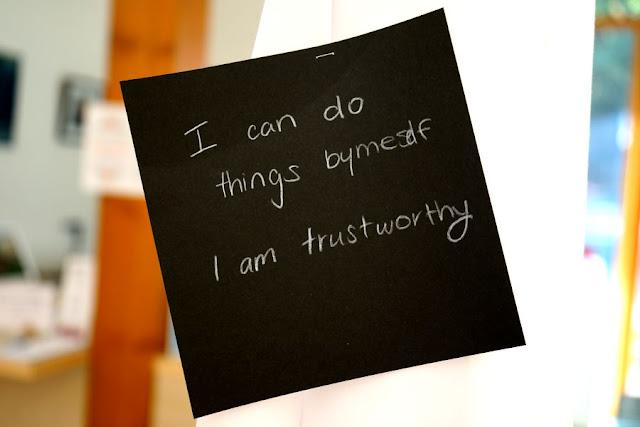
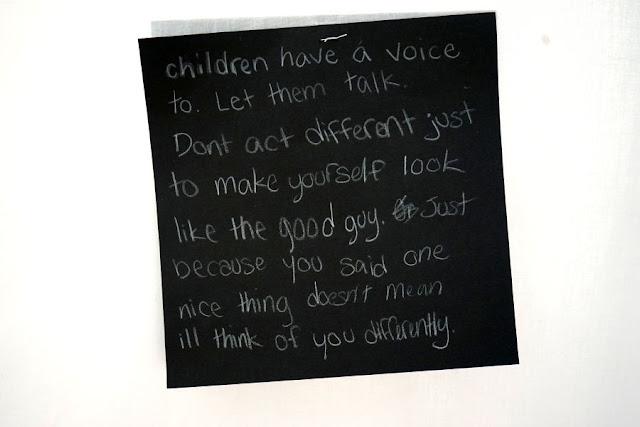
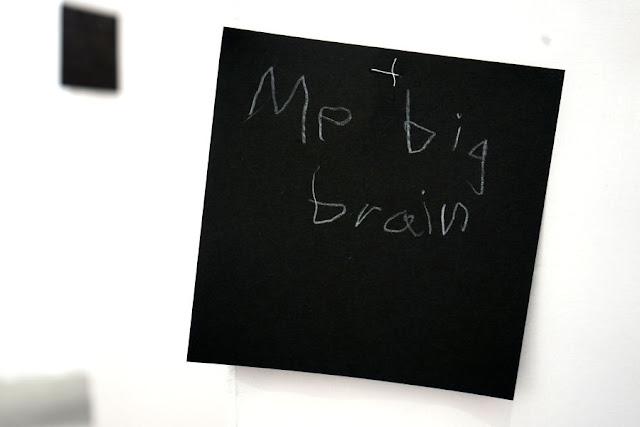
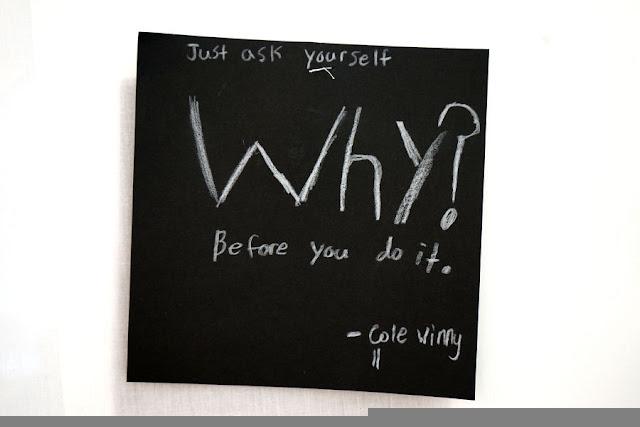
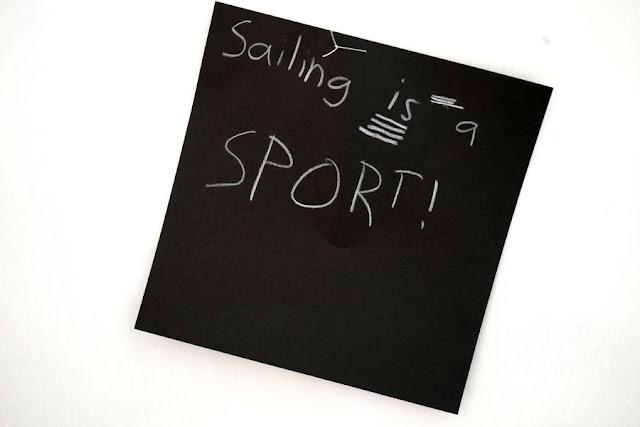
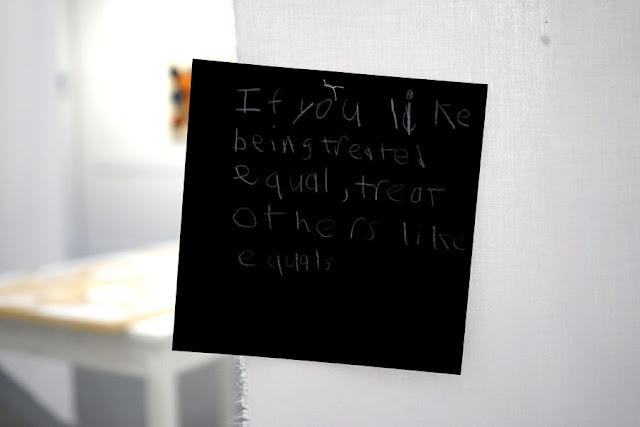
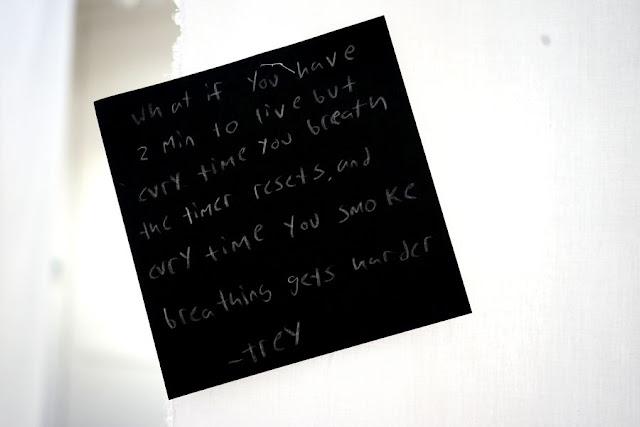
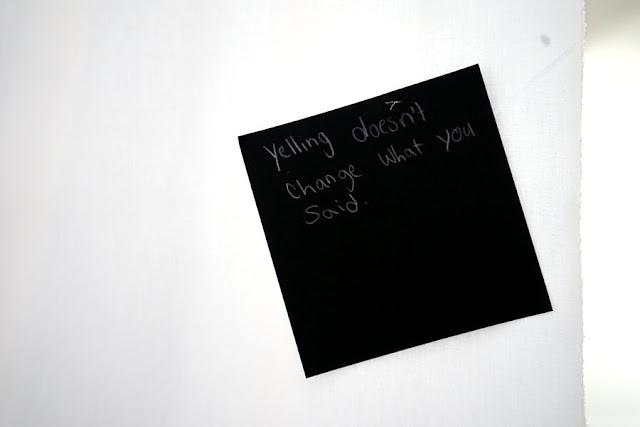
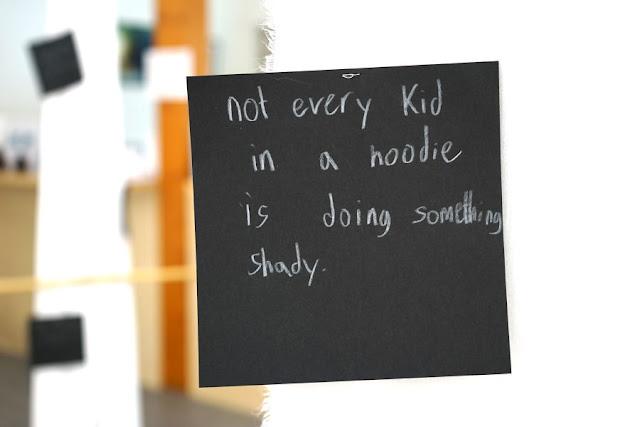
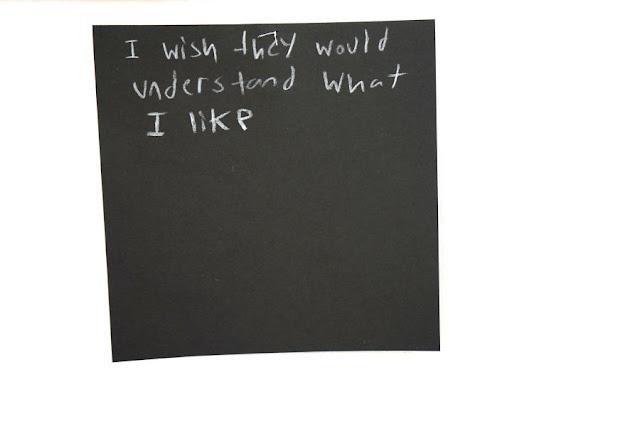
*The handwritten statements accompanying this article were contributed by teens at a 2019 installation of a piece called "Building Blocks: What do you want the adults in your life to know and respect about you?"
My 2019 exhibit included, as its central installation, this piece about children's rights. It's made of plastic clothing storage boxes, which I covered in portraits of children, holding signs that state their various answers to the question, What would you like the adults in your life to know and respect about you?
The children who contributed the answers for this sculpture range in age from 5 to 17, and the sculpture is interactive. Visitors to the installation were encouraged to put on white gloves and play with the cubes, rearranging again and again to make a vast assortment of different children.
The installation included a small tray of black paper, where young visitors could write their own answers to the question. I hung these answers around the installation as they appeared.
These are the voices of our children – mostly anonymous children, and therefore everychild. These are the things that all children need us to know. They need us to shed our busy-ness, our righteousness and our preoccupations and hear their voices. And their voices keep coming. Let's be good listeners.
I have this huge big massive stick of graphite. I mean it's about the size of a Landjaeger sausage. And soft. I keep it wrapped up in leather so I have something to hold it by without sliding around in the graphite, myself. And I use it to attack my work. The giant smudgy dark and soft and hard lines it makes are as enigmatic as my feelings.
The biggest reason I'm a hands-on materials artist is emotion. I use art to deal with my emotion, so my art is usually pretty expressive. There's a lot that comes out of the body – feeling through physicality that then gets transferred to the work. I remember my highschool art teacher encouraging me to paint by just holding the very end of a long paintbrush, and I struggled hard with that. I struggled to keep control, until I grew up and realized that she was right: when the conscious mind loses control, the unconscious is still in there, and finally shines, with all its crazy, unpredictable ways. Emotions are freed.
I have an autoimmune disease that has never been formally diagnosed but has been explored for decades by my faithful doctor. My symptoms shift and change and I've been through all kinds of potential diagnoses and healing modalities. The one thing I can tell you for certain is when I'm emotionally distressed my body reacts with inflammation. So my doctor sent me to a psychologist who explained to me that my body was harbouring the emotions I wasn't letting out, packing them into various places to manifest as inflammation and dysfunction.
So these days I let the emotions out. I put on the music that either inspired the piece I'm working on or that speaks to the feeling of it; I dance and sing and shout in my studio, I scribble and slash and hit and often push the material I'm using into the substrate with my bare hands. I laugh and often cry. I can't tell you how many times I've left the studio with paint or graphite in my hair and on my face from wiping away tears. I don't care anymore about keeping some kind of respectable appearance. I care that I put everything I had into the piece. I care about getting the damn emotions out of my body and onto the surface or into the dress, or into the words I'm writing.
I hope my emotions reach people. I hope I give people a space to feel and to express and become. I hope we can all find more spaces to emote, to share, to live and love and cry together.