Art for Change: When Connection and Conversation Are the Outcome

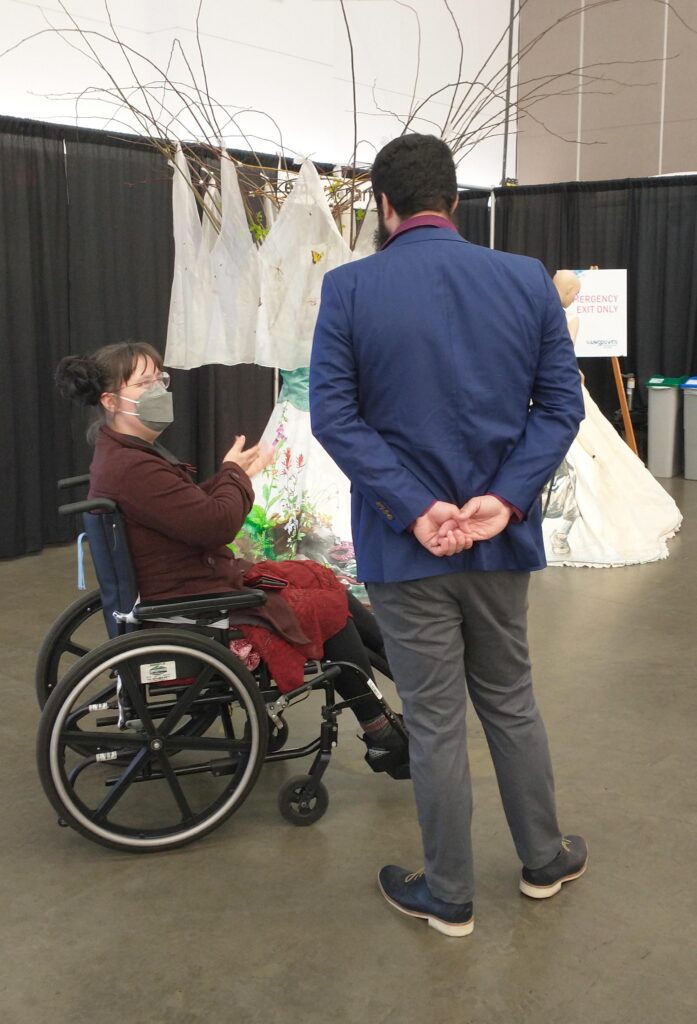
I could see him drifting across the polished concrete floor of the convention centre, blue-jacketed arms spread into a perfect reflection of the very wide smile that punctuated his neatly-trimmed ebony beard. He was studying the very sad-looking portrait of my recently-divorced brother that adorns the train of the gown I had on display. He circled the gown slowly, hands splayed as if to catch every bit of story it offered, taking it in with sparkling eyes and smiling, smiling, until he looked into mine, and said, "did you make this?"

Artist Emily van Lidth de Jeude sits in her wheelchair, wearing black leggings, a short red dress, a burgundy jacket, and a grey face mask. She has two curly fake hair buns, and is gesturing with her hands as she speaks to a dark-bearded man in grey pants and a blue suit jacket. Some of Emily's wearable art pieces are visible in the background.

"Yes," I answered. "It's called '(dis)robe: Nursing Gown'. Tell me about your big smile!" And he told me he felt seen. We talked for a long while about how crippling our societal expectations can be for people of all genders. We talked about how trapped the painted man looked, even though he held the mannequin by a dog-collared lead. We talked about how the patriarchy crushes all but the wealthiest people–it was never about men versus women; it's just a few billion pawns fighting for survival under the shoe of someone much more powerful. And what if we were to work together, instead?

I just finished a four-day stint of exhibiting some of my wearable art pieces at the Art Vancouver fair. This gave me opportunity to reflect quite a bit on why I do what I do. My purpose as an artist hasn't changed, but it has deepened and I suppose I feel it more intensely, now. I'm here to connect people with each other, with their own authenticity, and with a more equitable, sustainable future. My art is a conversation-opener. Conversations like the one I had with this blue-jacketed man are the cornerstone of social change. They're the space where the change takes root in our hearts.

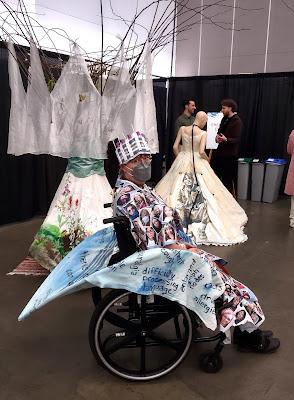
See those two people talking at the back of the image below? They're talking. Their hearts are making change. During this show I also spoke with many children who wondered what was "going on with the boobies" on that Nursing Gown, or whether they could touch the insects on the Gaia Gown, and I saw children pull their mothers around the skirt to identify the flowers they knew. People wondered where they might wear such unusual dresses, or why anybody would want to. "Definitely not to work!" One of them exclaimed.

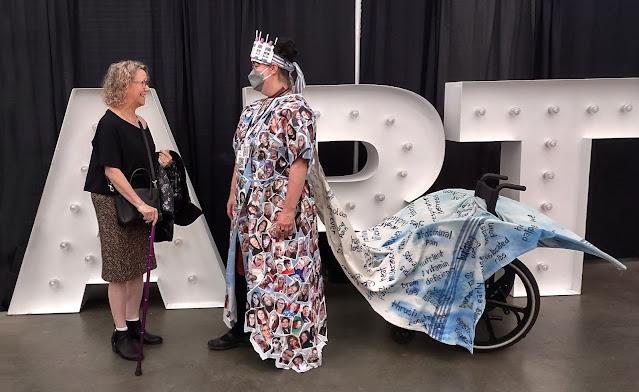
The artist, Emily van Lidth de Jeude, sits in her wheelchair, wearing the Hospital Gown project she created. Hospital Gown is a wearable art piece covered with selfies of over 300 Long Covid patients, and a train (which she's sitting on) covered with many of the most common symptoms of Long Covid. In the distance, two more of Emily's wearable art pieces can be seen, on display.

The main piece of this winter's artistic journey for me was the Long Covid gown, '(dis)robe: Hospital Gown' (image at the top). It involved over 300 selfies contributed by Covid long-haulers from around the world, transferred to an altered donated hospital gown. From the back of the gown, trailing from a drawing of my son's hands (because when my Long Covid was at its worst, he used to help me walk by gently pushing my back), was a hospital-blanket train covered in some of the most common symptoms of Long Covid. These are the symptoms that millions of people worldwide live with every day, often confined to home or bed, invisibly. So the train is supported by a wheelchair that is also partially hidden. There's symbolism in everything I do, and this was my opportunity to give a voice to the millions of people who, like me, live mostly invisibly with Long Covid.
And when I got too exhausted (shaky, blurred vision, heart palpitations) from wearing the gown and talking to people, I could just step back and sit in that wheelchair. A purpose-built wearable art piece! This is what comes of making art that truly deals with my own personal experience.

I invited many people from the Long Covid community to attend, so it was no surprise that this was a conversation piece for long-haulers, nurses and other health professionals. Some people even came to delight in finding their own faces on the gown! But it was also a chance for us all to be visible to others–many of whom had never realized Long Covid was happening in the world. Education is change-making.

This weekend was, for me, an opportunity to see other people becoming; changing, evolving, and questioning themselves. It was an opportunity to hug so very many lovely souls, and to express gratitude for their thoughts and opinions. There were people just visiting from afar, people who came to support artist friends, and people who were also showing work at the fair, or working to organize. There were people who came just to buy a pretty painting, but ended up chatting about climate change, gender politics, and the healthcare system. My own display confronted people with sometimes-difficult topics, and yet they bravely engaged. This reminded me that while we sometimes want to hide from challenges, humans are mostly courageous, and generous with our intentions.

I was not the only artist there trying to change the world through art. Humanity is a great kaleidoscopic spectrum of beautiful people, reaching across so many circumstantial divides to connect and thrive. We're like all the network of roots, mycelium, compost and microorganisms in the forest floor: a vibrant bubbling potion of hope, and a foundation for continued life. In following our own paths with so many tentative, compassionate feelers, we're finding our way.

Disinformation and Meanness: What is going on?!

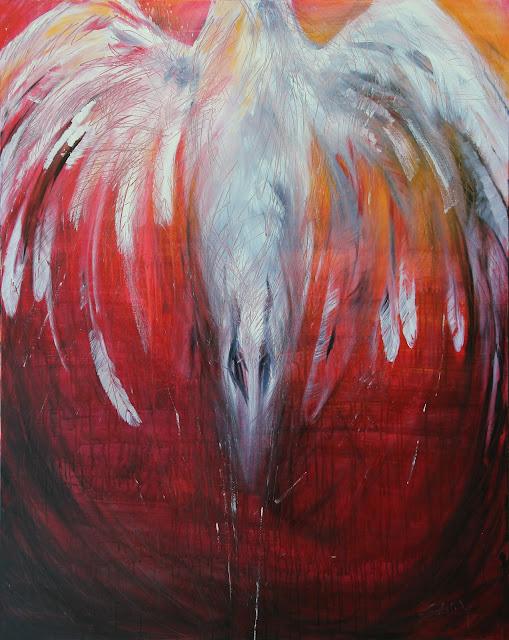
A giant white bird flies upward off the canvas, semi-abstracted, belly in full view, head cut off by the top of the canvas, and feathers disintegrating into the red background, which fades away to black, at the bottom, mirroring the bird's small black feet, pulled tight against its tail.
Escaping the Nest (middle of triptych), by Emily van Lidth de Jeude

It just hit me that maybe ten years ago I was worried about the rise of misinformation on social media. I saw it once in a while; people posting things from known biased sources, or just stating information they assumed was correct but wasn’t. Extensive fact-checking became more necessary than I had felt it was, before, since even trusted sources seemed infiltrated with presumption and error. Or maybe I was just becoming more aware. 

Recently, though, it feels like disinformation is the norm, and complicated with some serious cruelty. On the bigger social media groups I’m a part of (chicken-keeping, canning, foraging, mushrooms, birds, education, etc.) it’s just absolutely normal for somebody to post a question and receive 30–70% wrong answers. It seems people have just become accustomed to stating an uneducated guess as fact. (And seriously — for canning, foraging, mushrooms, chickens, and schooling, this can lead to disaster, for example when someone asks for ID on a poisonous mushroom, and half the responses say it’s edible, and most of the other half are phallus jokes.) And then there are the people berating each other, not just for being wrong, but for correcting the mistakes, as well. Or for totally unrelated things. Like when said phallus jokes become linked to anti-trans attacks. It gets awful out there.

THEN there’s the morality war. There is a propensity for people (mostly white men, I’m sorry to say), to stick their uneducated opinions into posts about LGBTQ2IA+, indigenous, children’s rights, women’s rights, and BIPOC issues… again, as facts. Many of these “facts” are colonial constructs held by our society because they keep white men in power (and because the rest of us think they ensure our continued prosperity). But many are now also just lies made up by conspiracy theorists (like all the supposed chemical, psychological and media conspiracies to make our kids gay or trans or supportive of minority rights…) Sure, there are many sides to every story, but some things are actually not happening. I’m not even getting into the massive quagmire of people in power (often leaders of large corporate enterprises, politicians and religious leaders) using minorities as stepping-stones to more power. Some of us use these crimes as security for our privilege, without ever questioning ourselves.

In my art life this takes shape as criticism and fear: Am I appropriating symbols that are proprietary to a marginalized group that I’m not a member of? Rainbow spectra and feathers were important in my work before I became aware of appropriation, and it’s been hard to sideline them, even though I know how important it is. Even harder was the bickering between artists and members of the LGBTQ2IA+ and BIPOC communities. Oh yeah, and the outright hate-filled rhetoric between some feminists of different stripes. These issues make communicating online really fraught, even without the added question of misinformation or disinformation.

What is going on?! Why is our culture disintegrating into this kind of nastiness and ignorance? As a long-time unschooling parent who notices the lack of this behaviour in the unschooling groups, it’s easy to feel like it might have some kind of relationship with our education system. Especially since unschooling mindset is one of curiosity, acceptance and learning, and unfortunately the compulsory, competitive nature of our school system can provoke a rebellion against curiosity and learning, as well as a propensity for bullying tactics. The rebellion against understanding and the bullying are apparent in a lot of the online attacks I’ve seen. But I think that, in the bigger picture, there’s a deeper reason. We’re experiencing a massive cultural shift. Our minds are opening. And that’s just messy.

We’re threatened from all angles as climate change changes every single foundation our cultures were built on (predictability of seasons, harvests, weather, migration, and therefore employment, finances, housing, healthcare, and even cultural norms). So in this state of growing societal panic, some people are trying to keep things as they were (ignoring the fact that the great majority of underprivileged people have already been suffering these unpredictabilities forever). Some are taking opportunities to fight for rights long-denied to them. Some, like me, are gleefully running headlong into the change, wanting to create a new and better world out of the chaos, and ALL of us are rather ungrounded in the process. There’s so much change, so much fear and threat, that we’re all just kind of scrabbling for understanding all the time. I guess it’s not surprising that a lot of people are confused about the facts, in this kind of chaos! I am too. Everything seems to take so much research now! And patience, tact, and caution! And in the rush of this change, and the feeling of urgency everywhere, it’s not surprising we don’t feel we have time to fact-check or to come to an understanding of the issues we’re talking about before making assumptions and proclamations. 

So it’s frustrating, and sometimes even extremely upsetting, when people resort to cruelty because they feel threatened or inadequate in the face of such big unfathomable change. But it’s necessary that we remain patient and kind, reminding ourselves that these actions are a part of our societal growth. And I’m choosing to see it as a great sign that big change is happening. As a woman with many friends and family in marginalized communities, I’m glad to see my own and other people’s rights have a chance to be respected. As a person living on earth, I’m glad we are making changes that might make our future survivable! Maybe we can all take deep breaths and remind ourselves that everybody is confused and frightened. And maybe saying lots of wrong things is part of our process. We’re learning to learn and communicate! Real learning with an open heart and mind is how we will adapt to our new civilization. It’s how we will all grow to meet the challenge of a world none of us have lived in, before.

10 Ways to Save Humanity Even if You Can't March on Sept 15th

As the death-toll from Libya’s storm floods surpasses eleven thousand, and various hurricanes march their ways across the oceans, people all over the world are gearing up to March to End Fossil Fuels, tomorrow. (Find your city’s event on this map.)

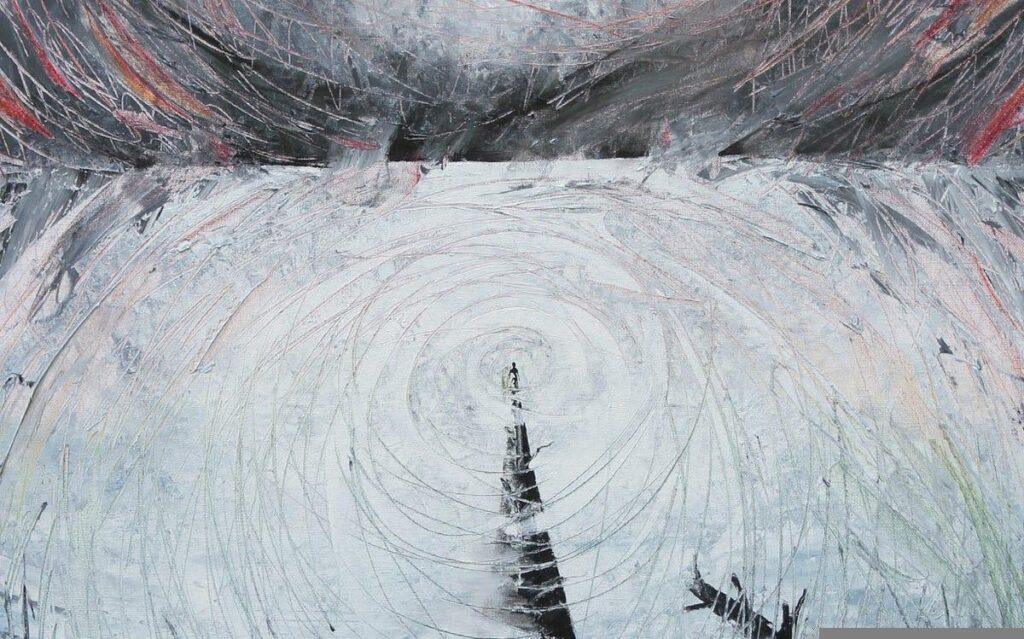
A painting by artist Emily van Lidth de Jeude. Mostly white and grey; a kind of abstract landscape, maybe, with fiery grey in the distance. A jetty or log stretches from the foreground into the distance of what might be a lake, a sea or a plane, and a very tiny distorted human figure stands at the end of it, encircled by nothingness.
Not a Thing Between Me and You (detail) … Recent painting by Emily van Lidth de Jeude, in response to Neil Young’s song, “Overhead”. This painting deals with our compulsion to just keep going into an unknown future, together, even when we don’t know we’re not alone. It’s about courage.

But what if we can’t march? And even if we can, how are we going to propel this impetus into action? How are we going to actually save our future on this planet? (Let’s face it, we’re not going to another planet, and instead of talking about “our children’s future” now, we’re talking about our own.) We’ve got months or a couple of years to turn this around, and even if we do, storms like this are now here to stay. So what can we do about it?

  1. Become resilient.
    We can stop following the status quo, and learn to live differently than our youths and the media told us to. Learn to cook our own food. Learn to pivot our careers and plans and housing situations as needed, and without being traumatized. Adaptable creatures survive.
  2. Make our kids resilient. 
    So you might know I usually write about unschooling. That was (and still is) my effort to raise resilient, independent, capable adults. And it worked! At 18 and 21, my kids are now living independently (together), paying their own way, and making changes for a better world. 
    Unschooling isn’t the only way to make our kids resilient. Any kind of freedom to explore and develop their own skills will help. As will encouraging schools to opt for explorative learning, wilderness education, and all the things that will help our kids be connected, creative, courageous, and resourceful. Those are the skills our kids will need to survive our new world.
  3. Grow food.
    Whatever we can do, whether it’s growing sprouts on our kitchen counters to save $10/week in veggies, or escaping the rat race to go whole-hog on a homestead — just do it. We can all (and yes I mean all) grow at least some of our food. This not only saves money (if we learn from someone else who’s doing it effectively and don’t fall for sales tactics for all the gadgets we don’t need), it also brings us closer to our food, giving us a deeper understanding of life, our bodies, our connection to the ecology we live in, and nutrition. It’s healthier for us (fresher food), and it’s also healthier for the environment, since everything we grow (sustainably) ourselves is something we don’t buy from the unsustainable agricultural industry.
  4. Buy local.
    For all those foods and other things we can’t grow or make, ourselves, we can buy local! I guarantee you there is somebody out there trying to get rid of a bunch of homegrown zucchinis or apples right about now. What if we paid them instead of a big supermarket chain? What if we bought from local farmers, builders, and creators instead of from the capitalist industries that are the root of climate change? This is a shift we can make.
  5. Don’t buy! Boycott capitalism.
    Buying local is one way of sidestepping the corporations who are doing the most damage, but buying less is an even better way. A big part of our problem is overpopulation, and then there’s overconsumption. We really don’t need all the stuff. We don’t need big houses. We don’t need big cars, we don’t need lots of clothing or school supplies or travel or household items. We don’t even need as much food as we currently consume, and we especially don’t need to be wasting as much food as we do through restaurant and supermarket refuse, and simple neglect at home. How many times do people go on a fabulous vacation and then declare they need a vacation from their vacation? What if we just took a local vacation in the first place — one that doesn’t displace people from rental accommodation, and that connects us with our homes in ways we hadn’t experienced, before? In the space that’s left without the things that we don’t *actually* need, we will learn to find convenience, fulfillment and joy. We will have space to keep building that resilience and resourcefulness I mentioned earlier.
  6. Be happy with less.
    Along with resilience and resourcefulness comes happiness. It is just plain so rewarding to grow my own food! I go out every day now and tend my chickens, weed a bit of veggie garden, eat some food right off the plants, and just generally revel in a lifestyle that I once found daunting. I feel empowered by my mended clothing in a way I don’t feel empowered by something brand new. I now have some serious disabilities, and learning to be resilient and resourceful has made me happy, similarly to how my job working with kids used to make me feel.
  7. Love our local ecology.
    Partly the joy I get is from being active in my local ecology (also similarly to when I worked with kids on wilderness exploration)! I have learned so much about how connected we are; am currently fascinated with the many types of wild bees and other insects that frequent my small yard, and with their life’s work and activities that all contribute to the diversity we depend on. How does this love save our world? By connecting us with it. If we love our ecology, we’ll know it better, and the more we know and love, the greater ability we’ll have to protect it. We need our ecology. If only for the simple reason that it feeds us and protects us from storms. That in its diversity it will recover when we finally do turn the trend of climate change around.
  8. Love our neighbours.
    We’ve got a couple of new neighbours recently. We’re making an effort to connect with them. You know why? Because when the power goes out, when a tree falls across the road, when someone’s pipes freeze or someone needs any kind of help at all — or just a hug, we will be there for each other. When the storms come, we’ll need each other.
  9. Love our children.
    Obviously. Because the hell that we’re going to experience pales deeply against the hell that our kids will know. If we love them, we need to save them.
  10. Just love.
    And when it’s all too much, when we’re succumbing to doubt and fear and a feeling that nothing we do could possibly be enough, we can love. If I’m going to die, I want to do it in the arms of someone who loves me. And more importantly, I’m far less likely to die early if I share a deep love. Our future and neighbours and children and the whole global population is more likely to thrive if we live a life of love instead of material acquisition. 

Love is actually a hard thing to do. So I’ll tumble out of my list now, just to write a little about love. Love is a challenge. It’s like a great wave piling up behind us, saying …RUN! And can we do it? Can we keep going even when the wave is catching our ankles? Can we slog through the wash around our waists, grasping at the ungraspable wind, to haul ourselves out when the wave peters out, and get up and run again before the next wave comes? That’s love. It’s work. Neverending, challenging, heartbreaking impossible work. But it’s also the only thing that’s worth working for. Love is, in many ways, survival. When love (of a person, planet, dream, or future) compels us, we can access the resilience, courage, creativity, and resourcefulness needed to meet all the challenges. Climate change included. 

So whether or not you can join a climate march tomorrow, do something. Something that will make you feel empowered and resilient. Something that will save us, tomorrow. And tomorrow? Do something again!

With love,
Emily

Smoke, Fire, Ashes, and Covering Everything With White

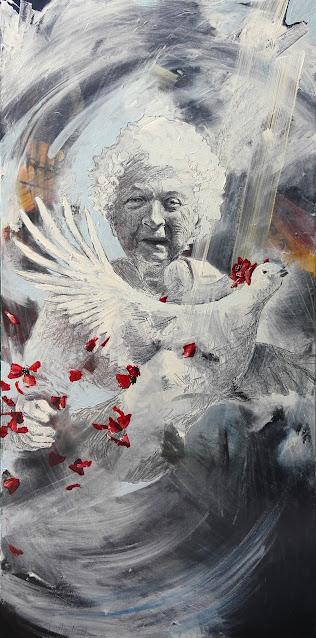
A mostly black and white painting. A portrait of an old woman with white curly hair, wrinkly skin and a big laughing smile. She's reaching her arms forward to the viewer, and a white ptarmigan is flying out of her arms, towards the right. A trail of red poppies and poppy petals tumbles off the ptarmigan as it goes.
Grandma Frees the Ptarmigan, 2023

I sometimes wonder why everything I paint recently, and somehow even the installations I do, gets a clouded overlay. It's oil paint, white fabric, soft white light; whatever. I keep washing everything away into a purposeful obscurity. (Except my portrait of my Ukrainian Grandma releasing her war trauma. For that I made the obscurity first, and she came out of it. That's a strange happening!) Recently I also found out I have cataracts, apparently caused by the various courses of prednisone I've been subjected to over these last 3.5 years of struggling with long COVID. Blah. Great. Not the news you want, as an artist! But even more recently I realized I might be replicating my own clouded cateract vision in my work. Huh.

I mean, part of me wants to embrace that (since the inflammatory effects of my long COVID also mean cataract surgery is not recommended), but part of me is still looking for a deeper meaning. And the white thing has been going on in my work for longer than I've had cataracts. I think I found my deeper meaning, during this current fire-season. It's self-silencing. 

We live in a world full of fear, watching homes and towns and futures burn and flood and life just get harder and harder. And the best comfort we can give ourselves is to wrap up in the status quo. Get a latte from a huge corporate entity and watch some non-reality on Netflix. We Canadians aren't even allowed to share the news anymore (Meta: Working to silence the world!) 

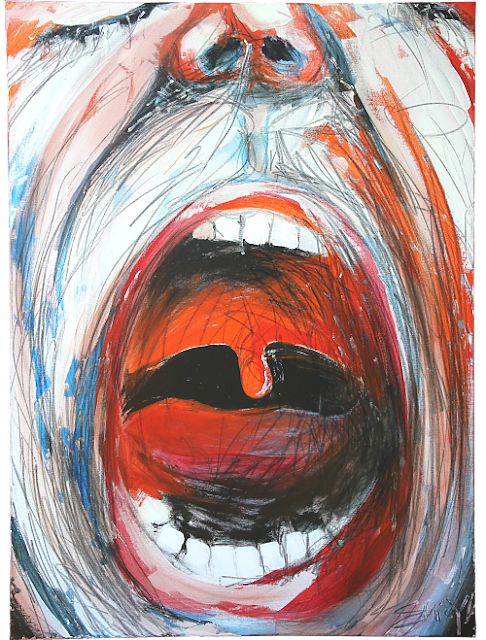
A big rough abstract painting and drawing of a screaming mouth, which basically fills the whole canvas, though a bit of nostrils are visible at the top. It's very rough and scribbly. Some people say upsetting but I don't think so because it's my own mouth!! It's called (I open my mouth and) Nothing Comes Out. It's a picture of a dream I've had most all of my life, where someone's being horribly hurt and I'm screaming for help, but... guess what?! Nothing comes out!! (How did you guess...?) 
Predominant colours in this horrible scribbly drawing/painting are white, graphite grey, orange and pthalo blue. And red.
There's an uvula in the middle of the canvas but clearly... it's not doing anything. Maybe I got carried away with this description.
(I open my mouth and) Nothing Comes Out, 2016

I've been passionately determined to change the status quo since I was a kid, but people get defensive if I talk about change. People write off my personal status-quo-breaking experiments (unschooling, regenerative farming, rejecting many popular conveniences in an effort to live sustainably) as impossible for most, or, even worse, "crazy". I feel so frustrated; so unheard, and so afraid of losing community support (and friends!) because my voice has been too loud; too radical. So I'm trying to shout my meaning while simultaneously silencing myself (!) Yeah. That's weird.

Is it necessary? Do I risk being written off like Sinéad O'Connor and everybody else who just couldn't keep silent? Who tried to change us? Or am I getting desperate enough not to care?

Drink Before the War, 2019

I was so saddened by Sinéad's death that I got even quieter. Now I'm so infuriated with watching my province burn (the homes of family friends gone, family evacuated and praying they don't lose everything, and my own veggies wilting and dropping in the smoke) while so many continue their world travels, unnecessary purchases, and general adherence to the status quo. I feel like I've been shouting for change my whole life, and my voice is hoarse but still somehow no sound comes out. So today I'm going back to the studio and just see what comes out of my brushes, because I just can't not scream about it all right now.

I don't think I'll stop using white. It's also evocative for me these days of the smoke and ash that's now a part of our every summer. And the blindness with which we're going into the future. My blindness. But I'm going to try to stop silencing myself.

Procreate Project Archive X Air Gallery

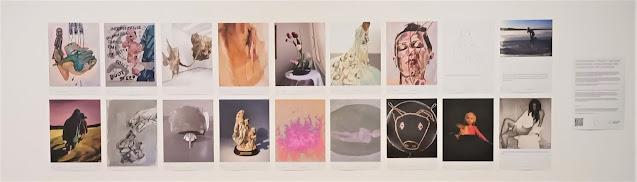
A series of 18 art posters in a double row on a white wall. Predominant colours are pale yellows an creams, pink, and blacks.

I love this!! 

So happy to be a part of this great project that puts the art of motherhood into public spaces!
That's my work (dis)robe: Maternity Wear you see near the top middle of the spread above. But it's just one of the many, many poignant pieces that are now out spreading the motherhood vibes in Manchester.

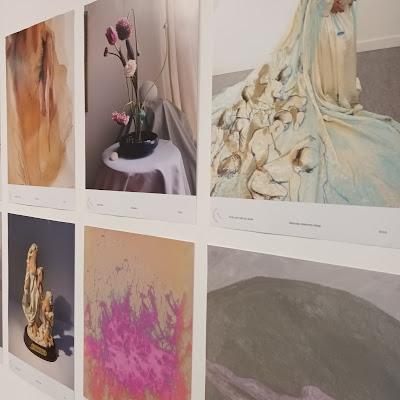
Six art posters are shown on a wall. 
Three are abstract, one shows a bouquet of bending pink and white flowers, one shows a woman in a wedding gown upon which clamouring babies and a pregnant belly are painted, and one poster shows a figurative sculpture that is too distorted by the angle of the image to identify.

Currently the project creators are collaborating with Air Gallery to show it in various Manchester locations, but the whole poster series is available for other exhibits as well, so who knows where it will go next! What a fabulous creation.

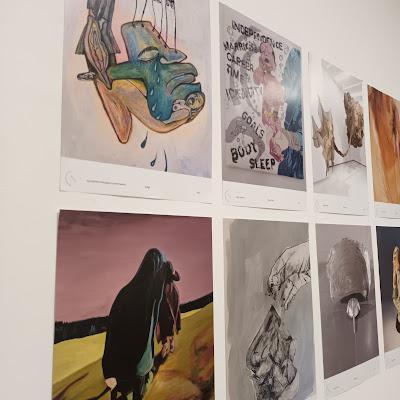
Eight art posters hang on a wall. They're fabulous, but also hard to see because of the angle of the photo and the light reflection on them! Some figurative; some not. It's a great wall of posters by fabulous women, but you'll have to check out the link below it if you want to see more work!!

Do check out their site at procreateproject.com!

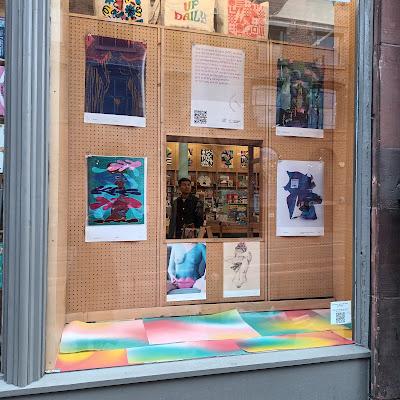
A shop window in Scotland shows a series of art posters on tack-board, surrounding a peekaboo window-within-a-window, where a person is seen shopping. One of the posters shows a naked woman sitting on a chair, legs spread, and holding a pair of giant pink plastic lips in front of her crotch. There are rainbow watercolour paintings on the horizontal surface at the bottom of the window. Yay rainbows!!!

 All images credit: Procreate Project Archive

w h a t . h o m e in Gibsons, BC!

With huge thanks to the Gibsons Public Art Gallery and Canada Council for the Arts for putting their confidence in me, I can FINALLY announce that  w h a t . h o m e  is home in BC, where it all began. 

In 2017 I began interviewing residents of BC's west coast on the subject of 'home'. I had some idea of where the topics might go, but I was surprised again and again by the amazingly heart-full, extremely unexpected, and often challenging stories that emerged. I've discovered through this work and other interview-based projects I've done that in any cross-section of humanity there will be a deep exploration of belonging, and a desire to make the best of always surprising circumstances. This project puts this on display. 

However, the first iteration of this project was installed at Goleb in Amsterdam, as the culmination of my residency, there–a long way from home, you might say! But also not. I have family in the Netherlands, and began my art studies there, as well, so it is in fact a kind of displaced second home to me. I was invited to this residency by my friend and colleague, Igor Sevcuk, and received much support and feedback from him, his wonderful partner (and scientist and fellow artist) Go-Eun Im, other artists at Goleb, and of course my own partner, Markus Roemer. Not only did the project complete with this support, but also with visits and input from various Dutch friends and family of mine. The most amazing thing to me was that the stories and feelings from the West Coast of Canada translated perfectly to a Dutch audience. Amazing that we can take humanity from one side of the world, plop it down in another place, and we're still… human. With the same basic needs, and the same love.

Happily, though, now I get to bring the project back to where it began. And what a wonderful time we had putting up the dual-channel installation of
w h a t . h o m e !

OK maybe it was a little stressful given the tight timeline, but we made it, and pretty sure we've survived! Here's a little video compilation of the process of installing. You'll see me sitting on the floor doing a video-interview with Rohit Joseph for CBC Radio's weekend morning show, North by Northwest. Here's the fifteen-minute interview, if you'd like to hear it. It really was a joy to talk to Rohit, and a highlight of my career at this point.

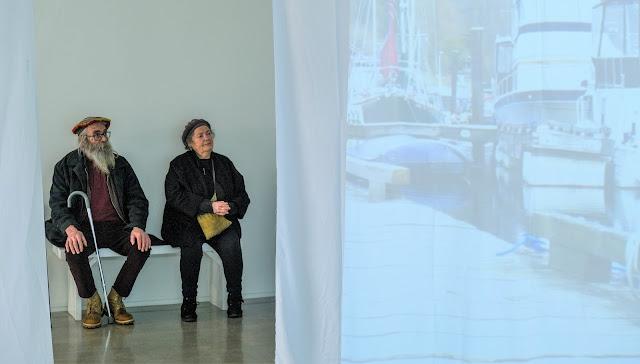
Two artists in black pants and jackets sit on a bench of the Gibsons Public Art Gallery, framed by hanging projections of Emily van Lidth de Jeude's show, what dot home. The man on the left wears a colourful tam, and black-rimmed glasses, and has a long grey beard and hair. His grey walking cane rests between his hiking boots. The woman to his left wears a darker tam, has short grey hair, and holds a yellow purse in her lap. Both are looking thoughtfully at the projections on the hanging sheets, around them.

The opening was really incredible for me. Such a huge amount of support from my family, friends and community. I was totally blown away.

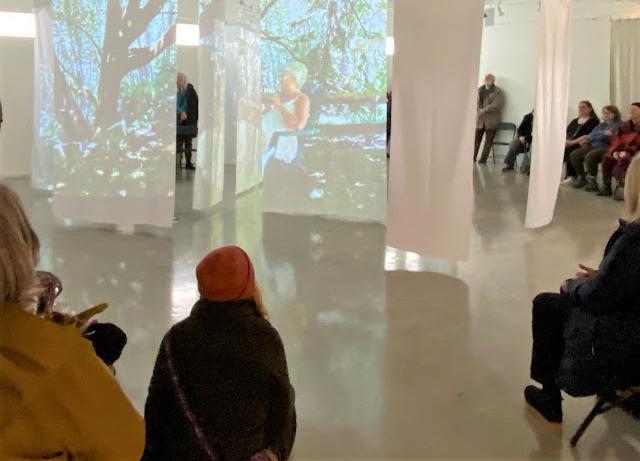
Seven white sheets are hanging in the middle of a gallery with concrete floors, covered with projections of a deciduous forest scene within which a woman sits on a chair ,talking. People are gathered in chairs and seated on the floor all around the exhibition, listening to the show.

Probably the biggest shock for me though was the unexpected appearance of a fabulous kid I once taught in the Netherlands. I haven't seen her in about thirty years, and she, her mother, and her kids now live on the Sunshine Coast, and came to the show!! AND she's an artist!!! What a wonderful surprise to connect again. Yet another thing that made me realize how grateful I am for the life I'm privileged to have. Here are a few photos from the opening. Thanks to my son Taliesin and brother Adrian for the photos. 🧡

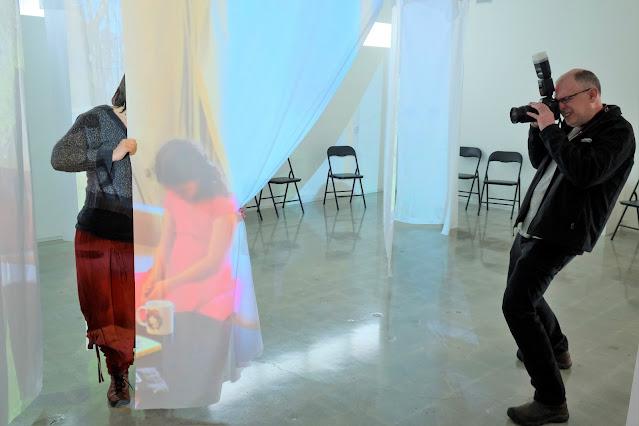
Artist Emily van Lidth de Jeude stands half-hidden behind a hanging white sheet, upon which is projected the image of a young girl in a pink dress. Emily is wearing red pants, red shoes, and a dark grey sweater. A photographer stands on the right side of the frame, leaning back dramatically while taking a photo of Emily and the projected girl.

Also this guy!! Michael Gurney. What a fabulous reporter!! He came fully prepared, having already checked out the show and having a bunch of really good interesting questions about it. And his article shows he actually researched this quite thoroughly. I am truly honoured to have this show written about by him. He said some interesting things about it that even helped me understand it more, myself. Here's a link to the article he published: https://www.nsnews.com/local-arts/bowen-islanders-exhibition-at-gpag-is-homeward-bound-6574236

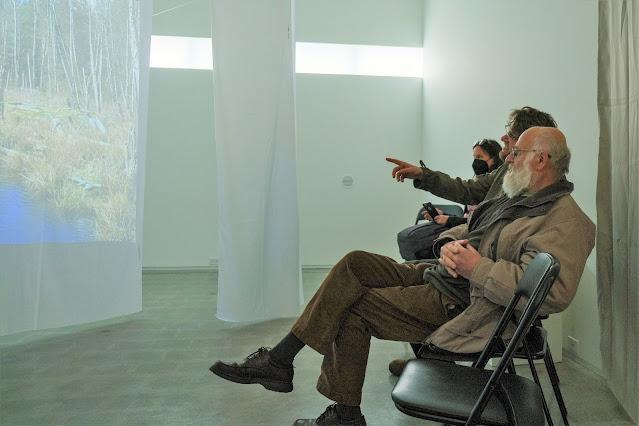
Two men are seated near a gallery wall, smiling pointing at sheets hanging in the middle of the room, which have landscape projections on them. In the distance, another woman is seated, wearing a black respiratory mask.
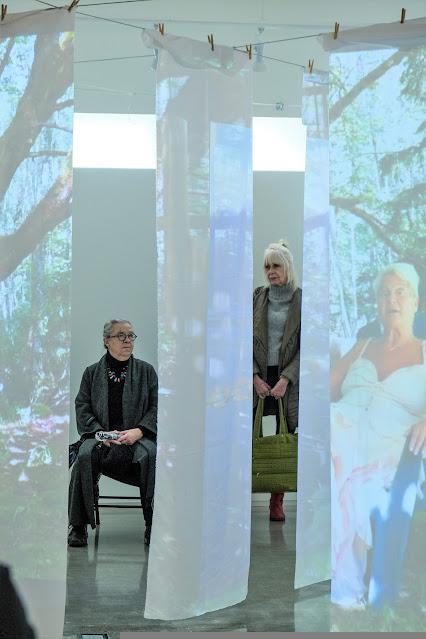
Two artists, Judi Gedye and Diane Buchanan, are framed by separate sections of the hanging white fabric of what dot home. Judi, on the left, is seated on a bench and wearing mostly black with a grey shawl-like coat and a white necklace. She has grey hair and black-rimmed glasses. Diane, standing on the right, wears red boots,a grey turtle neck, a green-grey jacket, and holds a green bag in front of her legs. She has long straight white hair, tied back. On the sheets, a projection of poet Jude Neale is shown. Jude is wearing a white and coloured summer dress, and has short white hair.

We acknowledge the support of the Canada Council for the Arts.
Nous remercions le Conseil des arts du Canada de son soutien.
https://canadacouncil.ca

the struggle between change-making and capitalism

A Universe Inside Me, a change/able painting by Emily van Lidth de Jeude
To view this piece in action, see my MakerTube video.

All my life I've been interested in change-making. Other than loving my family, there's nothing in the world more important to me. But that's the issue–change-making costs money, and time that means I can't make money. My partner and I are constantly making choices to deny our kids some of the things their friends consider essential (travel, city-living, new devices, new shoes, a better car, and so many extra-curricular programs), in exchange for working on projects that we hope will better the world or just our own future. And yet, here we are with young adults on the verge of fleeing the nest, walking straight into the same capitalist trap they were raised in. And we're thinking of how to support their new city life while the world falls down around them. 

Cognitive dissidence is the least of it. I'm sitting here in the bizarrely unsurprising October heat and drought, the other side of our yard obscured by smoke, and really just wondering what comes next. 

In my work-life, I'm producing installations intended to bring people into connection with the ecosystems they live in, and with each other. I do commissioned portraits on the side, just to add a little tiny cash-flow to our family, but I've chosen a career that costs more money than it makes. I'm proud of this choice, but the balance is that my partner makes the family-sustaining income by creating software that, among other things, is used by companies logging old-growth forests around us, destroying the ecosystems I'm trying to save. 

At home, we're trying to grow our own food, which has turned out to be a very good thing, now that inflation is hitting us so hard. But we're buying plastic bags to store chickens in, and the climate is so unpredictable we're constantly re-planting, or nurturing struggling plants for months that ultimately fail to produce crops. No learning-curve can keep up with the speed of climate change. So we keep ending up in the stores with everyone else, trying to meet our nutritional needs as cheaply as possible, while wasting endless dollars buying chips and treats made by corporate behemoths that we feel will keep our kids happy. So we can send them smiling into the future.

In our community we're traipsing around making improvements while our friends drop like flies around us. We're afraid to ask for help when we need it because we know everyone else is already beat up by their own struggles, so we isolate and feed our lonely pain with all the subscriptions and addictions we can. And we contemplate the struggle: How can we make enough money to feed our kids without destroying their future? How can we raise them happy in a world where nothing matters more than the capitalist quest, but safeguard them against a capitalist apocalypse? How can we output joy when there's only fear coming in?

I wish this was a post where I have all the answers. Sometimes I try to write posts like that, and at those times it feels like there's a possibility we can plan and manage our way out of this mess. Right now I just sink into a futile wish that we'd all just stay home and forget the dreams we were sold as children, as impossible as that seems. I wish we'd stop selling the same dreams to our own kids at the cost of even the meagrest subsistence in their future. I wish we would all just grow food in peace, love each other and what remains of the world outside our doors.

Learning everything all over again–only different again, too…

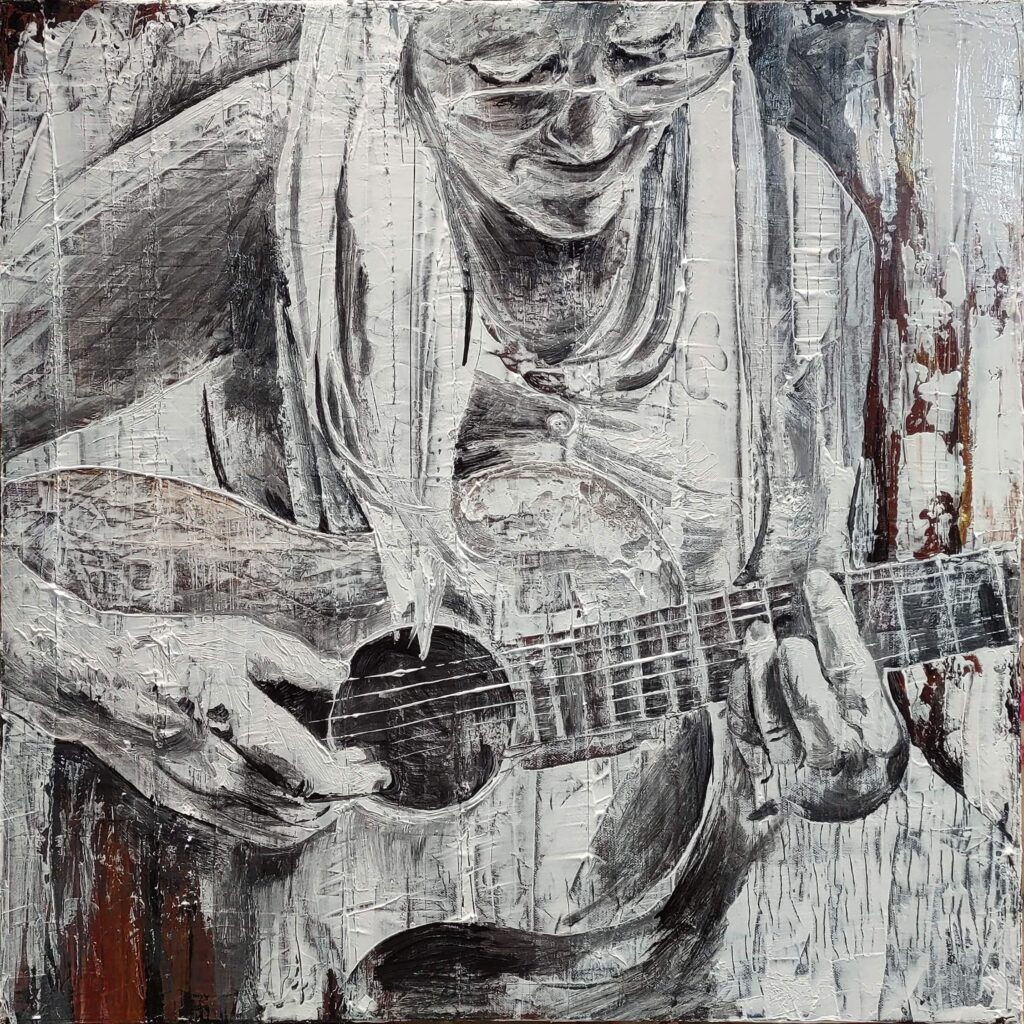
A mostly black and white painting of a woman playing a guitar. She has long white hair, glasses dropped down her nose as she is leaning forward over her hands, smiling but crunching one eyebrow as if concentrating on the chord she's playing.
Painting by artist Emily van Lidth de Jeude, called "Mum playing guitar".
Emily van Lidth de Jeude: "Mum playing guitar", 2022.

1994, Royal Academy of Visual Art, the Hague, Netherlands: My first painting instructor showed up to my studio during the first week and told me to get rid of the acrylics. He pointed to a painting sitting drying under the table, and described the dullness; the surface quickly losing any and all beauty it might have possessed just minutes before. So I did, and have been bonded to a series of ever-more-ecologically-friendly oil paints and mediums ever since.

I've used oils for nearly thirty years now, and I LOVE them. I love the smell, the feeling of them, the way they layer and all the ways I can scratch and draw through them. I grew up as a painter with oils… and in less than two weeks I'll be participating in a live painting event where oils are not an option (not allowed due to VOC's, and also because paintings must be dry and hung by morning!) So here I am teaching myself a new skill in a hurry!!! It turns out very little of my painting style and technique translates to acrylic, so I'm having to reinvent myself.

Anyway, here's my beautiful mama in one of her happy places. She's my first attempt at finding a new style and technique using only acrylics. It didn't go at all the way I thought it would, but I'm getting somewhere I like, anyway. And it's already dry!

The Unboxing Project at Sainte Croix de Mareuil

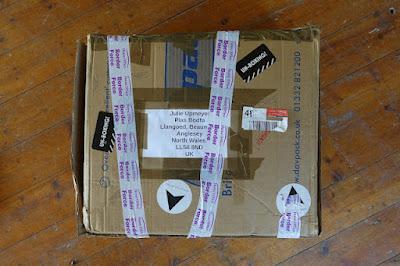
A cardboard box covered in postal tape and labels sits on a worn wooden floor.
Un-boxing at Plas Bodfa (Wales) photo from Julie Upmeyer

It's been interesting to follow the Un-boxing project on its travels so far. Gudrun Filipska's Arts Territory Exchange creation, a box of contributions from artists all over the world, has been making its way slowly from one exhibition space to another, and as an artist participant, I get to witness the remarks of curators along the journey. So here I link you through to curator Jane Linden's essay from La Vieille Closerie, Sainte-Croix-de-Mareuil in Aquitaine: "Curatorial Reflections on Un-boxing at Sainte-Croix-de-Mareuil by Jane Linden". 

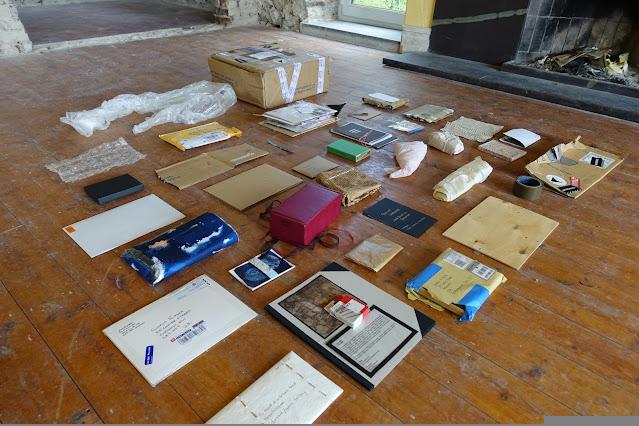
Contents of the Unboxing box lay neatly arranged on the worn wooden floor: The box, some packing plastic, and 34 items, most of which look like parcels or envelopes.
process of Un-boxing at Plas Bodfa photo from Julie Upmeyer


Jane has also posted some photos from the box's visit to France on her instagram: https://www.instagram.com/lavieillecloserie/

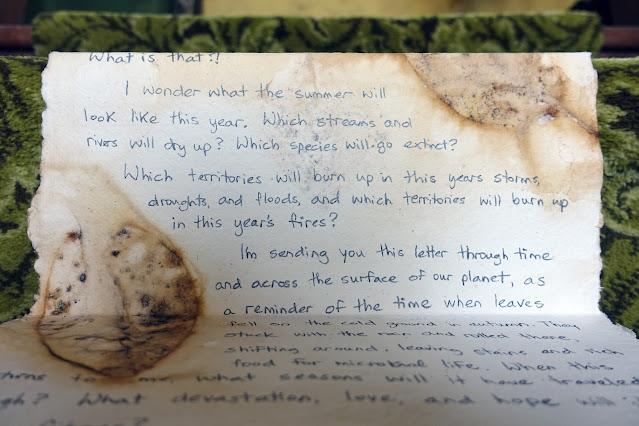
A raw-edged piece of handmade paper lies folded on green-carpeted stairs. There are rotted-leaf prints on the paper, and text written between them. The text says:
What is that?!
I wonder what the summer will look like this year. Which streams and rivers will dry up? Which species will go extinct? Which territories will burn up in this year's storms, droughts, and floods, and which territories will burn up in this year's fires?
I'm sending you this letter through time and across the surface of our planet, as a reminder of the time when leaves...
(The rest of the text is at too steep of an angle to decipher.)
part of my own contribution to Un-boxing, displayed at Plas Bodfa photo from Julie Upmeyer

Do You Really Want Your Kid to Be an Artist?

A young girl with straight brown hair in a white nightie and apron is seen from behind, seated on a wooden stool, facing a wood-panel wall. She is painting on a piece of paper that's taxed to the wall. She has painted blue clouds at the top of the page, and holds brushes in her free hand, on the left.
Me, at 7, being an artist.

When I was a kid, I wanted to be an artist. Or a botanist, or a hair-dresser. My parents and grandparents gave me wonderful art supplies, and my father even made me a palette with a hole in it for my thumb, and positioned the kitchen stool in front of the wall of our trailer for me to use as a painting stool. That’s me in the photo, in the early nineteen-eighties, feeling wonderful and accomplished, but with absolutely no idea of what it meant to “be an artist”.

So What, Exactly, Is an Artist?

I'm an artist, now. Twenty-five years and two kids after I got my degree in visual arts, my career is built on helping people reach beyond societal expectations to un-silence themselves, and connect genuinely with the world we inhabit. I do paint, and I do have gallery exhibitions, but I also tromp in the forests, use materials I never imagined would one day be called “materials”, and make art I never imagined would be called “art.” The focus of my work is to connect people with our own deeply-held stories; as an explorative learning consultant I also encourage parents and teachers to do the same with their children. It turns out art was just a vehicle for something more important to me. And I’m still an artist.

The stereotype of the famous artist making masterpieces in his (he's almost always male, white and powerful) studio has almost nothing to do with a successful art career. I wish somebody had explained this to me when I was a kid. Picasso was an abusive, deceitful creep, and we don't have to appreciate his work to be artists. There’s SO much more wonderfulness in being an artist than I had imagined! So much more diversity!

Artists are responsible for not only the beauty we see in our human-made world, but also for the connection we make with neighbours, for the realizations we make about our own lives and feelings when we watch movies, listen to music, or read books. Artists determine how easy it is to use the devices we buy. Through media, artists determine which devices and foods and colours will be more popular. They understand the influence of shapes, colours, sound, movement and texture on our emotions, and… like it or not, our emotions govern much of what we do. Artists are powerful. A “career in the arts” is a massively open-ended term, but also, having a grounding in artistic practice and theory means a deeper foundation or influence in any career we choose. Moreover, having the ability to express ourselves is an important foundation of meaningful connection.

I like to imagine a world full of people who were encouraged in this way. How happy, satisfied, and valuable could we all be? How would our chosen paths be enhanced by a facility with self-expression and material, sound, or movement exploration? Do you really want your kid to be an artist? And if so, how can you support them?

What NOT to do: Unsolicited "Help"

It's incredibly easy to break kids' confidence in art (or anything) and less easy to build it. As with so much in life, the first thing we can do to "help" our kids succeed is to get out of their way. It's not easy, especially when we're watching them struggle with something we know there's an easy solution for. But we zip our mouths, find something else to occupy our attention, and trust that they'll get where they need to go. And never, ever critique.

Criticism is more likely to break our confidence than to teach us something, and a shattered confidence is a massive barrier to success. My daughter is a writer, and was recently working on her second novel. I edited her first novel for her, judiciously reporting back on only glaring typos and missing punctuation. It was an amazing realistic fiction coming-of-age story, written from the bold heart of a young girl whose grandfather had recently died. I love it so much I heartily recommend it to readers of all ages. Her next novel, though, was a departure from the world she knew and understood so well, and required a steep learning curve. It was an epic fantasy, full of people from different cultures and a massively complex magical world… all of which she dutifully researched and developed before writing. But then she was challenged by trying to fit this enormous complexity into a single story. And when it came time for me to edit her book, I didn't hold back with the criticisms and suggestions. Some chapters were confusing, some events seemed out of place, and mostly I was confused by the timeline. Sure, she was only fourteen, but I just knew she was capable, so I critiqued! Despite my attempts at being gentle with my criticism, it all seemed insurmountable to her, and after a few attempts at editing, she abandoned the book. To her credit, she's keeping an open mind about the possibility of writing it in the future, but unfortunately I feel I threw a hammer at a beautiful glass sculpture she was creating, that actually she just needed more time with, alone. Without my critiquing.

So that's how not to build confidence. Just think of all the ways we're doing that, in every part of our kids' lives, and even our own. So many of us have an overachieving inner critic. And a culturally-supported fear that that critic is what's keeping us on the straight-and-narrow. But you know what? It's not. What would happen if we just didn't correct our kids? Well I have some experience with that, now, both in teaching and parenting. It's ridiculously hard to shut up my inner critic sometimes, but when I do, the kids thrive.

My daughter is truly an excellent writer–so much so, that in her frantic enthusiasm she charges ahead, forgetting to put periods at the ends of sentences, capitals on names, or sometimes misspelling words. She edits herself, and (as we all are prone to doing) sees right through her mistakes to read what she intended to write. What if she asks me to edit and I just ignore those mistakes? I've experimented with that. Sometimes she looks over her work later and discovers her mistakes. Sometimes she puts it aside for a few months, grows and learns, and comes back to it to realize she would now write it differently. Sometimes, even, she submits or publishes something with mistakes. And you know what? That's just fine! I frequently go back to my own work from years earlier, and see how much I've learned and grown since my thirties–and yet my work was appreciated then, as well. Have you any idea how many typos I still find in my writing? Tons. I'm especially accomplished at missing words and totally redundant examples. Sometimes I don't even bother to correct them. Because they're part of my humanity. Our kids deserve that space to be human, too.

Honouring Growth

As a visual artist, I love to look back and see all my mistakes. I look at portraits I painted years ago, and wonder why I did them the way I did; sometimes I also notice things I thought were problems at the time, that now inform new directions in my work. Growth is where it's at, people! Otherwise what are we living for? In some deep place, children know this, as from the moment they're born they challenge themselves to grow by exploring different tastes, movements, and expressions.

A very young girl with blond hair pulled back into a ponytail, and wearing a rainbow tie-dyed shirt, stands painting at a stand-up easel with a red tray on the bottom, containing a children's cake-paint-palette. She has painted a scene with a blue line of sky, blue clouds, a yellow sun, an orange flower with a green centre, and a big pink person stretching its arms out.
Rhiannon, age 5, experimenting with paints.

Children, like my daughter in the photo, above, want to represent their world. But it isn't always as we might expect! As parents, we have a choice about whether to show our children how to draw things the way we think it should be done, or to allow them to discover their own ways, through experimentation. My son was once drawing a whole page full of lines, and I asked him what he was drawing (something I've since learned not to do), and he told me it was a drum. I was totally perplexed, and asked him where the parts of the drum were. This was a boy who had no problem drawing a circle–why would he choose to represent a drum with a whole lot of unconnected lines? "It's the sound of the drum." He said. Boom.

He didn't need my assumptions. He needed my appreciation, and the freedom to keep exploring. As long as we respond to our kids' experiments with curiosity and loving encouragement, they'll continue to know that where they are on their journey of growth is perfect. And that will be the impetus they need to keep growing with enthusiasm. I have no idea how my son's drawings of sound influenced his life, but considering he now is employed as a visual artist and makes music to accompany his personal visual projects, I'm relieved I didn't get in the way of that particular growth pattern by showing him "how to draw a drum."

Asking Helpful Questions

I realized during my children's earliest years that questions like "what are you drawing?" are extremely limiting. In that question I have determined that my child must be trying to represent a specific thing, and the assumption is usually that it's a visual representation of something we know. But what if it's not? What if it's our children's experimentation with colours, shapes or lines? Or sound, as in the drum example? That kind of experimentation–without intent to satisfy outside demands–is essential for learning to use materials. Professional artists actually bill for material experimentation; it's called "research". We even sometimes mount gallery exhibitions composed entirely of experimental output–often to great acclaim. So why would I limit the possibilities of my own child's artistic output?

But we want to ask questions! We know it's important to engage and encourage! So how can we ask questions that promote growth-dialogue about art (or anything), without limiting our children's growth or expression?

Think about the words in the question "What are you drawing?" The word 'what' carries the assumption they're trying to represent an object. The word 'drawing' means we assume they're focused on the output of the material in their hands, as opposed to the feeling, taste, smell, or movement of it. How are these assumptions limiting the range of acceptable answers?

A child's drawing in green ink. Appears to be a kind of triangle filled with messy circular and straight-line scribbles, but definitely a few intentional unidentifiable shapes. In the corner of the drawing an adult has written: "Taliesin. Feb 1, 2006. Nothing. I didn't tell you."
Drawing by Taliesin, age 3.

Maybe we have a kid who is happy to contradict us, and says, "I'm not drawing anything. I'm dancing the pen," or, as in my son’s drawing, above, “Nothing. I didn’t tell you.” (I learned a lot about parenting from that bold rejection.) But more likely, our kid wants to please us; to learn from our example, and will find a suitable answer, like, "some lines," or as my daughter used to do, look at a bunch of lines she was experimenting with and come up with a wild explanation like, "it's a dog on a house with the family having dinner." It's tragically very common that kids learn to minimize themselves to match what they perceive coming from adults. I've seen plenty of kids who were making successful attempts at depicting what might have been people or animals declare that they were “just scribbling.” Why? Because maybe they feared hearing our criticisms, or maybe we've previously defined their drawings of animals as 'scribbling', or maybe, because their own inner critic is already developed enough to silence their voice.

Adults are notoriously bad at asking kids questions, and kids generally have rote answers ready to respond to each of them: How old are you? How is school? What are you making? What is your favourite colour/subject/sport/etc.? How are we so uninspired?! These questions aren't about engaging with kids or developing rapport; they're expected. What if, instead of asking what they're drawing, we invite them to tell about what they're doing? This is an open invitation to consider what they're doing and talk about it. It's up to us to be open to hearing their response, no matter how long, unexpected, or confusing it may be. Not all questions will be helpful for all kids in all situations, but through practice we can become better at asking good questions. Here's a list of interesting open-ended questions to use in engaging kids to talk about their art:

  • Interesting! Can you tell me about this?
  • Does this have a story or feeling?
  • How do you feel about what you're doing?
  • Show me how you like to use [material]…
  • What do you think about the materials you're using?
  • Are there any other materials you'd like to use?

Materials

Ah how I love shopping for materials!! And hoarding them!! Don't we all?! How much of our parenting waste is comprised of once-used adorable kits that were soon replaced by something newer and more exciting? I won't go on at length about this, because I've previously written a whole article about Supplies and Practice of Open-Ended Art Exploration. But suffice it to say that well-chosen art materials are the foundation of good artistic experience. And I don't mean the expensive stuff. I mean well-chosen. Materials can be anything from kitchen supplies to mud and sticks outside, to a mish-mash of mark-making, gluing, cutting and melting tools. The important feature of all of these things is that they do not come with instructions or intended uses. How we present and use materials is much more important than what they are.

Modelling

From the moment they were born, and possibly earlier, our kids have looked to us to lead them. The important thing to remember about modelling to our children is that it's happening all the time; not just when we do it intentionally. Our kids see our hesitation and fear with art as much as they see our enthusiasm. They see us avoid trying new things, and they see us when we courageously do them, and when we have small successes and failures. They emulate not only our actions but also the way we emotionally deal with these things.

With this in mind, the absolute best thing we can do for our children is to use any and all materials available to us to explore creatively, for our own happiness. That last bit is important. Kids can smell a fraud from a mile away, so we have to be creative in the way that we want to be. Otherwise we're just teaching our kids to put on a show for someone else's benefit, and that's nothing about authenticity.

And we should stretch ourselves. If we're accustomed to buying craft kits and following the instructions, we should absolutely try to break that habit (more on why in the materials article, above) and try experimenting with new materials. We can also stretch our definition of art-making. Try experimental baking! Try sewing or crocheting! Try putting on your favourite music, getting dressed up in fancy dress or costumes and dancing your heart out! Try painting your whole self and rolling around on an old sheet, outside. In the rain! It doesn't matter what or how you engage in art, just as long as you do it. And if your output isn't what you expect? Even better. Keep experimenting. You're modelling growth to your children.

Living a life full of joyful exploration and learning, ourselves, is the best way we can teach our children.

Nurturing Important Skills

A child in a plastic cartoon apron stands outside a sliding door on a wooden porch. She has short straight brown hair, and her hands, feet, and part of her face are completely covered in red paint. There are also red footprints all over the porch.
Me, age 4, being an artist.

We’re culturally trained to associate specific skills and attributes with art: dancers should be thin and flexible, visual artists should be able to draw realistic depictions with technical skills like shading, perspective, and colour theory; musicians should first learn to read music and do scales. Unless we’re born talented, of course.

Oh hell, I hate the word ‘talent’! It's such a harmful concept. I wasn't born talented; I developed some skills in accurate rendering of my observations by having a keen interest in observing how things are put together; how the light plays on them, and being given room to experiment with materials throughout my life. It was easy for me because I loved it, just like my daughter loves telling stories, so writing is easy for her to learn. We develop the skills we need when we realize we need them, and as long as we're not discouraged from exploring them.

As parents and teachers, we need to help build foundational skills for life, and trust that those material skills will come when needed. As an artist, I owe a huge amount of my career satisfaction to some less-concrete skills and passions:

  • seeing the big picture in life, art, etc.
  • a keen interest in social phenomena
  • a passion for exploration and discovery


We really can't know what skills will be foundational for each of the unique kids we work with. Neither can we know the cultural landscape our kids will grow into, nor what careers will be common, when they’re grown. Who knew, when I was in art school twenty-five years ago that people would be making virtual and even invisible art to sell online, one day? Who knew I’d raise a son who gets paid to make thousands of geographically plausible planet renderings by using procedural generation techniques? His art process looks like a bunch of visual programming. I could never have predicted this, never mind taught him these skills. So when trying to support kids I parent and teach, I try to encourage growth of all sorts of skills. Life is not divided by subject. Careers are not determined by skill-acquisition. It's all interconnected. The more we learn, the more we can learn.

So Do You? Really?

Yes. I guess I really do want my kids to be artists–however that looks for them, and however it looks in the future we can only dream of. I want them to explore all the materials and develop all the skills I can’t even fathom right now. I want them to change the definition of the word “artist” to mean new and wonderful things, and I want them to keep on growing as the world grows, around them.