Playgrounds, Gaza, and a Forest: How Competition Impedes Prosperity

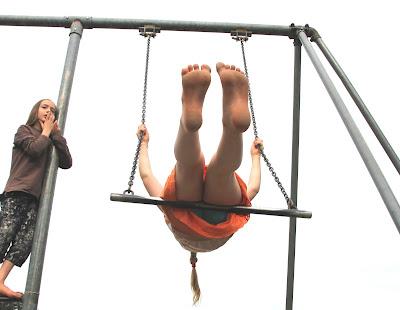
A long-haired boy in a long-sleeved brown shirt and black and white capri pants stands on a bar, half-way up a swing-set, looking wistfully off into the distance. His sister, in an orange skirt, turquoise shorts, and a shirt that is obscured by the angle of the photo, swings on a trapeze, beside him. Her feet stick out into the centre of the photo, in the foreground, and her long braid trails behind her.

One damp autumn day, I crossed the dirt and wood-chip playground to the swings, where I saw a girl a couple of years younger than I was, and also the bottom of her grade's social heap, swinging on the best swing. You know the best swing? It's the one that is for some reason not spun up out of reach by the older kids, and the most visible to the playground supervisor, so other kids don't bother trying to haul you out of it. During those years, I spent all recesses and lunch hours either hiding on the bluffs, up in a tree, or firmly glued to that swing and swinging fiercely back-and-forth, back-and-forth, daring people to come near me with a glare they never noticed. But this day, this younger girl's thick brown hair flew back-and-forth, back-and-forth over her raincoated shoulders. I stood at the pole of the swing-set and ground my boots into the dirt. When nobody was looking, I told her passing face that I was magic and would turn her into a rock if she didn't get off and give me the swing.

When I was a kid I was near the bottom of the social heap. The kids who hurt me the most were also hurt the most by their parents, or by other kids at the school. It's normalized, in our culture, to turn and dish out to someone else a cruelty that was served to us. School, career-building, politics, capitalism–they're all just games of getting ahead of others, and put us in a position where we feel that "getting ahead" is the same as "prosperity". It's an illusion, but our longstanding capitalist social structure leads us to believe in it at the cost of vision and community. 

Israel is flexing its playground seniority in Gaza. It feels heartless to compare genocide to playground bullying, but I want to point out that in accepting what we see as insignificant cruelty in our privileged day-to-day as a necessary cost of getting ahead, we also pave the way to accept greater and greater atrocities. I understand from my playground experience how easy it feels to commit some lesser act of cruelty against another person when I've been hurt. So by extrapolation, I get that maybe if your people has been persecuted for thousands of years, and even in living memory was the pointed victim of horrific acts of genocide, it might seem less than horrible for (some members) of that people to commit genocide against the next victim down the chain. I mean, aren't we all just making gains by stepping up upon the backs of those just below us in rank, privilege, or esteem?

Well no–not everybody is doing that. Some of us from every race, religion, and social ranking in the world are in fact trying very hard not to be that kind of monster. Some of those in my circles who are most vocally supporting freedom for Palestinians are my Jewish friends. Because fighting to get or stay on top of a social pyramid does not equal prosperity! Because some of us learned this important lesson in childhood.  

Back in my elementary school playground… I have never forgotten the look of horror on that girl's face, and my triumph at seeing her run away, so I could get to safety on that swing. My triumph was the worst. I remember the sick feeling in my stomach, after she left. I didn't know where she had run to, or who might be kicking her, feeding her dirt, or holding her down and whispering the most vile threats in her ears. I remember thinking we looked rather similar and maybe she could have been my friend if I hadn't been so desperate to get that swing. I felt that getting the swing gave me safety, but it also took away hers. I remember that my triumph came with a horrible cost to my feeling of righteousness, and that year I became one of those people who knows better than to pass the bullying on to the next rung down the ladder. Sometime after that I bravely spoke a few words to my bullied-mate in the classroom. We had a breath-holding competition. So for a couple of minutes we found common ground in an environment of terror and ladder-climbing, and I think in some small way we both learned to transcend the hierarchy of our class.

We can ALL learn from our mistakes. We can all look at our leaders and our cultural and personal privileges and refuse to make progress at the cost of others. Sure, we're trying to survive in what is, at its root, a culture of competition, and to some degree we have to participate in the status quo to survive. But we can also work to change it. Those of us with more privilege have more ability to effect change. We can change the ways we look at others; we can choose to befriend the people who make less money than we do, the people whose lashes lower when we speak to them; the people who seem least likely to improve our social status. We can look critically at our privilege and resources and belongings and ask ourselves what we actually need, and how we can change our lives and share the excess to achieve a social balance in our community. We can remind ourselves that a balanced community means prosperity for all. 

Does prosperity mean a lack of suffering? Of course not. We're all going to die. We're all going to hurt. We're all going to lose loved ones, and health, and hope. But a balanced community is exactly the only thing that will sustain us through these challenges. And we can look to the ecology just outside our city limits for inspiration in achieving prosperity through social balance. 

A tree in a forest. If a maple drops ten thousand seeds on the forest floor, all but a few hundred of those are likely to be eaten by insects, rodents and birds before they ever sprout, and of those that do sprout, most will be eaten as spring greens by the likes of deer, and others. And maybe five will grow to be saplings, and maybe zero will live to become trees, most years. Until one day the mother tree has crumbled under the weight of some winter snow and in the mess of her fallen limbs, one of last year's saplings will grow sheltered and become a tree, itself. But you know what? In all those years where not a single one of those seeds grew to maturity, that original tree fed the ecosystem around her, and reached her roots through the landscape to share nutrients with the neighbouring trees. All the other plants and animals' droppings and dead bodies fed the soil, and now that soil is rich with microbial life and nutrients, and that new maple tree will grow strong–not on the backs of all those it conquered, but in an ecology of giving and dying and growing. The maple tree has no fear of falling behind. She is a sanctuary for mosses, ferns and all kinds of insect, microbial and animal life–she is part of that life. She's just growing and giving and crumbling and feeding her ecology. And that is why she prospers. I want to learn some of that wisdom.

What if there was no fear of falling behind in human society? Would we carry, feed, and connect with each other; with our ecology? Would we relish those connections instead of conquering others? I feel like I've experienced this when I sing in community. When my own voice drowns away among the voices of others, but together we're a beautiful sound. I experience it when I play with children in the wilderness. We're each so insignificant in the big forest, but our play changes the landscape and we see the impact of our being there; we learn to play carefully. We learn that if we destroy the stream-bank, then the water downstream will be muddy, and then we'll have no clean water for drinking, anywhere. We learn that affecting anything (anybody) will have impacts on ourselves.

If my life depends on privilege gained through competition, and supported by people who aren't being supported by me, then when those people's lives falter, so do I. We can't build a pyramid to stand on, then rip out the stability of the base, and expect to keep standing on the top.

And from another perspective, when we've prospered exponentially at the cost of the ecosystem that supports us without honouring it, giving back to it, and living in harmony with it, the ecology we depend on is faltering underneath our ridiculous pyramid, and we're all beginning to discover what happens, then.

Our system of pyramid-climbing is not a strong one. A strong system is lateral. Like a forest, or a group of people singing. A strong system loses a limb and regrows to heal the wound. A strong system has no leaders, but many trusted and equal members, all giving instead of taking. Giving is not sacrifice, it's prosperity.

It's scary to think of not having enough (food, money, land, power, achievement, influence, etc.) In a hierarchical culture, "not enough" equals failure, threat; fear. For those near the bottom of the cultural pyramid in my community it means no shelter; no food. For those on the bottom in Gaza it means abject trauma every day. It means death. Is this an acceptable cost for my "getting ahead"? I don't want this kind of unstable throne. I don't want to support a global society that prospers on hierarchical oppression, because in that kind of culture, everybody is a potential pawn, or enemy. Everybody is unstable. 

I want to transcend capitalism and find joy in uplifting others instead of uplifting myself at a cost to others. I want to stop prospering as an individual, and when I fall, I want to fall down in community, knowing that others will grow into my wounds. I want to be worth more than what I own or who bends under my feet. In a lateral community I will be worth the whole of us. I want the mirage of hierarchy to disappear and I want us all to be free.

Free Palestine.
Disinformation and Meanness: What is going on?!

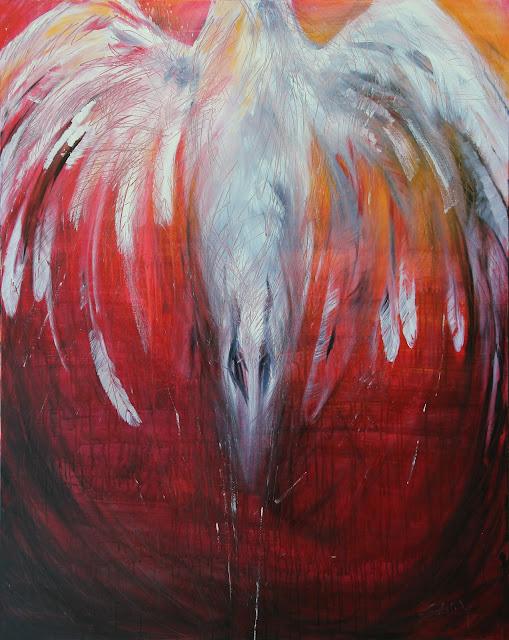
A giant white bird flies upward off the canvas, semi-abstracted, belly in full view, head cut off by the top of the canvas, and feathers disintegrating into the red background, which fades away to black, at the bottom, mirroring the bird's small black feet, pulled tight against its tail.
Escaping the Nest (middle of triptych), by Emily van Lidth de Jeude

It just hit me that maybe ten years ago I was worried about the rise of misinformation on social media. I saw it once in a while; people posting things from known biased sources, or just stating information they assumed was correct but wasn’t. Extensive fact-checking became more necessary than I had felt it was, before, since even trusted sources seemed infiltrated with presumption and error. Or maybe I was just becoming more aware. 

Recently, though, it feels like disinformation is the norm, and complicated with some serious cruelty. On the bigger social media groups I’m a part of (chicken-keeping, canning, foraging, mushrooms, birds, education, etc.) it’s just absolutely normal for somebody to post a question and receive 30–70% wrong answers. It seems people have just become accustomed to stating an uneducated guess as fact. (And seriously — for canning, foraging, mushrooms, chickens, and schooling, this can lead to disaster, for example when someone asks for ID on a poisonous mushroom, and half the responses say it’s edible, and most of the other half are phallus jokes.) And then there are the people berating each other, not just for being wrong, but for correcting the mistakes, as well. Or for totally unrelated things. Like when said phallus jokes become linked to anti-trans attacks. It gets awful out there.

THEN there’s the morality war. There is a propensity for people (mostly white men, I’m sorry to say), to stick their uneducated opinions into posts about LGBTQ2IA+, indigenous, children’s rights, women’s rights, and BIPOC issues… again, as facts. Many of these “facts” are colonial constructs held by our society because they keep white men in power (and because the rest of us think they ensure our continued prosperity). But many are now also just lies made up by conspiracy theorists (like all the supposed chemical, psychological and media conspiracies to make our kids gay or trans or supportive of minority rights…) Sure, there are many sides to every story, but some things are actually not happening. I’m not even getting into the massive quagmire of people in power (often leaders of large corporate enterprises, politicians and religious leaders) using minorities as stepping-stones to more power. Some of us use these crimes as security for our privilege, without ever questioning ourselves.

In my art life this takes shape as criticism and fear: Am I appropriating symbols that are proprietary to a marginalized group that I’m not a member of? Rainbow spectra and feathers were important in my work before I became aware of appropriation, and it’s been hard to sideline them, even though I know how important it is. Even harder was the bickering between artists and members of the LGBTQ2IA+ and BIPOC communities. Oh yeah, and the outright hate-filled rhetoric between some feminists of different stripes. These issues make communicating online really fraught, even without the added question of misinformation or disinformation.

What is going on?! Why is our culture disintegrating into this kind of nastiness and ignorance? As a long-time unschooling parent who notices the lack of this behaviour in the unschooling groups, it’s easy to feel like it might have some kind of relationship with our education system. Especially since unschooling mindset is one of curiosity, acceptance and learning, and unfortunately the compulsory, competitive nature of our school system can provoke a rebellion against curiosity and learning, as well as a propensity for bullying tactics. The rebellion against understanding and the bullying are apparent in a lot of the online attacks I’ve seen. But I think that, in the bigger picture, there’s a deeper reason. We’re experiencing a massive cultural shift. Our minds are opening. And that’s just messy.

We’re threatened from all angles as climate change changes every single foundation our cultures were built on (predictability of seasons, harvests, weather, migration, and therefore employment, finances, housing, healthcare, and even cultural norms). So in this state of growing societal panic, some people are trying to keep things as they were (ignoring the fact that the great majority of underprivileged people have already been suffering these unpredictabilities forever). Some are taking opportunities to fight for rights long-denied to them. Some, like me, are gleefully running headlong into the change, wanting to create a new and better world out of the chaos, and ALL of us are rather ungrounded in the process. There’s so much change, so much fear and threat, that we’re all just kind of scrabbling for understanding all the time. I guess it’s not surprising that a lot of people are confused about the facts, in this kind of chaos! I am too. Everything seems to take so much research now! And patience, tact, and caution! And in the rush of this change, and the feeling of urgency everywhere, it’s not surprising we don’t feel we have time to fact-check or to come to an understanding of the issues we’re talking about before making assumptions and proclamations. 

So it’s frustrating, and sometimes even extremely upsetting, when people resort to cruelty because they feel threatened or inadequate in the face of such big unfathomable change. But it’s necessary that we remain patient and kind, reminding ourselves that these actions are a part of our societal growth. And I’m choosing to see it as a great sign that big change is happening. As a woman with many friends and family in marginalized communities, I’m glad to see my own and other people’s rights have a chance to be respected. As a person living on earth, I’m glad we are making changes that might make our future survivable! Maybe we can all take deep breaths and remind ourselves that everybody is confused and frightened. And maybe saying lots of wrong things is part of our process. We’re learning to learn and communicate! Real learning with an open heart and mind is how we will adapt to our new civilization. It’s how we will all grow to meet the challenge of a world none of us have lived in, before.

10 Ways to Save Humanity Even if You Can't March on Sept 15th

As the death-toll from Libya’s storm floods surpasses eleven thousand, and various hurricanes march their ways across the oceans, people all over the world are gearing up to March to End Fossil Fuels, tomorrow. (Find your city’s event on this map.)

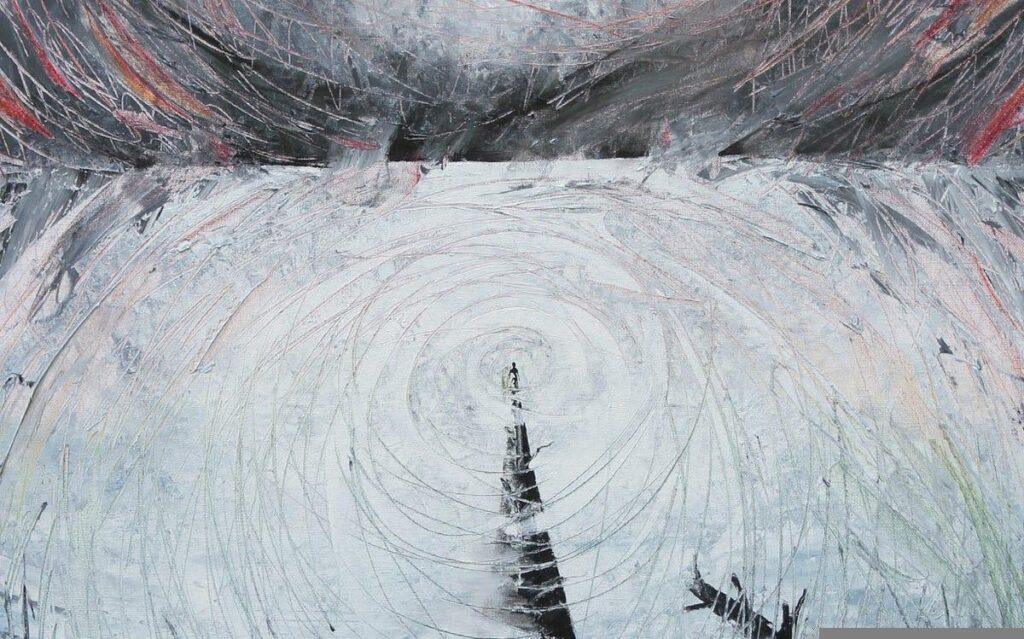
A painting by artist Emily van Lidth de Jeude. Mostly white and grey; a kind of abstract landscape, maybe, with fiery grey in the distance. A jetty or log stretches from the foreground into the distance of what might be a lake, a sea or a plane, and a very tiny distorted human figure stands at the end of it, encircled by nothingness.
Not a Thing Between Me and You (detail) … Recent painting by Emily van Lidth de Jeude, in response to Neil Young’s song, “Overhead”. This painting deals with our compulsion to just keep going into an unknown future, together, even when we don’t know we’re not alone. It’s about courage.

But what if we can’t march? And even if we can, how are we going to propel this impetus into action? How are we going to actually save our future on this planet? (Let’s face it, we’re not going to another planet, and instead of talking about “our children’s future” now, we’re talking about our own.) We’ve got months or a couple of years to turn this around, and even if we do, storms like this are now here to stay. So what can we do about it?

  1. Become resilient.
    We can stop following the status quo, and learn to live differently than our youths and the media told us to. Learn to cook our own food. Learn to pivot our careers and plans and housing situations as needed, and without being traumatized. Adaptable creatures survive.
  2. Make our kids resilient. 
    So you might know I usually write about unschooling. That was (and still is) my effort to raise resilient, independent, capable adults. And it worked! At 18 and 21, my kids are now living independently (together), paying their own way, and making changes for a better world. 
    Unschooling isn’t the only way to make our kids resilient. Any kind of freedom to explore and develop their own skills will help. As will encouraging schools to opt for explorative learning, wilderness education, and all the things that will help our kids be connected, creative, courageous, and resourceful. Those are the skills our kids will need to survive our new world.
  3. Grow food.
    Whatever we can do, whether it’s growing sprouts on our kitchen counters to save $10/week in veggies, or escaping the rat race to go whole-hog on a homestead — just do it. We can all (and yes I mean all) grow at least some of our food. This not only saves money (if we learn from someone else who’s doing it effectively and don’t fall for sales tactics for all the gadgets we don’t need), it also brings us closer to our food, giving us a deeper understanding of life, our bodies, our connection to the ecology we live in, and nutrition. It’s healthier for us (fresher food), and it’s also healthier for the environment, since everything we grow (sustainably) ourselves is something we don’t buy from the unsustainable agricultural industry.
  4. Buy local.
    For all those foods and other things we can’t grow or make, ourselves, we can buy local! I guarantee you there is somebody out there trying to get rid of a bunch of homegrown zucchinis or apples right about now. What if we paid them instead of a big supermarket chain? What if we bought from local farmers, builders, and creators instead of from the capitalist industries that are the root of climate change? This is a shift we can make.
  5. Don’t buy! Boycott capitalism.
    Buying local is one way of sidestepping the corporations who are doing the most damage, but buying less is an even better way. A big part of our problem is overpopulation, and then there’s overconsumption. We really don’t need all the stuff. We don’t need big houses. We don’t need big cars, we don’t need lots of clothing or school supplies or travel or household items. We don’t even need as much food as we currently consume, and we especially don’t need to be wasting as much food as we do through restaurant and supermarket refuse, and simple neglect at home. How many times do people go on a fabulous vacation and then declare they need a vacation from their vacation? What if we just took a local vacation in the first place — one that doesn’t displace people from rental accommodation, and that connects us with our homes in ways we hadn’t experienced, before? In the space that’s left without the things that we don’t *actually* need, we will learn to find convenience, fulfillment and joy. We will have space to keep building that resilience and resourcefulness I mentioned earlier.
  6. Be happy with less.
    Along with resilience and resourcefulness comes happiness. It is just plain so rewarding to grow my own food! I go out every day now and tend my chickens, weed a bit of veggie garden, eat some food right off the plants, and just generally revel in a lifestyle that I once found daunting. I feel empowered by my mended clothing in a way I don’t feel empowered by something brand new. I now have some serious disabilities, and learning to be resilient and resourceful has made me happy, similarly to how my job working with kids used to make me feel.
  7. Love our local ecology.
    Partly the joy I get is from being active in my local ecology (also similarly to when I worked with kids on wilderness exploration)! I have learned so much about how connected we are; am currently fascinated with the many types of wild bees and other insects that frequent my small yard, and with their life’s work and activities that all contribute to the diversity we depend on. How does this love save our world? By connecting us with it. If we love our ecology, we’ll know it better, and the more we know and love, the greater ability we’ll have to protect it. We need our ecology. If only for the simple reason that it feeds us and protects us from storms. That in its diversity it will recover when we finally do turn the trend of climate change around.
  8. Love our neighbours.
    We’ve got a couple of new neighbours recently. We’re making an effort to connect with them. You know why? Because when the power goes out, when a tree falls across the road, when someone’s pipes freeze or someone needs any kind of help at all — or just a hug, we will be there for each other. When the storms come, we’ll need each other.
  9. Love our children.
    Obviously. Because the hell that we’re going to experience pales deeply against the hell that our kids will know. If we love them, we need to save them.
  10. Just love.
    And when it’s all too much, when we’re succumbing to doubt and fear and a feeling that nothing we do could possibly be enough, we can love. If I’m going to die, I want to do it in the arms of someone who loves me. And more importantly, I’m far less likely to die early if I share a deep love. Our future and neighbours and children and the whole global population is more likely to thrive if we live a life of love instead of material acquisition. 

Love is actually a hard thing to do. So I’ll tumble out of my list now, just to write a little about love. Love is a challenge. It’s like a great wave piling up behind us, saying …RUN! And can we do it? Can we keep going even when the wave is catching our ankles? Can we slog through the wash around our waists, grasping at the ungraspable wind, to haul ourselves out when the wave peters out, and get up and run again before the next wave comes? That’s love. It’s work. Neverending, challenging, heartbreaking impossible work. But it’s also the only thing that’s worth working for. Love is, in many ways, survival. When love (of a person, planet, dream, or future) compels us, we can access the resilience, courage, creativity, and resourcefulness needed to meet all the challenges. Climate change included. 

So whether or not you can join a climate march tomorrow, do something. Something that will make you feel empowered and resilient. Something that will save us, tomorrow. And tomorrow? Do something again!

With love,
Emily