On Shame and Invisible Disability

Once, while downtown with my young children, I noticed a man walking by with a pin that said “invisible disability”.

“Gad, how awkward”, I thought. He’s obviously not that disabled, as he’s walking around, downtown. And as we carried on our way, I continued to wonder what on earth his supposed invisible disability was, and why he felt the need to declare it on his jacket. Could he have partial blindness, and the pin is supposed to warn people he may bump into them? Could he be deaf, and we should help him in case of audio-only emergencies like an air-raid siren? Maybe he just has cognitive decline or a mental health problem. Likely that. Yeah. A mental health problem that causes attention-seeking and makes him feel sorry for himself because he just can’t deal.

I found a clean-looking bench and sat my kids down to consume our sandwiches. Gluten-free bread in those days was a novelty, but necessary for my son, so our sandwiches were rather hard and crumbly. I’d made up for the tasteless bread with super-tasty salami and tomatoes. No mayonnaise because my son was also allergic to eggs. Maybe the pin-guy just had food allergies and felt sorry for himself, but why would he advertise it?

I was a young mother at the time, still flailing to just understand my own kid’s food allergies, and pretty entitled. I worked my butt off with parenting, teaching, and running community programs. I prided myself on working hard, and I couldn’t imagine anybody more tired than me; more in-pain from lifting children; more deserving of accommodations or understanding. I certainly couldn’t imagine that one day I’d have an invisible disability.

Now that my kids are grown and I live with a serious invisible disability, I still don’t want to advertise it. Because shame. That pin-wearing guy was much more courageous than I am. I mean to challenge my shame with this photo:
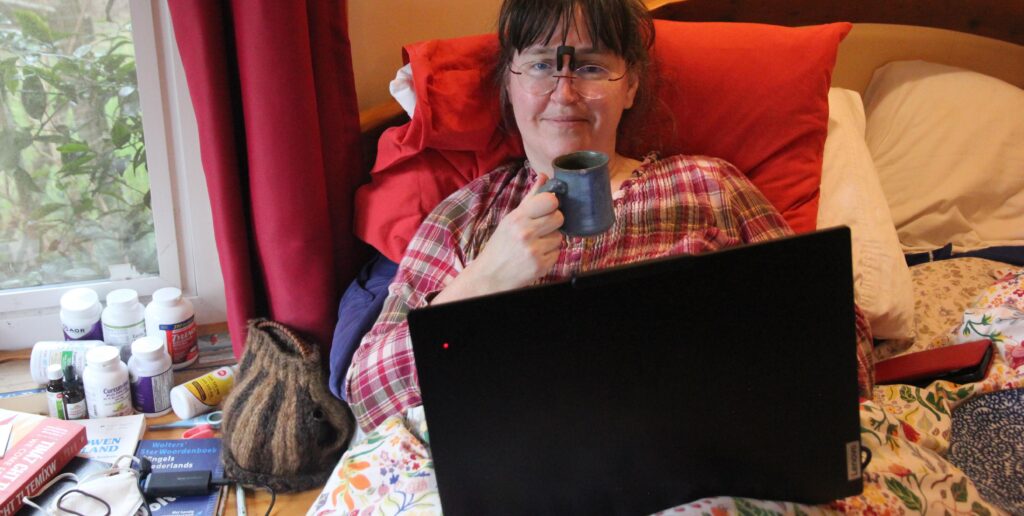
Author Emily van Lidth de Jeude is reclining in bed with a small handmade cup of tea, a laptop on her knees, and a black plastic clip pinching the top of her nose, between her eyes. On her left, on the blanket, is a phone and an empty plate. On her right is a nightstand covered with a teapot, various books, an N95 mask, and nine bottles of medication and supplements.

Here I am in my usual morning location, writing this article. This photo was taken by my partner and caregiver, Markus, because I asked him to. The weird black thing on my face is an acupressure clip for migraines. I tidied the nightstand for the photo. Now I’m out of breath from doing so.

In early 2020 I was a parent, a visual artist, a self-determined learning consultant, and a leader of art and wilderness programs. I also grew many of our family’s veggies, in a garden I loved. I spent a lot of time hiking, crawling and climbing around in the wilderness with kids. Then I, my daughter and most of her class that I’d been teaching, came down with a sickness that nobody could identify, because although our symptoms matched those of the then-new Covid-19, there wasn’t yet any test available to confirm it. After a week of fever, some blacking-out and a visit to urgent care, then a few weeks of ongoing respiratory symptoms, we recovered and went back to work and school.

By March, I was exhausted. My body hurt everywhere, and I developed a new, ongoing respiratory issue; I felt like I couldn’t get enough air, and was given asthma inhalers of two different types, that made the symptoms much worse. I had a headache all day every day, but I told myself I can handle pain, and kept working. After a day of work I’d be wheezing and shaking in the evening; sometimes also with a fever. I cut back my work days to only two per week. Then one. Then one every two weeks. And by summer I was flat-out in bed, most of every day. I eventually learned that the name for one of my major symptoms is postural orthostatic tachycardia syndrome, or POTS. It’s basically a circulation and autonomic nervous system issue, and means that if I’m upright for too long, I get blurred vision, dizziness, nausea, and will eventually pass out. I spent the latter half of 2020 and all of 2021 mainly in bed.

I had Long Covid. I still do, but those first two years were the worst. I couldn’t get out of bed for more than about five or ten minutes at a time, maybe three times a day, without suffering intense shooting pain, wheezing, dizziness, blurred vision, and fever. My partner helped me to dress and undress. He washed me, and administered the many trial-medications and supplements I was offered. He worked gratefully from home and took frequent breaks to bring me food or tea, to keep up with errands, and sometimes to feed me or help me to the toilet. On the occasions I did leave the house, my son would walk behind me and push gently up on my back to help me walk. My daughter, also suffering from Long Covid, but less severely, would curl up beside me in bed, where we spent endless hours just keeping each other company. My kids took over most of the cooking, garden and chicken duties. I find it difficult to talk about the extent of my physical disability in those years, partly because my symptoms were dismissed and mocked by so many physicians, at the time, but also probably because I carried around a huge ableist attitude. And because my disability was invisible.

The most obvious invisibility was that I was in bed. No longer able to attend community functions or even just go to the store and bump into neighbours, I was no longer part of my community. This experience forced me to realize something I’d never believed, before: Most people don’t really miss you, when you’re gone.

But as the years went by, and more and more was learned about Long Covid, my health did improve. I benefited greatly from the BC Women’s Hospital’s Complex Chronic Diseases Program, and a series of interventions that slowly brought me to the point where I am, today: I can spend hours of every day out of bed, mainly in the afternoon, and therefore can go out in public once in a while. Despite POTS, arthritis and other inflammatory pain, I can do at least a couple of “big activities” each month, such as watching a show, attending a family gathering, or grocery shopping. Sometimes one per week, if I rest thoroughly for the week in-between, to recover from the resulting fever, viral flare-ups, nerve, organ and joint inflammation. If I don’t rest, or if I am unfortunate enough to pick up “a slight cold”, as it’s known to others, I can end up with months of shaking, untreatable fever, passing out from lack of oxygen and/or pain, pneumonia, bronchial, sinus, and urinary infections, or pleurisy. I’m now allergic to at least one antibiotic, because of this, and have cataracts from prednisone. So I’m very, very careful about masking in public, sticking to my treatment regimens, and how much I go out. I’m not as careful as I should be around staying home, because it’s lonely, here!

This, too, is a kind of invisibility. When I’m out in public, people see me and tell me I look so healthy! I say “yes! I’m doing really well!” and then return to my house, where I curl up on the couch, my partner wraps me in a blanket, and I wait for the fever to subside.

Once in a while I mention my reality to people. In a sentence or so I try to describe my symptoms—an effort, I guess, to break the invisibility shield; create some kind of connection. And while some people are curious; compassionate, even, many sort of drift away, or roll their eyes. Sometimes, out of love or concern, they offer advice: I’m suffering because I got vaccinated, or otherwise because I am an anti-vaxxer. I should try going paleo, or vegan, or eating only meat, or mainly blueberries. More reasonably, I should see a therapist, or a doctor, or maybe get some exercise. I get it. I really do. I have the same propensity for offering unsolicited advice, myself, and know it comes from a good place. All they can see of me is that I’ve put on weight and am not out working in the community. They care about me, but my experience is largely invisible. They don’t know that I’ve already seen over a dozen specialists, tried even more interventions, and that as much as it physically pains me to put on weight from lack of exercise, exercise itself makes me put on weight by causing inflammation and more hours lying in bed.

I am SO aware that this sounds like a pity party. If you’re still reading, I commend your patience and tolerance. I’m still here because, as I healed, I discovered there are in fact millions of (by one estimate 400 million) people living with Long Covid, and fighting for others’ visibility is worth confronting my own shame. In 2024 I created a wearable art piece and performance called (dis)robe: Hospital Gown, that included the faces and common symptoms of over three hundred Long Covid patients. The intent was to advocate and create visibility for this massive group of people, but I also learned a lot, in the process.

I learned that most of us are women. I learned that while some had pre-existing health issues, many were very active, healthy people. Long Covid doesn’t seem to discriminate, and may not, in fact, be a result of laziness or incompetence. The list of symptoms is very long, but many are common to most of us. All of us have been discriminated against, either for mask-wearing, sitting down to rest, using mobility aids, or for being anti-vaxxers (most of us aren’t). I’ve learned that very few have actually been helped. The number of people who were or are still dismissed by medical professionals is alarming. The number of medical professionals who still treat us with disdain is sickening.

A few days after my second Covid vaccine in 2021, my partner brought me in to the ER, as I was wheezing, blacking out from either lack of oxygen or the excruciating pain in my chest, shaking, squirming uncontrollably, and running a moderate fever. My partner pulled our car up to the doors of the ER, but I couldn’t get myself out. He ran inside and luckily found friends who were there with their elderly father, and they helped me in to the waiting room. The place was packed; there were no beds, and everyone was stressed. Because I couldn’t see, was wheezing loudly, and was in too much pain to speak clearly or state pertinent facts, my partner tried to describe the situation to the intake coordinator. She barked at him that I could speak for myself, and told me to stop hyperventilating and get my act together. My partner tried to steady me in the chairs as we waited beside an unused stretcher, until he couldn’t manage it anymore, and just put me on the stretcher, without anybody’s permission. The ER doctor came by every few hours, offering me opiates for the pain, which I’m allergic to, and every time I declined she rolled her eyes and left in exasperation. Eventually she told me to get a thermometer and go home. Nobody even looked at my lungs, and thankfully, I did eventually recover.

In 2025 I lost a friend to pneumonia. She was a mother, like me, to a teenaged child. She wasn’t formally diagnosed with Long Covid, because our system hasn’t yet managed to find, diagnose, or treat all those who are suffering. She thought she had Long Covid, and as someone who knew her well, and saw the similarities in our symptoms and the way she was dismissed by medical professionals, I don’t doubt she did. Her official cause of death was pneumonia, though. It will not be recorded as Long Covid, and nobody cares, even so. Well… I do. Juanita is one of the people for whom I’m writing this. She was extremely courageous. Lots of people, including me, were put off by how forward she was; how open and honest about her life’s challenges. People like to ask you how you’re doing, and hear back “great, thanks! How about you?” They don’t actually want to know. My father told me this when I was a teenager and I thought he was just obnoxious. Now I know he was right.

My father had Parkinson’s. It was, eventually, a very visible disability. Although unfortunately, before he used a walker, people sometimes just saw his wobbliness and assumed he was a drunk. When people asked him how he was doing, he often said, “better than I could be!” It was a way of seeing the positive in what was actually an extremely challenging, progressive disease. He also liked to say his cup was so full it was overflowing.

I guess I’m following my Dad’s lead on this. When people ask me how I’m doing, I might answer that my chicks are growing adorably, or I’m sure loving this weather, or maybe that I’m so happy my kids are living well in the city. Sometimes I take my Dad’s lead and say something that hopefully points at the ongoing challenge of my disability while sounding positive about it.

Disability.

That’s still hard to write. Even though I have a disability parking tag in my car. My car that mainly my partner drives, because driving taxes my system too much. I lie there with the passenger seat reclined and my feet up, heating my body with the seat heater, trying to conserve energy and circulation for whatever we’re driving to. I haven’t applied for all the disability benefits I am supposedly entitled to because the process is too much work, and (mainly) because I’m ashamed. Internalized ableism. Gad, how awkward.

I long for the life I once loved: leading adventures through the bush, running art programs and tromping out as an installation and performance artist, making change in the world, for the better. But I hold my adorable chicks; I make an excursion from my bed to the sunshine. And I remind myself that I have an invisible disability, and I’m better than I could be.
How to Give a Gift to the Future

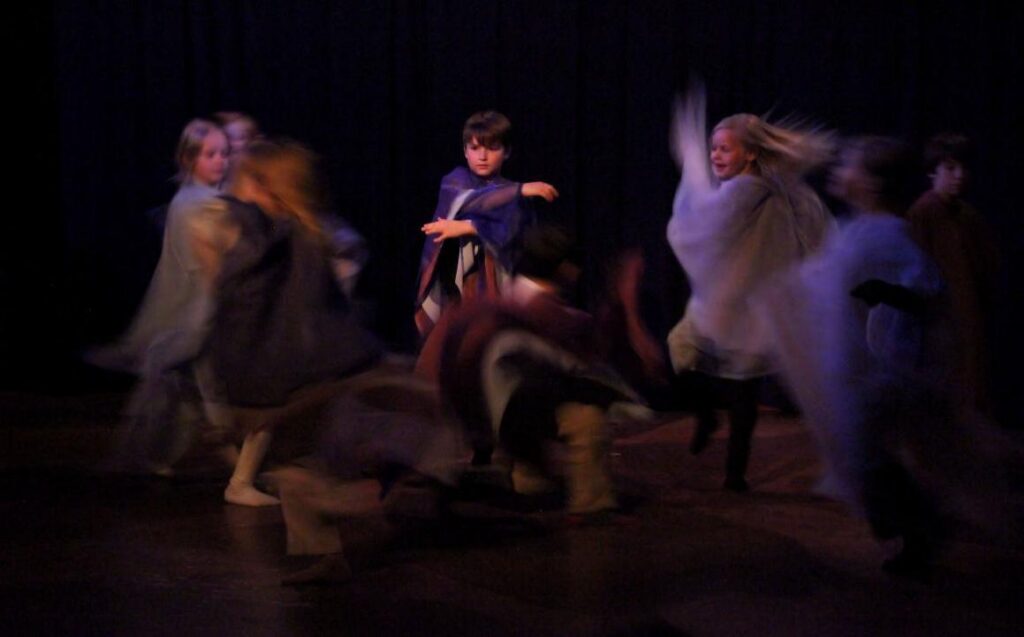
Mid 1980's. Behind the loose rehearsal set for our play, I was stuffing my winter socks into my mother's bra, transforming from my role as the sandwich-board-wearing, singing pig to the obnoxiously-vain queen. I was nervous about my fellow actors watching me put this giant bra on over my t-shirt, and remembered Julie's words from when we'd been swimming at the beach just last summer. She'd been changing into her swimsuit, under the veil of her shirt, and said, "I don't know why I'm shy; I have nothing to hide!"

Julie was my best friend's mother, the cooker of tofu dinners and the owner of fluttery, gentle hands that tucked me into bed on the hundreds of nights I slept in her home. She was the giver of twenty-five cents' allowance to any child who happened to wake up in her home on a Sunday morning, and the offerer of hugs, should any of us need them. When she offered me the role of the pig and the queen in her and Jack's new theatre program, Tir-na-nOg, I accepted because I loved her. I accepted because I knew I'd be safe with her. And I was.

And in the refrain of the play we performed, (yes, of course it's normal for a play to have a refrain!) we sang,

My leaves, they fall, like yellow tears
My bones, they are bared, to the bite of the wind
I am fading away; I am fading away

…because, collectively, we young performers were a tree, and the wind, and whatever else we needed to be for the beautiful, heart-full, obscurely profound story we were telling to the handful of parents who came to watch us.

Close your eyes, follow me, come and see

The words of this song still permeate my dreams, now that I'm fifty. Now I'm fifty, Jack and Julie's little theatre school has nurtured two generations into adulthood, including my own children. They worked with a local developer to build a space for their dream, and have been operating out of this little space for decades, now. On the east side of the building is a wide open room full of props and costumes, some chairs, and the spirit of so many imaginative group adventures that have echoed off its walls, over the years. It's the space where Jack gathers children's ideas around a story and helps knit them all into an adventuresome script. It's where Julie flits through the developing story, reflecting and celebrating each child's contributions with a kind of joy that infuses the whole room with glittery delight. On the west side of the building, Jack has built a spectacular theatre. It's small, but supremely functional, and his beautiful curved walls, trap doors and secret passageways have inspired much creativity for the children who use them. The set is empowering to children, because it gives them a way to work with their resources and surprise people with ingenuity. Julie paints the set; the backdrops. Julie brings the ephemeral magic to the space. This building, and the nurturing of our children's dreams within it, are a foundation of our community, you might say.

Tir-na-nOg production of the NeverEnding Story, 2013.

Tir-na-nOg isn't just the Land of Perpetual Youth. It's the place where youth is a key to growth. A place where imagination, delight and authenticity play with each other in the spaces between children's faces. And adults'. Because now many children stay with Jack and Julie into adulthood. Some have gone on to very successful careers in the performing arts, but no matter where their life-paths have gone, all have had their lives enriched, their confidence bolstered, and their prospects widened by the lessons they learned at Tir-na-nOg.

My own first child was one of these. Taliesin knew Jack and Julie personally; had played with their grandson in their small apartment above the theatre school, and had gone to see their school's plays multiple times, as well. He wanted SO much to be a part of this magical world. But he was also one of the shyest children I'd ever known, so actually going in to the first day of theatre class proved to be impossible for him. We tried again every week, even taking homeopathic stagefright remedy, arriving before the other children, and more acclimatization visits… to no avail. After six weeks, Jack worried that Taliesin was missing too much of the year's program, and suggested maybe we should wait until the following year. But Tali was determined, and somehow just the sound of Jack's soft gentle voice gave him the confidence he needed, and… he just went in!

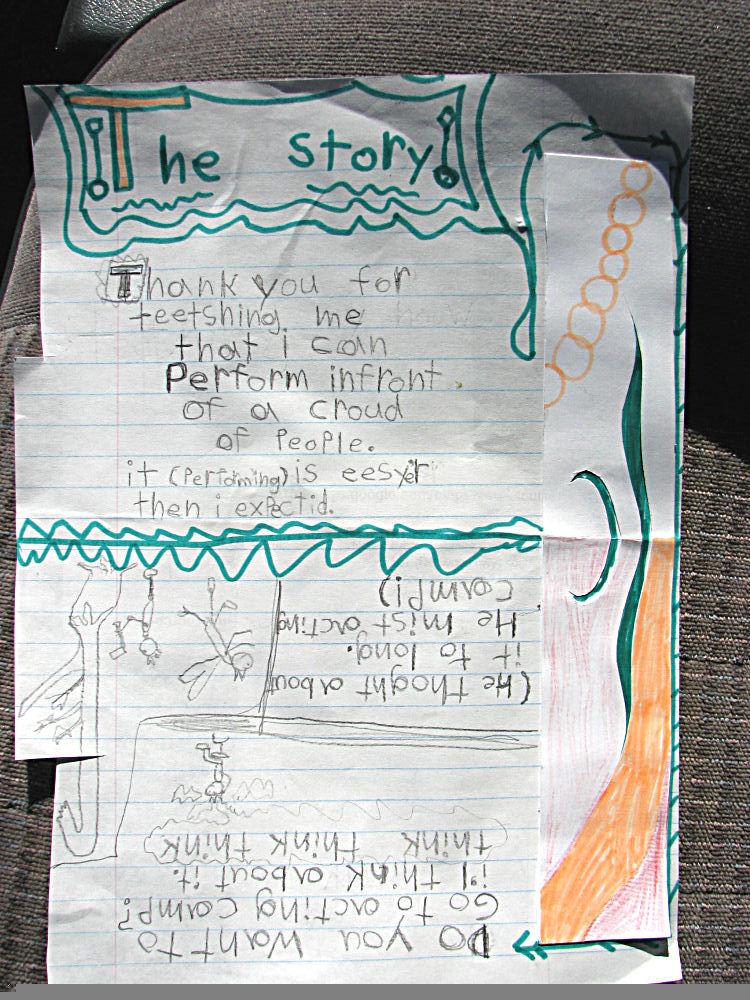
A letter with many child's drawings of fairies, a woodcutter, and other characters, along with much decoration. In the child's printing it reads, "thank you for teaching me that I can perform in front of a crowd of people. Performing is easier than I expected. 
The Story: Do you want to go to acting camp? I'll think about it. (Think, think, think.) He thought about it too long. He missed acting camp!
Taliesin's thank-you letter to Jack and Julie, after his first year at Tir-na-nOg.

That year Taliesin created a non-speaking role for himself, but then started taking on speaking parts, and eventually leading roles with many many lines, that he diligently practised, while also making himself costumes, often with friends who were also in the program. Taliesin went on to create YouTube videos about science topics he was interested in, as well as animations and comedy. He acted in various school plays, but his dream career is not theatre. That doesn't mean the gifts he got from Tir-na-nOg aren't still serving him.

In adulthood, Taliesin became a digital artist, building upon the creativity and confidence nurtured at Tir-na-nOg. And he also ended up working part-time for the H.R. MacMillan Space Centre, while he lived in Vancouver. He became that quintessential inspired science-show-guy, excitedly demonstrating rocket propulsion and other seeming miracles to a crowd of parents and kids! When I went to watch his show, I cried with joy. In the audience that day were a few children, and as he looked out into their eager and shy faces, I saw the same look in his eyes that I know from Jack. He saw them. I mean he really connected with those kids; took their questions at face value and, gently but enthusiastically, made his science show theirs. When he brought up a kid to help him demonstrate, that kid knew he was safe up there on the stage, which is a gift Tali got from Jack and Julie, and now passes on to younger children, as well.

So many of Tir-na-nOg's alumni are spreading Jack and Julie's gifts to the world. Some even still live on the island and are more directly still associated with the school.

Jack and Julie's gift may be spreading into the world, but the fate of the theatre school itself is now in jeopardy. Jack is undergoing treatment for aggressive prostate cancer, and Julie has been diagnosed with Alzheimer's. The fact that they managed to keep the school operating so long with their current troubles is a miracle, indeed, but now they need our help. Our community is fundraising to pay off their building loan, so that the dream of Tir-na-nOg can continue, without their constant personal involvement. Donations can be made at https://www.gofundme.com/f/support-jack-julie

And in our future, may we continue to see our children grow into their confidence. May we continue to see their dreams blossom, and Jack and Julie's gifts spill out into the bigger world. Maybe we continue to hum, as we walk along,

Close your eyes, follow me, come and see

What If We Were Beautiful?

After my dad died, in 2015, my Mum saw me grieving and told me to paint something beautiful. I didn't have it in me, and I painted a whole lot of anger and pain. Sometimes we just have to paint our truth. But… what we create becomes our truth, as well. My mother also told me–countless times throughout my life–that if I wanted to feel happy, I could just make myself smile. That's the last thing you want to hear when you need to be seen and heard; when your experience needs to be acknowledged. But it's also true. And it's been the way I manage the worst experiences life throws at me. I stretch my lips out sideways, rub my cheeks vigorously, and just grin. I fake a laugh until I feel how silly I am, and it becomes real. I paint the most beautiful things I know–the birds and trees and plants and wind and flowers–until their beauty fills up the void left by the pain.

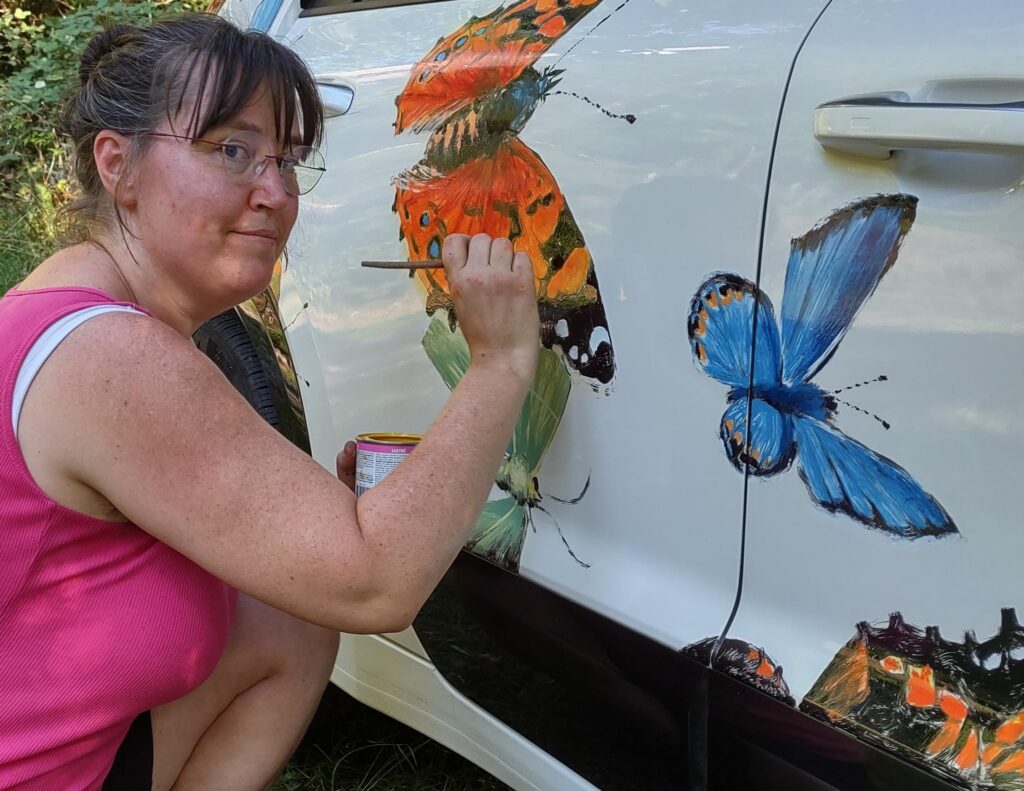
A woman is painting butterflies on the side of a car. The woman has brown hair pulled back in a bun, and is wearing a tank top. She's smiling at the camera, while holding a can of metal paint in one hand, and a paintbrush in the other. The paintbrush is mid-stroke on an orange and black West Coast Lady butterfly wing. Below the butterfly are a green moth and a blue butterfly, and another West Coast Lady butterfly.

When my mother was dying, I painted my car. I covered it with butterflies. "Why?!" People asked me. "Oh the resale value!!" But I did it because beauty. Because the local species of butterflies and moths I painted remind me of a happy day in my garden, and of the butterfly-effect, where small acts of beauty (like painting my car) might in turn create much larger beauty. I painted it because I don't want to live in a world where something as essential to my life as my vehicle is effectively just a gamble against the future, waiting to be re-sold. And I painted it because my mother was dying, and I needed something joyful to do, in between the doom and pain that pervaded our days.

It's not that the pain is really gone, of course, just because we create some beauty. We still need to deal with the horrors of life, and to heal the pain, itself. But at the same time, the world is carrying on around us, and we are contributing to how it grows, whether we're aware of it or not.

Decades of studies have shown us, by now, that the media we consume affects how we experience the world around us. What about what we create? What about how we create? I spent a few years creating social media videos about our local ecology and my nascent regenerative food farm. Making the videos forced me to consider the way I spoke about those things. Editing the videos made me think about how my words would come across to others. Publishing the videos exposed me not only to generally positive feedback from viewers, but also to other videos with similarly nature-celebrating themes that came up in my own feeds.

On the other hand, I've also landed in negative feedback loops, for example when posting my negative political views on our local forum. People fought me, I became angry and argued back, people stated all kinds of further negativity, and generally the conversations devolved, and community bonds broke. I'm not trying to imply that we shouldn't speak up for causes we think are important, but how we do it matters greatly.

What if, instead of calling out harmful things we notice (or in addition to calling them out, if they really need to be stopped imminently), we built the world we want, right alongside the world we don't want, and just lived in that world we want? Would others join us? I think so! Or maybe they'd all be building their own utopias, and one day there would simply be more of us living in joy than in fear and resentment. What if, instead of being ugly with our thoughts, we were beautiful?

It's not possible to be beautiful all the time. Sometimes we just have to curl up in a ball and let the sad times roll over us. But I feel like I come out of such times healthier when I've cultivated enough beauty inside of me that some of it is still there to blossom, when the tears dry up. Then there's more of me to go about building the world I want, by making all life's little choices in line with my vision for a beautiful world.

My mother's gone, now, so I have to summon the memory of her voice in my heart: Emily, make something beautiful. And I, like she, and like you, have to be that voice for ourselves and others. Go make something beautiful. Be beautiful. Find what brings you joy and cultivate it.

Do You Illustrate with AI?

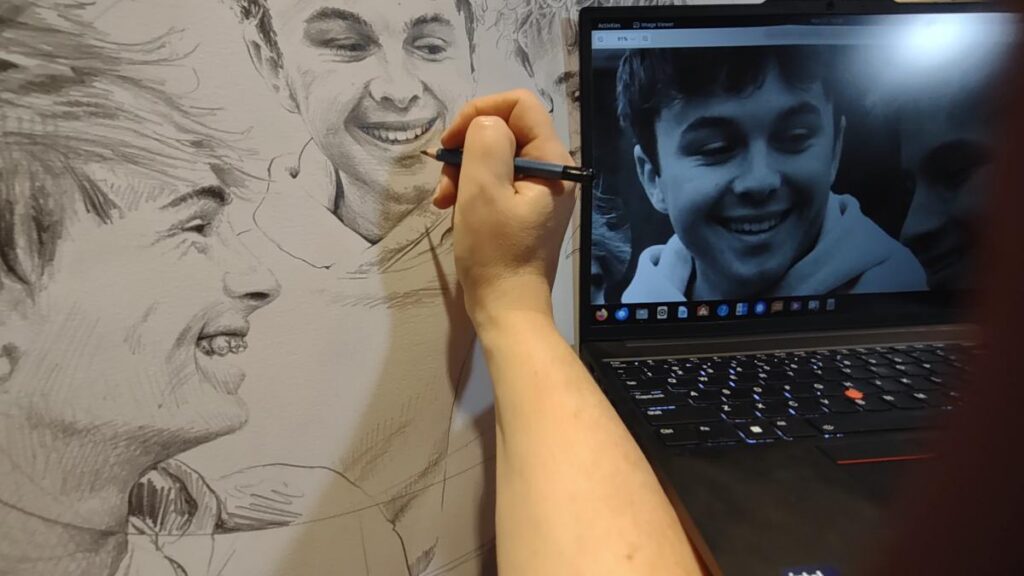
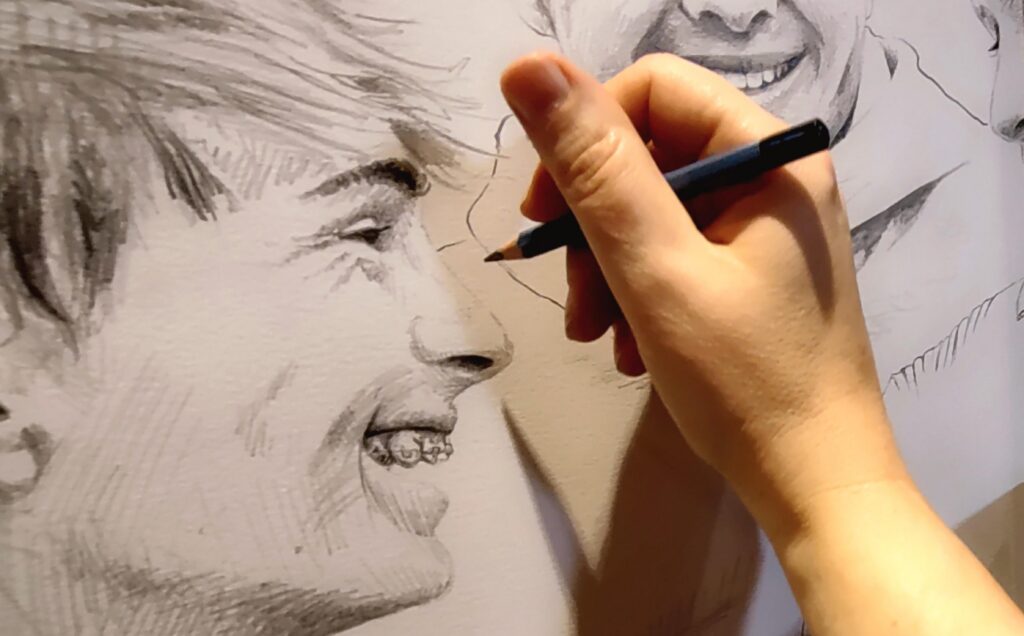
This is not AI. This is a photo of my hand drawing a portrait of three young men, with a reference photo open on my laptop, beside it. So it's a photo of a drawing of a photo! This photo was taken by an artist: me, Emily van Lidth de Jeude. I interviewed the young men and got them laughing together, to create a happy memory from which to draw their portrait. I photographed them during the interview. I then communicated with their family to determine how the final portrait would look. I then drew their portrait, and communicated more with their family to ensure the final product was what they hoped for. Then I sent the portrait to an art printer, who made a print of it, for their grandmother. Then I packaged up the portrait and delivered it. I spent dozens of hours creating this portrait, and the family evidently loves it. Why? Because it's real. It's their children. It shows a real moment of happiness and connection. It shows love. And it's not AI.

This is not AI. This is a photo of my hand drawing a portrait of three young men, with a reference photo open on my laptop, beside it. So it's a photo of a drawing of a photo! This photo was taken by an artist: me, Emily van Lidth de Jeude. I interviewed the young men and got them laughing together, to create a happy memory from which to draw their portrait. I photographed them during the interview. I then communicated with their family to determine how the final portrait would look. I then drew their portrait, and communicated more with their family to ensure the final product was what they hoped for. Then I sent the portrait to an art printer, who made a print of it, for their grandmother. Then I packaged up the portrait and delivered it. I spent dozens of hours creating this portrait, and the family evidently loves it. Why? Because it's real. It's their children. It shows a real moment of happiness and connection. It shows love. And it's not AI.

And now this image is an illustration for a blog post I'm writing, myself. Also not using AI. These thoughts are actually fully my own. These words are they way I think them, in my own mind, and share them with you.

This morning I received a blog post written by a person whose work I admire, illustrated by OpenAI. It's so depressing to see intelligent, thoughtful people write wonderful essays, and illustrate them with AI. As an artist whose work has been scraped, I say 'thanks for nothing'. No pay for our work; not even credit to the artists' work used by the AI.

I'm performing one of my wearable art pieces at the Museum of Vancouver in March and they're pointedly paying me properly for my work, as well as providing human-created promotional material around the event. It shouldn't be amazing to simply be respected and paid for my work, but these days it definitely feels amazing.

Kudos to all the people out there still respecting artists' and writers' work; still seeing our world as a community of creative, resourceful minds, instead of workers on a treadmill run by AI.

Dear Little Emily: Psychosomatic

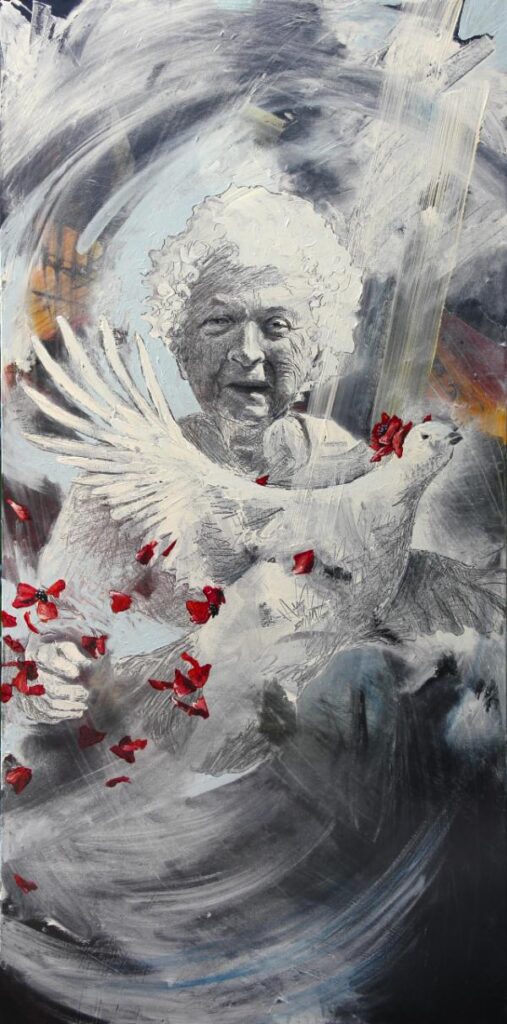
An oil painting, mainly in grey tones and white, of an elderly woman, laughing in a swoosh of white. She's holding her hands toward the viewer, and a white ptarmigan is flying out of them, towards her left, leaving a flutter of red poppy petals behind.
Grandma Frees the Ptarmigan, oil and graphite by Emily van Lidth de Jeude

The audio version of this story is available on my MakerTube.

Dear Little Emily,

You’re sitting on the floor of Mum and Pappa’s house, by the big brown bookshelf and the wide darker-brown row of Encyclopedia Britannicas. You have one open on your lap—number twenty-two—its huge brown covers rested against your bare knees, and you’re running your finger down the one of the many shiny, thin-paper pages of the PSYCHOLOGY section. Jeez there are a lot of things to say about psychology. But nowhere, not anywhere at all, do you see the word ‘psychosomatic’ popping up. Finally, after picking through hundreds of words you can’t bother to try out, you land upon this: PSYCHOPHYSICS, "a department of psychology which deals with the physiological aspects of mental phenomena." Mental. Grandma is a mental case, that’s for sure.

And amazingly, like the heavy book is calling her right out of crazy-land, the next listing in the book is PTARMIGAN. "A gallinaceous bird akin to the grouse." Whatever that means. It says it’s Gaelic, which is impossible, because you know ptarmigans are Canadian or Ukrainian. Grandpa is Irish and he never mentioned a ptarmigan. Grandma says ptarmigans live in Ukraine and in the Rockies, so. There they are.

But what the hell. Psychosomatic. It’s not even in the encyclopedia, right? Like even the definition of Grandma’s craziness is not in the book, that’s how imaginary it is. And the encyclopedia, now you’re nearly twelve, and it’s nineteen-eighty-seven, is the biggest, most trustworthy source of information in existence. As far as you know, little me, and you know more than some eleven-year-olds, but not nearly as much as you think you do.

You’re thinking about the last time you visited Grandma. Daddy dropped you off there for a sleepover, which seemed like a wonderful escape from the terrifying basement corner that you have to sleep in, at his house. But soon you realized there are other kinds of bad.

You sat in the wooden nook while Grandma smoothed her long, pearlescent nails. They’re three times as thick as your nails, because she’s old (though not as old as most Grandmothers, Mum says), and her nails are all covered with ridges, which she fills with layer upon layer of nail polish. You heard the plastic scrape of her nails; the rattle of her bracelets, and you shifted your gaze to the pink and turquoise squares of the kitchen floor. She was still talking, and you were getting tired. “The Devil lives in her,” she went on. “He lives in her mind and when she dies he’ll take her away to his lands.”

This wasn’t the first time Grandma professed to understand the Devil’s behaviour, and it usually somehow involved Mum. Mum says it doesn’t matter because we don’t believe in the Devil, so you sat quietly just waiting for Grandma to finish. “People who leave their husbands are evil,” she continued. “Your mother has the Devil in her heart, and you were born from that woman’s evilness. You have to pray to God to take it out of you.”

“I don’t believe in God,” you said, then, looking bravely up into Grandma’s wrinkly face; her nose kind of lumpy, in a way that made you think that must be the Ukrainian coming through. The angry concern in her sinister eyes leaked out the wrinkles of her face and into the perfect curls of her permanent-set hair. She looked like she might bite you, but you were too tired to care. It would be hours before Daddy would be there to pick you up, and by this point you thought you might fall asleep right there on the table, next to Grandma’s hands, her plastic bracelets rattling beside your head.

“Your mother taught you to say that. She put the Devil in you.”

“I’m so tired, Grandma,” you pleaded.

She looked up then, again, from her nails, and appeared surprised. “Oh, yes, dear. Would you like some Sprite?”

“Can I lie down on your bed for a minute?”

“Of course, doll-babe,” she replied. “I have to go call in the sun.” 

You walked down the short hallway to Grandma’s bedroom as she slowly descended the brass-rattle staircase to the basement door, where the sun had begun to peek through, from the cedar trees, outside. “Come on, Sun!” She exclaimed. And, “oh hello, how’s your morning?” She asked of some random bird flying through her yard. And you lay there on her perfectly pink bed thinking about the mystery of fibromyalgia that caused Grandma to stand in the doorway and soak up the sun, every time it shone; that caused her, also, to keep her house a few degrees above normal, because supposedly it helped her pain. Grandma says she has fibromyalgia. Mum, Daddy, and everybody else say she has psychosomatic illness. It’s all in her head. And the Encyclopedia Britannica, for all its wisdom, has declined to comment. 

You woke up with Daddy’s hand on your back. Somehow in your thoughts you’d slept two whole hours away, and it was time to go home. 

Home is a place of reason; a big tree-speckled yard full of food plants and flowering plants, some ponds, rabbits, chickens, a dog and a safe house to live in. No gods or devils, no ‘fairytales’, as Pappa calls them. You eat what you grow and you see how the actual world works. Everyone is upfront, or so they say. And illnesses are real—the kinds of things you can check with a thermometer and heal with cough syrup, chicken broth, and Earl Grey tea. Nobody has psychosomatic illness in this home. Nobody also calls in the sun, nor talks to birds.

Mum says it’s not really Grandma’s fault she’s crazy. She was born to parents who fled when Russia invaded, and that kind of family trauma can make people a little strange. Grandma says she remembers her own mother hiding up in the trees as her entire village was murdered. Grandma says this as if she herself was in those trees. Which is impossible, of course, since Grandma wasn’t born, yet. But she remembers. Daddy says Grandma is just wasting Grandpa’s money by keeping the house so warm. Pappa says it’s none of our business what she does with Grandpa’s money. You just wonder why Grandma doesn’t have her own money. 

Times are going to change, little Emily. Here I am, writing you from twenty-twenty-five—a date you likely find it difficult to imagine. I found it difficult to imagine the year two-thousand only months before it arrived! But here we are. You’re grown. Me. We even had kids who’ve grown up, by now. Russia is beating the shit out of Ukraine, again, and Grandma didn’t die of war or fibromyalgia; she died of strokes, kind of, in the end. Mum died of a brain tumour, and so far as I can tell, the Devil didn’t take her, because I still hear her voice in my head, sometimes reassuring me, sometimes giving her opinions, and sometimes shrieking in alarm. Maybe it’s the Devil after all. Who knows. And I have fibromyalgia. 

Yeah. You. You, when you’re grown up, little me, are going to have fibromyalgia, just like Grandma. And no family member is going to dare tell you it’s all in your head, because they’ll all watch you experience the pain and struggle that this stupid illness involves. In fact, one of the doctors who diagnoses you will mysteriously test a bunch of seemingly-random spots on your limbs for pain, and when they all hurt like bruises, she’ll explain that those pain spots are specific to fibromyalgia. She’ll then suggest self-treatment by using saunas, keeping your house warm, and perhaps also trying infrared therapy. Infrared light is contained in sunlight, little Em. The doctor will one day tell you to call in the sun. Well… metaphorically-speaking. 

You’re not exactly going to start calling in the sun. But I do try to soak it in as much as my fair skin and hot flashes will allow. I sit out there on the porch, watching the yard of this place you grew up in and that I eventually raised our own children in. I see the garden where I still grow most of our food, and I watch Eamon, the raven who’s been living around here for a few years now, fly low over the sunflowers, and land under the walnut. “Good morning, Eamon!” I call. He doesn’t answer, but sometimes when I’m in the garden he calls, and I do answer. We play a game where I copy his calls, and he changes them. Or at least I think we play this game. Maybe it’s all in my head. Who cares.

Love, Emily

How I'm Leaving Big Fascist Tech in the Dust

Painting by artist Emily van Lidth de Jeude, showing a mostly black sea of adult legs in pants and shoes, walking by. In the centre of the image is one lit person: A small child in a party dress and hat, fists clenched at her sides and her face looking stern and perhaps horrified. She looks out from the sea of passing legs with indignation. The title of this life-size painting is "Did you shuffle of the pavements just to let your betters pass."
"Did you shuffle off the pavements just to let your betters pass?"
Oil and graphite on canvas. Artist Emily van Lidth de Jeude

Thijs’ face remained open and calm as he described his childhood memory of his Jewish neighbours being removed to whatever fate they met: “I remember the SS or Germans going upstairs, kicking them down the stairs, so they rolled right on our sidewalk, in front of our door.” I was interviewing him for an installation about the concept and feeling of ‘home’, and this was part of his response. I think that I, too, looked unphased by this story. We both have lived so long in a society that treats such traumatic experiences as passing news, and turns to chemicals, distraction, or denial to keep from dwelling on the horror.

But it IS horror. It’s horror every time a starving Palestinian child tries to get food and is blown to pieces, but still alive, briefly, to witness the cries of his mother. It’s horror every time a child holds the dead face of his parent, living only in terror, oblivious to what life will be like as an orphan of genocide, however short that life may be. It’s horror every time a girl, a child; a desperate woman is captured, owned, and brutalized to feed some sick person’s illness, and then silenced, for the good of the nation, or at least for the benefit of those profiting off the nation. It’s horror every single time a person of colour, an indigenous person, a woman, or a poor person is kidnapped by brutal masked agents of terror, hiding behind anonymity and the letters I, C, and E, or simply balaclavas. It’s horror while these people sit rotting in internment camps created with the intention of brutalizing their bodies, minds, and futures. It’s horror when a child is raised with such depravity that they applied for the jobs that mean brutalizing their fellow citizens; that they are willing to create more such depravity in hopes of rising above it, for the good of the nation. For the good of the family. It’s horror when we turn away, because it hurts so much to see, and blindly, through chosen ignorance, raise our own children to be unphased by the horrors that we condone, for the good of the family.

It’s easy to buy cheap milk eked out of tortured beasts on tortured stolen indigenous land because my children need calcium, to bubble their water with a machine made on stolen Palestinian land, and to turn their eyes away from the news, towards a screen filled with shiny ads. To turn my own eyes away from how those ads are harming them, because I need time to make their dinner, and it's easier. It’s easy to allow the fascist few to benefit from our choices, for the good of the family. For the good of the nation.

What family?! What nation?! What kind of monsters are we that we can look but refuse to see?! I hear a siren right now outside my window, and I’m scared because I know that siren means someone in my community is scared, too, right now. 

I can’t turn away. I can’t be the person who allows these horrors to happen, while I avert my eyes. Neither can you. I know that, because you probably looked at the news, today. You’re reading this, right now. Not to numb yourself, not to bolster ignorance, but to SEE. You’re trying to see. You’re looking to bolster community by being willing to share the suffering of others.

We know we’re bound to each other as humans. We know each child stripped of dignity, health, safety, love and life by the greed of the tiny fascist few is a part of us. We know, even, that those greedy few are part of us, so like we need to weed them out of our society, we need to weed the tendency to greed and ignorance from our own psyches. We need to rise up as individuals to save the whole of us.

I know this all sounds very big-picture. Very abstract. We want something actionable. We want to reject the rise of greed, hate, and fascism. But how? I’m working on that. I can’t say how it will look for you, but I can, at least, describe what I’m doing, and hope it helps inspire you to make whatever choices make sense in your life.

Ending Reliance on Fascist Corporations

Those photos of Trump surrounded by the tech billionaires whose private jet flights we fund with our digital existence were very enlightening, to me. I can no longer pretend a single one of them is good. Not even if they tout vaccines for impoverished populations or free transit. They’re a huge piece of the fascist landscape, and I can’t be supporting them. Obviously, it’s difficult to just quit these giants in a world that they’ve carefully arranged to be mandatory opt-in. In fact, we pay for the right to use these systems that we’ve been convinced we can’t live without!

Well, I’ve been dumping the tech giants at a steady pace for about six months, now, and I’m here to tell you it’s not only less daunting than I feared; it’s liberating!! It feels wonderful!! So here’s a list of the great alternatives I’ve found. And of course there are many more! Luckily, we live in a whole world full of caring, creative individuals, working in community to build a better world.

*NOTE: Rebel Tech Alliance, one of the groups building this better world, recently contacted me regarding this article, to point me to their amazing resource for this exact information! Do check it out; they've compiled a very useful list of options! https://www.rebeltechalliance.org/stopusingbigtech.html

…and here are my choices:

Facebook/Instagram/Twitter ⟶ Mastodon 
Mastodon, with it’s cute little Elephant logo, is wonderful for connecting to like-minded community. A bit of an adjustment in terms of how posting works, but not difficult, by any means. Yes, it’s part of a whole landscape of options, but you don’t even need to understand that to use and enjoy it!

WhatsApp ⟶ Signal 
For some reason I had the idea that Signal was for right-wing people. (?) Once I joined, I discovered that wasn’t true at all. It’s just for people. Some might be right-wing, but I wouldn’t know, just like you wouldn’t know that about your phone contacts list. It is, after all, just an app you can use for free video, phonecalling, and messaging, that uses your contacts list. But it’s an app that’s not stealing and selling your data. And yes it’s free.

News sources ⟶ Al Jazeera and local sources
Obviously, this depends on where you are. But Al Jazeera definitely has a more open view of world events than any mainstream North American news sources I’ve looked at. And I augment my news intake by subscribing to local and indigenous sources that have more to say about my specific local interests.

Blogger/Website ⟶ Autistici/Noblogs 
Yeah!! I haven’t moved my domain name over yet, but I was honoured to be accepted by the good people who create and maintain Autistici. I’m slowly transferring all my previous content to my site there, and will redirect my domain name when I’m ready. This (moving all my content) is definitely the most daunting task I’ve undertaken, but it’s worth it, not to be chained to Google/Blogger.

Web/Chrome ⟶ Mozilla Firefox
Mozilla is an amazing group of people fighting very hard to maintain fair and open internet. They make Thunderbird, which is a great email reader/system (I’ve been using it for decades), and Firefox, which is possibly the best, safest, most versatile web browser out there. Yes, it’s WAY better than Chrome!! Mozilla’s browsers are free, but you can donate if you want to. Of course the US fascist regime has cut their funding, so now is a great time to donate to such things!!

Gmail ⟶ Autistici
I got a free email account with Autisici too, and use Mozilla Thunderbird to access it.

Spotify ⟶ Bandcamp 
I never used Spotify to begin with because the musicians I know were losing out to it from the beginning. But Bandcamp is where many of them publish, so that's what I use, or (for big-name musicians) I buy directly from their websites. Also, Bandcamp makes an expressed point of banning AI. Right on!!

YouTube ⟶ MakerTube 
Part of the PeerTube system, MakerTube allows creatives to upload very similarly to YouTube, but without the ads, constant AI spam, and data domination. And free, too, of course! I’m also slowly migrating my content to my new MakerTube account: https://makertube.net/c/emilyartist/videos
(For video-watching, PeerTube definitely doesn't have the amount or variety of content that YouTube has, yet, but it's increasing every day! And it's real, unlike the AI dumping-ground that YouTube has become.)

Google ⟶ Ecosia 
On both phone and laptop, I search with Ecosia. I’ve installed it as the default search engine on my Firefox browser. While Google uses ads to raise their already astronomical profits and fund fascism, Ecosia provides the same search, but uses the ad revenue to fund reforestation. I am, however, increasingly irritated by Ecosia's deep dies to AI, and the increasingly useless search results. I may end up switching to something like Duck Duck Go.

Windows ⟶ Linux Ubuntu
This was the scariest change for me, but it turned out to be both simple and amazing!! Not only are there incredibly robust and useful (free, open-source, decentralized) alternatives for every single application I previously bought or subscribed to, but the platform itself is only slightly different from the platforms we’re used to. Also: There’s an amazing community of Linux users ready to help me when I have a question! 

Next I plan to replace the Android on my phone with Ubuntu touch, which will apparently relate seamlessly with my laptop, and be free (from costs, data insecurity, AND fascism!) I’m also going to get a fully repairable Fairphone

Here are some of the apps I use, on Ubuntu. They're also available for use on Windows. Every single one of these is actually better than what it replaced for me. And free.

Word/Spreadsheet/pdf Processor ⟶ LibreOffice
Image Editor ⟶ GIMP
Video Editor ⟶ Kdenlive
Audio Editor ⟶ Audacity
Video Player ⟶ VLC (plays all kinds of things that popular players can’t)

There was one program I couldn’t get an alternative for, which is Blurb’s BookWright app. This worried me, because I do use it frequently. But it turns out there’s an easy fix for this issue! I installed Wine from the Ubuntu store, which emulates Windows, and thusly runs BookWright for me, effortlessly. That’s what’s going on in the background. What I see is just the BookWright app logo on my desktop, and it runs like there’s no background at all. 🙂

Freedom and Human Rights

At some point I realized that in almost every country, it’s illegal to live without buying or renting space on the planet. Sure, there are organizations trying to help those who can’t afford the luxury of shelter, but their goal is still to get people earning enough money to rent space. Eating is the same. You must make enough money to pay someone else to produce food, because growing it, while not always illegal, is at least only available to those who pay for space to grow it. As corporations like Nestle commandeer water resources, and municipalities begin taxing citizens for water-use, but not corporations for draining aquifers, many are now also unable to afford water. We always have to pay for our right to live. And who makes that money? Those depraved billionaires, of course. The only way to keep the basic human rights of taking up space, eating and drinking, is to exercise those rights.

I’ve noticed, personally, that when I go into the city, I feel like I need to pay for food or entertainment, if I want to sit down. To buy a cookie if I want to use a toilet. Cities offer parks and benches, of course, but I feel like there’s a growing expectation that if we’re using the spaces, we should be paying someone. The right to simply rest should not belong to the wealthy.

So taking up space is part of exercising our rights. Drink from the creek. Begin to care where it’s coming from, and who’s polluting it. Sit on the sidewalk and learn to see your neighbours. Encourage them to sit on the sidewalk, too. Plant food crops in disregarded soil. We have the right to live a good life on this earth, with the gifts this earth gives to all animals. Live it.

Activism

I’ve been severely limited by disability these last few years, and haven’t attended a single protest. Luckily, protests are not the only way to act against tyranny! They may not even be the most effective way! My auntie reminded me of this when she sent me this poem, yesterday. With a dizzying array of health problems like strokes and pneumonias that have put most of her career as a poet, performer, educator and author on hold, she still managed to write this poem, record it, and send it out. So I took one minute out of my morning and shared it on my MakerTube and Mastodon! We can ALWAYS do something. 

Maybe the something looks like growing our own food, and sharing the bounty with neighbours. Maybe it looks like writing to people in position to make political or corporate change. Maybe we can make change by choosing how and where we spend our money, or earn it. Maybe we reject industries and products we know to be harmful. My son messaged me yesterday to say he sadly forgot to ask for oat-milk in his cappuccino. Why? I asked him. His answer was that the dairy industry is terrible. We didn’t talk about the coffee industry, but it’s a small thing to request oat milk instead of dairy. Maybe coffee is next. We make a journey by taking one step at a time, and every step matters.

The solution to so many of the world’s problems seems to be thoughtfulness. Awareness. Like when I talked about drinking from a stream, to allow us to take stock of who’s polluting that stream, we need to go through our lives with our eyes open, so that we are compelled to make the changes necessary to live well.

The people who profit off of our ignorance pay big money to maintain that ignorance. But we still have the power to open our eyes. To witness and make choices. When Thijs watched his Jewish neighbours rolled out onto the street he didn’t look away. In fact, eighty-odd years later, he’s still telling the story. Still using his traumatic experience of witnessing genocide to educate; to help all of us to open our eyes. 

We’re all witnessing genocide, today. We’re all witnessing a rise of fascism that is stunning in its similarity to what Thijs and many of our elders experienced less than a hundred years ago. It’s up to each of us to not turn away. To not accept. To not condone. To not support fascism. 

I know it's not so simple. We're funnelled into supporting fascism with every breath we take. But this is war, now. We're dying from our apathy, and the only thing that will save us is taking responsibility for the change. Nobody else is going to do it for us. As Sinéad O'Connor sang in "Drink Before the War", "Somebody cut out your eyes, you refuse to see". They can force us all they want, but the choice to see or not to see is still ours.

It’s up to each of us to build the world that feeds the many instead of the few. It’s up to each of us to look at our own hands and be sure they’re doing work we’re proud of. It’s up to each of us to open our eyes and become aware of the consequences of every action we take, and only take actions we’re proud of. For the good of the family. For the good of all people, and the future and ecology that feeds us, we must open our eyes and choose to see.

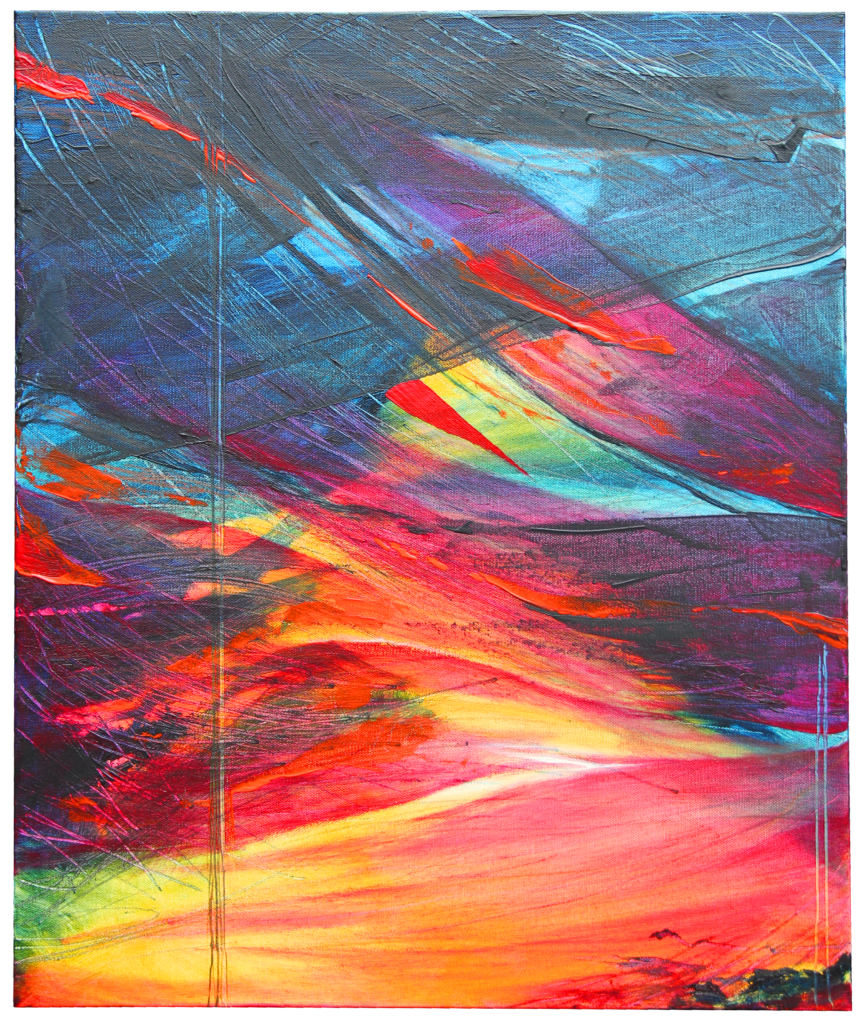
An abstract oil painting in red, orange, yellow, green brilliant blue, dark blue and black. It is reminiscent of explosions and fire in the night, with many crossing lines, a bit like a landscape. Named after Sinead O'Connor's song, Drink Before the War.
"Drink Before the War" 
Oil and graphite on canvas. Artist Emily van Lidth de Jeude

Labelling Weeds: Art for Public Engagement

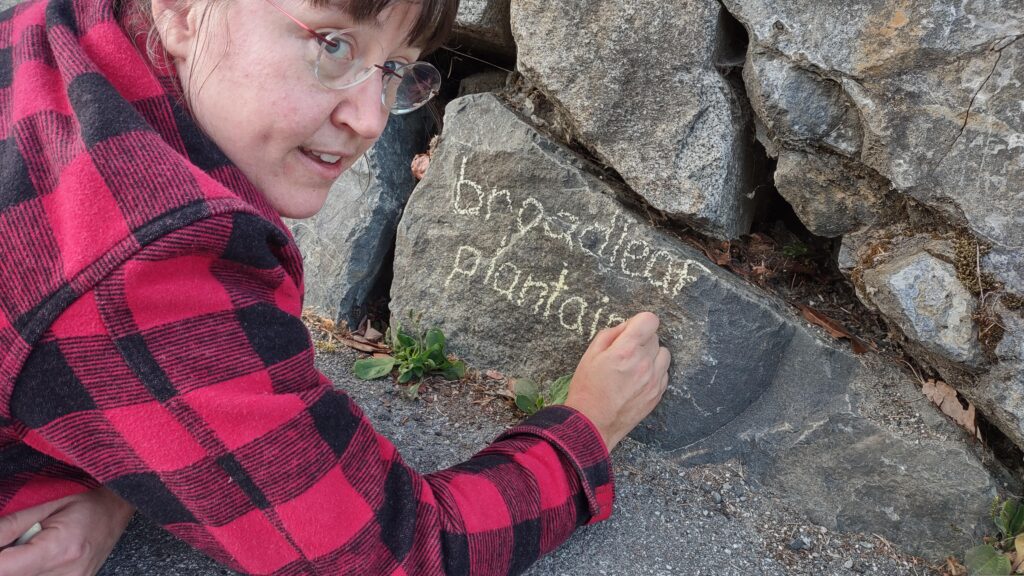
Close-up photo of artist Emily van Lidth de Jeude, with brown hair in buns and a red and black lumber jacket, printing the words "broadleaf plantain" on a rock with chalk. There are small plantain plants growing out from under the rock.

This has become one of my favourite things to do. Every year I go out and label the weeds and trees in the place with the highest foot-traffic on our island.

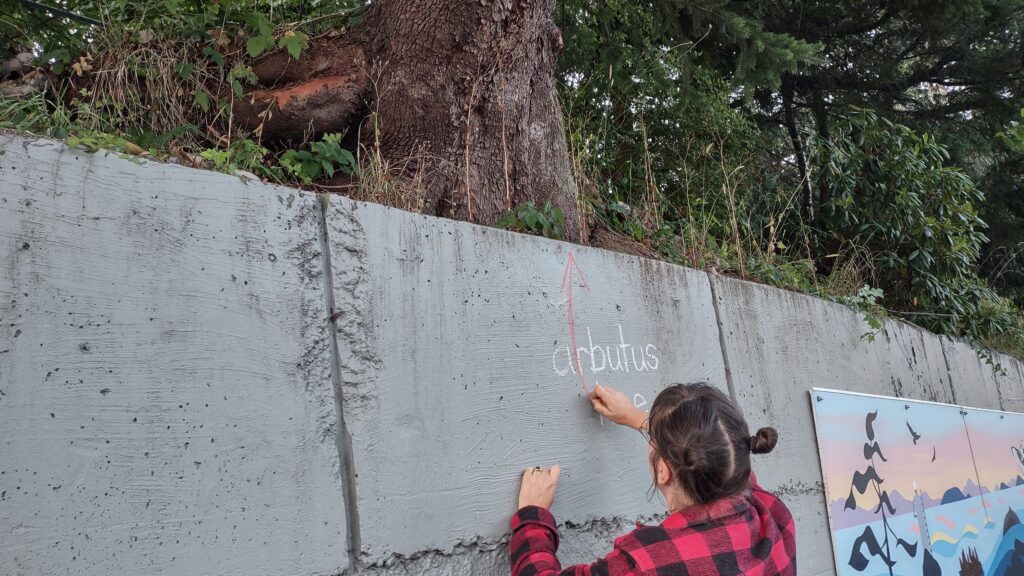
Photo of the back of artist Emily van Lidth de Jeude, with brown hair in buns and a red and black lumber jacket, printing the words "arbutus tree" on a concrete block wall, and a red arrow pointing up to the base of a large arbutus tree that is growing ontop of the wall.

I hope people see these and begin to notice a bit of the world around them in ways they may not have, before. I hope people also go home and find the same weeds, there. Sure, it's the simplest kind of art.

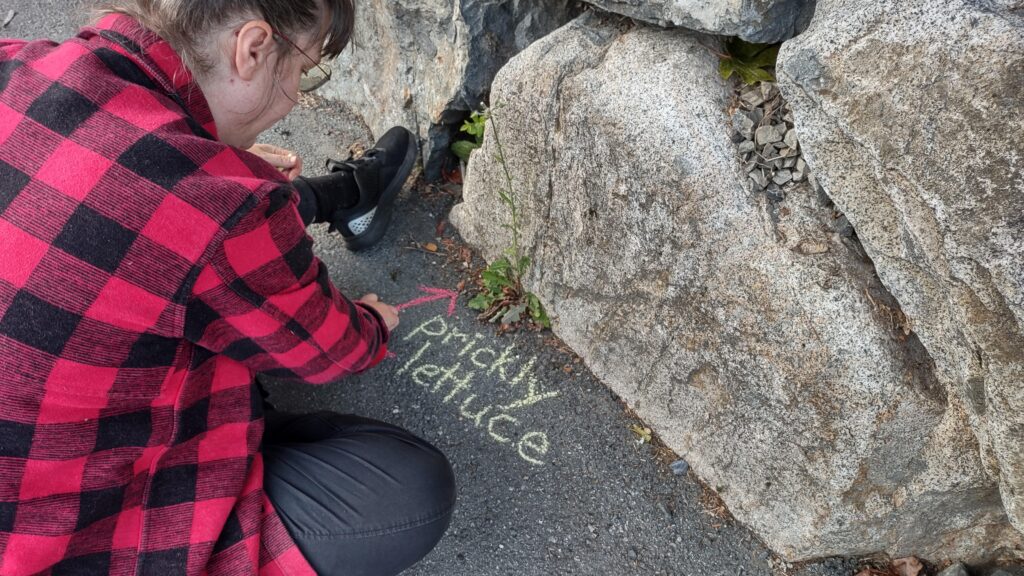
Close-up photo of artist Emily van Lidth de Jeude, with brown hair in buns and a red and black lumber jacket, sitting on the pavement next to a rock wall with a small plant growing out at the bottom. She he printing the words "prickly lettuce" in chalk, on the pavement.

I'm just chalking rocks, walls, and sidewalks with plant names! But I really feel it might be one of the most impactful works I've done.

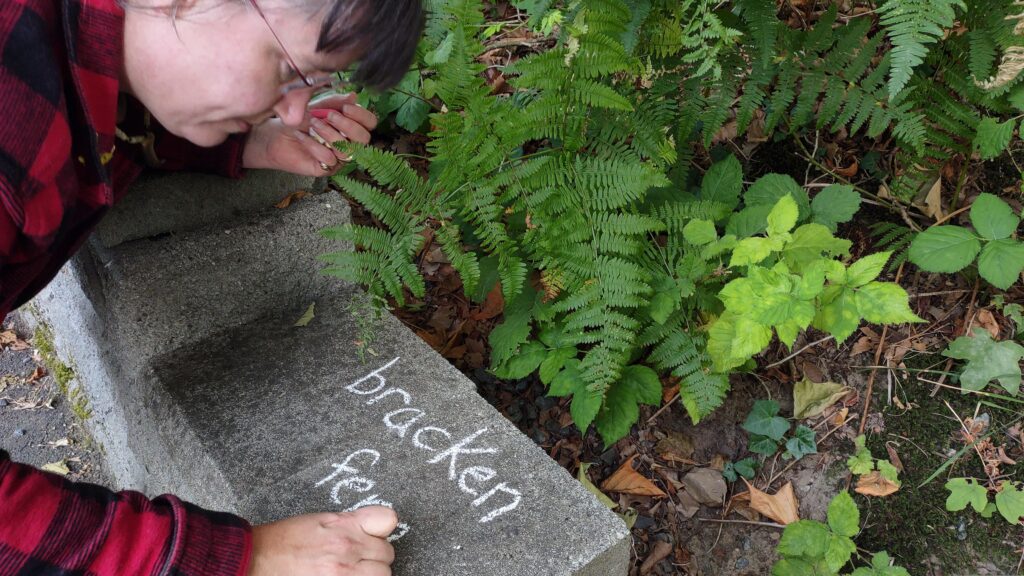
Close-up photo of artist Emily van Lidth de Jeude, with brown hair in buns and a red and black lumber jacket, printing the words "bracken fern" ontop of a small concrete block wall. There are bracken ferns growing on the other side of the wall from where Emily is standing.

And yes, if you're wondering, I do have municipal permission to do this! So the credit for this also goes to open-minded officials and other citizens who can appreciate the benefits of art and education in our communities. 🙂

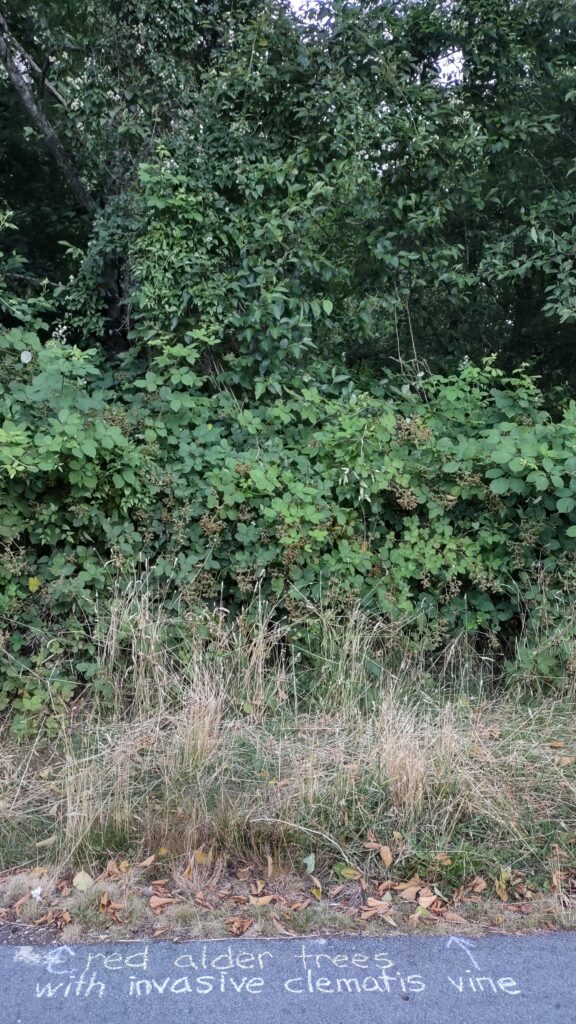
A photo of a sidewalk with the words "red alder tree with invasive clematis vine", written in chalk on the pavement. Beside the pavement is dry grass, then blackberry bushes, then above those red alder trees filled with invasive clematis vines, flowering white.

It’s Our Job, as Artists, to Imagine Hopeful Futures

A photo of the artist's hand holding a pencil, drawing a portrait of two boys laughing joyfully.

As artists, we have the power, ability, and honour of building our future civilization. Some of us may be doing so intentionally; many not. But whether we're aware of it or not, we are responsible.

Sci-fi is often touted as predicting the future. But does it? Writers and other artists imagine plausible eventualities based on current directions and capabilities… and then they often happen. Maybe the artists are soothsayers, or more likely we're just creative… and humans have evolved by being resourceful. If we're given a wild idea, we take great pleasure in making the seemingly impossible happen. So maybe artists are visionaries. That's not a pat on the back. Most of us want to be seen as visionaries, I suspect, but it's a huge responsibility.

What are we putting out into the world? Books, movies, and other art that may very well have been intended to warn us away from a dystopian future might instead be creating it; putting the ideas for such dystopia into our minds so that our resourceful society will create it. I'm not talking about some evil genius who sits in their dark basement playing apocalypse video games and then thinks, "ooooh I could destroy the world… bwahahahahaaaa!" I'm talking about all of us becoming gradually more and more accustomed to seeing and hearing about such dystopian events so that as they happen, we don't stand up and stop them.

What are artists supposed to do? Become blind Pollyannas and make fluff? Cotton candy dreams with no real plot and no intrigue? No, of course not. Nobody would look, at all. People like to look at what terrifies us. And art needs to deal with our problems, too; not just look the other way. I'm totally not immune to creating work that deals with humanity's pain and failings. But I also feel that we need to be creating work that posits hopeful futures. We need to be imagining the world we want to see, instead of the one we're afraid of.

And luckily, we have nature to look at, for inspiration. Nature is resourceful and opportunistic and ruthless. And extremely beautiful. The whole of nature evolves because of these things, and humans are definitely part of that whole. Nature limits itself simply because it's impossible to keep living if one devours all one's resources at once. I keep an ecosystem-integrated food forest around my home, which teaches me this every year. This year we're having quite an infestation of flea beetles. In previous years it was cabbage moths and one year–spectacularly–it was mourning cloak butterflies. But each of these infestations either destroys it's own habitat and thereby starves itself out, or attracts some kind of predator that eats it alive. Nature limits greed. So, despite my current paltry pea crop, due to the flea beetle infestation, I'll still have food, because my garden is diverse, and next year I don't expect to have such an issue with flea beetles. They've destroyed so many of their resources and attracted so many predators that they can't be such a problem, next year. Humans are in the process of self-limiting, as well, painful though it is for us as individuals. 

Contrast my garden flea beetle situation to a garden where all that's planted is peas (because: monocrop=money). The flea beetles now threaten the entire garden, as opposed to just the peas and the odd brassica or tomato, here and there. So now all we see as farmers is the flea beetle problem. And we blast them all to hell with pesticides. Now we have peas, and we make money, but we're poisoning ourselves and the land, and most of the other species that live on it. So in a couple of years of this practice, we've devastated our ability to grow peas, or perhaps anything at all on that piece of land, because we no longer have the diversity of life needed to sustain… life. 

It doesn't take much vision to see that that way of farming (or living, or envisioning our human future) is hopeless. It takes a little more vision to imagine and create a hopeful future.  

As an artist, I'd like to be one who plants more diversity, in preparation for new ways of living, instead of just imagining bleak futures for us to tumble numbly into. Humanity might indeed extinguish itself by imagining negative futures. But the life of this planet will go on. Yes, it will be utterly changed, because human folly is powerful, and we're destroying life at an ever-increasing rate. But some kind of collection of species (likely including some humans) will carry on beyond our rather short-lived civilization, and will develop its own rich community of life when it settles into the cradle that this planet offers. This new collection of species will imagine itself and grow into what it imagines. And, like my garden, the more diverse this new ecosystem is, the more resilient it will be.

I love to feel the responsibility of such a future. Let's imagine!  

How to Be a Safe Space for Our Own Children and Others

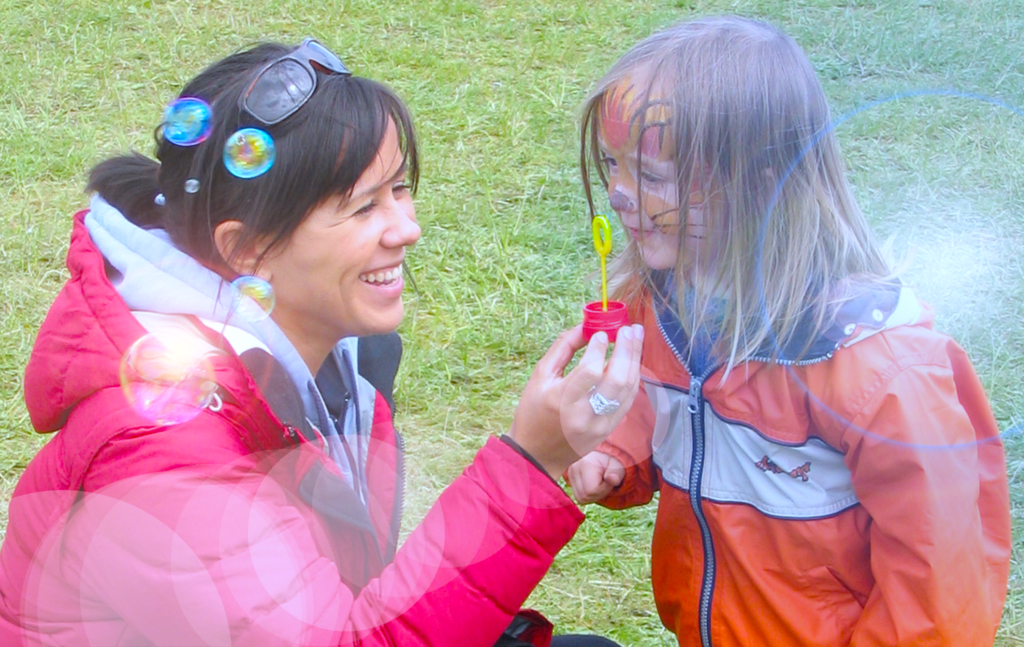
A young boy with long blond hair and his face painted like a tiger blows rainbow bubbles through a bubble wand that's being held by a smiling Hispanic woman who has long black hair.

In 2023 the CDC released this report, which pertains to data that has since been removed from the CDC’s website, because it referred to what the Trump administration calls “harmful” “gender ideologies.” But here’s the meat of the report. The first statistics are referring to teen girls:

  • Nearly 1 in 3 (30%) seriously considered attempting suicide—up nearly 60% from a decade ago.
  • 1 in 5 (18%) experienced sexual violence in the past year—up 20% since 2017, when CDC started monitoring this measure.
  • More than 1 in 10 (14%) had ever been forced to have sex—up 27% since 2019 and the first increase since CDC began monitoring this measure.

The report also found more than half (52%) of LGBQ+ students had recently experienced poor mental health and, concerningly, that more than 1 in 5 (22%) attempted suicide in the past year. Trend data are not available for students who identify as LGBQ+ due to changes in survey methods.

Findings by race and ethnicity also show high and worsening levels of persistent sadness or hopelessness across all racial and ethnic groups; and that reported suicide attempts increased among Black youth and White youth.

***

Let that sink in. What did you think? What did you feel? I am in tears.

My tears are not because I’m a parent of two beautiful newly-fledged children whose safety I fear for every day. They’re not because I’m a woman who knows from personal experience as well as any woman does that the increasing rate of sexual violence still only begins to touch the true horror of our lives as objects. My tears are not even because one of my children is female, and now attends frat parties. My tears are because this damned report says ‘LGBQ+’. My tears are because there is no T.

My tears are because, among the many children I’ve taught and known and loved over the years are a couple handfuls of trans kids, whose stories and hearts and lives matter. Because the rate of depression, suicide, and violence that looks alarming in this CDC report is much higher for trans kids than for anybody else, and it’s not documented, here. My tears are for Marlin, my beautiful trans cousin who struggled with extreme depression and finally killed himself just after Trump was elected, the first time.

And my tears are pointless. Just like hopes and prayers are pointless. All the billions of tears shed for the children we’ve lost will not save all the children we have yet to lose. Our tears are pointless. We have to act.

And what if we don’t know any trans kids? What if our kids are straight, cisgender*, white, wealthy and male? Why should we care? We should care because, in a world where it’s OK to erase people for being trans, it is also OK to erase people for being gay, disabled, non-white, female, or poor. And eventually to erase anyone, for looking different in any small way; for making a mistake or getting sick. And even if our kids are among the privileged few, that world is not a safe place to be. A safe world values everyone. Even the rich. Even trans kids. And besides, we don’t actually know how our kids identify, especially if we haven’t built a world where they feel safe enough to tell us. So what can we do to build this safe world?

My first act after the gut-kick of seeing trans children erased is to write this article. And I will never, ever shut up. I will write more and open my mouth more, and speak up against every ignorant human who tries to tell me they’re saving the children by persecuting trans kids (yeah this isn’t my first walk around the block, in this regard). I will keep wearing the ally pin my kids gave me a couple of years ago, not only because I’m so very proud that they see who I am, but mostly because I know that some frightened child might see the rainbow on my lapel and know that I care; that I will stick up for them, even when they don’t know about it. I wish I had known what Marlin was going through before he died. I wish I’d been able to help him. I wish millions of us had built a safe world for him to grow into, long before he changed his pronouns.

I’ve been asking myself since I was a teenager how I can support LGBTQ+ people in my community. Ever since a boy my age followed my friend and me home, nagging us—either of us—to date him. So I told him we were gay. It was a lie, and half-joking (I had NO idea at that point the severity of what LGBTQ+ people were experiencing.) I thought I could throw him off by making us unavailable to him. His response was, “well that’s a waste of two beautiful girls!” It stuck with me forever. I still think about it. The fact that we were unavailable to men made us a waste. Worthless. That response lit a fire under my butt that has never been extinguished.

It turned out my friend actually was gay, as was my other best friend at the time. And as the years went on, I discovered that more and more of the people I loved were treading the terrifying social swamp of being unavailable to straight cis white men. At around the same time, I found a porno magazine (in the possession of ten-year-old boys) with a photo-rich article about a man converting a lesbian by raping her. That lit another fire. Literally. I stole the magazine and burned it.

And then I had kids. And I had to protect them from the harms leering at them from every corner. And as the number of trans kids we knew grew and grew, and as my own kids educated me about gender and inclusivity, the fire under my butt grew and grew, too. And then we lost Marlin. And now he and every other trans kid I know has been erased. Now the fire is so big I’m a damned rocket. And what are you?

How are you going to protect your kids? How will you make sure they know that if they come home with a new girlfriend or boyfriend or non-binary partner you’ll be delighted, enthusiastic and welcoming? What about if they come home with a new name or pronouns? Will you learn what they know, and follow? Will you stand up for their rights when they decide to start hormone therapy? Will you wear the trans flag when you take them to the doctor?

We adults often think we’ve learned all the stuff. We think it’s up to us to teach the children, but it’s the other way around. We need them to show us how to use our phones, and we need them to teach us about gender and sexuality. Because they know. Yeah. Sexuality. Let go of your pearls. Our kids knew before we taught them the word ‘vagina’. Some of them were raped before that. We need them to teach us what they know, and we need to be open to hearing it. We also need to admit when we’re wrong.

A bunch of years ago, I was walking home with my young teenage daughter, and announced that I was so proud she was non-binary. I was also proud of myself for having recently learned this word.

“Um…” she faltered. “I’m not sure you know what that word means.”

I swallowed. “I thought it means you don’t see or stereotype people for their genders. Like it’s not all black and white. I’m proud that you see the diversity of people.”

“No, Mama.” She corrected me gently. “It means you don’t subscribe to gender binary.”

“Right? That’s sort of what I said, right?”

“No, like personally you don’t subscribe. For your identity. If I was non-binary, I wouldn’t consider myself male or female. I would probably use the pronouns they/them.” She walked on beside me like what she was explaining was just part of everyday knowledge, and I guess to her, it was. “I’m definitely female,” she said. “And Tali is definitely male. Even Marlin was definitely male. But if someone is non-binary they wouldn’t be either one. They’d be non-binary.”

At the mention of Marlin, the conversation became a lot less jovial. I was sorry I hadn’t understood, and I felt very small. Sad. Like suddenly maybe my misunderstanding presented a hazard to my daughter’s safety, even though she is cis. What else did I not understand? But she was forgiving, and understanding of my mistake. “Sorry, Mama,” she said.

“It’s OK.” I swallowed my shame and carried on. “So do you have any non-binary friends?” Out of respect for her friends’ privacy, she couldn’t tell me. And I was proud of that, too.

I’ve learned a lot. It turns out non-binary people can also identify as male or female. The gender umbrella is diverse!! And it’s OK to be confused. It’s a great place from which to build curiosity. My kids moved out a few years ago now, and are still my greatest teachers in many ways, especially where culture, inclusivity, and love are concerned.

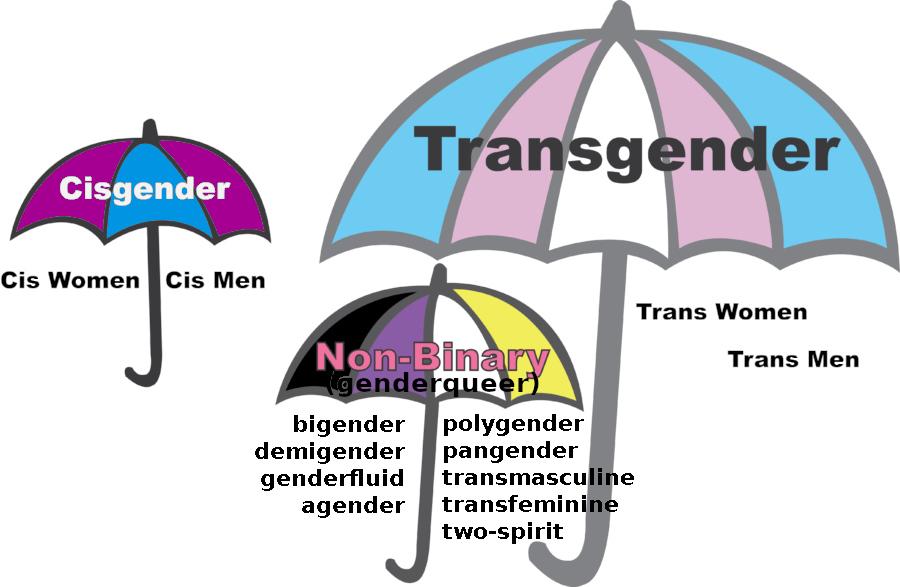
Three umbrellas provide a visualization for gender identity terminologies. On the left, a dark pink and blue umbrella (cisgender flag colours) says 'cisgender', and shelters the words 'cis women' and 'cis men'. On the right, a large umbrella in the colours pastel blue, pastel pink and white (trans flag colours) says 'transgender, and shelters the words 'trans women' and 'trans men', as well as a smaller umbrella, that says 'non-binary', and 'genderqueer' in parentheses. This non-binary umbrella is black, purple, white and yellow--the colours of the non-binary flag. Under this non-binary umbrella is a list of words representing some of the many diverse non-binary identities: bigender, demigender, genderfluid, agender, polygender, pangender, transmasculine, transfeminine, and two-spirit.
graphic used and adapted with permission from Gayta Science

Love. Yes, there has to be a fire under our butt. And it has to be fuelled by love. Where the rise of fascism is tearing at the already-shredded fabric of our diverse society, we have to wipe away our tears and start building, with love.

How do we build a safe and inclusive society? We have to swallow our fear and pride and shame and speak up at every opportunity, to wear the colours that show we’re safe adults, to teach other adults what our children teach us, and mostly we have to listen with open arms and open hearts, because many of our children are light-years ahead of us in doing this work. The answer is openness and curiosity.

What I think this all comes down to is that as people with a certain amount of privilege, and sometimes very little understanding of the LGBTQ+ world, we cis parents can still be part of the solution. We can look at the children we love with curiosity and respect. We can amplify their voices and knowledge and build the world they envision. And we can see and support the many safe spaces that empowered LGBTQ+ people are building, already. Because they are powerful. We are powerful. And when our power comes from love, we are all empowered, together.

My cousin Starry, Marlin’s mother, has been a guiding light for me, in my efforts to expand my mind, following the loss of Marlin. When he died, most of us in the family didn’t even know he was ‘he’, or calling himself Marlin. We hadn’t built the kind of safe space in our relationship that he needed to be himself, with us. It was Starry who informed me who he was, despite her pain. Starry, as you might imagine, suffered deeply with the loss of her child. And as the years have gone by, she not only received support in her loss from trans youth, but has also intentionally made herself and her presence a safe space for LGBTQ+ people. She continuously educates herself, and has three trans “foster daughters”, now. Loving others doesn’t only help those we love, it helps us too. Love is always the answer.

So let’s go. It’s Pride season, but it should always be Pride season. Let’s stoke our fires and make sure we’re building and supporting safe spaces, with love.

***

My own children, as well as Marlin’s surviving family members gave their consent to my mentioning of them, in this article. Consent-seeking is part of building safe spaces. I’m grateful for advice and feedback on the article from my own children, and Starry’s friends. Listening and hearing others’ opinions is part of building safe spaces.

Definitions, Links

*The word cisgender (often shortened to cis; sometimes cissexual) describes a person whose gender identity corresponds to their sex assigned at birth, i.e., someone who is not transgender. (Wikipedia: https://en.wikipedia.org/wiki/Cisgender)

A transgender (often shortened to trans) person has a gender identity different from that typically associated with the sex they were assigned at birth. (Wikipedia: https://en.wikipedia.org/wiki/Transgender)

Non-binary or genderqueer gender identities are those that are outside the male/female gender binary. Non-binary identities often fall under the transgender umbrella since non-binary people typically identify with a gender that is different from the sex assigned to them at birth, although some non-binary people do not consider themselves transgender. (Wikipedia: https://en.wikipedia.org/wiki/Non-binary) AKA: gender non-conforming.

CDC Report: U.S. Teen Girls Experiencing Increased Sadness and Violencehttps://www.cdc.gov/media/releases/2023/p0213-yrbs.html

How to Be an Ally: https://queerintheworld.com/best-lgbt-ally/

Fascist Ideology: https://en.wikipedia.org/wiki/Fascism_and_ideology

The Safe Zone: An incredibly informative site, which also offers resources and training for allyship. https://thesafezoneproject.com

TransWhat? A very informative site created by trans teen, Adam, which I highly recommend for further reading! https://transwhat.org/

Gayta Science: Using data science to visualize and promote understanding of LGBTQ+ issues. https://www.gaytascience.com/

Performance in My Home Community!

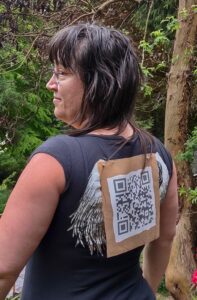
Artist Emily van Lidth de Jeude wearing a black t-shirt with wings on the back, and with a large QR code pinned to the back of her shirt. The QR code leads to a webpage that explains the (dis)robe: Hospital Gown project.

I'm so happy that the (dis)robe: Hospital Gown piece I made last year will be on display this autumn in Vancouver, but meanwhile… I get to wear it to an art event in my hometown, tonight!! This is will be the first time I've shown it locally, and I'm REALLY nervous. This piece is all about my disability, and to say people roll their eyes when I talk disability is an understatement. But this piece features other people from our community, too, so it's time to REPRESENT!!! Here I go! 

Off to the Bowen Island Community Centre. 🙂

Will update this post with a photo, later, if someone takes one. 

UPDATE:
It was a pretty quiet event, but nice to meet some other artists and visit with friends. I think only one person scanned the QR but that's OK! Here are some photos from before I actually put the gown back on and went inside…

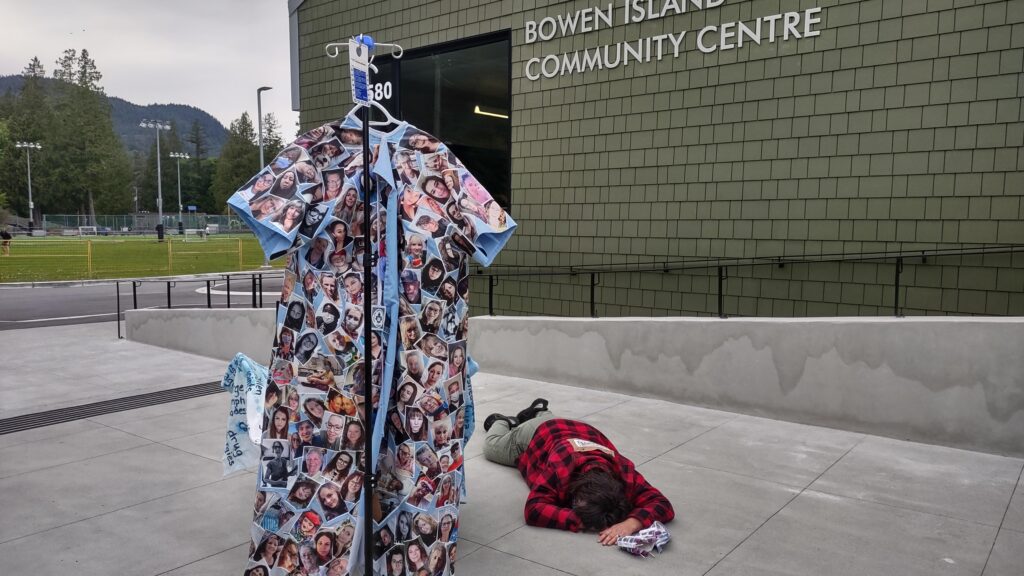
A photo of a blue hospital gown covered with the faces of over 300 Long Covid patients, hanging from an IV pole, standing on the concrete patio outside a building that says Bowen Island Community Centre. Artist Emily van Lidth de Jeude is lying on the ground, wearing a red lumber jacket, green pants, and with a QR code pinned to her back.
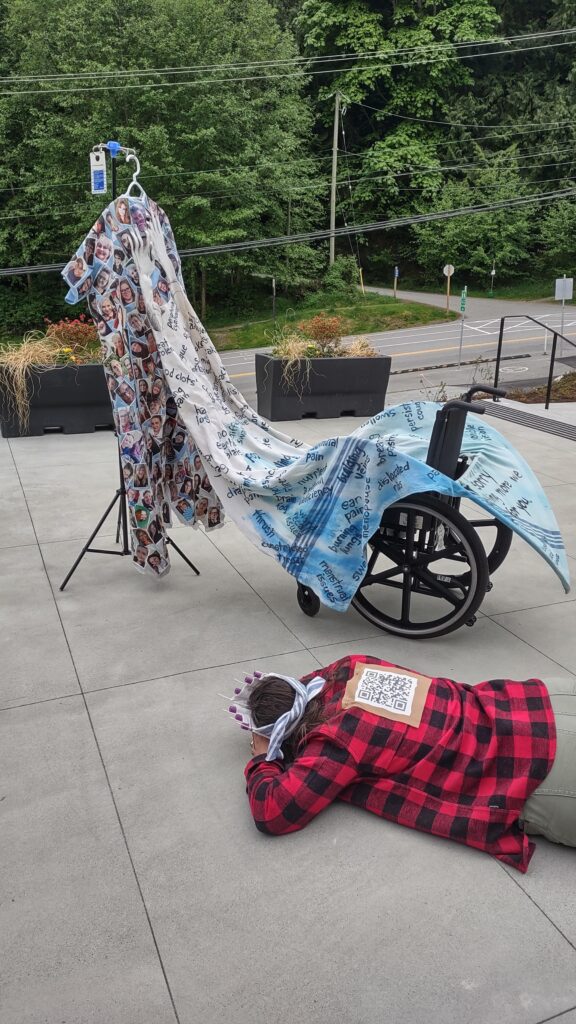
A different view of the blue hospital gown covered with the faces of over 300 Long Covid patients, hanging from an IV pole, standing on the concrete patio of the Bowen Island Community Centre, with planter boxes and a road, behind it. The back of the gown is now visible, where a long train made of a hospital blanket is attached to and covering a wheelchair. The train is covered with the names of common symptoms of Long Covid, and is attached to the back of the gown with a pair of white fabric hands. Artist Emily van Lidth de Jeude is lying on the ground, wearing a red lumber jacket, green pants, and with a QR code pinned to her back. She is wearing a crown made of hospital blanket, blood vials, and covid testing kits.

Thanks to my partner Markus, not only for these photos, but for always supporting me both in life and in art. If you're wondering where that QR code points, here's the link: https://emilyvanartist.noblogs.org/qr/