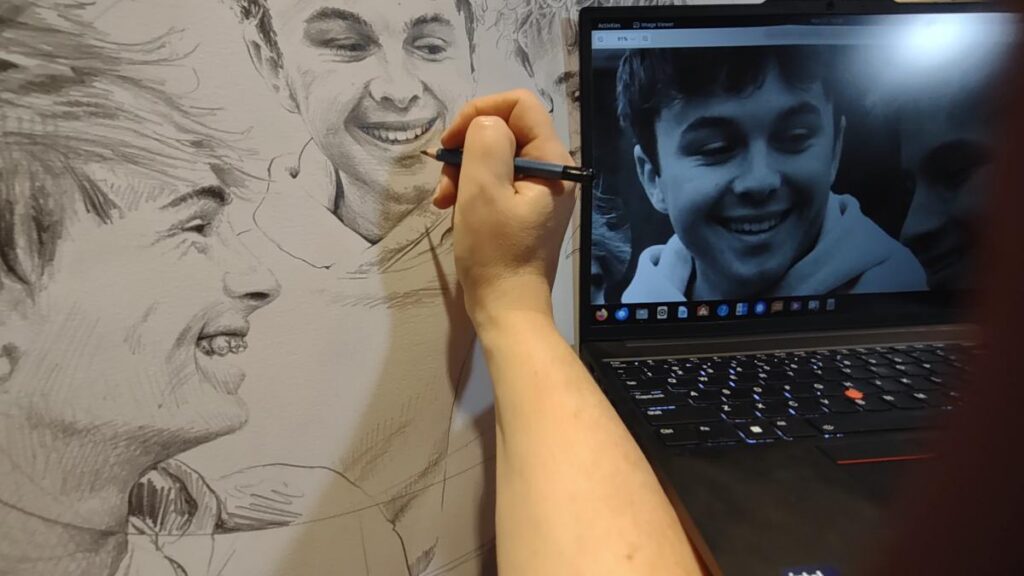
This is not AI. This is a photo of my hand drawing a portrait of three young men, with a reference photo open on my laptop, beside it. So it's a photo of a drawing of a photo! This photo was taken by an artist: me, Emily van Lidth de Jeude. I interviewed the young men and got them laughing together, to create a happy memory from which to draw their portrait. I photographed them during the interview. I then communicated with their family to determine how the final portrait would look. I then drew their portrait, and communicated more with their family to ensure the final product was what they hoped for. Then I sent the portrait to an art printer, who made a print of it, for their grandmother. Then I packaged up the portrait and delivered it. I spent dozens of hours creating this portrait, and the family evidently loves it. Why? Because it's real. It's their children. It shows a real moment of happiness and connection. It shows love. And it's not AI.
And now this image is an illustration for a blog post I'm writing, myself. Also not using AI. These thoughts are actually fully my own. These words are the way I think them, in my own mind, and share them with you.
This morning I received a blog post written by a person whose work I admire, illustrated by OpenAI. It's so depressing to see intelligent, thoughtful people write wonderful essays, and illustrate them with AI. Not just depressing because the result is so devoid of human connection, but also because the person who used the AI to illustrate is also becoming devoid of neurological connection. Yes–I'm serious. A 2025 study out of MIT showed that:
Brain connectivity systematically scaled down with the amount of external support: the Brain‑only group exhibited the strongest, widest‑ranging networks, Search Engine group showed intermediate engagement, and LLM assistance elicited the weakest overall coupling. In session 4, LLM-to-Brain participants showed weaker neural connectivity and under-engagement of alpha and beta networks; and the Brain-to-LLM participants demonstrated higher memory recall, and re‑engagement of widespread occipito-parietal and prefrontal nodes, likely supporting the visual processing, similar to the one frequently perceived in the Search Engine group.
(N. Kosmyna, E. Hauptmann, Y.T. Yuan, J. Situ, X-H. Liao, A.V. Beresnitzky, I. Braunstein, P. Maes, (2025). Your Brain on ChatGPT: Accumulation of Cognitive Debt when Using an AI Assistant for Essay Writing Task. (Preprint, Under Review.) p. 2.) https://arxiv.org/pdf/2506.08872
So, this study was focused on writing with AI. Still, it seems blazingly obvious to me that using AI to illustrate our work is going to deprive us of our own illustration abilities. And I'm not just talking about our ability to draw or photograph well. These are skills that can easily be learned, anyway. I'm talking about our ability to conceptualize. I'm talking about our ability to understand how others think: what kind of an illustration might pique their interest in our work, and how that illustration might reach them emotionally (which is essential for impact). It's really about human connection. And when we lose that, what do we have left?
Julianne Holt-Lunstad states that "scientific evidence has been credibly demonstrating a significant causal effect of lack of social connection on leading physical and mental health indicators, such as cardiovascular disease, stroke, depression and dementia." (J. Holt-Lunstad (2024). Social connection as a critical factor for mental and physical health: evidence, trends, challenges, and future implications. (World Psychiatric Association.)) https://pmc.ncbi.nlm.nih.gov/articles/PMC11403199/
OK, OK… Let's not get all dramatic. We're not busy thinking about our future health, right? We're not busy thinking about the future at all! All 55 participants in the study I quote up above were university students, and the study lasted only four months. That's four months for significant brain disconnection to occur. Where do you see yourself in four months? Personally, I hope my brain-health is still improving, not declining. And same for my social connection. So from a purely selfish perspective, I don't use AI.
I am trusting (but also researching to determine that my trust is well-placed) that by continuing to engage in my own work, I will have a part in making my life and my greater community better. I trust that in researching, I still depend on my own observations and fact-checking, to be sure the information I'm gathering is accurate. I trust that in sharing this information with you, I lead with my brain and heart, instead of being blindly led by an LLM whose interest was programmed by a corporation who doesn't give a crap where I'm at in four months. I trust that the image I created and used to illustrate this article will remind you that I'm human, and I trust that being human is still worth a lot. I trust in our shared connection to support us all in the future we're creating.
I performed one of my wearable art pieces at the Museum of Vancouver recently, and they pointedly payed me properly for my work, as well as provided human-created promotional material around the event. It shouldn't be amazing to simply be respected and paid for my work, but these days it definitely feels amazing. And simply wonderful to be working with a team of actual humans on making this performance happen. Collaboration is part of being human.
Kudos to all the people out there still creating; still respecting other humans' work; still seeing our world as a community of creative, resourceful minds, instead of workers on a treadmill run by AI.