Dear Little Emily: Mickey O'Flaherty and the Dog Poop

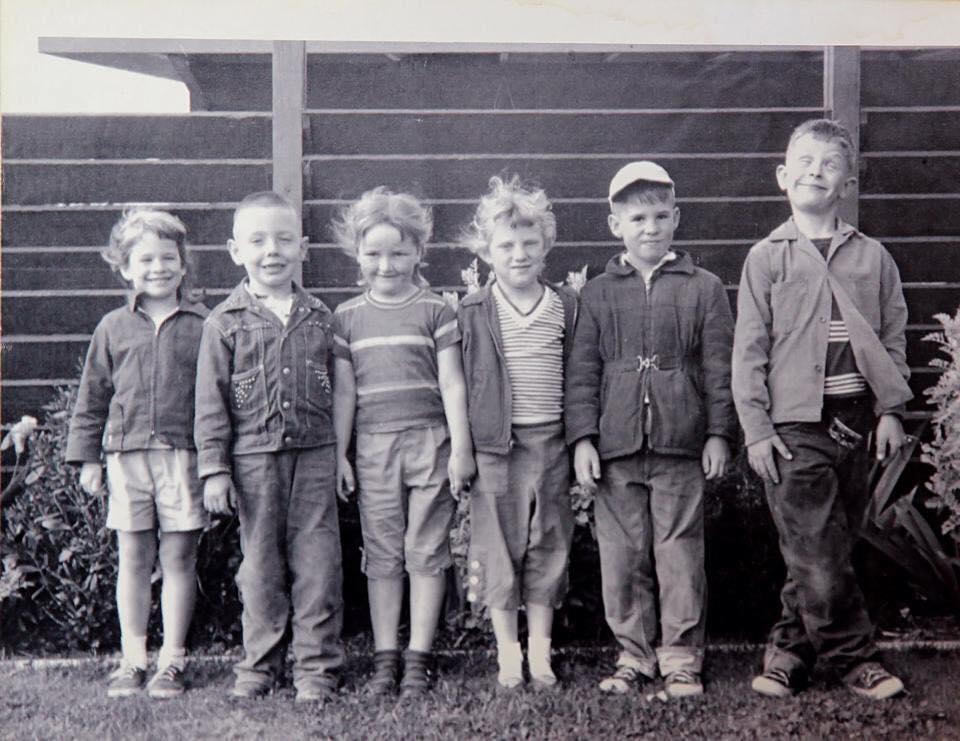
A row of six children stands against a few shrubs and a wooden fence.

The audio version of this story is now also available on my MakerTube!
https://makertube.net/w/4ikHDR1cK3fhjeNB7cxSm8

~~*~~ 

Dear Little Emily,
When you grow up, you’re going to keep singing with Mum, at the folksong retreats. Mostly the old ballads and work-songs that you usually sing, with all the spirituals that tie your hearts up into warm packaged balls of hope. And also sometimes songs Mum’s written. Like this one:

Well I know your Darn Dog done been here,
Done been here, neighbour, done been here!
I know your Darn Dog done been here,
He done blessed my yard and gone.


Mum is really never going to stop writing parodies. This one is of “I Know My Good Lord Done Been Here”, and you’ll be mighty glad Daddy will be dead by the time she writes it, because he’d sure not appreciate the vain usage of his Lord’s name! Haha. Pretty sure you would have sung it to him if she was going to write it while he was alive. Sometimes you’ll be so embarrassed, though, and this is no exception, although by the time you sing this, you’ll be me—your adult self—and have learned that a little embarrassment is worth the reward of a great memory.

Good morning, Mr. Otis
I wonder where you’re bound
You look like you’re on a mission
And you’re walking on landscaped ground

Well I know your Darn Dog done been here,
Done been here, neighbour, done been here!
I know your Darn Dog done been here,
He done blessed my yard and gone.


One of Mum’s favourite memories to tell, is of Mickey O’Flaherty. Even his name seems to delight her, and the stories fall out of Mum all your life long. I know you know this already. You’re around ten. But it never stops—I promise.

Mum has a framed photo on her wall of herself and Uncle Jim, and a bunch of their friends standing in a line on their street in Mill Valley, where they grew up. Six kids. Uncle Jim is the weirdo on the right with his legs and eyes crossed. Mum is third in from the left, and just beside her sheepish grin, Mickey O’Flaherty’s ears stick out. He looks like he’s just about to say something. Maybe that’s my imagination. He apparently had a lot to say.

Mum likes to tell about the protest signs Mickey put up on his front lawn, declaring “My Mother won’t give me hot chocolate!” and other such things. Apparently Mickey used to have breakfasts at little Mum’s house in the mornings, before they went off to school with Katie and the other kids. He spent a lot of time at Mum’s house. Grandma looked after him, I guess, because his mother was single. I guess like Mum was single for a little while after she left Daddy, and you both lived in the apartment, and Pappa brought you groceries, before he became your Pappa. So I guess maybe you have Mickey’s sense of humour to thank for Mum’s silliness. And perhaps this song.

You know that poodle Mitzi
She’s easiest to find
She’s just like Hansel and Gretel
She keeps leavin’ her crumbs behind

Well I know your Darn Dog done been here,
Done been here, neighbour, done been here!
I know your Darn Dog done been here,
He done blessed my yard and gone.


So the best story goes like this: There was some rude neighbour—and that’s important—he wouldn’t have met the same fate if he hadn’t been rude to children. And on top of all that, his dog used to poop all over the neighbourhood. So (and Mum swears this was Mickey’s idea), she and Mickey did a community service and picked up all this neighbour’s dog’s poop, and gift-wrapped it beautifully. They tied it up with a string and put a neatly-written note on top, that said, “Your dog did this. Be proud!” Then they set it on the neighbour’s doorstep, rang the bell, and departed.

I used to walk out barefoot
When I was just a lass
I don’t walk barefoot anymore
Because there’s danger in the grass

And I know your Darn Dog done been here,
Done been here, neighbour, done been here!
I know your Darn Dog done been here,
He done blessed my yard and gone.


So when you’re all grown, little Emily, you’re going to make a big road-trip down the coast, with your own teenaged children, and you’ll stop in Mill Valley, on Meadow Road, to look at the house our mother grew up in. The house will look rather as she described it: A single-story home with a garage and a lawn. You can imagine little Mum on that lawn, spread out with Mickey and Katie and maybe Uncle Jim, all painting on scraps of cardboard, some kind of creative advocacy for their rights. Mum spent her whole life advocating for children’s rights, as a preschool teacher. Although by the time you’re grown she’ll be an infant development consultant, doing the same thing. Did their exploits inspire her? 

Around about now, when you’re ten, Mum and Pappa want to get you a passport, but Daddy won’t allow it. He’s fighting for custody of you, and I know you’re scared. Scared that every time Mum and Pappa come back from that courtroom it will be to say goodbye; to send you off to Daddy’s house forever. I wish I could tell you right now, Mum would never let that happen. She may not have money for a lawyer, and she may just be a preschool teacher married to a bearded man with a woven tie who cringes at the sight of documents, but she knows how to speak up for herself and your rights, and she’ll find a lawyer at the last second; a friend who is a straight-standing, clean-shaven man in a crisp suit and who will walk into that courtroom and silence all those people trying to take you away from her. He’ll silence them just by walking in like he belongs there. He walks like a man who knows he’s worth something. Like maybe his mother was like your mother, and knew how to give children a voice. That friend will save your life that day, little Emily. But he’ll be there because Mum was brave enough to ask him. And maybe all of it because she and Mickey developed their voices as children, so they could speak up when others couldn’t.

Good morning to you, neighbour
And how do you do?
I’d ask you in for coffee
But you’d get dog shit on your shoe!

And I know your Darn Dog done been here,
Done been here, neighbour, done been here!
I know your Darn Dog done been here,
He done blessed my yard and gone.


Sing the songs, little Emily. No matter how embarrassing. You never know where they came from nor what importance they carry. Sing the songs with your friends, now, and with your children and their friends, later. You’re going to be a teacher, too, and an artist, and you, too, can give people a voice, even though right now when you’re ten you don’t feel you have one at all.

I think it’s the struggle we go through as children that gives us the courage and power to stand up for others, later on. I wonder what became of Mickey O’Flaherty. What will your fear of going to Daddy’s house do for you? Your fear of speaking up, and the danger of not speaking up? I mean – I’m almost fifty, now. I kind of know what you’re going to do with your life. But I think I’ll leave that to you to discover, as you go. Sometimes the joy is in the finding. Unless it’s poop you find, I guess.

Well I know your Darn Dog done been here,
Done been here, neighbour, done been here!
I know your Darn Dog done been here,
He done blessed my yard and gone.


Love, Emily
Dear Little Emily: Katie's Thermometer

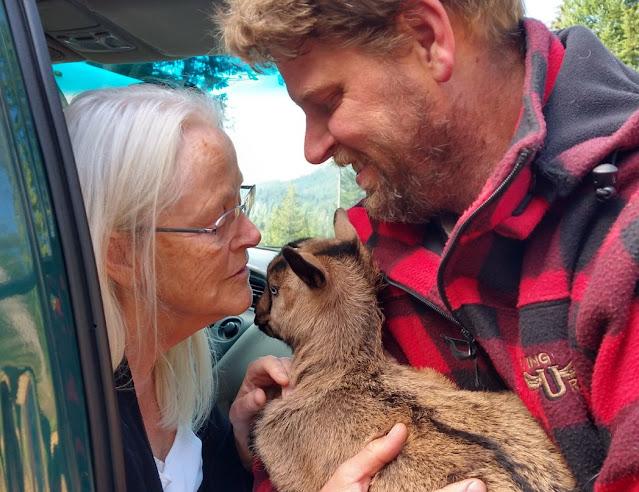
A man with short blond hair and a red and black checkered jacket holds a baby goat up to a woman in the open door of a car. The woman looks lovingly into the face of the small goat, her long straight white hair falling around her face.

Dear Little Emily is a series of letters to my childhood self, exploring loss, love, and personal growth.

~*~ 

Dear little Emily,
Do you remember Mum’s friend Katie? I mean, of course not, because we weren’t born yet. But I know Mum told you, with a sparkle in her eyes. When Mum was a girl, and lived in Mill Valley, Katie’s mother used to take her temperature every morning before school, in the little cookie-cutter house that was just like Mum’s, and sometimes Katie would bite the thermometer in half, and pour out the silver-heavy drop of mercury into her hand, and carry it out to play with. Mum and Katie delighted at the way the mercury rolled over their hands; wondered at the pure and clandestine droplet of magic. Funny to think that it was poison, when everything about it was so curative—the thermometer, the naughtiness, and the friendship.

I was thinking of this while taking my temperature, today; looking for the fine line of silver on the old thermometer that has survived for decades while countless surely-better digital thermometers died and went to plastic heaven. Like Mum. Is there a heaven for children who grew up to have their own children, and worked their lives away, and then retired and died of brain tumours, cut just under their white and beautiful hair, just as we expected them to finally start living? Is there a heaven for children who treasured and understood the joy of play so well that they grew up to teach and care for children all their lives; to learn and practise and master the art of growing through play? Children who played with mercury? Like Mum?

Little Mum sat in her classroom after she’d moved north from Mill Valley, and stared out the window at the first snowflakes she’d ever seen. Her teacher rapped the back of her hand with a ruler, to punish her for not paying attention. Mum grew up to have her children in Canada, where she delighted in the snow falling, and rolling and jumping and sledding in it, and in skating on the frozen lakes. She took you and little Adrian out to play not only in the snow, but the waves and the forests and the fields of most beautiful grasses and flowers and insects. She married a man who brought you gifts of found animals—almost-pets that you could never keep but who opened your hearts to a sense of wonder. You and Adrian will both become teachers. You and Adrian will never stop playing, even though the constraints of our worker-hungry world will try to make you.

Right now, little me, you’re ten; maybe eleven. You think Mum’s harsh because she says you really do have to learn the long division, even though it’s obviously stupid. Like a game of numbers that has no purpose but to prove your insufficiency. Like the barely-visible stripe on the thermometer: Always insufficient. Always too low to mean staying home from school. There is no such thing as a proficient thermometer.

Mum says babies are born proficient. They can breathe, and pee and poop, and they take only a day or so to learn how to nurse; no time at all to learn to cry, to tell us they need us. They need our love. And in that warm circle of our love, they grow. By the time they’re a month old, they’re proficient at so many things, from telling us when they need a diaper change, to when they’ve had enough milk, to using their ears and eyes and fingers and tongues to explore their growing world. And as soon as we notice these proficiencies, we try to control them.

By the time they’re a few months old, babies have learned to navigate our systems and controls; to cry only enough to get what they need, even if love is not available; to make do in a world that is ever-more restrictive. They’ve learned to grow despite the challenges we present. And by the time they’re half-grown, like you are, now, my little old self, they’ve learned to hide their true selves away: to master the art of appearing-to-be-doing-something, while growing in secret; breaking the thermometer to go do science at the back fence on the way to school. By the time they’re twenty, they’ve come to recognize the restrictions were for their safety, and by the time they’re thirty-five, like Mum is now, in your world, little Emily, they’ve learned to tell their children to finish their long division homework. Even if they wish they didn’t have to.

I’m almost fifty, now, little Em. I took my temperature, today, because I have Long Covid, and I get a fever from over-exerting myself, like I did today, by visiting with my Aunties. I wanted to break the thermometer, but I guess I was never as brave as Katie from Mill Valley in Mum’s childhood. I’d be so angry if my own children behaved so recklessly. What have we done? What have we done to ourselves, and our children, and our future?

Not wanting to be the parent our mother was, but inspired by her knowledge about child development, and by my own teaching experience, I ended up unschooling our children; Mum’s grandchildren. Much to her initial concern, but I did it anyway. I explained that it was like taking the premise of her child-centred preschool and expanding it to the whole life of the child: To present and encourage opportunities for growth, and to always support the children in their endeavours, while being a bit of a safety-net, on the other side. 

One day, before Mum’s dead, you will show your children the game of long division. You’ll sit them at the dining-room table, your eyes full of excitement, and show them how the numbers fall into place like satisfying blocks tumbling into their designated holes in the block-sorting-box. Your daughter will expand the game into a mind-bending board-game, and your son will revolt, but then go on to take a calculus course at a local college, in his teens. For fun. We can’t always know how a child will experience wonder, but we can make space for it. 

The unschooling “worked”, you might say. Your one-day kids are grown, now, and living independently; supporting themselves with varying degrees of financial security. And they’re happy. They live their lives in the world I failed to change, but somehow they are the change. I never gave them a mercury thermometer in their lives, because I was afraid they’d break it for fun, and maybe poison themselves. 

Little Emily, I’m sorry you have to do your long division. I’m sorry you also never were left with a fun little stick of mercury to break out and roll around in your palm. But you had salamanders and frog’s eggs. You had trees to climb at lunch hour. You had a mother who took snow days very seriously, as she did “town days”, which meant getting out of school and going for adventures in town. And she won’t flinch much, when you tell her her grandchildren are leaving her preschool not to go to school, at all. She’ll cringe and fight it just a little before she, like all humans do, grows from the experience. She’ll sometimes take them for town days, too. And give them silly putty to play with, even when they’re ten or eleven, and listening to music that horrifies her. She knows what matters to them, as it does to all people growing. Even to aging preschool teachers who are about to die of brain cancer, and just don’t know it yet.

What matters is nurturing growth. Play. Discovery. Mum never lost the ability to wonder; to make space in her own life for joy. Just before she died, last year, her movements and language oppressed by the tumour’s growth in her left parietal lobe, her heart broken by the grief of saying goodbye, Mum went to visit Adrian’s new baby goats. The last trip she made outside of her house in this life was to look lovingly into the eyes of these babies as she did thousands of times in her life, with baby humans. She couldn’t speak anymore, but her eyes tell me she saw those babies’ potential. She saw their little growing selves and all the dreams they didn’t yet know they were going to dream.

Wonder. Mum didn’t look at them to see their sense of wonder, but I know that seeing the wonder in those babies’ eyes connected her to her own. The wonder we allow children to experience is what can sustain them through a lifetime of having to make do in a world that is never ideal. Wonder gives them a space to discover, learn, and grow. And in the end, when their lives are coming to an end, it gives them joy.

After Mum died, I dreamed I was holding her on my hip, and turning around in our yard, as she pointed wordlessly to the sparkling needles on the trees, the flock of singing birds flying by, and then the bulbs coming out of the snow and blooming. We turned further and she pointed at the veggie seedlings on the black earth, and the worms and beetles and pupae in the ground, bustling about their lives. We looked up, and she pointed at the sky, which had become a prismatic dome of light, shining above us, in a perfect white that somehow let its rainbow self show at all the edges. A matrix of wonder. 

Little Emily, our mother was a conduit of wonder. She knew what children and all people need for growth, and she did her best to give you that gift. 

Love, Emily