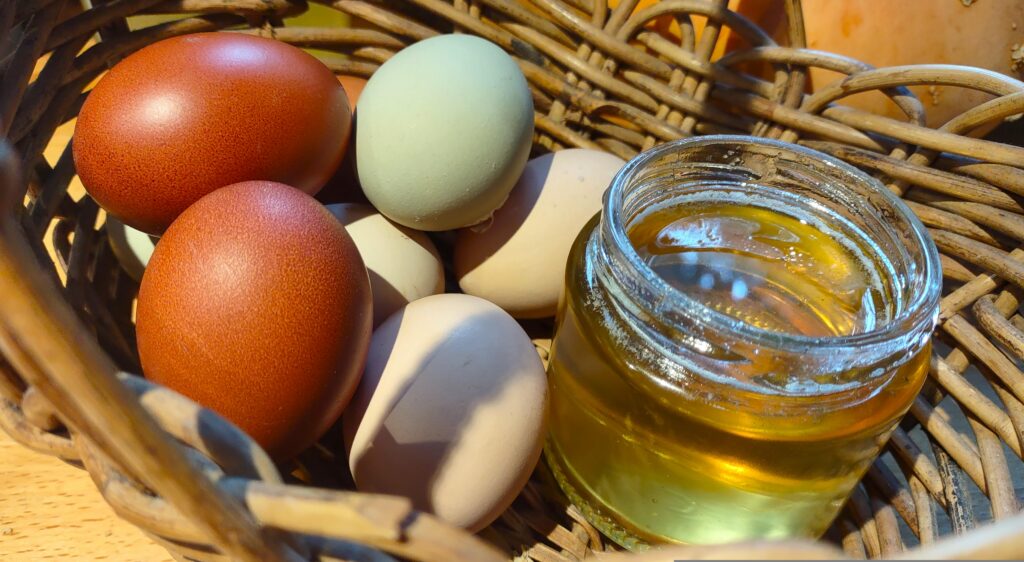
We had a beautiful moment, yesterday, when two young women who grew up next door to us brought us a jar of honey in trade for our chickens' eggs. They're just visiting their parents' house, as they both moved out years ago, now, and it was lovely to catch up a bit, and chat about what flowers the bees were drinking from.
Here's how it works: Both my and these young women's parents bought land, when it was affordable, here. Our parents grow and tend to a plethora of flowers, fruit trees and vegetables. Their parents keep bees that drink from the flowers in both of our yards (and pollinate the veggies and fruits we grow, as well!) and we keep chickens, who not only fertilize our veggie garden, but provide eggs and meat that we can trade for this gorgeous honey… made partially from the nectar of our own flowers. The neighbours on the other side of us grow corn that for some reason we can't grow just a couple hundred feet to the west, so we delight in fresh corn, in August, in addition to all the crops we grow ourselves, and buy from others in the neighbourhood. All of us have to give away zucchini and other too-plentiful crops to the broader community, as well. And we teach people how to do what we do, because the more people do this, the richer we'll all be.
It seems really too idyllic to be true, but this is the dream my parents had in the seventies, and through three generations we've now managed to carry it on, to some extent. And it's the foundation of what it truly means to buy local.
Now here we are clenching our teeth, watching a bunch of fascists try to take over a rather large chunk of the world, munching through Hitler's playbook one vile action at a time. Whether you're here or there, or whether you're repulsed or scared by their actions, eating local is a good idea. In fact, eating local has always been a good idea, because it's sustainable. And now maybe the trade war or the scarcity caused by fascists kicking a large percentage of farm workers out of their countries will push more people to eat local, too. I hate to think there might be a silver-lining to all of this, but also I'd rather build that silver lining than only wither away amongst the negatives. I think maybe that silver lining is bigger than food, too. I think now we can we use our frantic flee from fascism as a leg-up on the way to save humanity from pernicious greed.
And it doesn't matter what country we live in, either. All of us are going to be affected by the trade-war, and all are going to be affected by food and labour shortages. But we don't have to suffer. Yesterday I saw someone asking where to get fresh local produce in winter. Well… we live up north, so we probably can't, unless it's from a greenhouse. So the question is not so much how to simply buy locally, but how to change our diets and expectations in order to buy locally.
Me? I only eat fresh corn in the summer. That's when it's abundant, here. And frankly, it tastes a lot better than whatever well-travelled corn is available in the stores in other seasons. Maybe I freeze some of my neighbour's corn in the summer, and can add it to a nice Spanish rice or pot of chili, right now. Because it's winter. I'm eating a lot of veggies, legumes, fruits and meats that I dried or froze last summer, along with some fresh greens that I'm growing on my windowsill and under a grow-light (pea-shoots, alfalfa sprouts, and a few lettuces). In fact, even if you don't store food yourself, the best-tasting food in the grocery store during a northern winter was flash-frozen fresh from local farms, last summer. A bag of frozen broccoli is much more delicious than those slightly grey imported broccolis in the fresh produce section.
It definitely takes a little more planning to eat what's locally grown and seasonally available, instead of just going for fresh avocados, tomatoes and apples, year-round. But I like a small challenge, and to be honest, it's not much of a challenge after you've done it for a year or two, and mostly… it's so enjoyable! That fresh corn that I only eat in summer? It's not only more delicious because it's fresh and comes from my smiling neighbours' hands; it's also more delicious because we only eat it during one month of the year! It's like Christmas treats: by the time we get back around to Christmas, we're craving that stuff! Scarcity makes things delicious.
But what about expense; affordability? Have you seen the prices at the local farmers' market?! This kind of seasonal local eating is only for the privileged, right? Well yes, to some degree I can see that line of thinking. I have a huge privilege in being able to farm on the land I rent, but my family is also on the lower end of the middle class, and we've managed to make these choices by prioritizing where we spend our money. Instead of taking vacations, we built a garden; instead of owning a home, we rent. We cut expenses wherever we can, and spend a little more on the things we feel matter most: a healthy home and meaningful time with our children. We spend more than most people on ethical, partly-foraged meat, because raising our own chickens, buying neighbours' lambs, local, sustainably-caught seafood, and local grass-fed beef and dairy is very expensive! So we minimize our consumption of it, and we supplement with legumes and pulses. I buy some dried and grow/dry some myself, and then I just soak them overnight, move them to a tray for sprouting, and cook them in a day or two, whenever I feel like it. We pay pennies per cup of food, this way. Unless we add expensive cheese, which… I confess happens more than it should!
But boxed cereals, cookies, prepared foods; even canned foods–these I consider a waste of money. Our culture spends a lot on processed foods that don't nourish us, and deplete not only our finances but also our land and cultural heritage. Learning to cook from scratch is a huge benefit not only to our health, but also to our pocketbooks. It's true that it takes more time, but for our family this became quality time. By the time my kids moved out they were fully capable of growing food and cooking from scratch. I can't imagine a more important skill, but it's also a point of bonding for us, as we still get together to make and share meals.
How about a useful list. I'm in the Pacific Northwest, and can only talk about my own experience, really. So here it is, a list of common locally-produced foods from my region. I'd be happy to hear yours!
Fruits:
- Spring: blossoms! (OK it's not a fruit but you can see my reasoning…)
- Summer: all kinds of berries, grapes, and stone-fruits
- Late summer: figs, kiwis, more berries, tomatoes
- Autumn: apples, pears, quinces, tomatoes
- Early winter: persimmons,
- Winter: stored apples (still fresh), jams, canned fruits, frozen fruits, and dried fruits
Greens:
- Spring: Pea shoots, edible-pod peas, spinach, lettuces, overwintered kale and broccoli, wild greens
- Summer: Lettuce, Chard, kale, cabbages, broccoli, green beans, shelled green peas, celery
- Autumn: same as summer, plus spinach
- Winter: some fresh kale, stored cabbages, frozen or dried greens, and fresh sprouts/shoots
Other vegetables:
- Spring: seaweeds, overwintered cauliflower, baby carrots, asparagus
- Summer: turnips, celeriac, carrots, beets, cauliflower, new potatoes, peppers, eggplants, artichokes, sunchokes, zucchini and other summer squashes
- Autumn: same as summer, plus potatoes, winter squashes
- Winter: seaweeds, stored potatoes, carrots, sunchokes and squashes, canned or frozen other things, dried seaweeds, peas, beans and lentils
Grains:
- Autumn: most of our local grains are harvested in late summer or autumn, and of course they store on our shelves all year, after that. We have quite a few available in our area, despite not being the prairie: oats, barley, wheat, rye, corn, buckwheat and sorghum are what I'm aware of.
Nuts and seeds:
- Autumn: mainly hazelnuts (indigenous, here!), but also some walnuts, hemp seeds, pine nuts, beechnuts, and chestnuts.
Animal products: (not by season because some can vary, and most can also be stored frozen)
- meat: fish, invertebrates, poultry, larger birds, rodents, lamb, pig, and beef. I believe it's more sustainable to only eat locally and ethically-grown meat, and to eat it only rarely, supplementing with eggs, legumes and pulses, as well.
- eggs: although many non-industrially-farmed chickens produce fewer eggs in the winter, it does depend on the breed and the conditions, so it's absolutely possible to have fresh eggs all year round.
- dairy: we have lots of local sustainable small dairies here, producing cow, goat, and sheep products!
Sweeteners: (mostly made in autumn; stored all year)
- maple syrup, barley syrup, honey, corn syrup, and beet sugar.
- apples, grapes, figs
Salt, spices, etc.:
- we do actually have sea salt produced on the west coast!
- many herbs, peppers, seeds, spices, etc. are grown here and preserved before winter.
- seaweeds, kelps
What to cook! This is just some of my favourites:
- Spring: all the flowery salads, dairy, eggs, and bright fresh greens! Also legume/pea salads, wild-green and egg sandwiches.
- Summer: (Do I have to say this, even?) ABUNDANCE of fresh and grilled foods!!! We even make our own ice cream by putting frozen fruit, honey and local cream into the food processor!
- Autumn: pies (fruit and savoury), hearty soups, hot potato and grain dishes.
- Winter: chili, stews, & casseroles made with dried and frozen produce, baked desserts of grains and dried fruits,
I'm getting hungry writing this list. Yum. Every region of this earth has its own delicious range of available nutritious foods in every season. We can not only survive but absolutely thrive by embracing the goodness of the places we call home. Tomorrow, I'm going to make a fruit-filled bread with my eggs, honey, local butter, home-dried apples, and some locally-grown oats I can grind into flour using my handy little mill. 💛