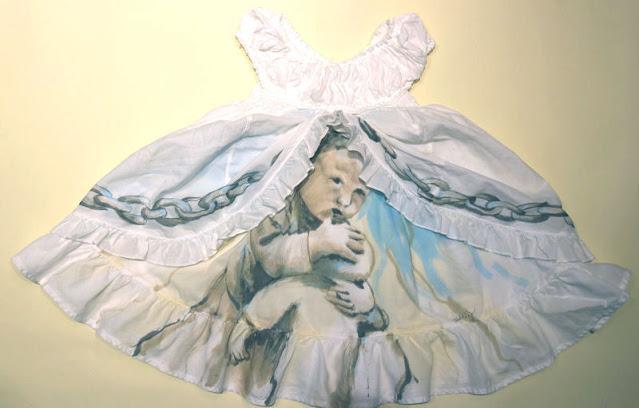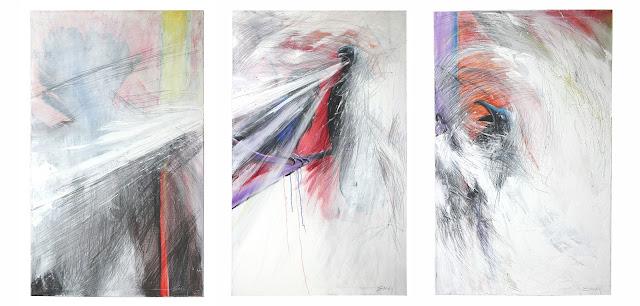
Songs of the Apocalypse is a series I’ve been working on since around the time my birth father died. He had lived a long time with Parkinson’s, but the circumstances of his death in hospital, while recovering from spinal surgery, are a complete mystery, and in that post-shock landscape of fear, confusion, and a resurgence of shallow-buried family traumas, his side of my family fell apart. So this series of paintings began as a way for me to deal with my emotions of that time. But of course those personal issues are deeply intertwined with the societal issues we all live with: helplessness in the face of climate change, capitalist, colonialist and patriarchal damage, global societal upheaval, and the fallout from those things. For example, many of my own childhood experiences are a direct result of my grandparents’ war traumas. Two of my grandparents come from families fleeing war and famine in Ukraine and Ireland. Others recently lived here through the great depression, and all of these unknowingly stored those experiences in the many generations to come. So those bigger-picture problems filtered down through the generations to effect even my own children’s health and genetic makeup, a hundred years later. Divorce, childhood trauma, and family strife are just microcosms of the bigger picture. So in dealing with individual portraits I’m also looking at our society as a whole. In looking at the wounds and the healing, I’m hoping to create psychological pathways for us all to heal from the greatest struggles we face.
My parents did everything they could to support me, given the understanding and tools of our time. They created a safe and nurtured life for me on a small island, and they continue to support me in my adulthood. But life cannot be perfect. Life is not about good and bad, but about all people constantly growing. And growing looks very messy.
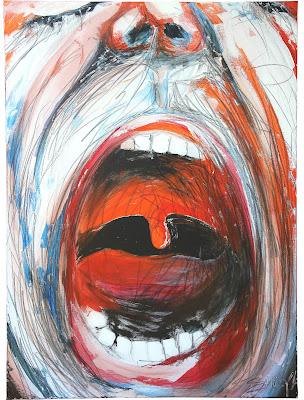
The circumstances of my childhood were not what we consider to be ideal, but they’re also not at all uncommon. Like many of us, I live with intergenerational traumas from histories of war, colonialism, famine, and domestic abuse. These things are rarely spoken about, as our culture tends to look down upon expressing too much emotion or speaking about emotionally challenging topics. But the effects of my buried experiences are borne in my body as autoimmune diseases, and they’re in my paintings. The image above is one of the first I painted in the Songs of the Apocalypse series. It’s a depiction of my own face as it appears to me in dreams, screaming for all I’m worth to help the people I love (who are always suffering horrible fates in my dreams)… but no sound is coming out. And nobody hears me. As an artist I’m trying to break that helpless invisibility, not just for me but for all of us.
I am a woman in a world where one in three women has been the victim of physical or sexual violence, usually by a partner or close family member. So think of three women you know. Which one is it? Think of twelve women you know. How many of the four has told you their stories? I am a woman in a world where women are not only not expected to achieve, but are taught not to expect ourselves to achieve. A world where we’re expected to be happy to just survive.
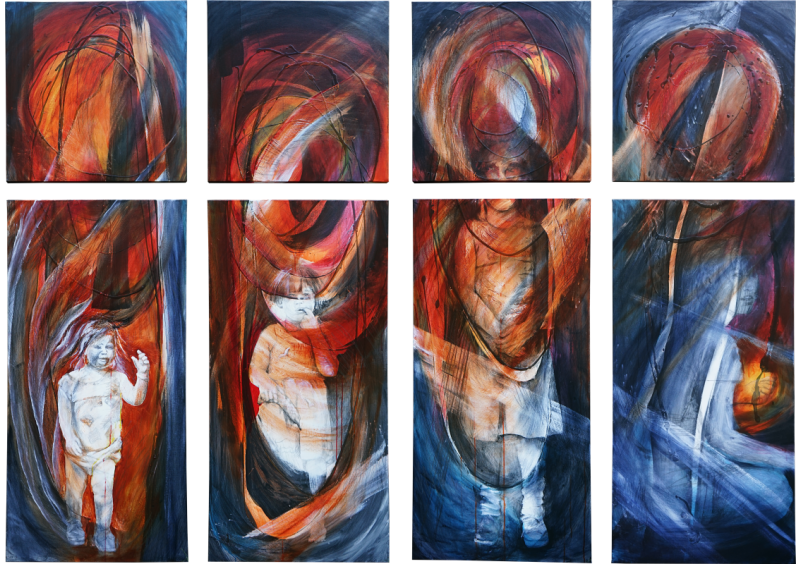
I don’t call myself a survivor because I want to do more than survive. This is a portrait of me at one, four, eleven and sixteen. It’s called Will You Love my Heart, and is painted to Sinéad O’Connor’s song, Love is Ours. It’s on exhibit July 24-August 18 at the Silk Purse Gallery in West Vancouver. As a synaesthete, I usually paint music, but not just any music. The song that inspires a painting will have a very specific meaning associated with my own memory, so what I’m painting is my visual experience of that song combined with my own memory and emotion. Love is Ours is about holding onto the pieces of our broken hearts and keeping each other alive. In our boxes of personal experience we grow out into the rest of the world, and then will we be loved? Or shoved back down into our private little trauma boxes? I’ve spent my whole life since my teens trying to get out of that box, to find love and healing, and grow into the many links between my heart and yours (yes you—we’re all connected).
I figure it’s a good idea to let my voice come out now, share my progress and hopefully inspire billions of others to do the same. That’s why I’m finally beginning to show the Songs of the Apocalypse series.
So think of those women again. Those 12 women, four of whom have been assaulted. Maybe you’re one of them. Maybe your child is, or your partner or your mother or your dearest friend. What can you do in this moment to raise her up out of the box built of her trauma? What can you do to break the walls of the box? How can you change even one thing about the space you give her; the voice you give her; the respect you give her, that could help her find her own way out of the box? And how does your love make her strong?
I’m a feminist artist with a loving, evolving male partner and a strong, courageous daughter, and an extremely emotionally-aware son. Being the strongest I can be strengthens the foundations for everyone, including all genders, ages and classes of people. It even will combat climate change, colonialism, the patriarchy, and capitalism, because as I become stronger I can lean less on the cultural norms that hold up those false shelters. Creating a world where I can come out of my box and thrive means creating a world where everyone can thrive. Equality doesn’t mean bringing anybody down. It means using the pathways created by love to hold each other up.