Teens

"Children are the most disrespected group of people in the world."

She turned her small face and looked at me intensely, maybe to see how I would react; maybe to be sure I heard her. She was one of a group of three teens who had just come through an installation about children's rights and left her comments behind. I hoped she felt respected by me as she walked out of the gallery.
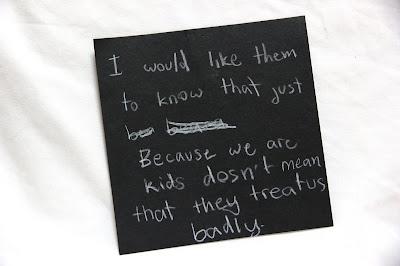
Text written by a teen in white pencil on a black square card, hanging from a thread in a gallery installation. The text says: "I would like them to know that just because we are kids doesn't mean that they treat us badly."

And then it hit me: "Group of people." That's how we see them. We see them as separate from us until we judge them to be old, wise, or experienced enough to earn our respect – as adults. We determine their clothing, their food, their education and other activities, their freedom to come or go and quite often we even determine their friends and hobbies. They tell us their fears and hopes and great big plans and we pat them on the shoulders and ignore them; carry on with our lives. When do we look them in the face and ask them to tell us more? When do we ask their advice? When do we heed it?
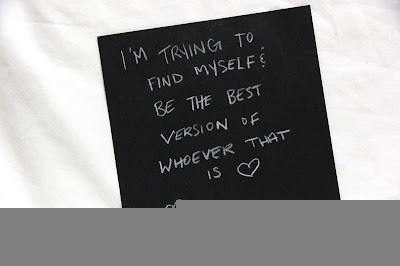
Text written by a teen in white pencil on a black square card, hanging from a thread in a gallery installation. The text says: "I'm trying to find myself and be the best version of whoever that is."

I grew up and eventually returned to raise my kids on a small island. For longer than I've been alive, the teens from this island have boarded a ferry five or more days per week to attend school on the mainland. Unchaperoned. As a teen I got up at six-thirty, washed my hair under the tap, dressed, put on my makeup and left to walk to the ferry at seven. In the winter I arrived at the dock with my hair frozen like brown sticks around my face. Unlike some of the other girls, I did not push into the crowded washroom to fix it in the two tiny mirrors. I sat at the end of my age-group of kids, watching the same kids get beat up day after day, watching the animated conversation of some girls I wasn't friends with, picking at the Naugahyde seats and avoiding the splash of the food fights. I moved further down when people started bringing compost to throw.

Twenty minutes each way. Morning and afternoon. The ferry commute was a drag, and a shared ritual, and also the rocking, floating bridge between the confines of childhood and the expected freedom of adulthood. In the 80's we skipped school by going en masse to the mall first thing, then arriving at school before lunch to report that we were all late because the ferry was late. We sometimes argued about the ethics of how to accomplish this feat. We shared time every day, but we were individuals. We had different stories, different values, and different lives.
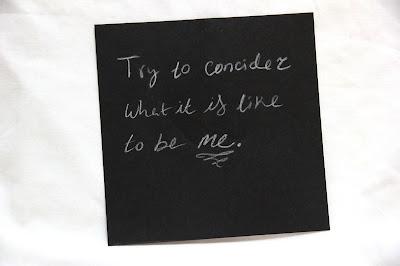
Text written by a teen in white pencil on a black square card, hanging from a thread in a gallery installation. The text says: "Try to consider what it is like to be me."

Our island also has a history of ferry exclusion. As a public-private entity, the ferry corporation has the right to ban people, and they have done so on various occasions that I remember. They banned a teenager in my grade for vandalism and mischief. He eventually took the ferry with a chaperone to attend school. They also banned our local petty criminal because the police thought it would do him good to get out of the community where he regularly slept in parked cars and picked drunken fights in public. It didn't help. Community members transported him back to the island in the trunks of their cars. My point is that these people, too, are individuals.

At various times we've had issues arise on the busiest ferry runs, like unidentified persons vandalizing the boat or flooding the toilets, and sometimes the first response is for the captain to make announcements to the teens. He tells them, as a group, to smarten up and behave themselves. He tells the adults on the next commuter run to rein in their children. Recently people in the community have been wondering aloud in public why teens (again, as a group) can't just behave themselves for twenty minutes at a time. Few, if any of us, know what the current transgression is, but we know it's been committed by teens. The captain has reportedly announced to our teens that if the unnamed incidents don't stop, the police will be involved and the surveillance footage will be reviewed. For me that crossed a line.

If criminal acts are being committed, it's perfectly reasonable to check surveillance footage and involve police. It's perfectly reasonable to expect people not to commit such acts, and to take steps to ensure that they stop. It is not, however, reasonable to reprimand, admonish, threaten and sometimes (as I have witnessed) deny service or civility to an entire group of people based on the premise that one or a few of them are suspected of having done something wrong.
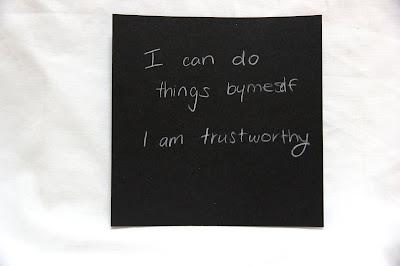
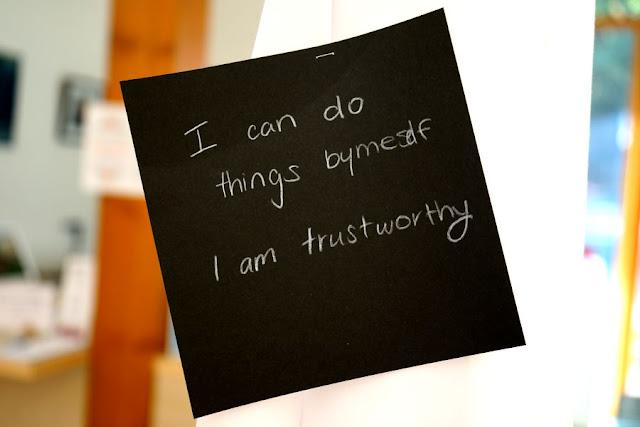
Text written by a teen in white pencil on a black square card, hanging from a thread in a gallery installation. The text says: "I can do things by myself. I am trustworthy."

When adults smoke on the ferry (which is wholly a no-smoking/no-vaping zone), they are asked to butt out. If they refuse, they are taken to the chief steward's office and spoken to, as individuals. I've seen this happen. I've stood at the chief steward's office while an adult smoker was being spoken to, and every effort was made to treat me with respect and provide me with service despite the fact that I, too, am an adult. The same can't be said for our teens' experience. Every teen is a suspect in some people's reasoning.
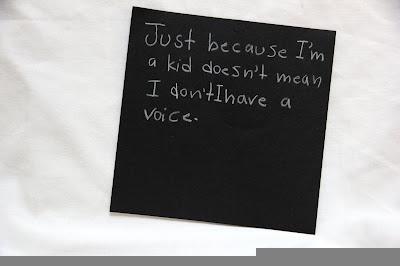
Text written by a teen in white pencil on a black square card, hanging from a thread in a gallery installation. The text says: "Just because I'm a kids doesn't mean I don't have a voice."

What do you think that does to a person? Imagine if every day you walked to work only to be eyed suspiciously at the door to the building, and every time a toilet overflowed, people called all the adults in the building together to reprimand them. How would you feel about using the toilet? Imagine if, when some person stole from the vending machine, they denied all adults access to the vending machines. Would you respect the people who judged you? Would you still care about upholding the values of your community if you weren't expected to uphold them anyway?

I'm responsible for denigrating teens as a group, too. When I was barely more than a teenager myself, a truck full of students from a nearby high school pulled up to my grandmother's lawn, dumped an assortment of fast food wrappers out the window, and drove off. A few years later, walking along our island road with my four-year-old son, we spied some litter in the ditch. He immediately shook his head and muttered grumpily, "ach… teenagers". I can't remember how I led him to that assumption, but I am certain I did. Now he's seventeen. He and his sister have somehow managed to get through a bunch of teenagehood without dumping their trash. Even more than navigating teen years myself, parenting teens has taught me to see them as individuals.
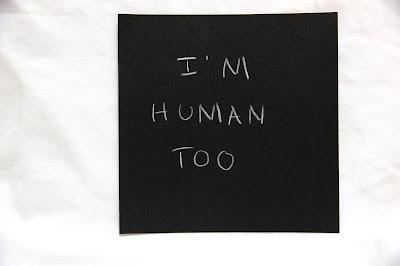
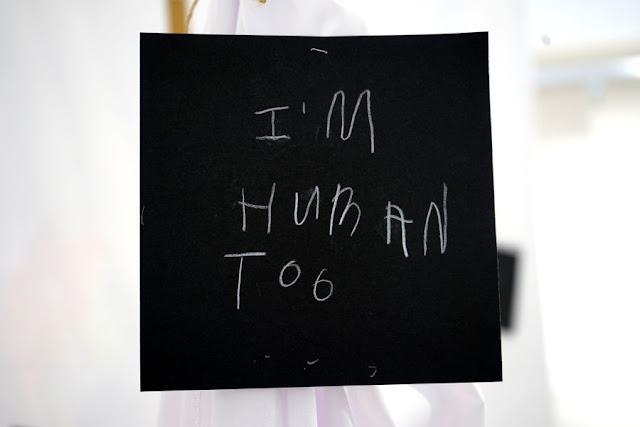
Text written by a teen in white pencil on a black square card, hanging from a thread in a gallery installation. The text says: "I'm human too."

Teens are worthy of our attention as individuals. They are humans learning to be adults, and counting on our respect and exemplary modeling to help them navigate their surprising, sometimes frightening individual journeys. If we want them to see adults as individuals rather than a homogeneous, brooding group, we need to model to them how to do that. We need to see them, and we need to show them how seeing people is done well.

Some teens are children. They have an innocent wisdom not yet drawn out of them by the pressures of growing up. Some teens are also adults. They know their own minds and they know when they haven't done wrong. Some teens see us when we're wrong, and they know when we aren't hearing their voices. Some teens know when not to bother speaking up, because we've lumped them all into one disrespected group and we can't hear their individual cries. In fact, when teens report crimes committed by adults, they are often ignored.

It's time we look into the faces of the children and teens we pass and see them as simply humans. It's time we see them as individuals with wisdom, needs, values, and human rights. It's time we respect them.
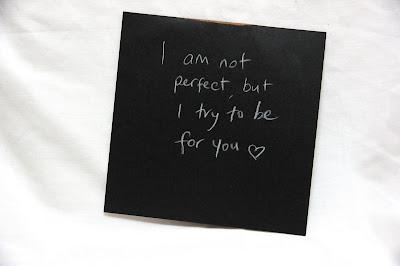
Text written by a teen in white pencil on a black square card, hanging from a thread in a gallery installation. The text says: "I'm not perfect, but I try to be, for you." There is a heart after the text.

*The handwritten statements accompanying this article were contributed by teens at a 2019 installation of a piece called "Building Blocks: What do you want the adults in your life to know and respect about you?"

Originally published in October, 2019.
What Children Need Us to Know

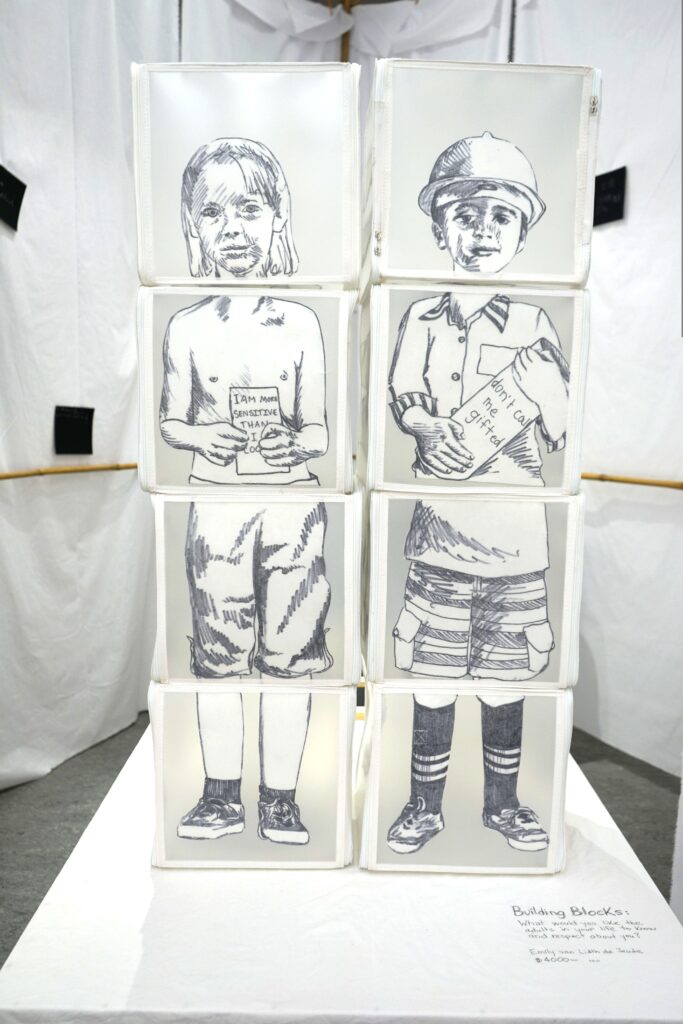
Two stacks of 4 translucent storage cubes with white fabric edges, standing side-by-side. Each stack forms a black-and-white hand-drawn portrait of a child (feet on the bottom cube, upper legs above, torso above that, and heads at the top). The children are holding papers that say "I am more sensitive than I look", and "don't call me gifted".

My 2019 exhibit included, as its central installation, this piece about children's rights. It's made of plastic clothing storage boxes, which I covered in portraits of children, holding signs that state their various answers to the question, What would you like the adults in your life to know and respect about you?

The children who contributed the answers for this sculpture range in age from 5 to 17, and the sculpture is interactive. Visitors to the installation were encouraged to put on white gloves and play with the cubes, rearranging again and again to make a vast assortment of different children.

The installation included a small tray of black paper, where young visitors could write their own answers to the question. I hung these answers around the installation as they appeared.

These are the voices of our children – mostly anonymous children, and therefore everychild. These are the things that all children need us to know. They need us to shed our busy-ness, our righteousness and our preoccupations and hear their voices. And their voices keep coming. Let's be good listeners.

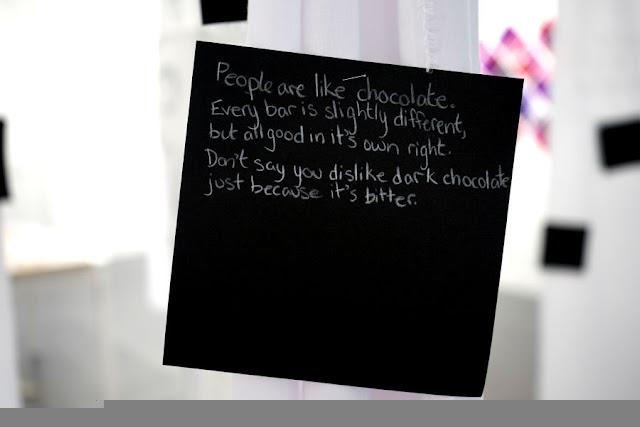
Text written by a child in white pencil on a black square card, hanging from a thread in a gallery installation. The text says: "People are like chocolate. Every bar is slightly different, but all good in it's own right. Don't say you dislike dark chocolate just because it's bitter."
Text written by a child in white pencil on a black square card, hanging from a thread in a gallery installation. The text says: "I'm human too."
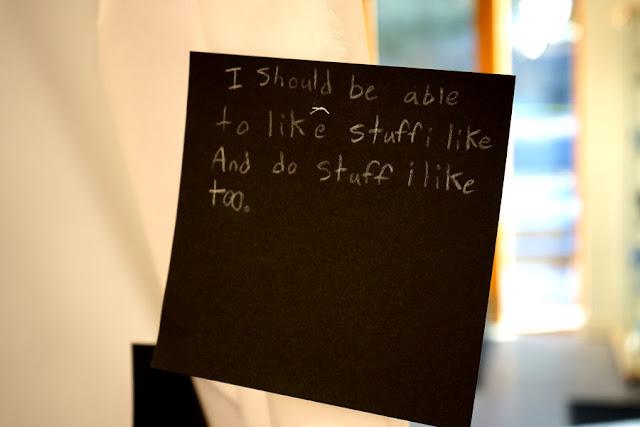
Text written by a child in white pencil on a black square card, hanging from a thread in a gallery installation. The text says: "I should be able to like stuff i like and do stuff i like too."
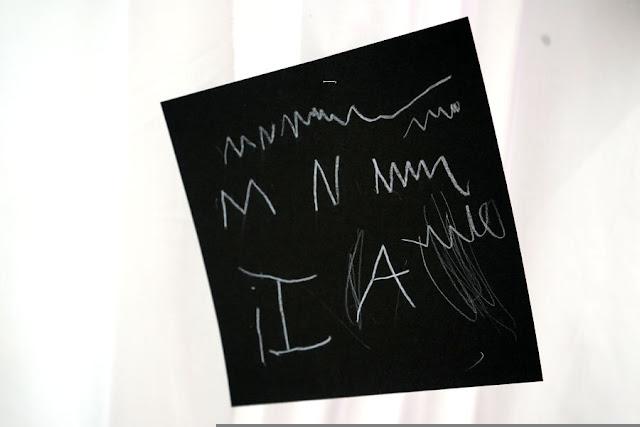
Text written by a child in white pencil on a black square card, hanging from a thread in a gallery installation. The text is not legible, but might say, "I am..."
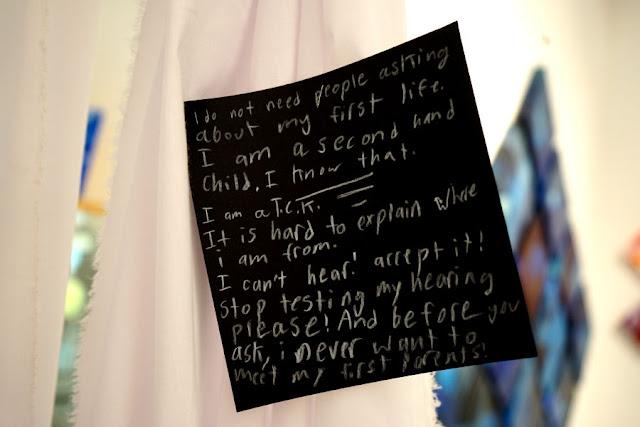
Text written by a child in white pencil on a black square card, hanging from a thread in a gallery installation. The text says: "I do not need people asking about my first life. I am a second hand child. I KNOW THAT. I am a T.C.K. It is hard to explain where I am from. I can't hear! Accept it! Stop testing my hearing please! And before you ask, I never want to meet my first parents!"
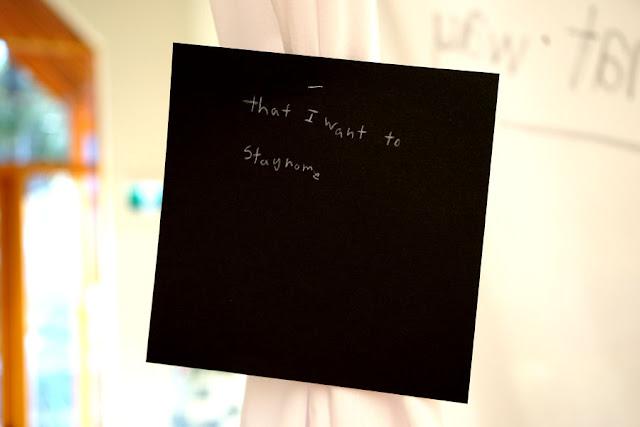
Text written by a child in white pencil on a black square card, hanging from a thread in a gallery installation. The text says: "That I want to stay home."
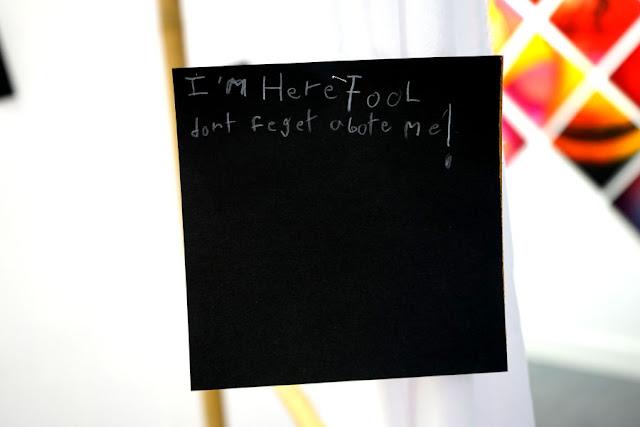
Text written by a child in white pencil on a black square card, hanging from a thread in a gallery installation. The text says: "I'm here, fool! Don't forget about me!"
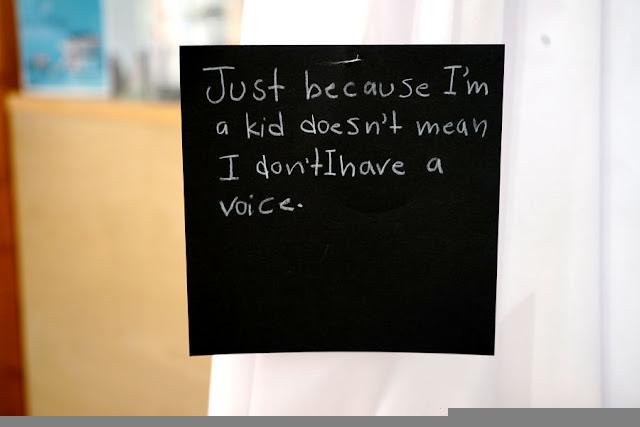
Text written by a child in white pencil on a black square card, hanging from a thread in a gallery installation. The text says: "Just because I'm a kid doesn't mean I don't have a voice."
Text written by a child in white pencil on a black square card, hanging from a thread in a gallery installation. The text says: "I can do things by myself. I am trustworthy."
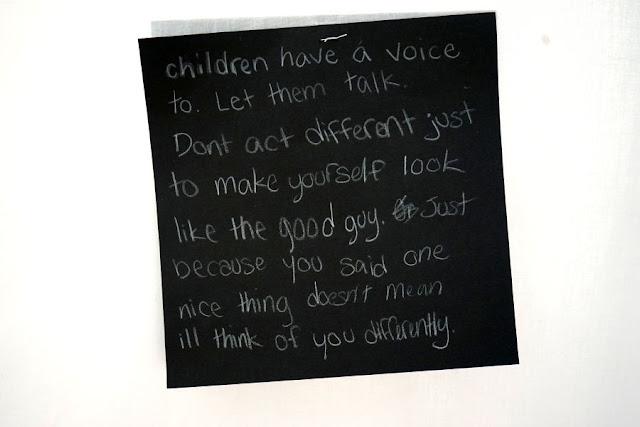
Text written by a child in white pencil on a black square card, hanging from a thread in a gallery installation. The text says: "Children have a voice. Let them talk. Don't act different just to make yourself look like the good guy. Just because you said one thing doesn't mean I'll think of you differently."
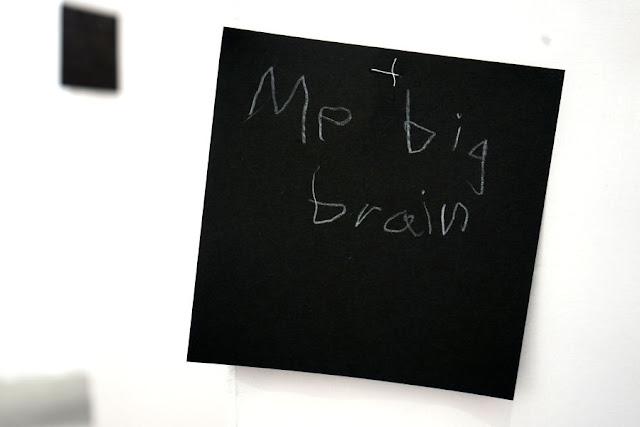
Text written by a very young child in white pencil on a black square card, hanging from a thread in a gallery installation. The text says: "Me big brain."
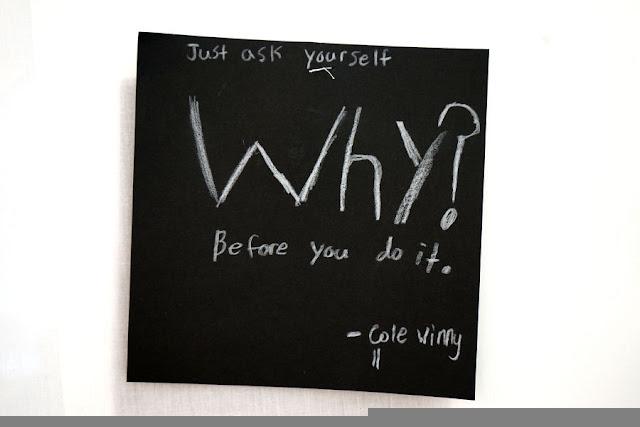
Text written by a child in white pencil on a black square card, hanging from a thread in a gallery installation. The text says: "Just ask yourself WHY before you do it."
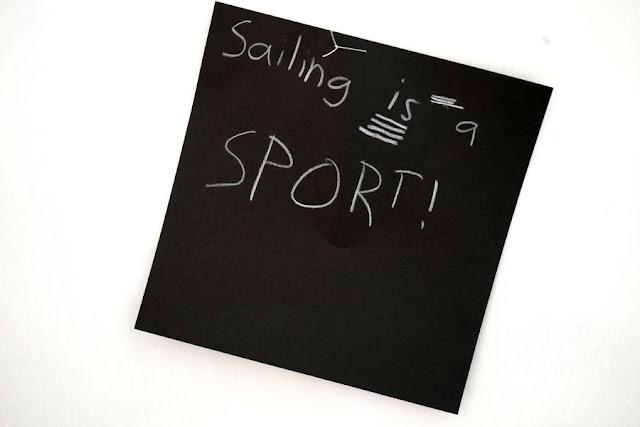
Text written by a child in white pencil on a black square card, hanging from a thread in a gallery installation. The text says: "Sailing is a sport!"
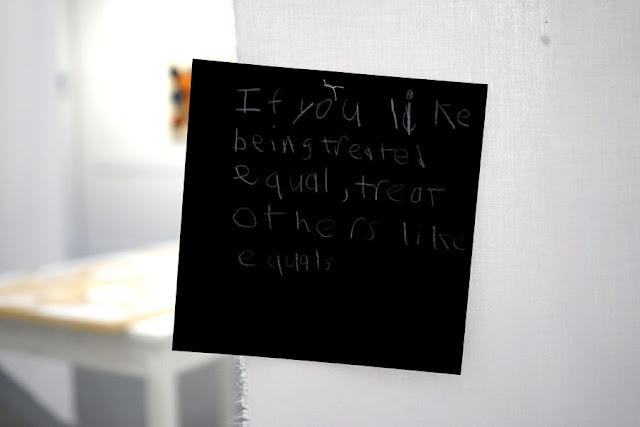
Text written by a child in white pencil on a black square card, hanging from a thread in a gallery installation. The text says: "If you like being treated equal, treat others like equals."
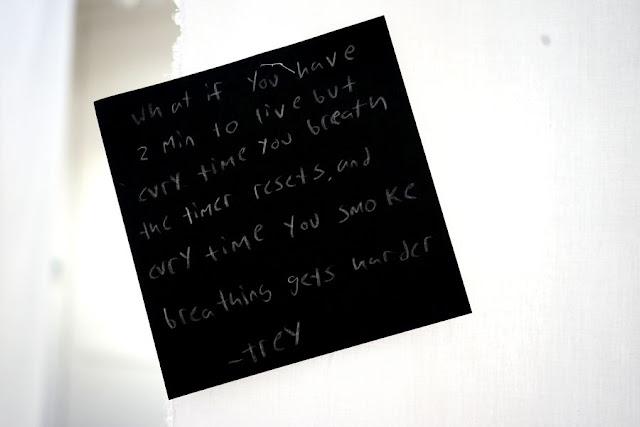
Text written by a child in white pencil on a black square card, hanging from a thread in a gallery installation. The text says: "What if you have two minutes to live but every time you breathe the timer resets and every time you smoke breathing gets harder?"
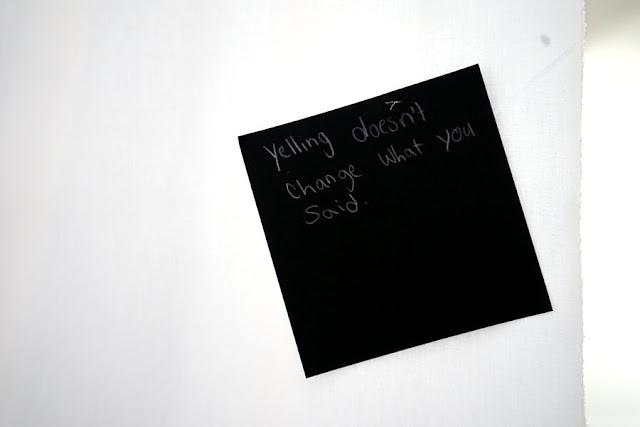
Text written by a child in white pencil on a black square card, hanging from a thread in a gallery installation. The text says: "Yelling doesn't change what you said."
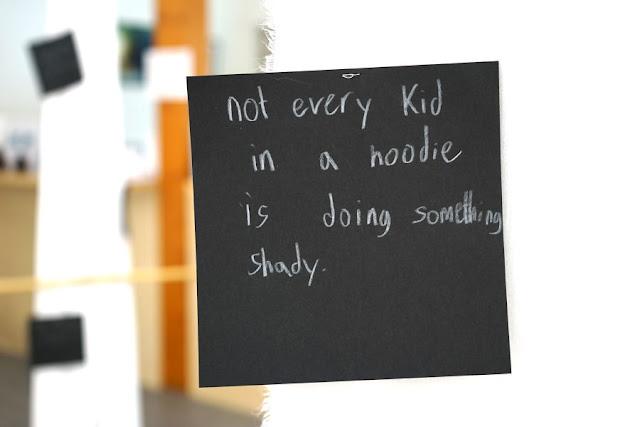
Text written by a child in white pencil on a black square card, hanging from a thread in a gallery installation. The text says: "Not every kid in a hoodie is doing something shady."
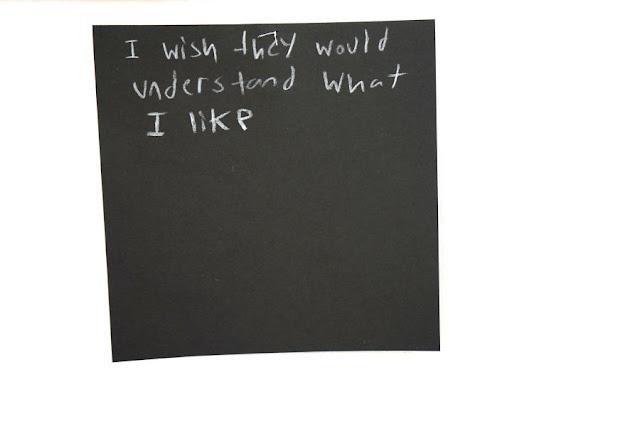
Text written by a child in white pencil on a black square card, hanging from a thread in a gallery installation. The text says: "I wish they would understand what I like."

Originally published in October 2019.

Layers and Layers and Layers: My Process

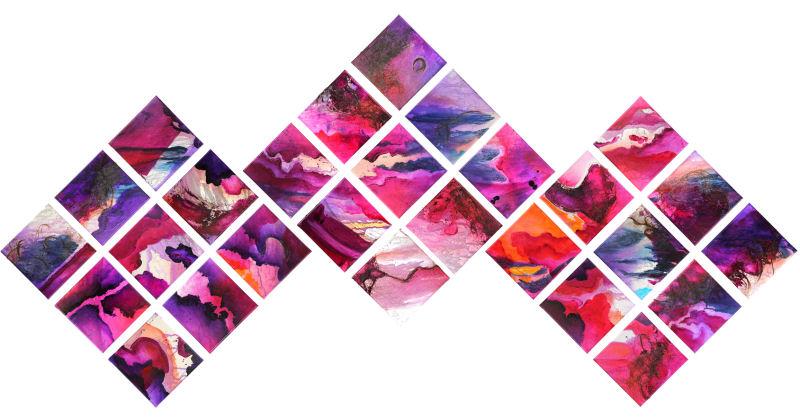
A painting by artist Emily van Lidth de Jeude: 27 square canvases are arranged into three tilted squares of nine canvases each. They are covered with an abstract watery-looking assortment of pink, orange, purple, brown and warm blue shapes, and include many strands of brown human hair emerging from under the paint. This painting is intended to be rearrangeable.
Requiem/Renewal, a Change/able painting by Emily van Lidth de Jeude

Question: What is your process? What paints do you use and how do you get the layered look?

This question pertained specifically to the work in the change/able show, but the answer relates to everything: Layers!

Both in materials and theory, my work is about layers. Maybe that's just how my mind works. I look at something one way, then turn it around and see the same thing another way. I despise going with the flow, and I'm going to disrupt it. If you tell me how wrong someone is, I'll try to see why they might be right. If everybody hates the rain, I'll organize a mud-splashing adventure. It's my nature to be contrary, and today I'm not going to deny it (but I might some other day, because I'm contrary like that).

The change/able show is all about change: accepting it, and making it happen. So in order to make these multi-canvas pieces, I hang all the canvases up on my studio wall and paint them, usually with a layer of textural acrylic, to begin. I love acrylic because it dries fast, and is easy to create harsh scrappy texture with. When that's dry, I rearrange all the pieces and make another layer, this time of oil. I let it cure, or mostly cure, then rearrange and layer again. Some of the layers are glazes; some are textural, and some involve graphite scribbling, which for me is usually the point that the most emotion goes into the work. I keep making layers until it feels finished, and that can be anywhere from about five to twenty layers. There's a good amount of curing time between many of the layers, so I'm often working on other pieces at the same time.

Basically I've changed things around so much that there is an infinite number of ways to fit the painting together, among which not a single arrangement will be wholly compatible, but all of it is beautiful. Like life. Life changes every time you look at it; emotions, conviction and ideation evolve. We look at things differently as our moods and circumstances change. The reason I work in layers is so that I can get all those many levels of thought and feeling into my work.

Originally published in October, 2019