(dis)robe series

(dis)robe is a growing collection of reclaimed, altered and painted garments that explore and question what we choose to wear and to discard, in the contexts of our societies, families, and personal journeys.

(dis)robe: Gaia Gown
See it here in performance:

https://makertube.net/w/rph8btiNYfi8TBHXbdWpWn

A year of plants and insects of the Salish Sea area (and a bit of sea life), painted in graphite and acrylic onto a reclaimed and altered gown. The original gown was worn for a concert given by singer and poet Jude Neale. Branches for the display from birch, willow, apple and rose, near my home.

This gown explores our human connection (and lack thereof) to the ecology of our home. How do we deify the wilderness while at the same time feeling ourselves to be above it? How are we, in fact, an integral part of it? How can we connect with the seasons as the plants, insects, and other animals do? Where do we find ourselves as humble and holy in the spectrum of our own ecologies?
Exhibited on Bowen Island/Nex̱wlélex̱wem, 2023, and Vancouver, 2024.

A woman stands smiling at the camera, wearing a wedding dress that is painted with a landscape of Pacific Northwest seasons around the skirt. Visible in this image is summer: A rocky shoreline with kelp and other seaweeds in the water, barnacles, seastars, grasses, and various blooming plants. The woman is wearing a giant headdress made of branches, that radiates out to all sides from her head, and there is a huge veil hanging all the way around the edge of the four-foot-wide headdress. The veil is painted with flying insects, through the seasons. The view in this photo is summer, and the insects include various northwest coast species of mosquitoes, wasps, bees, beetles, butterflies and dragonflies.
Emily performing the Gaia Gown. 2024
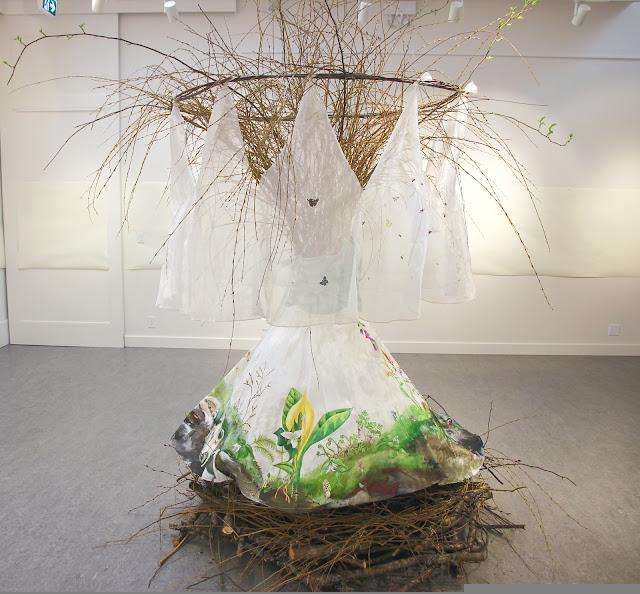
In a white-walled gallery, a wedding dress stands upright above a huge nest of branches, and a massive spray of willow branches emerges out the top, where a body and head might otherwise be. The skirt is painted with a landscape of Pacific Northwest seasons around. Visible in this image is spring: A damp mossy hummock with trillium, skunk cabbage, fiddleheads, and various small blooming wildflowers. From the top of the huge spray of willow branches, a circular four-foot-wide veil is hanging all the way around. The veil is painted with flying insects, through the seasons. The view in this photo is sprint, and the insects include various northwest coast species of mosquitoes, bees, beetles, butterflies flying ants, and moths.
(dis)robe: Gaia Gown on display at the Hearth Gallery on Bowen Island. 2022
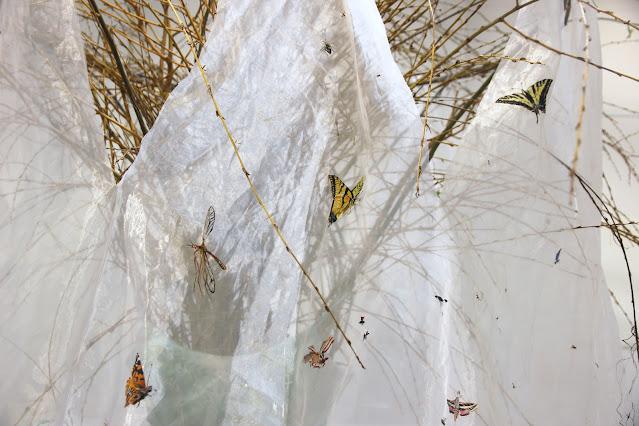
A close-up view of the disrobe gaia gown's insect-veil. Visible in this view is a small section of the veil, hanging down from a spray of willow branches. On the veil we can see a lot of flying insects: butterflies, a june beetle, moths, a crane-fly, mosquitoes, and flying ants.
A close-up view of the (dis)robe: Gaia Gown's insect-veil.
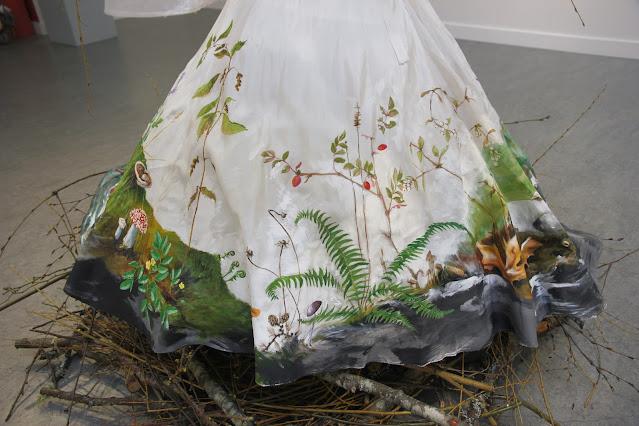
A white wedding dress skirt is shown, painted with plants of the pacific northwest as they might appear in late autumn and early winter. A tall dying stinging nettle laden with seeds is on the left, with amanita mushrooms, a bracket fungus, mosses, licorice fern fiddleheads, a browning sword fern, dried maple leaves, dried aster seedheads, and a baldhip rose with a few red rosehips on it.
An autumn and winter view of the skirt of the (dis)robe: Gaia Gown!

(dis)robe: Maternity Wear
See a video of this gown, here: https://makertube.net/w/kvC2kiPC1kYGrtyFwgqdYW

Used wedding gown, altered, painted and embellished to explore the choice mothers make to be the comforter/soother/carrier/carer/wearer of our babies. This reclaimed wedding gown includes a gang of painted toddlers climbing up the train, a built-in satin baby-carrier on the back, a plethora of hanging pacifiers, and a torn-open bodice from which protrudes a pregnant belly painted with the hands and face of an escaping, screaming mother.
Model in these images: Jewal Maxwell.
This dress is featured in Karen D. Miller's book, the Art of Mothering: Our Lives in Colour and Shadow, as well as in the Procreate Project Archive, based in Manchester.
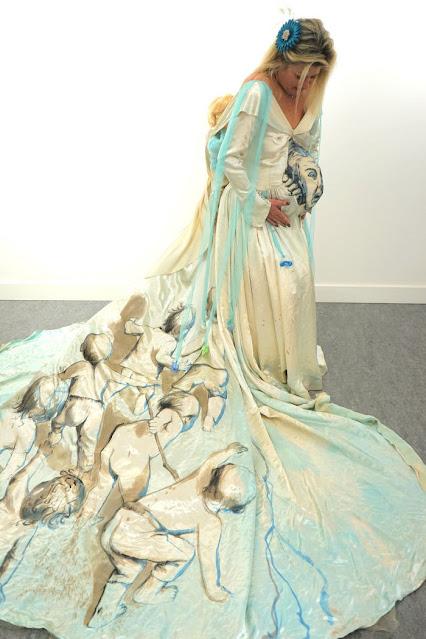
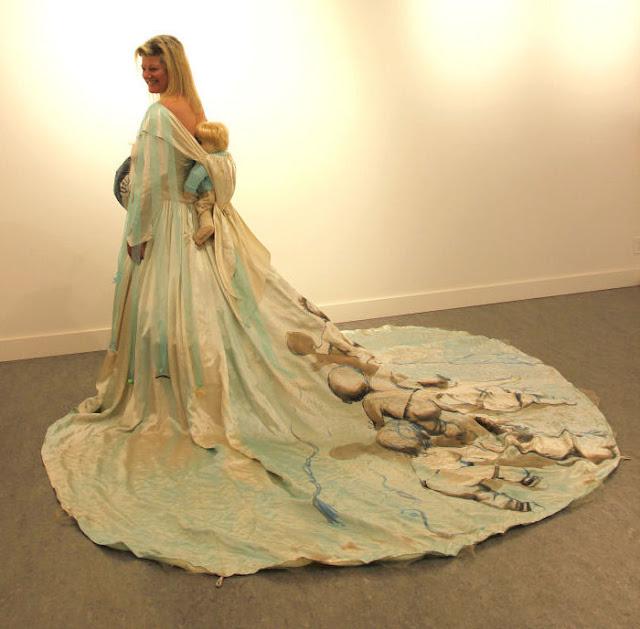
A woman hunches over her pregnant belly in a wedding dress with a huge train. The belly protrudes from the dress and is painted with the screaming face of a mother, pushing herself out through a tear in the bodice of the dress. The train is painted with seven babies in various states of partial dress, clambering up to the person wearing the dress. At the back of the dress, there is a built-in baby-carrier, with a baby doll hanging in it. The dress has soothers poking out of the bodice where the wearer's own nipples would be, and blue ribbons hanging from the shoulders, with more soothers on the ends.
A woman stands with her back turned mostly towards the camera, looking over her shoulder and smiling. A pregnant belly protrudes from the dress and is painted but we can't see with what in this photo. The dress's enormous train is painted with seven babies clambering up to the person wearing the dress. At the back of the dress, there is a built-in baby-carrier, with a large baby doll hanging in it. The dress has soothers poking out of the bodice where the wearer's own nipples would be, and blue ribbons hanging from the shoulders, with more soothers on the ends.

(dis)robe: Nursing Gown
This gown is my exploration of our cultural heritage around gender, caregiving, and partnership roles. Of course it's personal (painted onto this dress is my brother, in his wedding suit, at the time of his divorce). But in his story is a reflection of all of us. We all experience aspects of codependency in our lives, whether in partnerships or otherwise. So much of our culture revolves around preparing us for the supposed inevitability of really dysfunctional relationships. But does it have to be that way? Or can we let go of our psychological tethers and dependent fears, and move into something more beautiful?

I can't ethically photograph this dress on a model, because it's made to fit a small woman; a teenager, really. And I'd never put a teenager into such a vulnerable position. So this dress lives only on a mannequin. A bald mannequin. A mannequin that's plastic, with hand-painted eyebrows, makeup, and nipples. Because a painted mannequin is a better representation, to me, of what we expect of ourselves as women than a real woman could ever be.
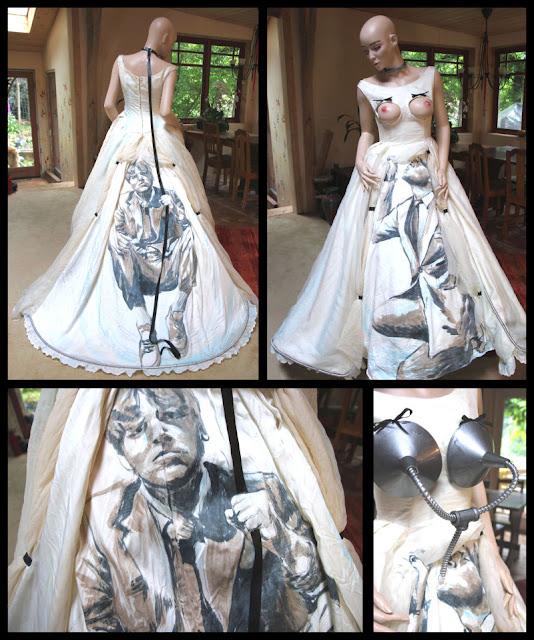
A grid with four views of the same dress, displayed on a mannequin with a bald head and eyebrows. First the back view of the dress shows the over-dress pulled up with small ties, to reveal the portrait of a man painted on the underdress. He's sitting on the train, wearing runners and a suit, looking out as if he's lost and sad. He's holding a real black leash that goes up to a black collar, worn by the mannequin. 
In the next quadrant of the image, the front of the dress is shown. Once again the overskirt is pulled up to reveal a man painted on the underskirt. This time he's holding the overskirt up with his hand while reaching his lips upward towards the bodice. The bodice has two round holes with black bows at the top, where the mannequins perfect round plastic breasts protrude. The nipples have been painted realistically. 
In the bottom left quadrant there is a close-up view of the man on the back of the dress, looking sadly but questioningly out at the viewer. 
In the bottom right quadrant of the image, the man on the front of the dress is shown again, but this time there is an industrial-looking device attached to the breast-holes, covering the breasts with funnels that lead to a tube, which goes into the mouth of the man. So it looks like he's being breasfed by some kind of milking-device.

(dis)robe: Chain Dress
An exploration of heredity, especially of mothering and caregiving roles among girls and women. It may be a chain of bondage or entrapment, but it is also a chain of generational connection.

The baby on this little second-hand Christening gown is my six-month-old daughter, cooing to her own little plastic baby.
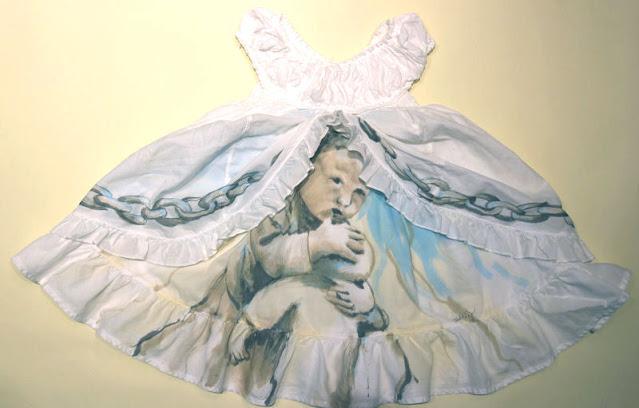
A tiny white cotton baby dress is displayed flat on a wall. The skirt of the dress has two layers. The top layer is painted with a chain, and the chain is pulled up to reveal the bottom layer, where a baby is painted, looking out apprehensively from under the chain, and clutching a baby doll to her chest, as if to keep it safe.

(dis)robe: Support Garment
Worn here with the Lovely Bush prosthetic pubic hair, and in front of a lovely painting by Lluis Garriga Felip at Art! Vancouver 2017. More photos of this dress in the Woman Story section of this gallery, as it was included in that installation as well. It looks into the many others whose support (and hindrance) we choose to accept and deny as we make our many ways through life.
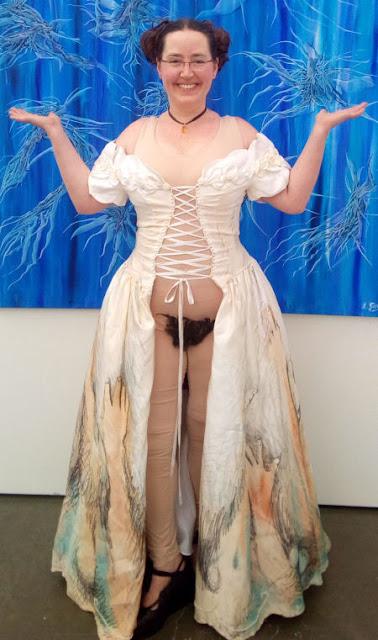
A woman standing in front of a blue abstract painting, wearing a white wedding dress that has been cut down the front and tied partially-closed with ribbon lacing. THe dress doesn't close all the way, which clearly exposes the front of the woman, who is wearing a bodysuit that matches her pale skin, upon which is sewn a curly brown mop of fake pubic hair.
The woman has her hair tied up into two buns, is wearing an amber necklace on a black ribbon, holding her hands up bewide her head, and grinning at the camera.

This gown was the impetus for the whole (dis)robe project. It began as a performance piece called I love me I love me not I love me, in which it was cut off my body, and put back on. Video here:

After that performance, I altered the dress and displayed it on a dress-form in a solo show called Woman Story, along with various other pieces, including a few prosthetic pubic hair pieces, called "Lovely Bush". Since that show, I've also worn and performed the Support Garment with the Lovely Bush at various events. I wrote an article about the response it gets, here: To the Guys Who Grabbed at my Crotch